


Frankenmuth Drives League Streak to 97
By
Paul Costanzo
Special for MHSAA.com
December 13, 2016
Tom Keller is willing to talk about the streak if you ask him.
He’s starting to get used to it.
 “It’s funny; it seems like a lot of people are bringing it up lately,” said the Frankenmuth girls basketball coach, who has led his team to 97 straight Tri-Valley Conference East wins. “We actually talked about it in practice the other day for one of the few times.
"(The streak) happens on a day-to-day basis. In our program, we don’t really set a lot of goals; we’re much more concerned about the process. If we do things the right way day after day, those wins and those streaks kind of take care of themselves.”
Frankenmuth hasn’t lost a conference game since Feb. 10, 2009 -- a 37-31 setback against Birch Run. Since then, eight senior classes have graduated, and dozens of players have gone through their entire varsity careers without a conference loss.
While it’s not something Frankenmuth players dwell on, it’s also not something they take for granted.
“You don’t just show up and put on your uniform and get the streak,” senior Hannah Karwat said. “We do have to work hard to get the winning streak we have. We work hard in practice.”
Karwat is one of very few Frankenmuth players on this year’s team with varsity experience. She’s a third-year player and first-year starter. Her classmate Lindsey Mertz started several games as a junior and is in her fourth year with the team, but Frankenmuth graduated five of its top six players from a year ago.
 The Eagles have done well so far, starting the season 3-1, including earning a 36-34 win this past week against TVC East rival Essexville-Garber to stretch the streak to 97. Their next league games are Wednesday at Bridgeport and home Friday against Millington.
“It’s always an interesting way to start the season when you have kids who are brand new to varsity,” Keller said. “Also, we have those kids that are returning in completely different roles than what they played in the past. We have two seniors who have played, and they’re going from being role players to go-to girls on this year’s team.
“It’s fun. I think it makes for great competition. When you have so many openings for a new team, it’s fun and great competition because everybody is vying for those roles. It does seem to draw out the best competitors.”
Mertz has settled in as a forward, although she has experience as a post player and a guard from her first three seasons and can go back to either if the Eagles need it. Karwat’s role has expanded following the graduation of a pair of 6-foot-plus post players. She’s 5-4½, but appears unfazed by the height disadvantage she faces each night.
Mertz and Karwat are two of five seniors on the team. Among the others is Sara Aldrich, who spent her junior season toward the end of the bench but has worked her way into a starting role, something Keller said he loves to see. Kayla Kueffner and Emily Janson, the Eagles’ other two seniors, are injured and have yet to play this season.
What those seniors may lack in experience, they make up for with leadership.
“Something that our program has valued is leadership,” Mertz said. “We have been doing leadership lunches once a week where we meet and talk about leadership and how serving the other girls on the team and dedicating time would help everyone grow on the team.”
Frankenmuth is matching that leadership with an aggressive style of play, making up for a lack of size.
“We’re making efforts to really attack the paint,” Keller said. “We still get touches inside, but we do it through penetration. In years where we’ve had two 6 footers, we were a high-post, low-post kind of team and we took advantage of that. This year, we’re very guard-oriented.”
Changing his team’s style based on personnel has helped Keller find success in each of his previous 10 seasons as Frankenmuth’s girls coach. The Eagles have won a conference title in each of those seasons, and added five Class B District titles, including at the end of the last two seasons.
 Keller said he was fortunate to inherit a great program, one that won the Class B title in 1992 and Class C in 1996 and also owns four MHSAA Finals runner-up finishes.
It’s a tradition, Mertz and Karwat said, that has girls in the community’s youth program pining to put on a Frankenmuth jersey one day. They also grow up knowing what it takes to get that honor.
“When I was younger, a lot of the girls in my grade loved basketball,” Mertz said. “But a lot of girls have quit because they know what’s expected and they know they can’t match that effort. Sometimes we’ll frighten some girls out of the program, but that makes the team we have one of the toughest group of girls because you have to be tough to be a part of it.
“Usually the girls that come out are the ones that are in it for the long haul, and willing to do the dirty work and put in the effort.”
Keller said he wasn’t quite sure what would equal a successful season for this year’s team. Getting better and more consistent each day is his main focus, and he’s optimistic that will happen.
As for the streak, Keller and the Eagles would love for it to survive. If it doesn’t, however, they’ll simply work to start the next one.
“It’s going to come to an end eventually, whether it’s this week or later this season or next season,” Keller said. “When it happens, we’ll just come back the next day and get ready for the next game.”
 Paul Costanzo served as a sportswriter at The Port Huron Times Herald from 2006-15, including three years as lead sportswriter, and prior to that as sports editor at the Hillsdale Daily News from 2005-06. He can be reached at [email protected] with story ideas for Genesee, Lapeer, St. Clair, Sanilac, Huron, Tuscola, Saginaw, Bay, Arenac, Midland and Gladwin counties.
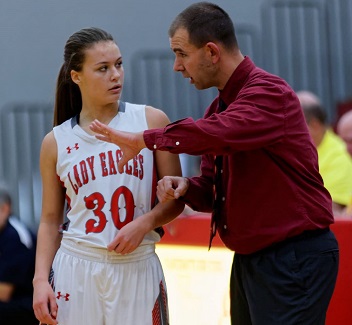
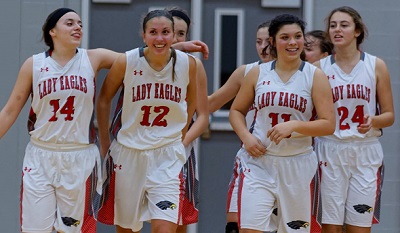
PHOTOS: (Top) Frankenmuth's Brooklin Karwat drives to the basket against Essexville-Garber last week. (Middle) Eagles coach Tom Keller speaks with Kaylee Kujat during the tightly-contested matchup. (Below) Frankenmuth players celebrate after defeating the Dukes 56-54. (Photos by Chip DeGrace/Eagle Eye Photography.)
Breslin Bound: Girls Report Week 12
February 22, 2016
By Geoff Kimmerly
Second Half editor
One week remains in the girls basketball regular season, and contenders are gearing up for District tournaments that begin a week from today.
Most weeks during the season, we check in with four teams from each class that have been especially impressive. After a bit of a hiatus, here’s a look at 16 more to remember when the tournament begins.
Class A
Allen Park (16-2) – After finishing second to Brownstown Woodhaven a season ago, Allen Park clinched the Downriver League championship Friday with a 56-20 win over Taylor Truman. The Jaguars’ only losses were to Woodhaven in their second meeting and Plymouth in the season opener.
Bloomfield Hills Marian (13-6) – The Mustangs have rebuilt quite a bit after winning last season’s Class A title, and finished only third in the Detroit Catholic League Central. But they beat second-place Warren Regina in the semifinal and then rival and league champion Farmington Hills Mercy 48-29 in Sunday’s A-B league tournament final.
Detroit Martin Luther King (16-1) – The Crusaders came back from their only loss this season – 68-65 to Renaissance on Dec. 17 – to beat Renaissance 68-66 and win their fifth straight Detroit Public School League Tournament title. King previously won the PSL East Division 1 title this winter.
Dexter (17-1) – The Dreadnaughts finished a perfect run in the Southeastern Conference White last week, defeating Ypsilanti Community 37-28, to win the league title outright after sharing the championship with Chelsea last season.
Class B
Bay City John Glenn (17-1) – The Bobcats bounced back from their lone loss this season, 50-47 two weeks ago to Ypsilanti Arbor Prep, to put 40-point wins on Tawas and Pinconning over the last two weeks and finish a dominating run through the North East Michigan Conference.
Detroit Country Day (18-1) – Since falling to Saginaw Heritage on Dec. 29, Country Day has won 14 straight. The slate has an argument for the state’s most impressive – wins over Detroit Renaissance, Haslett, Southfield-Lathrup and Ypsilanti Arbor Prep are among the brightest highlights.
Fruitport (17-1) – The Trojans haven’t fallen since Dec. 11 to Spring Lake and secured a share of the Lakes 8 Conference championship with a 46-19 win over Muskegon Catholic Central on Friday. Fruitport finished only fourth in the league a year ago.
Marysville (15-2) – The Vikings have won 13 straight since falling to Country Day on Dec. 17 and 12 straight league games to again claim the Macomb Area Conference Gold title outright after sharing the championship with Center Line last season.
Class C
Johannesburg-Lewiston (17-1) – The Cardinals wrapped up a share of the Ski Valley Conference title with a 60-57 win over Onaway on Thursday and can claim it outright by beating Pellston on Tuesday. They finished second to Bellaire last season, but split with Bellaire this winter.
Morley Stanwood (17-2) – The Mohawks claimed a share of the Central State Activities Association Silver title Friday with a 60-34 win over Holton, but they’ll need to beat reigning champion Kent City this week to win the title outright. Morley Stanwood was second last season but beat Kent City 55-41 in their first meeting, Jan. 22.
Negaunee (14-4) – The Miners can finish a perfect run through the Mid-Peninsula Athletic Conference with a win over Ishpeming this week, and also avenge one of their losses, to Marquette on Dec. 15. Negaunee tied for fourth in the league and finished only 9-13 a year ago.
Sandusky (16-2) – The second-place Redskins will need help in the Greater Thumb Conference East title race from third-place Brown City – which plays league leader Marlette this week in the final GTC game for those teams. But Sandusky’s only losses this season were to Marlette, by 12 and seven points.
Class D
Climax-Scotts (17-2) – The league-leading Panthers finished a season sweep last week of rival Battle Creek St. Philip, beating the Tigers 42-39 after finishing second to St. Philip in the Southern Central Athletic Association West a year ago.
Crystal Falls Forest Park (16-3) – The Trojans hold a half-win lead on Bark River-Harris in the Skyline Central Conference West standings thanks to Munising’s recent upset of the former league leader; Forest Park must beat Bark River-Harris this week to clinch the title after losing 51-25 in their first meeting Dec. 4.
Gaylord St. Mary (16-3) – Despite finishing second to Johannesburg-Lewiston in the Ski Valley Conference, the Snowbirds should be optimistic heading into the tournament riding five straight wins and with their only losses by a combined four points to the Cardinals.
Mendon (15-3) – The Hornets clinched the Berrien-Cass-St. Joseph Conference Blue title outright with a 46-27 win over Cassopolis on Friday and are already two wins better than last year’s team, which finished third in the old BCS East.
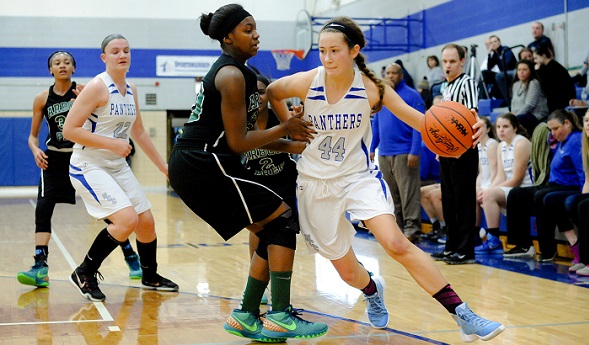
PHOTO: Ypsilanti Arbor Prep and Saginaw Nouvel are two teams expected to contend when the MHSAA Tournament begins next week. (Click for more from HighSchoolSportsScene.com.)