

To Get Ahead, Heritage Gets Defensive
March 16, 2018
By Geoff Kimmerly
Second Half editor
GRAND RAPIDS – This season, the Saginaw Heritage girls basketball team had, as junior Shine Strickland-Gills called it, an “epiphany.”
And it’s made the difference between another 20-win season and getting a chance to play for the Class A championship.
Expectations have been high the last few seasons for a Hawks group that’s shown plenty of ability against big-time opponents, but never put it entirely together for an MHSAA Tournament run.
After Friday’s 46-28 Semifinal win over Grosse Pointe North, Heritage finds itself one more victory from making good on all of that potential.
“It was a disappointment (last year) because we lost in second round Districts, and we were supposed to win,” Strickland-Gills said. “We didn’t because we really didn’t come out hard, and I feel like we’ve done what we’re supposed to do. We’ve actually listened and taken heed of what (coach Vonnie DeLong) has told us. And we’ve actually applied it in a game, and it really works.
“We had an epiphany.”
Heritage will face East Lansing in Saturday’s 12:15 championship game at Calvin College’s Van Noord Arena.
A Class A title would be the Hawks’ first since 2002 and cap a fourth straight season with at least 20 wins – but after Heritage was eliminated during the first week of the tournament a year ago.
All but four of the team’s points Friday were scored by four players with lots of experience, but who also had experienced last season’s disappointment.
 Junior Mallory McCartney had 13 points, while Strickland-Gills added 12, seven rebounds and four steals. Senior Jessica Bicknell had eight points and three steals, and junior Moira Joiner had nine points, five rebounds and three steals.
Joiner scored six points below her average and had only a point during the first half. But she also defended Grosse Pointe North star junior Julia Ayrault –holding her to 13 points, six below her average as well.
“My (coaches) go a great job scouting and really let us know what we have to do,” Joiner said. “For me, if I’m guarding the best player, I need to look at film and know what their tendencies are. Like Julia, she likes to drive and pull up, or she’ll shoot the long 3 so I have to get my hands up. It’s just a lot of paying attention.
“It was pretty obvious today; I didn’t have the best game I could have. But I knew if I could keep Julia to a certain amount of points, then my team could pick it up on the offensive end.”
Despite shooting only 38 percent from the floor over the first 16 minutes, Heritage (26-1) led by three after a quarter and nine at halftime. The Hawks kicked into gear during a 17-6 third quarter run as they drilled 57 percent of their shots and pulled away.
The 6-foot-2 Ayrault, who already has committed to sign with Michigan State, had nine rebounds and four blocks to go with her 13 points. But North (20-6) couldn’t recover from 23 turnovers, and as a team put up 18 fewer shots than the Hawks.
The 28 points were a season low by 13, but the experience should prove valuable for a team graduating only one senior.
“This whole season has been pretty much a gift to us. When we started, I didn’t think we were a very good basketball team,” said North coach Gary Bennett, who completed his 35th season. “Some time in January, things started to click a little bit and we started to become a better basketball team. And I mean a team in the truest sense of the word – we have a superstar and we’ve got role players, and the role player know they need the superstar and the superstar knows she needs the role players. And that’s kinda been our season.”
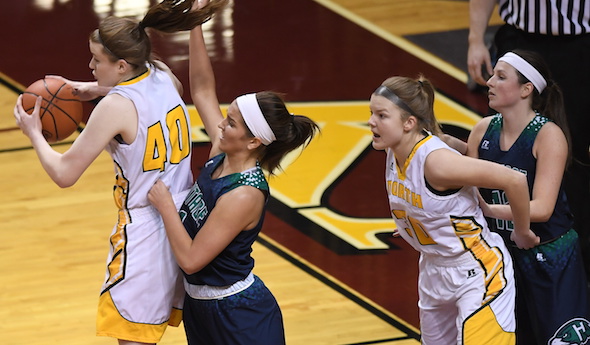
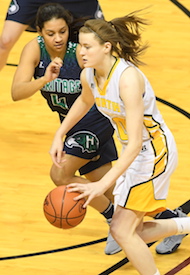
PHOTOS: (Top) Saginaw Heritage’s Madison Camp, left and Mallory McCartney provide a pair of obstacles between Grosse Pointe North and the basket Friday. (Middle) Heritage’s Moira Joiner defends North’s Julia Ayrault.
Breslin Bound: Girls Report Week 1
December 3, 2012
By Geoff Kimmerly
Second Half editor
More than 700 girls basketball teams hope to be playing at Michigan State University's Breslin Center when this season ends.
That may be fourth months away. But those quests began last week.
Each Monday, Second Half will tell you about 10 teams and individuals who jumped out the week before. What's below isn't any sort of statewide ranking – merely a top-10 list of notables for fans no matter where they live and who they will cheer on this winter.
I fully admit I won't be able to catch every team that does something special. That's where you come in. Post below and let us know which teams did what, or who we should watch coming up.
1. Brownstown-Woodhaven (1-0) – Much is expected this season out of the Warriors, who finished 22-2 last season. And Detroit Country Day is replacing an all-state backcourt that graduated a year ago. But a win over Country Day is still a win over Country Day, and Brownstown-Woodhaven got one Saturday, 54-52.
2. Goodrich (1-0) – The reigning Class B champion beat the reigning Class C runner-up, Grosse Pointe Woods University Liggett, 51-42. Goodrich still has a number of key pieces from last season’s run, while University Liggett has a few too, but is replacing Miss Basketball Madison Ristovski.
3. AuGres-Sims (2-0) – Welcome to high school basketball, Cassidy Boensch. AuGres’ 6-foot-2 freshman had 29 points, 17 rebounds, 16 blocks and 13 steals in her team’s 55-16 win over Whittemore-Prescott, and then 28 points, 12 rebounds and 10 blocks in a 51-42 win over Fairview. Click to read more from the Bay City Times.
4. East Lansing (1-0) – The Trojans and Lansing Waverly regularly have been the Lansing area’s best over the last decade and regularly face each other on the first Friday. This time the Trojans won big, 72-44.
5. West Bloomfield (1-0) – West Bloomfield got off to a good start with a 52-44 win over a team that has finished the last three seasons with victories. Waterford Our Lady has won the last three Class D championships.
6. Hartland (2-0) – The Eagles returned to the court after their 21-win season and second straight District title with a pair of close victories. Hartland beat Holly 36-31 and then Fenton 49-48.
7. Saginaw Michigan Lutheran Seminary (2-0) – The Cardinals showed perhaps some of the poise they learned during last season’s run to the Class D Quarterfinals. They won two close ones over Class B teams, 49-47 over Standish Sterling and 33-31 over Hemlock.
8. Oxford (2-0) – The Wildcats won 10 games last season, and are 20 percent of the way to equaling that total thanks to a pair of close wins. Oxford edged Rochester 35-34 on opening night, then Farmington Hills Harrison 30-27.
9. Leroy Pine River (1-1) – The Bucks rebounded from an opening-night loss to Reed City to double up the reigning Class C champion, Morley-Stanwood, 57-25.
10. Shepherd (2-0) – The Bluejays opened with wins against both teams that call Mount Pleasant home. They beat Class D Sacred Heart 46-37 and Class A Mount Pleasant High 36-23.
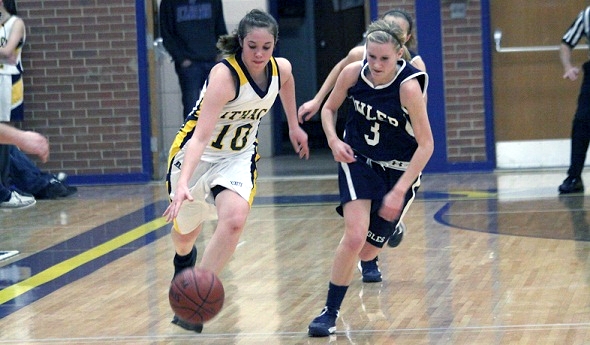
PHOTO: Fowler defeated Ithaca 51-37 on Tuesday. The Eagles are among teams that have begun 2-0 this season. (Click to see more at HighSchoolSportsScene.com.)