

Girls Basketball Builds Century-Long Legacy
By
Ron Pesch
MHSAA historian
February 1, 2016
A stroll through old high school yearbooks illustrates the amazing history of sports in Michigan.
Here one can see evolution. We see the influence of fashion, technology and the norms of society on uniform design, equipment and the games that we play. We see how photography changed.
Look cautiously, and with additional investigation, we can catch glimpses into the effects of migration patterns in our country. Turning pages, we can sometimes catch the building of gymnasiums, stadiums and fields of play.
With careful study and research, we can also gain knowledge on how education handled the female athlete.
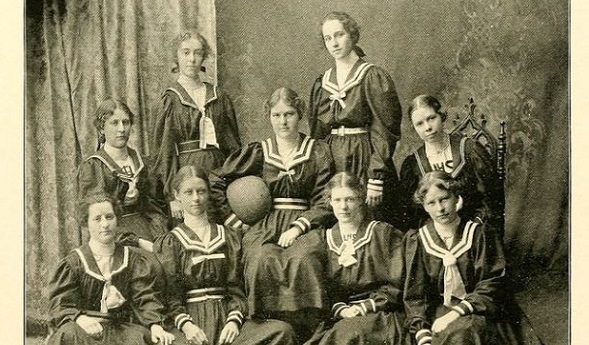
Dr. James Naismith created the game of basketball back in 1891 in Massachusetts at the Springfield YMCA. In Michigan, the sport dates back to at least 1898, when some senior girls at Lansing Central High School raised money for “baskets” and wine color “suits” trimmed in white braid and formed a basketball team.
“Their four games were played against the (Michigan Agricultural College) girls’ team. Two of these games were played before the public in the Lansing Armory,” wrote Lewis L. Forsythe, president of the MHSAA from 1924 to 1942, in his book, Athletics in Michigan High Schools: The First Hundred Years.
Hence, it is believed that the girls game predates the boys version at the high school level in the Great Lakes state. While we don’t know what rules were used by the Lansing Central girls, initially, girls played basketball by the same 13 rules created by Naismith. Senda Berenson, director of physical training at Smith College in Massachusetts, had read about Naismith’s game.
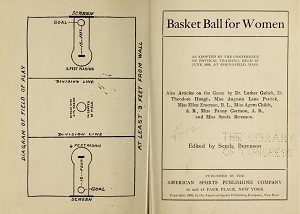 “As the game was first played it was almost too rough for girls or women to play,” states an article in the December 24, 1899, Springfield, MA Republican newspaper. Based on the suggestions from the players and the stamina of the girls she taught, Berenson altered Naismith’s original 13 rules to make the game more suitable for women. Her rules allowed 5-10 players on the court at a time on a court divided into three sections. By design, the players could not leave their section of the court. Like the men’s game, it was played during the winter sports season.
“So, at the conference of physical training held here last June,” continued the article in the Republican, “a committee of prominent physical directors of women’s colleges was appointed to draw up a set of rules.” The guidelines were adopted and the American Sports Publishing Company published “Basket Ball for Women” as part of their Spalding athletic library. Spalding guides were used by physical directors at colleges and schools across the country. Berenson would serve as editor of the Spalding guide until 1917.
“Basketball as an interscholastic game developed rapidly between 1913 and 1920,” wrote Forsythe in his book. “And quite naturally, as had been the case in other sports, the schools … came to talk about their status as ‘champions,’ or were acclaimed such by admiring followers or the press. Inevitably and perhaps with some ulterior motive, a college or a city came forward and proposed to conduct a ‘tournament’ to decide the issue among several schools.”
State Championships
Boys basketball tournaments in Michigan, designed to identify a state champion, date back to 1917 and perhaps before. Yet the governing bodies for high school sports did not sponsor a girls basketball championship tournament until 1973.
Why the difference?
As noted, it’s not that girls didn’t play basketball. The sport remained quite popular into the late 1920s. Like the boys prior to the arrival of the tournaments, local newspapers were quick to proclaim “state championship” honors for successful squads.
The 1914 Grand Haven girls team listed nine players on the team, with six positions listed: Running Center; Jumping Center; Left Guard; Right Guard; Left Forward; Right Forward. The team traveled by train to away games that winter and posted a 5-1 record against regional opponents. (The Grand Haven boys played eight games that year). The Grand Haven Daily Tribune proclaimed the girls “one of the best teams in Western Michigan if not the entire state.”
“Though hindered by lack of proper gymnasium room, 40 Central high school girls are practicing faithfully for basketball, now that a first class schedule has been arranged,” came word in a late December 1921 issue of the Flint Journal. The girls team from East Lansing High School occupied one of the spots on the published Flint Central schedule.
East Lansing’s girls were considered defending state champions after posting consecutive undefeated seasons in the winters of 1919 and 1920. The 1921 team continued the tradition, posting nine straight victories before falling 38-26 to Birmingham, another state power. East Lansing finished the regular season with a 13-1 record (although, it appears the contest with Flint never occurred).
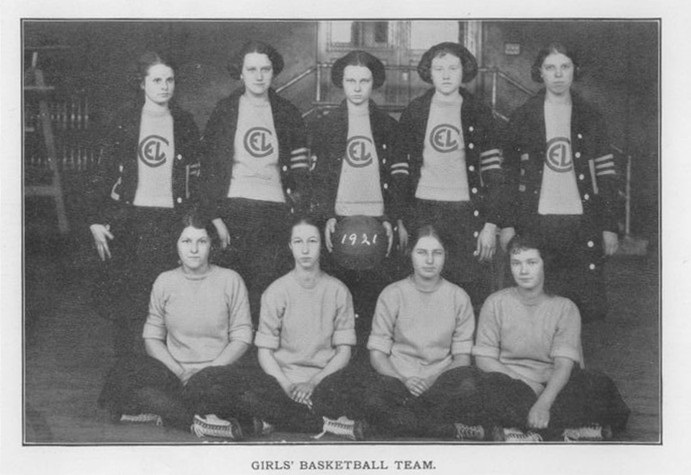 In April 1921, for the first time, four of the state’s strongest girls squads were invited to Michigan Agricultural College for a tournament. Although unsanctioned by the state’s high school athletic governing body, the old Michigan Interscholastic Athletic Association, the press felt that this invitational would decide a girls state champion. The games were played at the same time as the boys Class A tournament games at M.A.C. On Friday, Birmingham’s girls downed Saginaw, while East Lansing defeated Onaway. In the tournament final Saturday night, East Lansing avenged a regular season loss to Birmingham by a score of 50-15.
“There was little doubt in the minds of those that saw the return game but what East Lansing could rightfully claim the State’s championship for this, the third consecutive year,” wrote Raynor Hall, the athletic editor of the Ceniad, in the East Lansing annual.
Plans were in place to host another invitational in 1922, but were abandoned by the Agricultural College when more than 30 teams requested entry into the tournament. Without preliminary games for elimination, it became impossible to select representative teams. That, however, did not prevent squads from laying claim to state honors.
With the defeat of Onaway in its season finale before a crowd of 400, the Tawas City girls team proclaimed itself 1922 champion of northeastern Michigan and beyond. While newspapers around the state debated assertions on the crown by Tawas City, Muskegon and Saginaw Eastern, all once beaten during the season, the Three Rivers girls tossed their achievements into the ring. It was tough to question their merit. According to the Kalamazoo Gazette, the girls scored 518 points to their opponents’ 126 over 11 straight wins, including a 40-4 victory over Decatur, a team previously unbeaten in 13 games.
Following a victory over East Lansing on their home floor in March of 1923, the Birmingham Eccentric wrote, “This was the last game of the season for the Birmingham girls. They have won all their high school games and lost two independent games to the Central Methodist team. They may, for the third consecutive year, claim the championship of Michigan.”
Changes afoot
Activities at the 1923 convention of the American Physical Education Association would soon impact athletics for females in Michigan and across the United States. With the publication of the Official Handbook of the National Committee on Women’s Athletics, approaches began to shift as society wrestled with who should control athletic instruction for women. Despite the popularity, many academics, superintendents and school administrators felt that interscholastic competition was inappropriate for females, and suggested that it should differ from that of men. An emphasis on “play for play’s sake” and “a sport for every girl and every girl in a sport” gripped athletic instruction and administration.
Still, in Traverse City, a total of 50 girls tried out for the high school basketball team in 1925, “making it possible to select a team of unusual skill,” according to the editors of the school’s yearbook, The Pines. That same season, Coach Tena Nelson’s Muskegon Heights squad tallied 14 straight victories, and laid claim to the state’s mythical crown following a season-ending victory over that Traverse City team.
One year later, the 1926 Aurora annual from Saginaw High School (also known as Saginaw Eastern) described that philosophical shift that had swept across the state.
“This year girls’ athletic contests have been conducted under a plan very different from that of former years. Under the old system of inter-scholastic athletics very few girls could participate in the various sports. Now, under the new plan of intramural athletics, it is possible to include a large number of girls because each class has several teams. Thus the various classes compete with each other. Although the varsity girls have had to give up out of town games they have retained their enthusiasm for athletics.”
The 1926 Saginaw Arthur Hill yearbook, Legenda, summed it up more bluntly: “Due to an agreement made by the girls’ physical directors of Saginaw Valley to discontinue interscholastic games, only interclass games and those with Saginaw Eastern were played.”
Under the banners like Girls Athletic Association or Girls Athletic Club, intermural programs were established by administrators at numerous high schools across the state. In many cases, a point system was set up, based on participation, designed to determine the awarding of varsity letters. As more schools moved to this model, which often featured competition between sophomore, junior and senior classes, there were fewer schools to compete against interscholastically.
The 1928 edition of Grand Haven High School’s annual, Blue & Gold, noted that the girls basketball team won only two of seven games that school year. The 1929 edition of the yearbook stated, “No regular High School girls’ team was organized this year, but rather than giving a few the privilege of playing, Miss Smith organized a (intramural) league giving all girls a chance to play.”
At Muskegon Heights, the 1928 team finished with a 4-2 record. In 1929, the school had switched to inter-class basketball, with the school title won by the junior class.
Intra-Mural competition over Interscholastic
While by no means was the approach universal, for the next 30 years plus, girls across Michigan saw options to compete against other schools decrease.
With the 1929 arrival of Vaughn Blanchard, who served as director of health and physical education in Detroit, city league schools withdrew from statewide competition following the 1929-30 school year. As the state’s largest city, Detroit schools offered a broad range of competitive athletics, including competition in sports not offered by many outstate schools. Blanchard believed there was an overemphasis on competitive athletics, and chose to focus on a program of greater intra-school intramural activity.
Strong “house” programs of intramural athletics were added in Detroit and girls varsity basketball was retained. However, unlike past seasons, no city championships were played beginning with the 1930-31 season.
“Will intramural sports eventually replace interscholastic contests?” was the question raised in the 1933 Detroit Southeastern annual under the banner Girls’ Sports. “This is the question which will be answered in the very near future; in fact, there have been several decisive steps taken in this direction.”
Girls basketball competition among Detroit Public School League teams did continue in Detroit. Hamtramck completed a seven game schedule undefeated in 1935 against teams from Detroit Central, Northeastern, Western, Southeastern, Eastern, Northern, and Cass Tech.
 Outside Detroit, competition did remain between some smaller rural schools across pockets of Michigan, where intramural might not be practical due to small class sizes. For example between 1937 and 1942, White Cloud’s girls played a changing array of teams from Hesperia, Newaygo, Grant, Ravenna and Baldwin.
In 1938, girls basketball rules were officially changed to state that teams were made up of six players per side and the court was divided into two with three players on the offensive and three players on the defensive end.
“In the years following World War II, attitudes concerning women in general, and their participation in sports, had begun to change”, stated Joan S. Hult in the book, A Century of Women’s Basketball. Those changing attitudes, combined with the prosperity of the war years, did see girls interscholastic basketball return to some Michigan schools in fits and starts.
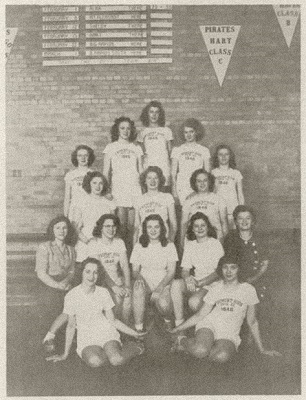
In Fremont, “the Packerettes, with Mrs. Miller as coach, entered their second year of existence with several losses to their credit,” noted a writer in the school’s 1946 annual, Mogul. “Only two of the players were back from last year’s team.”
Detroit Southeastern ended the 1945 season with two victories and two losses. The 1948 Detroit Cass Tech girls played games against teams from other Detroit school: Mackenzie, Eastern, Southeastern, Southwestern and Detroit Commerce.
 However, in the 1949 yearbook, it appears Fremont’s girls basketball team had changed to a girls sports club teaching the fundamentals of basketball. Based on 1955 annuals from Hesperia, Ravenna and Newaygo, it appears girls basketball disappeared from the varsity sports menu at those schools as well.
While the boys continued to explore an expanded menu of sports activities (including football, basketball, swimming, baseball, track, wrestling, tennis and golf), many yearbooks featured girls only as cheerleaders (which prior to the war had also been dominated by men). Competitive athletics didn’t always fit well with the "sugar and spice and everything nice" viewpoints of the time.
Still, the game found a home in some places. In the 1954 New Lothrop annual, the senior class celebrates its class history.
“The fall of 1953 finally arrived. … In this year our school got its gym, and we started our first year of Girls Basketball, by winning the first game from Byron.”
Girls basketball teams can also be found in cities like Morrice, Corunna, Fowler, and Holt, as well as in Detroit-area parochial schools like Detroit Servite and Harper Woods Regina and the Detroit PSL.
Changing Times
In 1966, the MHSAA formed the Girls Athletics Committee to look at the growth in girls high school sports in Michigan and across America. The group held its first meeting in October of that year with the intent of offering guidelines for schools choosing to offer girls athletic programs. For many, it signified the start on the long road back.
Advancements were slow but steady. For example, prior to the 1968-69 season the MHSAA Representative Council took action to increase the allowable number of varsity high school games from eight to 10 per team. In April of 1969, a move was made to sponsor a two-year experimentation using five-player basketball contests (involving extensive changes to the rules outlined in the official guide for the Michigan Division of Girls and Womens Sports). In 1971, the number of basketball games allowed for junior high school teams was increased from five to eight. Finally, the official rules of the game were changed to five-player, full-court basketball.
Still schools were not required to offer interscholastic athletics programs for females in 1971. A survey by the National Federation of High School Athletic Associations showed 707 high schools in Michigan offered boys basketball, while 296 sponsored girls basketball. Post-high school opportunities within the sport were slim. In addition, there were relatively few four-year colleges offering scholarships for women basketball players.
The arrival of Title IX on June 23, 1972 changed that. Legislation prohibiting discrimination against students based on race, sex, or religion, Title IX forced the creation of women’s athletic programs at high schools and colleges across the nation. With that, according to a survey by the National Federation, 699 high schools in Michigan sponsored boys basketball, while 627 offered girls basketball.
Oklahoma began tournament play for girls in 1919, missing one state championship in 1934 because of the depression. In Iowa (where the girls often outdrew the boys during March Madness), the women's tourney began in 1920. In December 1973, eight high school teams gathered at each of four sites around Michigan to compete for the first MHSAA Girls Basketball titles. In addition, many schools now offered softball, tennis, swimming, volleyball and track & field programs. With the stroke of a president’s pen, the world of high school athletics, and the view of the female, changed.
 Ron Pesch has taken an active role in researching the history of MHSAA events since 1985 and began writing for MHSAA Finals programs in 1986, adding additional features and "flashbacks" in 1992. He inherited the title of MHSAA historian from the late Dick Kishpaugh following the 1993-94 school year, and resides in Muskegon. Contact him at [email protected] with ideas for historical articles.
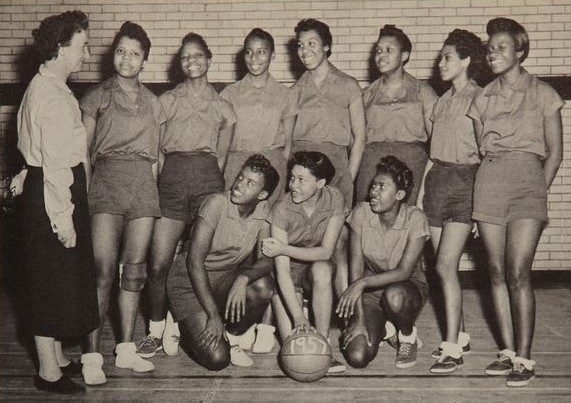
PHOTOS: (Top) The Lansing Central girls basketball team, in 1898, is believed to be the first girls high school team in Michigan. (Middle top) This Spalding guide outlined the rules for girls basketball. (Middle) The 1921 East Lansing girls team was a force of its time. (Middle below) The 1946 Fremont team played the second season of girls basketball at that school. (Below) The 1957 Detroit Northern team was among those representing Detroit Public School League member schools. (Photos collected by Ron Pesch.)
Moment: Powers Avenges 1999 Defeat
April 20, 2020
By Geoff Kimmerly
Second Half editor
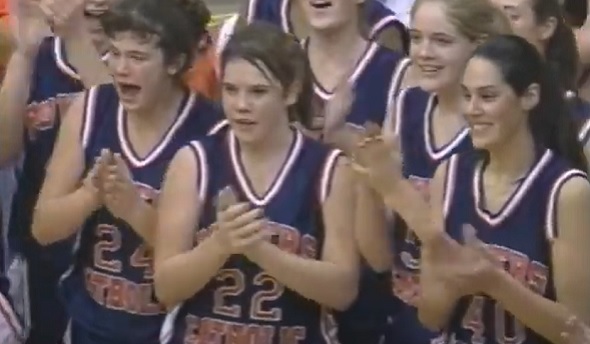
After being stung by Detroit Country Day’s fourth-quarter comeback and buzzer-beating game winner in the 1999 Class B Final, the Flint Powers Catholic girls basketball team would not offer an opportunity for the same dramatic ending in the teams’ 2000 rematch.
This time, the Chargers halted Country Day’s fourth-quarter surge a few points short, holding on for a 47-42 victory.
Senior Kelly Koerber – Powers’ leading scorer in the 1999 defeat – again set the pace, putting up 19 points while connecting on 9 of 12 shots from the floor. The Chargers actually trailed Country Day by two at halftime before going on a 15-4 third-quarter run to take a lead they wouldn’t relinquish. Koerber’s future Western Michigan teammate Carrie Moore led Country Day in scoring this time with 19 points as well.
The win gave Powers a 27-1 record for the season, its only loss coming to Flushing by a point. Powers would go on to also win the third-straight Class B Final matchup between the Chargers and Yellowjackets in 2001, 54-53, to cap a perfect 28-0 season.
Here’s the full broadcast of the 2000 Final from FOX Sports Detroit.