

Girls Basketball: It's the Final Countdown
March 14, 2012
Four months after the opening tip, girls basketball season will come to close this weekend at Michigan State's Breslin Center.
All four reigning champions are back -- Inkster in Class A, Dearborn Divine Child in Class B, St. Ignace in Class C and Waterford Our Lady of the Lakes in Class D. But also arriving in East Lansing are nine teams that have never won an MHSAA girls basketball championship -- including Class B favorite Goodrich.
The schedule, ticket and broadcast information follows below, along with team-by-team looks at all 16 competing this weekend.
Semifinals - Thursday
Class C
Grosse Pointe Woods University Liggett (22-4) vs. Concord (26-0) - 1 pm
St. Ignace (25-0) vs. Morley-Stanwood (26-0) - 2:50 pm
Class D
Portland St. Patrick (19-6) vs. Waterford Our Lady of the Lakes (21-4) - 6 pm
Athens (20-5) vs. Crystal Falls Forest Park (21-5) - 7:50 pm
Semifinals - Friday
Class A
Grand Haven (25-1) vs. Inkster (21-5) - 1 pm
Ann Arbor Huron (21-5) vs. Grosse Pointe South (22-3) - 2:50 pm
Class B
Grand Rapids Catholic Central (23-3) vs. Freeland (22-3)- 6 pm
Goodrich (26-0) vs. Dearborn Divine Child (24-2) - 7:50 pm
Finals - Saturday
Class A - Noon
Class B - 6 pm
Class C - 4 pm
Class D - 10 am
Tickets cost $8 per session for Semifinals and Finals. Parking at Breslin costs $5. All Semifinals will be streamed live on MHSAA.tv and FoxSportsDetroit.com. The Class D, C and A Finals will be broadcast on Fox Sports Detroit, with the Class B Final on Fox Sports Detroit Plus channels.
And now, a look at the contenders:
Class A
ANN ARBOR HURON
Record/rank: 21-5, unranked
League finish: First in Southeastern Conference Red
Coach: Steve Vinson, ninth season (142-64)
Championship history: Has never appeared in an MHSAA Final.
Best wins: 52-39 over Saginaw Arthur Hill (Quarterfinal), 58-34 and 51-41 over Temperance Bedford, 47-36 over Brighton (District Final), 48-40 over Hartland (Regional Final).
Players to watch: Devin Talley (5-8 sr. G – 10.6 ppg, 2.7 spg, 2.5 apg), Logan Sims (6-0 sr. C – 8.2 ppg, 5.1 rpg).
Outlook: Huron has won 18 straight games after a 3-5 start, but those losses – four came against Class A Semifinalists Detroit Pershing and Inkster and Class B powers Goodrich and Detroit Country Day – no doubt have made Huron more prepared for this weekend. The River Rats have been building toward this kind of run with three straight league titles and District championships three of the last four seasons.
GRAND HAVEN
Record/rank: 25-1, No. 1
League finish: First in O-K Red
Coach: Katie Kowalczyk-Fulmer, 14th season (219-109)
Championship history: Has never appeared in an MHSAA Final.
Best wins: 42-40 (2 OT) over honorable mention East Lansing (Quarterfinal), 43-39 over No. 4 Detroit Martin Luther King, 45-36 over No. 6 East Kentwood, 44-35 over Class B No. 10 Grand Rapids Catholic Central.
Players to watch: Shar’Rae Davis (5-9 sr. G – 10 ppg, 5.0 apg), Alex Law (5-11 sr. F – 12 ppg), Abby Cole (6-5 jr. C). (Statistics not submitted.)
Outlook: Grand Haven just got past East Lansing in Tuesday’s Quarterfinal, but should have no problem rebounding for a game it’s likely been waiting a year to play. The Buccaneers fell by a point to Detroit Renaissance in a Semifinal last season, and Davis, Law and Cole plus the team’s three subs that game all are back. That lone loss this season came to East Kentwood, and Grand Haven has won 21 straight.
GROSSE POINTE SOUTH
Record/rank: 22-3, honorable mention
League finish: Tied for first in Macomb Area Conference White
Coach: Kevin Richards, fifth season (83-30)
Championship history: Has never appeared in an MHSAA Final.
Best wins: 74-51 over honorable mention Warren Cousino, 56-45 over honorable mention Romeo (Regional Semifinal), 58-54 over No. 8 Waterford Kettering (Quarterfinal).
Players to watch: Caitlin Moore (5-10 sr. G – 16.2 ppg, 2.9 apg), Claire DeBoer (6-1 jr. F – 13.2 ppg, 10.4 rpg, 3.0 apg).
Outlook: The Blue Devils’ run is even more impressive considering the team has just four seniors, and only two who start – plus two freshman guards with significant roles. Grosse Points South beat its first five postseason opponents by 10 points or more – and also posted an impressive loss this season, falling to Class A Semifinalist Inkster 73-71 in overtime in the Blue Devils’ sixth game this winter.
INKSTER
Record/rank: 21-5, No. 10
League finish: Does not play in a league.
Coach: Ollie Mitchell, first season (21-5)
Championship history: Two MHSAA titles (most recently 2011).
Best wins: 56-53 and 59-56 (District Final) over No. 7 Westland John Glenn, 56-53 over No. 2 Lansing Waverly, 59-40 over No. 4 Detroit Martin Luther King (Quarterfinal), 52-51 over Class B No. 6 Dearborn Divine Child.
Players to watch: Kelsey Mitchell (6-1 sr. F – 19.5 ppg), Jamie Madden (5-8 sr. G – 16 ppg), Ariyanna Taylor (5-10 sr. F – 14 ppg).
Outlook: In addition to the mentioned wins above, Inkster has beaten both Semifinalists it could see if it defeats Grand Haven on Friday – the Vikings defeated Ann Arbor Huron 71-61 early in the season and Grosse Pointe South 73-71 in overtime a few weeks later. Mitchell – who has signed with the University of Michigan – leads an imposing frontcourt featuring four players 6-feet and taller and two more who are 5-11. Mitchell and Madden both started last season as well.
Class B
DEARBORN DIVINE CHILD
Record/rank: 24-2, No. 6
League finish: First in Detroit Catholic High School League Central
Coach: Mary Laney, eighth season (131-60)
Championship history: Five MHSAA titles (most recently 2011), one runner-up finish
Best wins: 45-35, 54-32 and 53-36 over Class A honorable mention Farmington Hills Mercy, 47-41 over Class D No. 7 Waterford Our Lady of the Lakes, 48-42 over Class A No. 4 Detroit Martin Luther King.
Players to watch: Rosanna Reynolds (5-9 sr. G – 12 ppg, 4.3 rpg), Morgan Blair (5-9 jr. G – 11 ppg, 3.2 apg).
Outlook: The reigning champion hasn’t had to face a ranked opponent during the postseason so far, but prepared plenty during the regular season. On top of its impressive wins mentioned above, Divine Child fell by one to Class A Semifinalist Inkster and by nine to Class C Semifinalist Grosse Pointe Woods University Liggett. Plus, senior guards Cara Miller and junior forward Mallory Myler joined Reynolds and Blair in last season’s starting line-up and together carry the most Finals experience of any team at Breslin this weekend.
FREELAND
Record/rank: 22-3, honorable mention
League finish: First in Tri-Valley Conference Central
Coach: Tom Zolinski, fifth season (93-27)
Championship history: Won Class C title in 1998.
Best wins: 66-52 over honorable mention Gladstone (Quarterfinal), 50-43 over honorable mention Muskegon Oakridge (Regional Semifinal), 63-39 and 73-66 over honorable mention Bullock Creek, 60-58 over Class C honorable mention Saginaw Valley Lutheran.
Players to watch: Tori Jankoska (5-7 jr. G – 25.5 ppg, 4.3 apg, 58 3-pointers), Tara Padgett (5-5 jr. G – 12.1 ppg, 4.0 apg).
Outlook: Jankoska, who will sign with Michigan State this fall, is arguably the top junior in the state and will get the chance to play on her future home floor. She and Padgett key an offense averaging 59 points per game and also has cleared 70 five times this season. The Falcons avenged one of their two losses – against Saginaw Valley Lutheran – with the other coming to Class C top-ranked team Morley-Stanwood.
GOODRICH
Record/rank: 26-0, No. 1
League finish: First in Genesee Area Conference Red
Coach: Jason Gray, 13th season (266-38)
Championship history: Has never appeared in an MHSAA Final.
Best wins: 56-47 over No. 3 Detroit Country Day (Quarterfinal), 70-67 over Class C No. 9 Grosse Pointe Woods University Liggett, 61-24 over Class A honorable mention Auburn Hills Avondale, 56-36 over Class A No. 3 Midland, 63-46 over Class A No. 10 Inkster.
Players to watch: Aketra Sevillian (5-6 jr. G – 13.7 ppg, 3.4 spg), Frankie Joubran (5-11 sr. F – 11.4 ppg, 5.2 rpg), Taylor Gleason (5-8 jr. G – 11.1 ppg, 3.6 apg).
Outlook: Goodrich could make the argument as the state’s top team, regardless of class. Four starters are back from the squad that fell by two in double-overtime to eventual Class B champion Divine Child during last season’s Semifinals. The Martians have beaten their opponents by an average of 64-30 this winter. Joubran has signed with Belmont and senior guard Destiny Stephens has signed with Detroit Mercy.
GRAND RAPIDS CATHOLIC CENTRAL
Record/rank: 23-3, No. 10
League finish: First in O-K Gold
Coach: Colleen Lamoreaux-Tate, 19th season (347-60)
Championship history: One MHSAA title (2010), one runner-up finish
Best wins: 48-33 over No. 2 Portland (Regional Semifinal), 49-46 (OT) over No. 5 East Grand Rapids (District), 54-35 and 46-31 (Regional Final) over honorable mention Grand Rapids South Christian, 68-41 and 53-28 (District Semifinal) over honorable mention Grand Rapids Christian, 48-34 over Class A No. 10 Inkster.
Players to watch: Tiesha Stokes (6-0 sr. C – 10 ppg, 8.0 rpg, 3.8 spg), Shellis Hampton (5-10 sr. G – 10 ppg, 9.0 rpg, 5.0 apg), Addie Johnson (5-11 sr. F – 10 ppg, 5.0 rpg, 2.2 spg).
Outlook: Stokes and Hampton also played significant roles on the 2010 championship team and are among eight seniors who have led this squad to its third Finals in four seasons. Grand Rapids Catholic has won nine straight and knocked out two top-five teams along the way. The Cougars are especially hard to defend because of their balance – three more players average six points per game, and sophomore Alyzia Dilworth hands out five assists per contest.
Class C
CONCORD
Record/rank: 26-0, No. 2
League finish: First in Big 8 Conference
Coach: Jeff Redman, fifth season (62-50)
Championship history: Has never appeared in an MHSAA Final.
Best wins: 31-28 over honorable mention Grass Lake (District Semifinal), 56-45 over No. 4 Niles Brandywine (Quarterfinal), 52-42 and 50-40 over Athens.
Players to watch: Megan Redman (5-4 jr. G – 13 ppg, 3.0 apg), Maycee Brigham (5-10 jr. F – 11.5 ppg, 7.6 rpg).
Outlook: A team with only three seniors is just three seasons removed from a 0-21 finish. But Jeff Redman has led the Yellow Jackets to two straight league championships and a run this season that’s included 22 wins by 10 or more points. Two of those wins were over Class D Semifinalist Athens. Megan Redman earned an all-state honorable mention this week.
GROSSE POINTE WOODS UNIVERSITY LIGGETT
Record/rank: 22-4, No. 9 (tied)
League finish: First in Michigan Independent Athletic Conference
Coach: Joe LaMagno, first season (18-3)
Championship history: Finished runner-up in 2011.
Best wins: 51-33 over No. 7 Flint Hamady (Regional Semifinal), 46-37 over Class B No. 6 Dearborn Divine Child, 77-63 over Class A No. 10 Inkster.
Players to watch: Madison Ristovski (5-10 sr. G – 19.2 ppg, 9.0 apg, 6.0 rpg, 3.0 spg), Haleigh Ristovski (5-10 jr. F – 10.2 ppg).
Outlook: University Liggett’s return seemed inevitable after it fell in last season’s Final 65-54 to St. Ignace. It is the only team left in Class C without a perfect record, but those losses all came to Class B or A schools, including B top-ranked Goodrich by three points. Ristovski was named the state’s Miss Basketball on Monday and has signed with the University of Michigan. Her freshman sister Lola also is a major contributor, starting and averaging 12.2 points per game. The Knights are without sophomore guard Bre’nae Andrews (11.7 ppg), who has a leg injury.
MORLEY-STANWOOD
Record/rank: 26-0, No. 1
League finish: First in Central State Activities Association
Coach: Bob Raven, 19th season (319-116)
Championship history: Has never appeared in an MHSAA Final.
Best wins: 70-50 over No. 8 McBain, 44-42 over No. 5 Kent City (Regional Final), 59-44 over Saginaw Nouvel (Quarterfinal), 62-53 over Class B honorable mention Freeland.
Players to watch: Bailey Cairnduff (5-10 sr. G – 16.8 ppg, 5.3 rpg, 2.3 spg), Alexis Huntey (6-1 sr. F – 15.7 ppg, 6.8 rpg, 3.5 apg).
Outlook: All-staters Cairnduff and Huntey hope to make this final run a memorable one after also leading the Morley-Stanwood volleyball team to that Class C championship in the fall. The Mohawks have won 11 straight conference and seven straight District championships – and more than 20 games in each of the last seven seasons too. But this is the first time in five tries during that run that they advanced to the Semifinals. Senior guard Elyse Starck adds 13 points per game and 3.7 assists as the main distributor to those standout posts.
ST. IGNACE
Record/rank: 25-0, No. 3
League finish: First in Straits Area Conference
Coach: Dorene Ingalls, 13th season (264-56)
Championship history: Three MHSAA titles (most recently 2011), two runner-up finishes.
Best wins: 70-69 (OT) over No. 9 Houghton (Regional Final), 73-65 over No. 8 McBain (Quarterfinal), 68-39 over Class D honorable mention Brimley.
Players to watch: Lauren Goldthorpe (5-8 sr. G/F – 15.5 ppg, 6.8 rpg, 4.0 spg), Kelley Wright (5-10 soph. G – 13.9 ppg, 4.7 apg, 5.4 spg), Emily Hinsman (5-10 soph. G – 12.3 ppg, 4.8 rpg, 4.0 spg).
Outlook: The reigning champion actually has reached the Final the last two seasons, falling in 2010. Goldthorpe, Wright and junior guard Sarah Cullip (10.4 ppg) started in last season’s championship game, although the team as a whole has picked up a lot of slack after graduating two eventual college players last spring. Goldthorpe earned an all-state special mention this season.
Class D
ATHENS
Record/rank: 20-5, honorable mention
League finish: Third in Big 8 Conference
Coach: Calvin Quist, seventh season (122-46)
Championship history: Has not appeared in an MHSAA Final.
Best wins: 34-32 and 48-34 (Regional Final) over No. 10 Climax-Scotts, 31-30 over No. 8 Lansing Christian (Quarterfinal).
Players to watch: Sierra Stevens (5-5 sr. F – 10.3 ppg, 3.4 rpg), Leia Fuller (5-8 jr. F – 5.9 ppg, 6.1 rpg).
Outlook: Athens has been on the verge of a trip to Breslin – Quist has led the Indians to six straight District championships, three Regional titles in four seasons, and at least 20 wins in five straight. Athens is on the low end, literally, in terms of size – Fuller is the team’s tallest player at 5-8. But that hasn’t affected the Indians defensively – they give up just 36 points per game, and have allowed more than 45 only three times. Two losses came to Class C Semifinalist Concord.
CRYSTAL FALLS FOREST PARK
Record/rank: 21-5, honorable mention
League finish: Second in Skyline Conference
Coach: Jeff Syrjanen, seventh season (121-35)
Championship history: Finished runner-up in 1995.
Best wins: 63-58 and 50-47 (Regional Final) over No. 1 Bark River-Harris, 50-39 and 50-29 over honorable mention Rapid River, 52-42 over No. 5 Eben Junction Superior Central (Regional Semifinal), 59-57 over No. 3 Gaylord St. Mary (Quarterfinal).
Players to watch: Alexis Gussert (5-11 soph. F – 21.8 ppg, 9.3 rpg, 2.8 apg, 2.8 spg, 2.0 bpg, 45 3-pointers), Tanner Bartczak (5-11 sr. F – 10.7 ppg, 5.9 rpg, 2.2 spg).
Outlook: The Trojans have staked their claim by beating three of the top five teams in the final Associated Press poll, although they also won 21 games last season. Gussert, an all-state selection this week, is the best player you probably haven't heard of right now – but you’ll know all about her by the end of the weekend. Just a sophomore, she’s got major college eyes turned toward the northwest corner of the Upper Peninsula.
PORTLAND ST. PATRICK
Record/rank: 19-6, unranked
League finish: Fourth in Central Michigan Athletic Conference
Coach: Al Schrauben, 27th season (531-137)
Championship history: Six MHSAA titles (most recently 2002), six runner-up finishes.
Best wins: 41-29 over No. 2 Mount Pleasant Sacred Heart (District Semifinal), 65-61 over East Kentwood West Michigan Lutheran (Regional Semifinal), 52-27 over Pewamo-Westphalia.
Players to watch: Sidney Hill (5-8 sr. C – 7.9 ppg, 5.3 rpg), Courtney Dixon (5-10 jr. C – 7.1 ppg, 6.2 rpg).
Outlook: Don’t overlook the Shamrocks because of their record, lack of rank, or no player scoring more than eight points per game this season. Few programs have had as much success on Girls Basketball Finals weekend. Although St. Patrick’s last championship game appearance was in 2006, it has won District titles four of the last five seasons and Regionals the last two.
WATERFORD OUR LADY OF THE LAKES
Record/rank: 21-4, No. 7
League finish: First in Detroit Catholic High School League East
Coach: Steve Robak, fifth season (105-22)
Championship history: Two MHSAA titles (most recently 2011).
Best wins: 37-35, 53-40 and 42-35 (District Final) over No. 6 Marine City Cardinal Mooney, 38-30 over Saginaw Michigan Lutheran Seminary (Quarterfinal), 47-44 and 39-38 over Allen Park Cabrini.
Players to watch: Carlee Cottrell (5-9 sr. G – 11.8 ppg, 3.3 apg), Lexie Robak (5-9 jr. G – 11.7 ppg, 5.4 rpg, 43 3-pointers), Tori Duffey (5-8 sr. G – 11.3 ppg, 4.4 rpg).
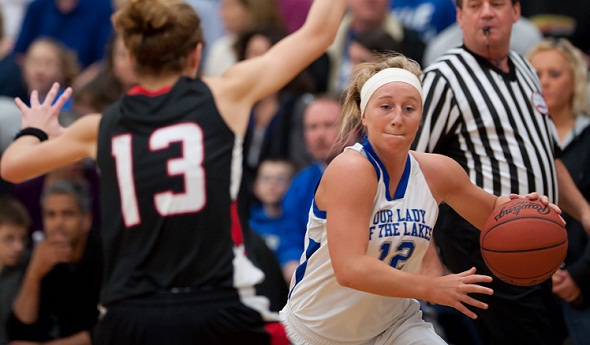
Outlook: Our Lady has won the last two Class D championships, and Lexie Robak and junior guard Ava Doetsch (9.7 ppg) started for both of those teams, while Cottrell also started in last season’s Final. Robak and Cottrell were named all-state earlier this week. The Lakers again battled through a tough schedule including a number of bigger schools, with losses to Class B Semifinalist Dearborn Divine Child and Class C Saginaw Nouvel. But they allowed only two postseason opponents within 28 points.
PHOTO: Waterford Our Lady senior Tori Duffey drives to the basket during a game against Marine City Cardinal Mooney. (Photo courtesy of Terry McNamara Photography.)
DeBoer Looks to Steer Sailors to Breslin
February 18, 2016
By Dean Holzwarth
Special for Second Half
CUTLERVILLE – Jenn DeBoer remembers the thrill of playing in the MHSAA Class B Final when she was a sophomore.
 The South Christian standout would like nothing better than to revisit that feeling in her final season.
DeBoer, a 5-foot-7 point guard, is currently leading the Sailors toward what they hope is another extended postseason run.
South Christian is 16-1 with three games remaining in the regular season before Districts tip off in March.
“That was a lot of fun, and obviously it was different because I was a sophomore and I knew that I had two more years after that,” DeBoer said. “But this year it’s a big goal for all of us seniors. We’ve talked about how we want to get back there and end our senior season strong.”
Led by DeBoer and a cast of veteran senior teammates, the Sailors have displayed the potential to make some noise in the MHSAA tournament.
They’re seeking an Ottawa-Kent Conference Gold title and currently own a perfect 7-0 mark in league play. Their championship hopes hinge on upcoming showdowns with Wayland and Grand Rapids Catholic Central.
“It’s been a blast so far,” DeBoer said. “I couldn’t ask for a better senior season. Our team chemistry is so amazing, and the other seniors and I get along so well. Obviously, winning has been fun too, and it’s probably one of the best teams I’ve been on.”
DeBoer, a four-year varsity player who committed to Division II Grand Valley State University before her junior season, has been the floor general of this year’s squad.
She has contributed in every aspect of the game, averaging 16.8 points, 6.0 assists, 4.6 rebounds and 3.8 steals per contest.
First-year South Christian coach Kim Legge has watched DeBoer improve and mature throughout the past years.
“She has made strides because of her work ethic, and she always wants to learn,” said Legge, a longtime assistant under recently-retired coach Jim DeBruyn.
“She’s like a sponge, and she’s been to a point guard camp the past two summers. That has really helped with her decision-making and leadership skills.”
DeBoer recently established two new school records for her 3-point shooting prowess.
During a recent win over Hastings, she set a new mark for career 3-pointers that had stood since 2003 while also surpassing the single-season record.
DeBoer toppled Leah Pettinga’s career record of 93 3-pointers made. She currently has 45 on the season.
 “It’s a huge honor to have the record now,” DeBoer said. “I knew I was pretty close because I focus on shooting 3s. It’s my favorite thing to do, and that’s just what I do. I wasn’t sure if I would ever make it, so it is definitely really cool to know that I have the record now.”
Legge didn’t know DeBoer was approaching the milestone until a few weeks ago, but she wasn’t surprised by the accomplishment.
“Anything that girl puts her mind to she seems to get done,” Legge said. “I got clued in a couple games before that she was getting close, but she would have never said anything to me. That’s how she is. She is so humble. It was a goal of hers, but it never would’ve come out of her mouth.”
DeBoer said the transition from DeBruyn to Legge wasn’t a difficult one.
“They both have similar coaching styles, but coach Legge is a lot more centered on defense so our defense this year has really picked up,” she said. “We have done a lot of the same things we’ve been doing in the past.”
DeBoer’s early commitment to the Lakers has allowed her to enjoy a stress-free final two seasons. It’s allowed her to focus strictly on helping her team succeed instead of lamenting over which college to choose.
“The pressure has been off, and I’ve been able to focus on my last basketball season at South,” DeBoer said. “The last four years have gone by pretty fast, and it doesn’t feel like I’m a senior until I think about it and look at old pictures. In a couple months I will be graduating, but I’m trying to enjoy high school while I’m still here.”
DeBoer is anticipating the jump to college, but is committed to ending her career on a high note.
“I’m definitely looking forward to playing in college next year, but I would really like to have a good ending to this season,” DeBoer said. “If we keep working hard, then I think we will do pretty well in the postseason.”
Legge isn’t one to look ahead, but with a starting line-up consisting of all seniors, expectations are high for the remainder of the season.
“We have a hard road ahead of us the last week of conference (play) and I don’t feel like we have peaked,” she said. “I really focus on what my team needs to do to grow on a day-to-day basis. Every coach in the state hopes their team makes a tournament run, and at this point of the season, it’s a goal of ours.”
 Dean Holzwarth covered primarily high school sports for the Grand Rapids Press and MLive for 16 years and more recently served as sports editor of the Ionia Sentinel and as a sports photojournalist for WZZM. Contact him at [email protected] with story ideas for Allegan, Kent and Ottawa counties.
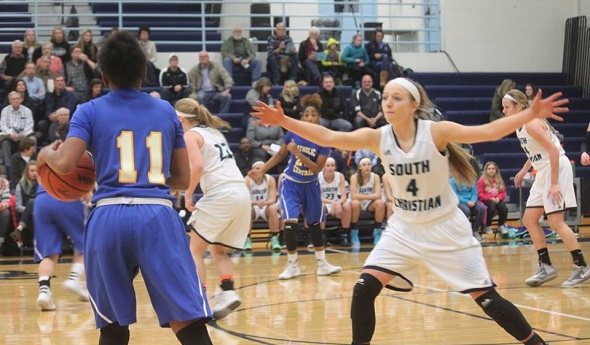
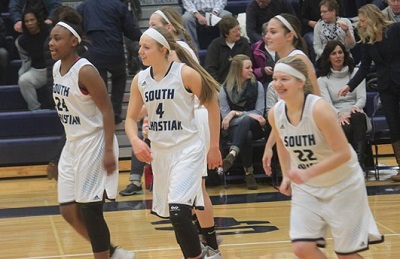
PHOTOS: (Top) Grand Rapids South Christian's Jenn DeBoer defends against Grand Rapids Catholic Central earlier this season. (Middle) DeBoer, 4, is one of a cast of experienced teammates hoping to finish with another Finals run; she takes the floor with Markayla Vander (24) and Sydney DeYoung (22). (Photos by Tracy DeYoung.)