

'If you want it, go get it.'
July 31, 2012
By Geoff Kimmerly
Second Half editor
SOUTH LYON – "If you want it, go get it. It's out there."
Annette Babers has lived on both sides of that message, as both the pursuer and achiever. And she explained how today's high school players can do the same last week in speaking to more than 200 athletes, parents and coaches attending the MHSAA's Reaching Higher girls basketball clinic at South Lyon High School.
 Reaching Higher, in its fourth year and in coordination with the Basketball Coaches Association of Michigan, provides the state's elite basketball prospects with a day not just of basketball training, but also instruction in what it takes to succeed both academically and socially at the college level.
And becoming a well-rounded athlete – physically, mentally and spiritually – was a main point of emphasis for Babers, considered one of that nation's top high school players in 1988 while a senior at Saginaw High (she averaged 24.8 points, 21 rebounds and 15 blocks per game) before going on to start at Michigan State University and playing professionally in Turkey.
She's also the aunt and a major influence in the life of Draymond Green, who finished his career at MSU this spring and was drafted by the Golden State Warriors.
Mixing in the lessons she'd learned while telling the story of her basketball career, Babers provided these nuggets:
- "Listen (and) be obedient. If you're obedient, you're going to have that drive. You're going to have that determination – if you've got love for the game."
- "If you want that next level, it's right there. Go get it. ... It's out there. You don't realize how much you can do ..."
- "You know there's more to this than just playing. You've got to get your body physically fit. You've got to get your mind ready."
- "Whatever you do, please, (mind your) attitudes. You never know who's watching."
- "Your parents have given you the tools of life. You've got to use them."
- "You've got to find the circle you're going to be in. And make sure your parents are part of that circle."
 Combined, 280 of the state's top boys and girls players were invited to Reaching Higher, as chosen by a selection committee made up of coaches from all over the state. The boys came to South Lyon on July 18, followed by the girls on July 26.
The six-hour sessions included skill training and three 36-minute games, plus a variety of speakers including current and former players Babers, University of Michigan standout Zach Novak and former Wake Forest and current German League standout Kyle Visser, who played his high school basketball at Grand Rapids Forest Hills Central. Also providing valuable insights were coach Marc Comstock, Childress Sports Consulting, Dave Ginsberg of Management and Motivational Strategies and University of Michigan NCAA compliance officer Elizabeth Heinrich.
Total, 81 coaches from 55 college programs attended either the boys or girls sessions, representing all three NCAA levels and the NAIA. Games were reffed by MHSAA officials, who also participated in training sessions throughout both days.
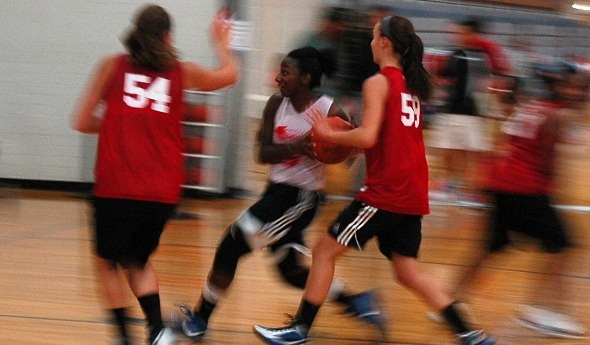
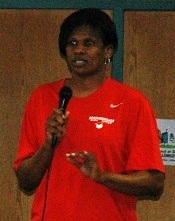
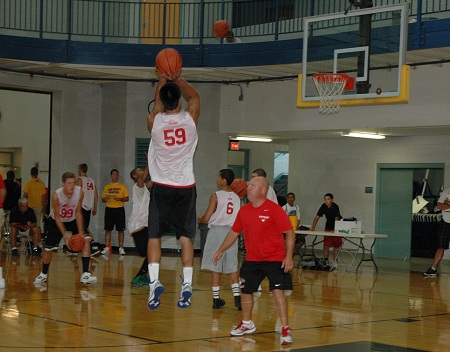
PHOTOS: (Top) Battle Creek Central senior Kayla Freeman (with ball) cuts through a haze of opponents on her way to the basket. (Middle right) Annette Babers speaks to the more than 200 players, parents and coaches at South Lyon High School. (Middle left) Salem senior Chris Dierker launches a shot during a drill at the boys clinic.
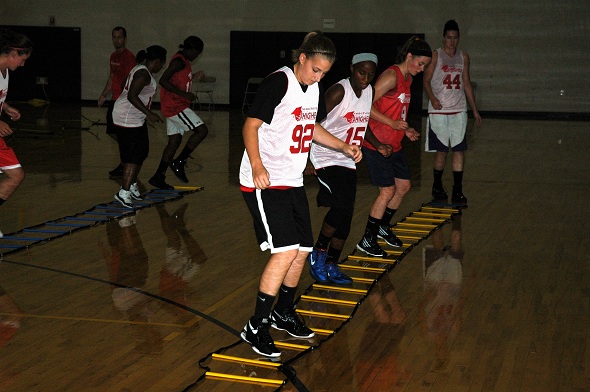
PHOTO: New Boston Huron sophomore Hailey Richardson (92) and Utica Ford senior Cris Harper (15) lead a group through an agility drill.
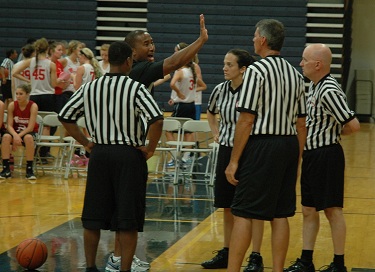 PHOTO: All three rounds of games during both Reaching Higher sessions were officiated by MHSAA referees, who also received instruction and evaluation. Left, Kendal Smith from the Metro Detroit Officials Association talks technique with a group during a break in their game.
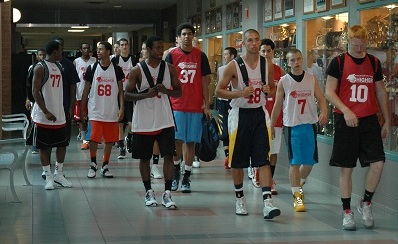
PHOTO: Reaching Higher participants return to the South Lyon High School gym after receiving instruction in the school's cafeteria. Standing tall is Ann Arbor Skyline junior Tristan Wilson (37).
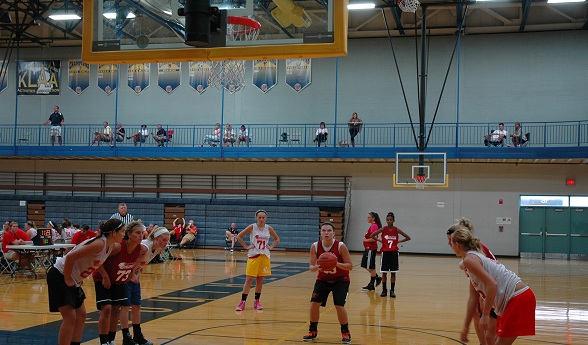
PHOTO:Richland Gull Lake sophomore Alexis Ahlert prepares to shoot a free throw during her team's game Thursday.
Sandusky's DeMott: 700 and Counting
By
Paul Costanzo
Special for MHSAA.com
January 3, 2018
When Al DeMott took the Sandusky girls basketball coaching job in 1979, he wasn’t planning on it being a long-term gig.
 A few losing seasons motivated him to turn the program around, however – and nearly 40 years later he’s not only succeeded in doing so, he’s become one of the most successful coaches in state history.
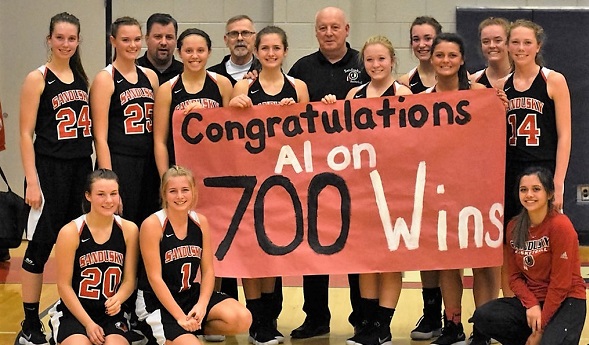
DeMott hit the 700-win mark on Dec. 5, joining Detroit Country Day’s Frank Orlando as the only girls basketball coaches in Michigan to reach the milestone.
“I’ve been coaching for a long time, and I know I’ve been blessed,” DeMott said. “I’ve had a lot of good kids and parents and assistant coaches who have been part of it. I’ve been blessed with great kids that work hard, and want to work hard.”
DeMott is 703-187 in his time at Sandusky, with 19 league titles, 25 District titles, seven Regional titles and one MHSAA Finals runner-up finish (1999). He’s also had the joy of coaching his three daughters, Marissa, Allison and Desiree.
“They have all actually helped me in my program,” he said of his daughters. “It’s been a lot of fun. I planned on getting out a few years ago, but I’m still having a lot of fun. I’ve got kids that are so fun to work with, and it’s hard to walk away from that. Thank God my wife has always been supporting me, too.”
It did take about five years for him to get things moving in that positive direction, though.
“We got a piece of the league title for the first time in 1984, then in 1985 we upset Flint Academy in the Regional,” he said. “That really sparked these younger kids, and we had pretty good success ever since.”
Starting a youth program in the early 1980s was a key cog in the turnaround, but also a sign of Sandusky and DeMott adjusting to the changing climate of girls basketball at the time.
“When I started, the level of play compared to what it is now is night and day,” he said. “Girls basketball has come a long way. Nobody did anything in the summer, but now they’re as active as the boys, or more active.”
As the game has changed, DeMott has, too. He’s won games with teams that lit it up from outside, he’s won games with teams that pounded the ball down low, and most recently, he’s won games with suffocating defense.
“Year by year it can change,” he said. “Depending on the personnel.”
What doesn’t change is DeMott’s commitment to the game and his team.
“There are so many secrets to his success,” Sandusky senior Haley Nelson said. “But he prepares us so well. He does his research. We know the other team’s plays just as well as they know them sometimes. He’s always scouting and he watches so much tape.”
Nelson is a four-year player for DeMott, and recently committed to continue her career at Saginaw Valley State University. She said playing for DeMott is something players in Sandusky look forward to from a young age.
“Coach DeMott is known by everyone in Sandusky,” she said. “If you say, ‘Al DeMott,’ everyone knows who he is. If you go other places, everyone knows who Al DeMott is. He’s very well respected.”
It’s partly because DeMott has coached so many members of the community, including those who eventually watched their daughters play for their former coach.
“I personally think it’s pretty awesome,” said Nelson – whose mother didn’t play for DeMott, but her older sister Keegan did. “If you could talk to your mom about your coach and it would be the exact same coach, that would be pretty awesome.”
Although, Nelson said, she’s heard he’s not exactly the same as he was back in the day.
“I hear back in the day he was a screamer,” Nelson said. “Clearly, he’s not like that anymore. He’s the calmest coach in America.”
This season’s Sandusky team is 7-1, and DeMott thinks it has potential to finish strong, despite a recent injury to a key player.
No matter how the rest of the winter goes, however, this year’s team will always be able to look back on the 53-26 win against Unionville-Sebewaing that put its coach into elite company.
“It’s pretty awesome,” Nelson said. “I felt like we just needed to do it for him, because he’s done so much for us.”
 Paul Costanzo served as a sportswriter at The Port Huron Times Herald from 2006-15, including three years as lead sportswriter, and prior to that as sports editor at the Hillsdale Daily News from 2005-06. He can be reached at [email protected] with story ideas for Genesee, Lapeer, St. Clair, Sanilac, Huron, Tuscola, Saginaw, Bay, Arenac, Midland and Gladwin counties.
PHOTO: Sandusky girls basketball coach Al DeMott stands with his team as they celebrate his 700th career win last month. (Photo courtesy of the Sandusky girls basketball program.)