

Kent City Shooting for Long Tourney Run
March 7, 2019
By Tom Kendra
Special for Second Half
RAVENNA – As Zara Weber explains it, part of growing up in Kent City is learning how to properly shoot the basketball.
 “They start us young at camps, working on our form and things like that,” said Weber, one of two senior starters for Kent City (18-4), which rolled over Holton 55-13 on Wednesday and into Friday’s Division 3 District Final against Muskegon Western Michigan Christian at Ravenna.
“They get us started, and then it’s up to all of us to put in the time. We spend a lot of time in the gym. A few of us made it our goal to shoot 10,000 3-pointers over the summer.”
So, for Weber, the 3-pointer that she made late in the first quarter on Wednesday was just another shot – but it was also the shot that tied the team state record for most 3-pointers made in a season.
It was fitting that the record-breaking trey, which came less than a minute later, was made by a reserve, senior Janelle Krueger – because all of these Eagles can shoot.
“Almost every girl on the team can shoot it,” said 10th-year Kent City coach Scott Carlson, who knows something about scoring as the all-time leading scorer in school history with 1,263 career points. “I don’t think the record really mattered. We knew we were getting close. I just have a great shooting team.”
Kent City, which was ranked No. 8 in the final Associated Press Division 3 poll, finished with eight 3-pointers on Wednesday, pushing its season total to 244 – and breaking the old record of 237 triples by Monroe St. Mary Catholic Central set in 2005.
The boys state record is 356 by Whitmore Lake in 2009-2010.
Carlson did not make a big deal about the state record. The game was not stopped after Krueger’s record-setting shot, and no announcement was made; in fact, most of the Eagles did not know until after the game.
Earlier this year, Kent City broke the state record for 3-pointers in a single game, making 25 in a home win over Holton. Kent City had the previous record of 23 in a single game, set during the 2012-2013 season, when current assistant coaches Kendal Carlson and Aleah Holcomb were on the roster.
How do they do it?
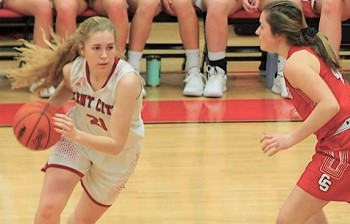 The Eagles’ motion offense normally features four players spotted up at different points along the 3-point arc, with players taking turns driving and kicking it back out to one of those players, who are always ready to shoot. KC shoots 32 percent from 3-point range and averages 11 treys per game.
The “big three” for KC all season long has been Weber and sophomore standouts Jenna Harrison and Kenzie Bowers – who have all made more than 50 3-pointers this season. The other starters for the Eagles are sophomore Audrey Dreyer and senior Lauren Freeland, an all-state track and cross country standout who will run at Michigan State next year.
“Shooters got to shoot,” explained Harrison, who led all scorers on Wednesday with 13 points, including two 3-pointers. “We know that we have to shoot if we are open; that’s the way our offense works. If the defense comes out on us, then we have to drive.”
The Eagles know their games will keep getting tougher, starting with Friday’s District championship game against Western Michigan Christian. If the Eagles prevail, it could set up a blockbuster Regional Semifinal matchup at home Monday against top-ranked Pewamo-Westphalia.
“That’s the game everyone in town is talking about, but we’re just taking them one at a time,” Harrison said.
The Eagles’ outstanding season has been a pleasant diversion for Carlson, who has experienced more family tragedies resulting from car crashes than any one man should ever have to endure.
In 1989, his younger brother Todd was paralyzed in a car accident. One year later, his younger sister Shannon was paralyzed and suffered a closed head injury in a car accident. In 2009, his mother, Jane, died in another car accident (Todd lost his right leg in the same accident).
Then last August, Todd – who served as an assistant coach for the Eagles and helped run Kent City’s youth basketball program for 15 years – died in yet another crash at the age of 49.
“It’s been tough because he was such a big part of this team,” said Carlson. “I’ve learned you just have to keep going forward. Basketball is something we have always had to focus on and work on.”
 Tom Kendra worked 23 years at The Muskegon Chronicle, including five as assistant sports editor and the final six as sports editor through 2011. E-mail him at [email protected] with story ideas for Muskegon, Oceana, Mason, Lake, Oceola, Mecosta and Newaygo counties.
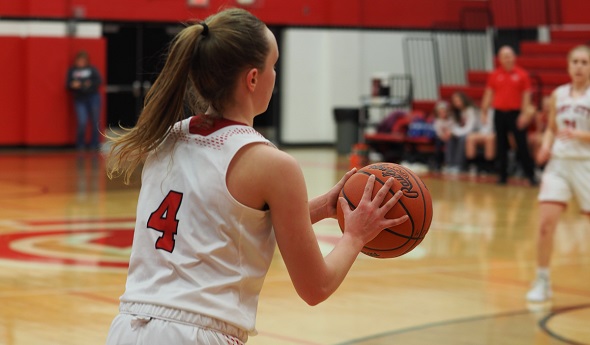
PHOTOS: (Top) Kent City’s Jenna Harrison lines up to shoot a 3-pointer against Cedar Springs during a Feb. 19 win. (Middle) Mikayla Loew (21) looks for an opening around the perimeter. (Photos courtesy of the Kent City athletic department/Sue Harrison.)
Breslin Bound: Girls Report Week 1
December 3, 2012
By Geoff Kimmerly
Second Half editor
More than 700 girls basketball teams hope to be playing at Michigan State University's Breslin Center when this season ends.
That may be fourth months away. But those quests began last week.
Each Monday, Second Half will tell you about 10 teams and individuals who jumped out the week before. What's below isn't any sort of statewide ranking – merely a top-10 list of notables for fans no matter where they live and who they will cheer on this winter.
I fully admit I won't be able to catch every team that does something special. That's where you come in. Post below and let us know which teams did what, or who we should watch coming up.
1. Brownstown-Woodhaven (1-0) – Much is expected this season out of the Warriors, who finished 22-2 last season. And Detroit Country Day is replacing an all-state backcourt that graduated a year ago. But a win over Country Day is still a win over Country Day, and Brownstown-Woodhaven got one Saturday, 54-52.
2. Goodrich (1-0) – The reigning Class B champion beat the reigning Class C runner-up, Grosse Pointe Woods University Liggett, 51-42. Goodrich still has a number of key pieces from last season’s run, while University Liggett has a few too, but is replacing Miss Basketball Madison Ristovski.
3. AuGres-Sims (2-0) – Welcome to high school basketball, Cassidy Boensch. AuGres’ 6-foot-2 freshman had 29 points, 17 rebounds, 16 blocks and 13 steals in her team’s 55-16 win over Whittemore-Prescott, and then 28 points, 12 rebounds and 10 blocks in a 51-42 win over Fairview. Click to read more from the Bay City Times.
4. East Lansing (1-0) – The Trojans and Lansing Waverly regularly have been the Lansing area’s best over the last decade and regularly face each other on the first Friday. This time the Trojans won big, 72-44.
5. West Bloomfield (1-0) – West Bloomfield got off to a good start with a 52-44 win over a team that has finished the last three seasons with victories. Waterford Our Lady has won the last three Class D championships.
6. Hartland (2-0) – The Eagles returned to the court after their 21-win season and second straight District title with a pair of close victories. Hartland beat Holly 36-31 and then Fenton 49-48.
7. Saginaw Michigan Lutheran Seminary (2-0) – The Cardinals showed perhaps some of the poise they learned during last season’s run to the Class D Quarterfinals. They won two close ones over Class B teams, 49-47 over Standish Sterling and 33-31 over Hemlock.
8. Oxford (2-0) – The Wildcats won 10 games last season, and are 20 percent of the way to equaling that total thanks to a pair of close wins. Oxford edged Rochester 35-34 on opening night, then Farmington Hills Harrison 30-27.
9. Leroy Pine River (1-1) – The Bucks rebounded from an opening-night loss to Reed City to double up the reigning Class C champion, Morley-Stanwood, 57-25.
10. Shepherd (2-0) – The Bluejays opened with wins against both teams that call Mount Pleasant home. They beat Class D Sacred Heart 46-37 and Class A Mount Pleasant High 36-23.
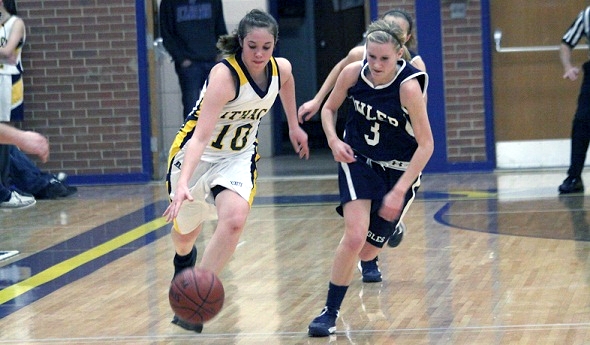
PHOTO: Fowler defeated Ithaca 51-37 on Tuesday. The Eagles are among teams that have begun 2-0 this season. (Click to see more at HighSchoolSportsScene.com.)