

Keyser's Final Mission: Lead Bucs Into Title Mix
January 9, 2019
By Tom Kendra
Special for Second Half
Alli Keyser wore a big smile coming out of the locker room Tuesday night, as if she just had completed a career night.
 In reality, the Grand Haven senior point guard was coming off one of her worst statistical nights in memory, scoring seven points (on 3-of-16 shooting) with six assists and four steals.
But the smile was a direct result of the Buccaneers’ 44-30 win over neighboring and Ottawa-Kent Conference Red rival Holland West Ottawa, which upped their record to a perfect 7-0 on the season.
“At this point in my career, I am just happy when we win,” explained the 5-7 Keyser, who started all 22 games for Haven as a freshman and has been the team’s starting point guard since. “I was off tonight, but other people stepped up and made up for it, which is great. We are going to need all of us to play well if we want to make a run.”
Keyser’s individual legacy at Grand Haven is already well-established.
Keyser, who committed to play basketball at Northwood University the summer before her junior year, broke her high school’s all-time steals record last month, besting the total achieved by 2003 graduate Julie Henderson. Keyser is also on pace to break Henderson’s all-time assists record.
As for scoring, Keyser recently moved past Abby Cole into fifth all-time in school history. If Keyser averages about 11 points per game the rest of the season, she will pass a “who’s who” of former Buccaneers greats – specifically Alex Law, Maggie Dwyer, Allison Miller and Emma Veach – and leave as the school’s all-time leading scorer as well.
“The ironic thing is that Ally is going to leave here with all of these individual records, but she is the definition of a true team player,” said 21st-year Grand Haven coach Katie Kowalczyk-Fulmer. “She is the consummate point guard, always looking to set up her teammates and help them get better. She is an incredibly talented player, but she’s a better leader.”
Keyser has two specific goals for her senior year: win an O-K Red title and then make a long tournament run.
Grand Haven won back-to-back Class A championships in 2012 and 2013, but since then the Bucs have not been able to advance out of Districts – running into roadblocks of Muskegon Mona Shores (led by 2017 Miss Basketball Jordan Walker) and more recently Muskegon High.
This could be the year the Bucs break through, but it won’t be easy with two of the most athletic teams in the state standing in their way.
In the conference, Haven has finished second behind East Kentwood the past two years. The Falcons are loaded once again led by backcourt stars Mauriya Barnes and Alexis McCully.
In Districts, the Bucs lost by one point to Muskegon last year, and the Big Reds appear to be even better this winter with senior point guard and Michigan State commit Alyza Winston. As fate would have it, Grand Haven will play Muskegon on the opening night of the Class A District at Muskegon Reeths-Puffer.
 “We have a chance with this group to do some special things,” said Kowalczyk-Fulmer, who is assisted by Katie Erickson and Norm Greene. “The problem is we have to beat some great teams to achieve our goals. Right now, we really have to get a lot better in order to do that. Fortunately, the season is a marathon and not a sprint.”
All three of those teams – Grand Haven, East Kentwood and Muskegon – are likely to be ranked in the top five when the first state Associated Press girls basketball rankings are released next week.
As has been the case for the past four years, the Bucs’ offense is keyed by Keyser.
Keyser, who also happens to be the leader and playmaker for Grand Haven’s soccer team, possesses the speed, ball-handling ability and poise to get the ball up the court against pressure from the likes of East Kentwood and Muskegon.
From there, the Buccaneers can hurt teams with their size inside. Seniors Esther Byington (6-3) and Kelly Olthof (6-1), who both missed most of their junior seasons with injuries, are back and healthy and are a formidable 1-2 punch on the interior. Both will play basketball next year at the Division II college level, Byington at Northern Michigan and Olthof at Lake Superior State.
Haven’s imposing post presence opens up plenty of 3-point shooting opportunities for junior Jolee Houle and senior Anna Strom.
Houle was on fire Tuesday night, burying five 3-pointers en route to a game-high 21 points. Olthof had a strong game inside with 10 points on 5-of-8 shooting, with a team-high nine rebounds.
“That’s my main job as a point guard, is to get everyone involved and then get it to the hot hand,” explained Keyser, who has been first-team all-conference the past three years and honorable mention all-state last winter. “It really doesn’t matter who it is. We’ve had games where most of our scoring came from the inside, and other games where it’s been outside shooting. We just have to be able to do both, and then we’re tough to stop.”
It’s when Grand Haven gets stagnant or starts struggling that Keyser takes over.
She has been remarkably consistent throughout her four-year varsity career, averaging 15.2 points per game her freshman season and 16.1 points this winter, along with 5.1 steals and five assists per game.
While Keyser’s speed, court vision and shooting touch always have been there, the biggest change in her game over the past four years is from a leadership perspective.
“I have become much more vocal,” said Keyser, who plans to major in business management at Northwood. “I was quiet as a freshman and sophomore and didn’t want to overstep my bounds. Now I’m more comfortable speaking up.”
 Tom Kendra worked 23 years at The Muskegon Chronicle, including five as assistant sports editor and the final six as sports editor through 2011. E-mail him at [email protected] with story ideas for Muskegon, Oceana, Mason, Lake, Oceola, Mecosta and Newaygo counties.
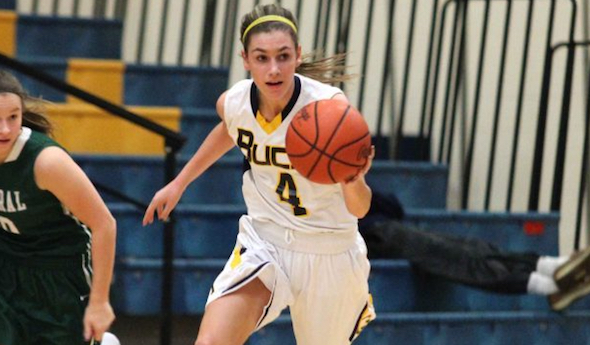
PHOTO: (Top) Grand Haven’s Alli Keyser pushes the ball upcourt, a frequent occurrence during her four seasons as a starter. (Middle) Keyser makes a strong move to the basket. (Photos by Tim Reilly.)
Breslin Bound: 2021-22 Girls Report Week 1
By
Geoff Kimmerly
MHSAA.com senior editor
December 6, 2021
Winter has moved in across Michigan, and this time we’re on time with the start of girls basketball season.
 Last season’s delayed start isn’t too distant of a memory yet, but a number of teams tipping off last week are putting disappointing finishes behind them, and we’ve features some of those below.
Every Monday with “Breslin Bound” we’ll take glances at five scores that especially jumped out from the previous week, provide snapshots of two teams in each division to watch as the winter progresses, and then give a glimpse of five intriguing matchups on the schedule during the week to come.
“Breslin Bound” is powered by MI Student Aid and based on results and schedules posted for each school at MHSAA.com. Send corrections or missing scores to [email protected].
Week in Review
The countdown of last week’s five most intriguing results:
1. Plymouth Christian Academy 65, Detroit Country Day 49 The Eagles wasted no time making a statement with this win over a returning Division 2 semifinalist; Country Day had won last season’s matchup 57-43.
2. Parma Western 43, Grass Lake 30 The Panthers put an exclamation mark on a 2-0 opening week with this win over the reigning Division 3 champion.
3.Essexville Garber 50, Saginaw Nouvel 49 The Dukes began rebounding from last season’s 4-11 finish immediately last week, edging a Nouvel team that went 17-2 last winter and came within a bucket of the Division 4 Semifinals.
4. Bloomfield Hills Marian 54, Clarkston 48 This rematch of a Regional Final again went Marian’s way, but a little closer than the 63-50 Mustangs win in March.
5. Saginaw Arthur Hill 43, Flint Hamady 29 The Lumberjacks won one game last season, and lost to Division 3 perennial power Hamady by 16 in an early-March matchup.
Watch List
With an eye toward March, here are two teams in each division making sparks:
Division 1
Grandville (3-0) After just a week, the Bulldogs are one win from equaling their win totals of each of the last three seasons – which all finished with four victories. Grandville opened with a 49-33 win over Middleville Thornapple Kellogg, then defeated Petoskey 40-37 and Marquette 42-37 to win the Northmen’s tournament.
Portage Northern (2-0) The Huskies opened with a championship at the Kalamazoo Loy Norrix Tournament, defeating Lansing Everett 43-14 and then the host Knights 49-34. Northern won only one game last season, also against Loy Norrix, and with two more wins will guarantee their best finish since 2016-17.
Division 2
Ovid-Elsie (2-0) The Marauders won 15 games two seasons ago and finished 12-5 during last winter’s shortened campaign. They lost the first game both of those seasons – but not this time, as they’re instead building off a pair of opening victories over Ionia (54-52) and Bath (50-29).
Sparta (2-0) The Spartans finished 12-4 last season and had won 10 straight before ending their season with a District Final loss to Newaygo, the eventual Division 2 runner-up. Sparta picked right back up last week with a 41-23 win over Muskegon Oakridge and 44-35 victory over Greenville.
Division 3
Harbor Springs (2-0) The Rams are coming off a 2-14 finish that included 11 straight defeats to begin last season. But Harbor Springs opened last week with a 52-38 win over Johannesburg-Lewiston and followed with a 60-45 victory over Indian River Inland Lakes. Those opponents went a combined 18-9 last winter.
Montrose (2-0) After winning two games a season ago, and six in 2019-20, the Rams won both of their games during the first week – in some dramatic fashion. Montrose edged Burton Bendle 43-42 on Monday and came back with a 44-42 win over Genesee the following evening. Genesee is coming off its second-straight winning season.
Division 4
Cedarville (2-0) The Islanders – 10-3 last winter – are off to a fast start with wins last week over two teams also coming off winning seasons. They opened with a 57-37 victory over Hillman, which was 10-7 last winter, and then emerged 50-47 over Frankfort, which was 13-5 and reached the Regional Finals a season ago.
Plymouth Christian Academy (2-0) As noted above, the Eagles – 10-4 last season – opened with the win over Detroit Country Day. They then defeated Schoolcraft at the Kalamazoo Central Icebreaker; Schoolcraft went 14-3 and made the Division 3 Quarterfinals last winter.
Can't-Miss Contests
Be on the lookout for results of these games coming up:
Tuesday – Midland Dow (2-0) at Hudsonville (1-0) – This is a rematch of a Division 1 Semifinal from last season; Hudsonville won 49-37 and went on to claim the championship.
Tuesday – Sault Ste. Marie (1-0) at Marquette (2-1) – Sault Ste. Marie went 14-2 last season and the Redettes finished almost the opposite, but they did hand the Blue Devils their only regular-season defeat.
Wednesday – Lansing Catholic (1-0) at Detroit Cass Tech (0-0) – These are two more teams looking to build on double-digit wins last season.
Saturday – Ypsilanti Arbor Prep (0-0) vs. Wayne Memorial (0-0) at Belleville – This Best of Michigan Classic matchup features teams that went a combined 31-6 last season.
Saturday – Buchanan (2-0) vs. Grosse Pointe South (0-1) at Belleville – Another Best of Michigan game matches Buchanan – 13-1 last season – against a South team that lost its opener last week but also won 13 games last winter.
Second Half’s weekly “Breslin Bound” previews and reviews are powered by MI Student Aid, a part of the Office of Postsecondary Financial Planning located within the Michigan Department of Treasury. MI Student Aid encourages students to pursue postsecondary education by providing access to student financial resources and information. MI Student Aid administers the state’s 529 college savings programs (MET/MESP), as well as scholarship and grant programs that help make college Accessible, Affordable and Attainable for you. Connect with MI Student Aid at www.michigan.gov/mistudentaid and find more information on Facebook and Twitter @mistudentaid.
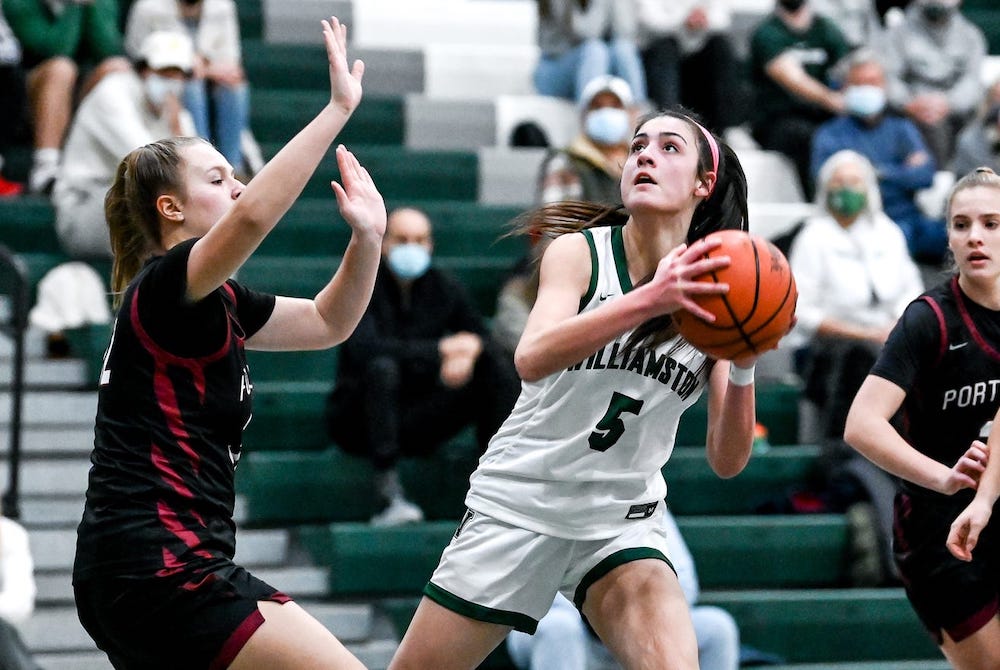
PHOTO Williamston’s Reese Gaytan works to get a shot up with Portland’s Alexa Weber defending Friday. (Photo courtesy of the Lansing State Journal.)