

Lenawee Christian Earns Saturday Return
March 21, 2019
By Geoff Kimmerly
Second Half editor
GRAND RAPIDS – When Division 1 Ann Arbor Pioneer made a last-second 3-pointer to force Adrian Lenawee Christian to overtime a little more than a month ago – and the Cougars still prevailed – junior Elizabeth Miller knew her team was on the way to another special finish this winter.
Only a season removed from the team’s first MHSAA girls basketball championship, there no doubt were recognizable signs.
“We really just played with heart in overtime and ended up winning, and that was a really big win for us,” Miller said. “That kinda motivated us to work really hard the rest of the season. I think that’s what pushed us to get here today.”
After winning Class D led by an all-state freshman and without a senior in the starting lineup, it may have seemed inevitable Lenawee Christian would return to Calvin College and the final day of this season.
The Cougars took the last step Thursday with a 57-36 Division 4 Semifinal win over Fowler, setting up Saturday’s 10 a.m. championship matchup with undefeated St. Ignace.
By looks of their scores this playoff run, Lenawee Christian (25-2) barely has been challenged – Thursday’s win was the sixth straight by at least 15 points since opening the tournament with an eight-point victory over Pittsford.
But it’s hardly been that easy, as the Cougars again prepped for this postseason with a slate of games against larger opponents, losing only to Division 3 top-10 teams Grass Lake and Michigan Center.
“We know we have to work hard. We know what it takes … just do it as a team to get here,” Lenawee Christian junior Dani Salenbien said. “We know what it takes, and we know it’s not going to be easy.”
Thursday’s start certainly helped.
A year ago, the Cougars needed overtime to get past Mount Pleasant Sacred Heart by two points in their Semifinal. This time, Lenawee Christian built a double-digit lead in just under five minutes, and kept it in double digits for good beginning with a Miller 3-pointer nine seconds into the second quarter.
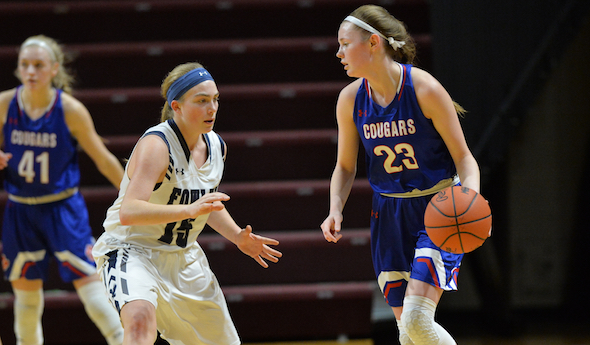
 Salenbien, an all-state second-teamer a year ago, led with 25 points and eight rebounds. Her sophomore sister Bree – the Class D Player of the Year by The Associated Press last season – added 17 points, nine rebounds and four assists. Both made at least half their shots from the floor, and Dani missed making the MHSAA record book by two free throws, connecting on 13 of 16 attempts from the line.
“I just think the target on our back has been extremely big, and the expectations have been really high,” Cougars coach (and Bree and Dani’s father) Jamie Salenbien said. “But a credit to these kids for being as young as they are, being able to handle that night in, day in and out. It’s been amazing to see. Their faith and the support from the community has been amazing, and they’ve been able to handle that.”
Expectations were not as high this season for Fowler – but the Eagles put an impressive finishing touch on an inspiring comeback story with their first Semifinal appearance since 1999.
They play in the Central Michigan Athletic Conference – home of Division 3 top-ranked Pewamo-Westphalia and six-time Class D champ Portland St. Patrick among a host of contenders – and two years ago were down to just a varsity team.
Fowler’s lone team went 5-16 in 2016-17, improved to 10-12 a year ago and put together a solid run over the last three weeks to finish this season 17-8.
“When Coach (Nathan Goerge) broke the news that we were only going to have one team my sophomore year, it was kinda hard for me to take,” Eagles senior forward Alyssa Vandegriff said. “But ultimately I think it was a good decision because it helped everyone who was on that one team come together, and we got to know each other. The people who were on that team with us are on our team today. If we weren’t on the same team together my sophomore year, I don’t think we’d be as close as we were or play as well together.”
Junior guard Kalani Koenigsknecht and freshman guard Mia Riley both scored a team-high 10 points for Fowler. Sophomore Sarah Veale had eight points, five rebounds and three assists.
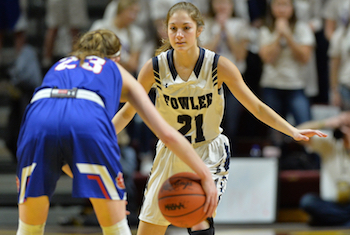
PHOTOS: (Top) Lenawee Christian’s Dani Salenbien directs the offense while Fowler’s Kalani Koenigsknecht defends. (Middle) The Eagles’ Josie Koenigsknecht defends against Salenbien.
Countdown to Calvin: Girls Report Week 8
January 22, 2018
By Geoff Kimmerly
Second Half editor
This week’s “Countdown to Calvin” came with some tougher choices than usual.
 Our “Week in Review” of the top five meaningful games could’ve been 10, at least. Our “Watch List” is growing in every class – and we had enough jump out this week especially in Class A that finding more to highlight the rest of the way won’t be difficult.
Countdown to Calvin is powered by MI Student Aid and based on results and schedules posted for each school at MHSAA.com. To offer corrections or help us fill in missing scores, email me at [email protected].
Week in Review
The countdown of last week’s five most intriguing results:
1. Kingsley 61, Maple City Glen Lake 45 – The Stags made a big statement in the Northwest Conference, remaining undefeated overall while handing Glen Lake its first defeat of 2017-18.
2. Detroit Mumford 44, Ypsilanti Arbor Prep 35 – A string of three losses at the end of December is becoming a memory for Mumford with big wins like this one over last year’s Class B runner-up, now arguably the favorite in Class C.
3. Grand Rapids South Christian 57, East Grand Rapids 40 – The Sailors stand alone atop the Ottawa-Kent Conference Gold standings after handing the Pioneers their first league loss and second defeat overall.
4. Gaylord St. Mary 41, Bellaire 39 – St. Mary moved a game up in the Ski Valley Conference standings and should in statewide Class D regard after this meeting of teams that are a combined 19-3.
5. Monroe St. Mary Catholic Central 52, New Boston Huron 47 (OT) – The Kestrels moved into first place alone in the Huron League with just one loss overall after handing Huron its first this season.
Watch List
With an eye toward March, here are two teams in each class making sparks:
CLASS A
East Kentwood (12-0) – The Falcons arguably have been the most impressive team in the state. After finishing Class A runner-up last season, East Kentwood opened this one with eight wins by at least 16 points. The Falcons then won closer over O-K Red rivals Grand Haven (8-3) and Caledonia (8-2), but upped the margin again beating second-place Hudsonville (9-3) by 31 on Friday.
St. Clair Shores Lakeview (12-0) – Last season’s 21-2 run ended abruptly in a District Final loss, but that’s proving to be just a bump as the Huskies are cruising again. Fraser has come closest to catching them, falling by only 11 on Dec. 12 – and Lakeview won the rematch Friday by 29. The Huskies also own a 20-point win over New Baltimore Anchor Bay, the next-best team in the Macomb Area Conference Blue.
CLASS B
Armada (9-1) – The Tigers won 13 games a year ago and finished second in the Blue Water Area Conference to Croswell-Lexington. Armada now sits in first in the league thanks to a 44-42 win over the Pioneers on Friday, with two more league wins by four points or fewer. The only loss came last week as well, by two to Marlette.
Stanton Central Montcalm (13-0) – The Hornets’ 17 wins last season represented an increase for the fourth straight winter, and they’re making an even bigger splash. Not only is Central Montcalm undefeated in a Central State Activities Association Gold that also includes Big Rapids (11-1) and Reed City (9-2), but the Hornets have 10 wins by double digits and another nice victory over Class A Greenville (7-3).
CLASS C
Allen Park Cabrini (8-2) – The Monarchs opened 0-2 but haven’t lost since Dec. 5, their latest win a one-pointer over Madison Heights Bishop Foley. That was one of only two single-digit wins during the run – Riverview Gabriel Richard got within five earlier this month. Big games against Wixom St. Catherine and Royal Oak Shrine over the next two weeks will be telling.
Harbor Springs (7-4) – Harbor Springs finds itself with some intriguing opportunities in the Lake Michigan Conference after upsetting Kalkaska 47-42 on Friday despite falling to the reigning league co-champion big twice last winter. The Rams this week get first place Traverse City St. Francis and second-place Charlevoix, with more visions of vengeance no doubt.
CLASS D
Chassell (10-1) – Since falling to L’Anse by four points in its opener, Chassell is undefeated and nearly unchallenged with only one other single-digit game – against Baraga on Dec. 12. The Panthers are first and Baraga is second in the Copper Country division of the Copper Mountain Conference after Chassell finished third a year ago.
Harbor Springs Harbor Light Christian (11-0) – The Swordsmen are building off Northern Lakes Conference and District titles last season, and excelling. They won an overtime game early over Harbor Springs (see above), but aside from a close win right after over Alanson have dominated. Harbor Light also has a 25-point win over NLC second-place Mackinaw City with their second meeting coming up next week.
Can't-Miss Contests
Be on the lookout for results of these games coming up:
Tuesday – Detroit Country Day (8-1) at Detroit Edison Public School Academy (9-1) – The reigning Class B and Class C champions, respectively, remain among heavy favorites in those brackets.
Tuesday – Bloomfield Hills Marian (9-1) at Farmington Hills Mercy (11-1) – This rivalry means as much as ever, as Marian won the first meeting 53-46 and the winner of this one could end up Detroit Catholic League Central champion.
Tuesday – Cedarville (11-1) at St. Ignace (10-0) – These are among the best small-school teams in the Upper Peninsula, with a 61-29 Saints win Dec. 6 the difference between which is undefeated.
Tuesday – Tecumseh (7-3) at Chelsea (10-1) – Both are undefeated in Southeastern Conference White play, Chelsea ahead in the standings with one more league win.
Friday – Macomb Dakota (9-2) at Warren Cousino (8-4) – After a 3-3 start, Cousino is surging in Macomb Area Conference Red play and can move into a tie for first place with Dakota if it can avenge a nine-point loss to the Cougars from Jan. 9.
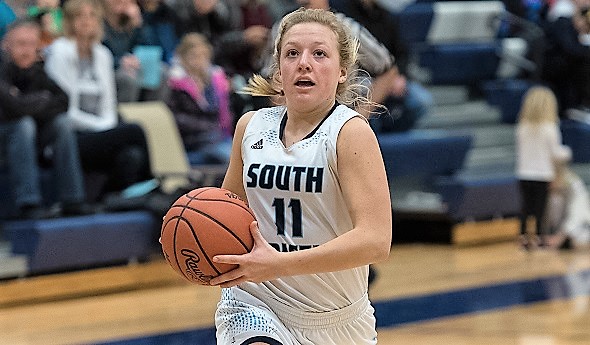
PHOTOS: Grand Rapids South Christian, here against Ada Forest Hills Eastern, has surged into the top spot in the O-K Gold. (Photo courtesy of the Grand Rapids South Christian athletic department.)