

Long Wait Ends as Fowler Returns to Finals
By
Steve Vedder
Special for MHSAA.com
April 7, 2021
GRAND RAPIDS – It took a couple years, but the wait was worth it for Fowler's girls basketball team.
The Eagles finally closed the book on a disappointing Quarterfinal loss two years ago to stun unbeaten Carney-Nadeau 61-37 in Wednesday's first Division 4 Semifinal at Van Andel Arena.
Fowler junior guard Mia Riley said her teammates had not forgotten a 57-36 Quarterfinal loss to Adrian Lenawee Christian in 2019, a loss which capped a 17-win season. The players used that memory to pound their way into their first Girls Basketball Final since finishing Class D runner-up in 1999.
"We've been waiting, just itching to get back," Riley said. "It was always in the back of our minds, and now it's just a great feeling."
The win snapped a 22-game winning streak for Carney-Nadeau, which had won its previous five tournament games by an average of 19 points per contest. No team had come as close as eight points to beating the Wolves this season.
But Fowler (15-4) never trailed after a layup by Avery Koenigsknecht snapped a 10-10 tie with 1:21 left in the first quarter. Fowler upped the lead to 33-17 at the half and 49-28 at the end of three quarters.
The win sent Fowler (15-4) into Friday's 10 a.m. Final against Bellaire at the Breslin Center.
Eagles coach Nathan Goerge said there was little to complain about after his team forced a whopping 31 turnovers, including 16 in the first half. That defense, which featured five players with at least three steals, was largely responsible for Carney-Nadeau attempting 28 fewer field goals (59-31).
"The execution was absolutely awesome. We had some breakdowns, but none that really hurt us," Goerge said. "We're a tough team to beat when we spread the floor and make shots. We always tell the girls when you have a shot, it's going up. We have a lot of good shooters on this team."
Fowler overcame missing its first nine 3-pointers to land three players in double figures while shooting 37 percent (22 of 59) from the floor.
Sisters Emma and Mia Riley head the list of good shooters. Mia, a junior guard, finished with 23 points, nine rebounds, four assists and four steals. Emma, a sophomore guard, added 18 points and eight steals. Emma Halfmann had 11 points.
Carney-Nadeau was led by Tessa Wagner's 21 points and eight rebounds. Taylor Kedsch added 10 points.
"We've handled the press well, but this was something new for us," Kedsch said.
Wolves coach Ken Lindor said the turnovers made it difficult for the team to sustain much consistency on offense.
"We just really struggled with their pressure," Lindor said. "They pushed us out on offense. We were okay shooting the ball (48 percent), but we had too many unforced turnovers that we don't normally make. We just couldn't get in a flow. They had good ball pressure and took away the passing lanes. We didn't move as well as we usually do; there was a lot of standing around.
"We haven't been this far in 20 years, and one of our goals was to get here,” he added. “We met that goal, and that was pretty special."
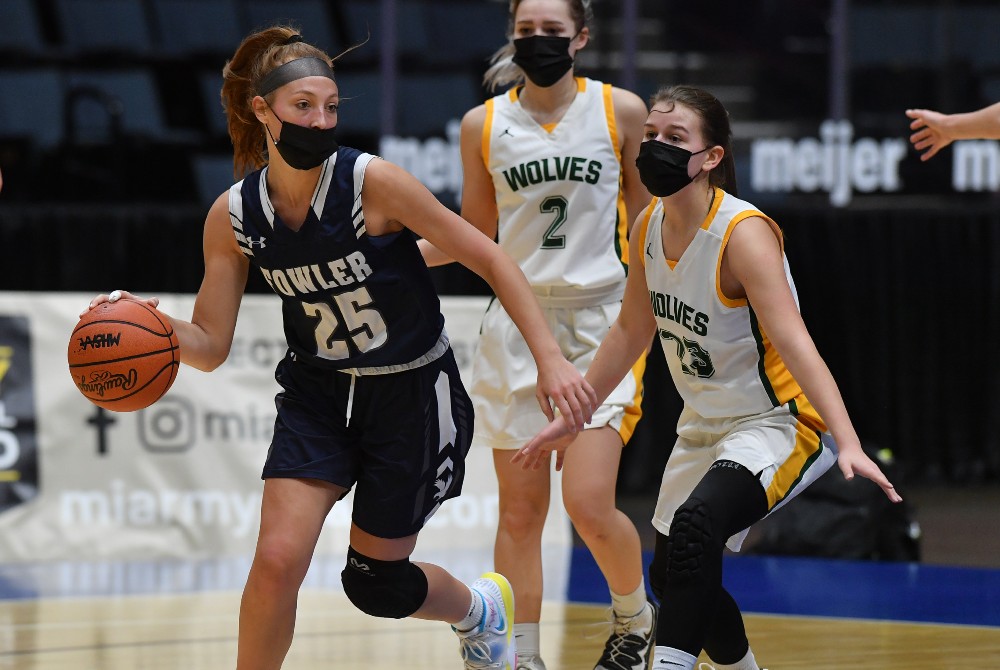
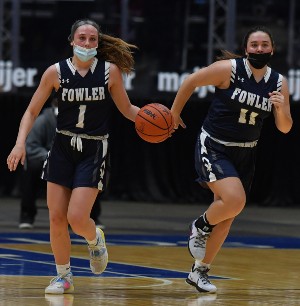
PHOTOS: (Top) Fowler's Mia Riley looks for an opening with Carney-Nadeau's Shae Linder defending. (Middle) Emma Riley brings the ball upcourt with teammate Emma Halfmann at her side . (Click for more from Hockey Weekly Action Photos.)
Breslin Bound: Girls Report Week 3
December 17, 2012
By Geoff Kimmerly
Second Half editor
As a general rule, basketball teams evolve plenty between the first games of December through the final regular-season contests in February.
But these pre-break matchups matter just as much in the win-loss columns. And a number of games are being played right now that will surely make a difference as this season draws to a close.
This week's report includes some of the teams that have came out on the winning ends of key December battles. (Results and records based on those reported to Score Center at MHSAA.com)
1. Inkster (4-0) – The Vikings are a regular at Breslin Center and made the Class A Semifinals last season, so another great start is hardly surprising. But it's proof why Inkster remains a force – last week’s wins were 51-45 over improved Detroit Mumford and 57-51 over always-powerful Detroit Pershing.
2. Waterford Our Lady (3-1) – The reigning Class D champion has bounced back quickly from an opening-night loss to West Bloomfield. Last week, Our Lady beat Livonia Ladywood 50-38 and Mount Pleasant Sacred Heart by the same score.
3. Detroit Martin Luther King (3-0) – This is another team always in the Class A mix, and it got a big win Saturday – 56-48 over returning Class A Semifinalist Ann Arbor Huron, which earlier in the week had defeated Detroit Country Day 65-58. King also beat Detroit East English 61-7.
4. Johannesburg-Lewiston (5-0) – The Cardinals lost only two regular-season games last season, both times to Ski Valley Conference rival Gaylord St. Mary. But they got a little bit of revenge last week with a 50-48 win over St. Mary after also beating East Jordan 57-43.
5. Holt (5-0) – The Rams are again setting up nicely to contend in the strong Capital Area Activities Conference Blue. They beat nonleague foe St. Johns 52-48 and then Lansing Everett 48-39 to keep early pace with other frontrunners Grand Ledge and East Lansing.
6. Napoleon (5-1) – Napoleon’s 15-7 finish in 2011-12 included splits against Michigan Center and Grass Lake. The Pirates got an early upper hand on both last week, beating Michigan Center 49-45 and Grass Lake 47-42.
7. Traverse City St. Francis (4-1) – The Gladiators opened last season 14-1, with that lone loss to Cadillac – which they beat last week 55-50. St. Francis also defeated Kalkaska 44-36 on Friday.
8. Pewamo-Westphalia (3-2) – The Pirates got off to a rough start with opening-week losses to Class B Williamston and Lakewood. But back in familiar territory in the Central Michigan Athletic Conference, they've won three straight – including 51-42 last week over returning Class D Semifinalist Portland St. Patrick.
9. North Farmington (3-1) – The Raiders are coming off a 10-12 season that included a pair of losses to Pontiac. But North Farmington earned the early edge this time with a 59-58 win over Pontiac, followed by a 58-48 win over West Bloomfield.
10. Powers North Central (5-1) – After opening with a 13-point loss to returning Class D Semifinalist Crystal Falls Forest Park, North Central hasn't fallen again. The Jets beat Stephenson 62-51 and Munising 50-22 to get nearly halfway to last season’s win total of 11.
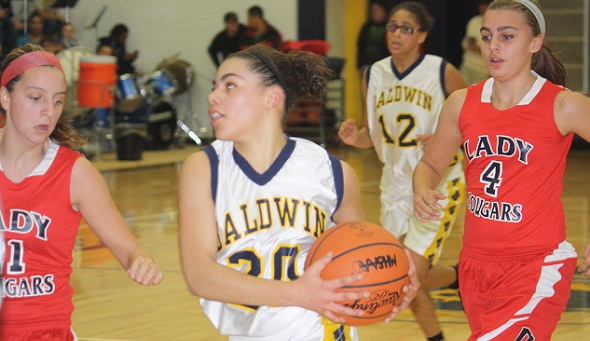
PHOTO: Big Rapids Crossroads (in red) defeated Baldwin on Thursday to move to 4-0 this season. (Click to see more at HighSchoolSportsScene.com.)