

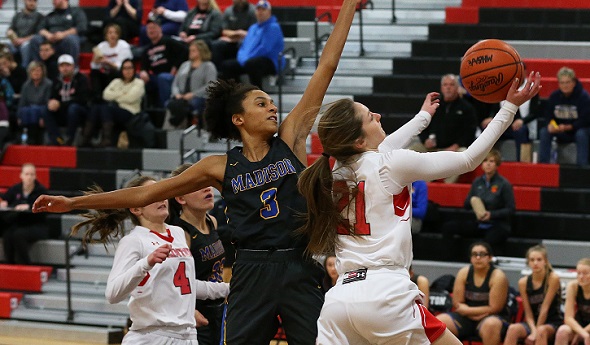
Madison 3-Sporter Wall Soars in Every Season
January 25, 2019
By Doug Donnelly
Special for Second Half
ADRIAN – How good of a senior year is Kaiya Wall having?
 In the fall, Wall again earned all-state honors after leading Adrian Madison to 47 victories, conference and District championships, and she signed a letter of intent to play Division I volleyball after high school.
This winter, her Madison basketball team is 8-0, ranked among the state’s 10 best Division 3 teams by The Associated Press and sitting atop the Tri-County Conference.
What’s more amazing is her best might still be yet to come. Wall figures to be an anchor on a Madison girls track squad that has won 87 consecutive Tri-County Conference dual meets and could be an MHSAA title contender this spring.
“I don’t know if she has a ‘best’ sport,” said Madison track coach Josh Powers. “She is pretty darn good at all three she is playing.”
Wall is one of those rare athletes who can jump from sport to sport without skipping a beat. In the summer, she would split time between summer basketball and travel volleyball.
She is the third-leading scorer on Madison’s undefeated basketball team heading into tonight’s TCC clash with Ottawa Lake Whiteford. She also is one of top defenders on a suffocating Trojans defense giving up just 24.3 points per game. Three of Madison’s last four opponents have been held to 20 or fewer points.
Wall missed basketball season last year due to an injury, but her return this year has solidified the Trojans on the court.
“Kaiya has made a tremendous impact on our team this season,” Madison basketball coach Rick McNeil said. “She is very quick and has become an outstanding defender.”
Wall also has improved on the offensive end. McNeil said that has been the biggest difference for her.
“She has developed her ball handling skills, and we are able to move her to the guard position where she is a match-up problem for many teams because of her height and speed,” McNeil said. “She is an excellent passer and has the ability to hit the perimeter shot.”
Playing volleyball in college was far from a slam dunk decision. She also was recruited for track.
“I struggled deciding between track and volleyball,” Wall said. “I’ve gone on visits for both. I knew I wanted to play something in college. When I fell in love with that campus, I just decided I wanted to play volleyball.”
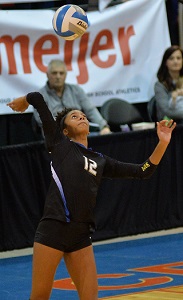 Wall was the Lenawee County volleyball player of the year as a junior and has earned second-team all-state honors three years running. She finished her career just shy of 2,000 kills and signed to play collegiately at Jackson State University in Jackson, Mississippi.
During her career she played in 545 sets, compiling 1,986 kills, 933 digs and 280 blocks – strong numbers for a girl who didn’t play competitive volleyball until seventh grade and only after friends talked her into it.
“I was terrible,” she said. “I was this tall, skinny girl, and they were like, ‘OK, you can play.’”
Her friends made a smart choice. Wall blossomed into a 5-foot-11 outside hitter.
“When I first met Kaiya, she was very raw with so much natural athleticism,” said Kathy Albers, now the head coach at Ypsilanti Lincoln who at one time coached Wall in travel volleyball. “She just needed to be taught and for someone to believe in her – but push her. After her first year of club with us, the talent was so apparent.
“She improved so much faster than most. Her height plus her jumping ability makes her tough at the net, and her quickness makes up for everything else.”
At Madison, Wall played for Dawn Opsal for her first three years and Kelsey Cortright this past season. Cortright stepped into the Madison job and saw first-hand Wall’s athleticism and leadership ability.
“Most importantly, she puts her team before herself,” Cortright said. “She is selfless and encouraging to all those around her, making her a role model for others both on and off the court. Outside of her abilities as a team leader, her athletic ability is remarkable.”
Jackson State coaches noticed that ability before ever seeing her in person. They found out about her by viewing a highlight video she had posted online. They reached out, and she went to Mississippi for a visit and fell in love with the campus and volleyball program.
Another criteria that helped her choose Jackson State was its academics. Wall has a 3.93 grade-point average and ranks 12th in her senior class at Madison.
“I plan on going into pre-med,” she said. “I want to be a trauma surgeon. They have a very good program.”
Had she not become enamored with the volleyball program, she might have been a track signee.
Wall won the Division 3 Finals 100-meter hurdles title as a freshman. As a sophomore she helped Madison win the team championship by finishing second in the high jump. Last year she was ninth in the high jump, second in the 100 hurdles and on the runner-up 1,600 relay team as the Trojans placed seventh as a team.
Powers, who will be inducted into the Michigan Interscholastic Track Coaches Association Hall of Fame next week in Lansing, said Wall is determined.
“She takes advice and works on it,” he said. “I am, and I think she is, expecting her best track season yet.”
 Doug Donnelly has served as a sports and news reporter and city editor over 25 years, writing for the Daily Chief-Union in Upper Sandusky, Ohio from 1992-1995, the Monroe Evening News from 1995-2012 and the Adrian Daily Telegram since 2013. He's also written a book on high school basketball in Monroe County and compiles record books for various schools in southeast Michigan. E-mail him at [email protected] with story ideas for Jackson, Washtenaw, Hillsdale, Lenawee and Monroe counties.
PHOTOS: (Top) Adrian Madison’s Kaiya Wall works to deflect a shot this season against Clinton. (Middle) Wall serves during a Division 3 Volleyball Semifinal in 2016.
Performance: Heritage's Shine Strickland-Gills
March 22, 2018
 Shine Strickland-Gills
Saginaw Heritage junior – Basketball
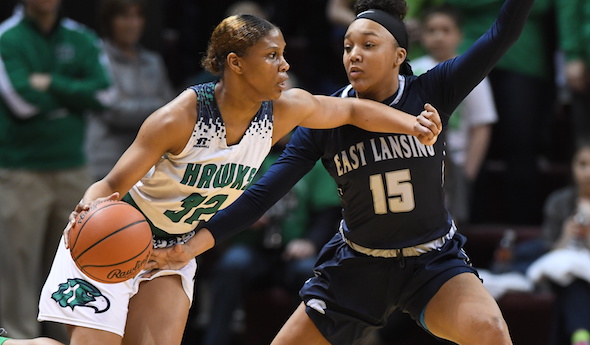
On back-to-back days, Heritage’s 6-foot-1 forward put together back-to-back standout performances at Van Noord Arena to lead the Hawks to their first MHSAA girls basketball title since 2002. She had 12 points, seven rebounds and four steals in a 46-28 Semifinal win over Grosse Pointe North, then 12 points, 12 rebounds and three blocks in Saturday’s 57-36 Class A championship victory over East Lansing to earn the Michigan Army National Guard “Performance of the Week.”
This season, Strickland-Gills averaged 12.5 points, 9.5 rebounds, 2.5 blocks, 2.2 assists and two steals per game as Heritage finished 27-1 – its only loss was in double overtime to eventual Class C champion Detroit Edison. She also started as a sophomore when the Hawks finished 20-2 and was a varsity sub when they were 22-2 in 2015-16.
 Strickland-Gills still has plenty of time to figure out her future, of course, but she'll choose from Division I college basketball opportunities and is interested in a career in the medical field, perhaps as a physician’s assistant. She’s also played volleyball and participated in track & field at Heritage, although she’s unsure if she’ll compete in either sport moving forward.
Coach Vonnie DeLong said: “Shine has developed into one of the best post players in the state. She has come so far since her freshman year, physically, mentally and emotionally. She has always been a very hard worker and spends hours in the gym. But this year there is a maturity about her that really took her to the next level. Her hard work was finally paying off and as she started seeing the results it just motivated her even more. She has developed a great understanding of the game. She has also become one of our vocal floor leaders, which allows her to ‘quarterback’ the back of our defense. I always tell my kids, ‘I can't give you confidence. The only way you gain more confidence is by putting the time in and transferring it to game situations. It comes down to preparation.' Shine has done that and is now a pretty confident basketball player. She has also become a great teammate. We don't win the state championship without her. … I'm excited to see what the next year holds for Shine. She seemed to get better every game this year, and after another offseason of workouts and AAU, I am sure she will be even better next year. I'm just happy I get the opportunity to coach her for another season. She is a very coachable, kind, fun-loving kid that I am really going to miss when she moves on.”
Performance Point: “What’s sticking out the most is how relentless we are and how focused we are because it’s extremely hard to play back-to-back like that, especially two really tough games,” Strickland-Gills said of her memories from the weekend. “That we came out and performed hard, and did the best we can, I was very proud of that. We knew that if we came to play Friday, we would have a sure chance of winning and to play on Saturday. And if Saturday we came to play, we could really do it. … There’s been a lot of congratulations. Every time I come down the hallway, every teacher I’ve had, and I got lots of teacher emails and stuff like that.”
Shining Moment: “When (Coach DeLong) took us out with two minutes to go, when everybody sat down, we were all just like, ‘We did it. Finally, we just really did it.’ And it really hit – we just won states. It was a very proud moment.”
 Expectations met: “In the past we’ve had really good groups. But this year was something special because we had a better mindset before we got into the tournament. Everybody bought in, and our practices were a lot, lot better. We even got better as a team during the tournament. … We never stopped getting better and we never stopped going hard, and I think that was a major difference that helped us.”
Pride in my roles: “My team is really good at scoring. That’s what they do. My team doesn’t always need somebody to score 20 points a game. We just need to play defense – you can’t win without stopping your opponent from scoring. My team (also) really needs me to rebound, so that’s what I focus on. I know if I do my job, I can really reap the benefits. … ‘Coming out, I need to score 10, 15 points,’ has never been a thought in my head. I just need to come to play and do what my coach tells me to do, and we’ll get it done. I take a lot more joy in my teammates scoring and seeing how happy they get, how happy the crowd gets, rather than just me.”
Making her name: “I was born in spring. At the beginning of April, it isn’t too warm, but it was super hot that day. (My mother) was like, ‘I don’t know what to name her.’ So my original name was going to be J. My dad wanted to name me Erma after his mom. So my mom said, ‘You know, it’s hot outside. So we’re just going to name her Shine.”
- Geoff Kimmerly, Second Half editor
Every week during the 2017-18 school year, Second Half and the Michigan Army National Guard will recognize a “Performance of the Week" from among the MHSAA's 750 member high schools.
The Michigan Army National Guard provides trained and ready forces in support of the National Military Strategy, and responds as needed to state, local, and regional emergencies to ensure peace, order, and public safety. The Guard adds value to our communities through continuous interaction. National Guard soldiers are part of the local community. Guardsmen typically train one weekend per month and two weeks in the summer. This training maintains readiness when needed, be it either to defend our nation's freedom or protect lives and property of Michigan citizens during a local natural disaster.
Previous 2017-18 honorees:
March 15: Skyler Cook-Weeks, Holland Christian swimming - Read
March 8: Dakota Greer, Howard City Tri-County wrestling - Read
March 1: Camree' Clegg, Wayne Memorial basketball - Read
February 23: Aliah Robertson, Sault Ste. Marie swimming - Read
February 16: Austin O'Hearon, Eaton Rapids wrestling - Read
February 9: Sophia Wiard, Muskegon Oakridge basketball - Read
February 2: Brenden Tulpa, Hartland hockey - Read
January 25: Brandon Whitman, Dundee wrestling - Read
January 18: Derek Maas, Holland West Ottawa swimming - Read
January 11: Lexi Niepoth, Bellaire basketball - Read
November 30: La'Darius Jefferson, Muskegon football - Read
November 23: Ashley Turak, Farmington Hills Harrison swimming - Read
November 16: Bryce Veasley, West Bloomfield football - Read
November 9: Jose Penaloza, Holland soccer - Read
November 2: Karenna Duffey, Macomb L'Anse Creuse North cross country - Read
October 26: Anika Dy, Traverse City Central golf - Read
October 19: Andrew Zhang, Bloomfield Hills tennis - Read
October 12: Nolan Fugate, Grand Rapids Catholic Central football - Read
October 5: Marissa Ackerman, Munising tennis - Read
September 28: Minh Le, Portage Central soccer - Read
September 21: Olivia Theis, Lansing Catholic cross country - Read
September 14: Maddy Chinn, Pontiac Notre Dame Prep volleyball - Read
PHOTOS: (Top) Saginaw Heritage's Shine Strickland-Gills works to get past East Lansing's Jaida Hampton during Saturday's Class A Final. (Middle) Strickland-Gills goes up for the opening jump.