

Martinez Back on Point for John Glenn
December 14, 2015
By Bill Khan
Special for Second Half
BANGOR TOWNSHIP — Laying on the basketball court in pain, Kalle Martinez didn't need a medical opinion to know she was in trouble.

"I knew that the pain I felt I'd never felt before, so I knew something was definitely wrong," she said.
The diagnosis: A torn anterior cruciate ligament in her knee.
What followed was one of the toughest periods in Martinez's young life — life without basketball.
The injury happened during a team camp at Central Michigan University during the summer of 2014, putting her sophomore season at Bay City John Glenn in jeopardy.
While going through rehab was physically and emotionally challenging, she approached the grind of getting healthy with the same work ethic that made Martinez a star as a freshman on a strong varsity team.
"It just gave me motivation when I found out what happened to get better and keep playing like I know how," said Martinez, who said she first picked up a basketball at age 4.
As a result, she was back on the court by mid-January, well ahead of schedule for someone with a torn ACL. She played in 13 out of the Bobcats' 19 games, averaging 10 points a game after putting up 18.8 per game as a freshman.
"Basketball is her life," John Glenn coach Cory Snider said. "When a huge portion of your life gets taken away from you, it's pretty tough. I tell you what, the same way she plays basketball, she attacked her rehab. She came back in 7½, 8 months from an ACL, which is normally a full year's recovery time. She wasn't herself, obviously, for those first couple months, but we kept saying 60 percent of Kalle is better than no Kalle."
"I was not 100 percent at all, but I wanted to play with my friends," the 5-foot-6 point guard said. "I knew I wasn't able to do what I used to do, so I worked with what I had and built from there."
Unable to physically work on her game during her rehab, Martinez tried to improve herself in other ways.
"I watched a lot of film," said Martinez, who received all-state honorable mention as a freshman. "I really just paid attention to detail and how to correct myself."
"She's back to where she was athletically her freshman year," Snider said. "She looks the same. However, she's become a much more intelligent basketball player, which is a huge difference. She sees the floor so much better. That was part of the process of going through that injury last year. She was forced to learn how to play the game instead of just beating everybody."
Martinez was healthy enough by summer to impress the staff at Central Michigan, which offered her a scholarship before the start of her junior year. Martinez accepted, removing the pressure of the recruiting process for her final two years of high school.
"It's a good feeling," she said. "I feel I made the right decision going there. I feel I'm going to fit in really well. It's kind of a relief to know I don't have to go to this camp to get noticed. I feel at home at CMU."
She also feels more like her old self at John Glenn, leading the Bobcats to a 5-0 start that included a 53-44 victory over a Southfield-Lathrup team ranked No. 1 regardless of class in several preseason polls. Martinez had 18 points in that game, hitting five 3-pointers.
"I feel good," Martinez said. "I feel 100 percent now. I'm blessed, because not everyone can say they came back completely."
Martinez doesn't need to fill up the net every night, because she runs an offense that includes Grand Valley State University recruits Jenai LaPorte and Cassidy Boensch.
LaPorte is a three-time honorable mention all-state pick who is John Glenn's all-time leading scorer with 1,223 career points. She averages 14.2 points per game this season, and Martinez adds 12.6. The 6-foot-3 Boensch averages 15.8 points and 8.3 rebounds. Jamie Brisson averages 8.3 points.
"This is the best team we've had by far," LaPorte said. "Just the way we've been playing together for some people four years, for some three years. We have a lot of experience. We know what everyone likes to do."
It's an experienced lineup that has its sights set on winning John Glenn's first District championship since 1991 — and more.
The Bobcats have been a District championship-caliber team in recent years, but were eliminated by Midland Bullock Creek the past three seasons. Bullock Creek reached the MHSAA Class B Semifinals in 2013 and 2014 and was ranked No. 1 last year when it won a 40-39 overtime thriller against John Glenn in the District Semifinals. The Bobcats reached the District Final four straight years before losing in the semis last season.
In order to be better prepared for the postseason, John Glenn loaded up its nonconference schedule. The first five games included Class A contenders Southfield-Lathrup and Detroit Renaissance, 26-time District champion Frankenmuth and Class A Midland. The Bobcats face five-time MHSAA champion Saginaw Nouvel on Wednesday.
"Coming into the year, our mindset was we'd rather go 15-5 and make a deep run in the playoffs than go 20-0 and possibly not be ready for tournament time," Snider said. "We want to make sure we're battle-tested and ready to go once that tournament rolls around. This first two weeks for us has been killer."
 Bill Khan served as a sportswriter at The Flint Journal from 1981-2011 and currently contributes to the State Champs! Sports Network. He can be reached at [email protected] with story ideas for Genesee, Lapeer, St. Clair, Sanilac, Huron, Tuscola, Saginaw, Bay, Arenac, Midland and Gladwin counties.
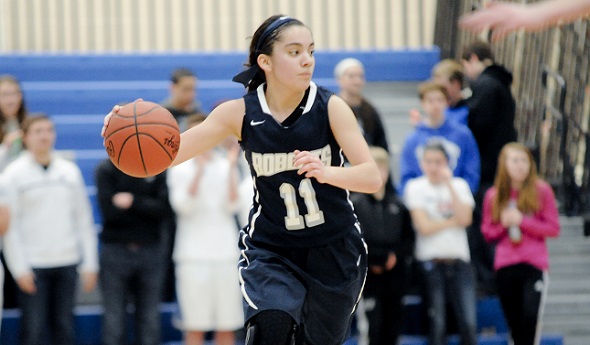
PHOTO: Kalle Martinez sets up Bay City John Glenn's offense during last season's game against Saginaw Nouvel. (Click for more from HighSchoolSportsScene.com.)
Class D Preview: New Champ to Emerge
March 14, 2018
By Geoff Kimmerly
Second Half editor
For two straight seasons, Pittsford didn’t lose a game.
But the Wildcats ended up in Class C this school year, and that means we’ll have a new champion in D this weekend – with a mix of familiar and new faces making the charge.
Waterford Our Lady and Mount Pleasant Sacred Heart are regulars for the final weekend of the season, and both have won Class D titles this decade. Adrian Lenawee Christian and Chassell have far less experience at this level – in fact, this is Chassell’s first trip to the Semifinals – but between them they are a combined 49-2 this winter.
Semifinals and Finals this weekend will be played at Calvin College’s Van Noord Arena in Grand Rapids.
Class D Semifinals – Thursday
Chassell (25-1) vs. Waterford Our Lady (20-4), 5:30 p.m.
Adrian Lenawee Christian (24-1) vs. Mount Pleasant Sacred Heart (25-0), 7:30 p.m.
Class D Final – Saturday, 10 a.m.
Tickets cost $10 per pair of Semifinals and $10 per two-game Finals session (Class D and Class A). All Semifinals will be streamed live on MHSAA.tv and viewable on a pay-per-view basis. All four Finals will be broadcast live on Fox Sports Detroit and streamed live on FoxSportsDetroit.com and the FOX Sports Go! app. Free radio broadcasts of all weekend games will be available on MHSAANetwork.com.
Below is a glance at all four semifinalists. Click on the name of the school to see that team’s full schedule and results from this season. (Statistics are through teams' Regional Finals.)
ADRIAN LENAWEE CHRISTIAN
Record/rank: 24-1, No. 3
League finish: Does not play in a league.
Coach: Jamie Salenbien, first season (24-1)
Championship history: Class D runner-up 2010.
Best wins: 62-31 over honorable mention Athens in Quarterfinal, 63-33 (District Semifinal) and 61-42 over honorable mention Morenci, 63-47 over Ida, 52-38 over Dexter.
Players to watch: Bree Salenbien, 6-2 fr. F (21.3 ppg, 9.8 rpg, 3.5 spg, 3.1 bpg); Dani Salenbien, 5-9 soph. G (13.3 ppg, 6.5 rpg, 4.7 apg, 3.8 spg, 46 3-pointers).
Outlook: Lenawee Christian is nine wins better than a year ago and will play its first Semifinal since 2010 under Jamie Salenbien, who formerly led Onsted to league titles all three of his seasons as head coach from 2011-13. This team has just one senior and seven underclassmen, with Bree Salenbien one of the most intriguing freshmen in the state. She followed her sister Dani with 37 3-pointers entering this week, and sophomore guard Libby Miller had 33. The schedule was filled with larger teams – the lone loss came by a point to Class A Monroe, while Class B Ida was a league champion and Dexter pulled off one of the biggest District upsets in Class A.
CHASSELL
Record/rank: 25-1, No. 6
League finish: First in Copper Mountain Conference Copper Country
Coach: Brandi Hainault, sixth season (79-57)
Championship history: Has never played in an MHSAA Final.
Best wins: 58-41 over No. 4 Gaylord St. Mary in Quarterfinal, 52-46 over No. 2 Munising in Regional Semifinal, 58-55 (OT) over Bark-River Harris in Regional Final, 62-35 over Ewen-Trout Creek.
Players to watch: Milly Allen, 5-3 sr. G (15.5 ppg, 3.7 apg, 4.0 spg); Sydney Danison, 6-1 sr. C (13.8 ppg, 9.3 rpg).
Outlook: Chassell won its first Regional title last week, and after going 5-16 in 2014-15 has upped its win total for the third successive season. The Panthers have eliminated two top-five teams over the last two weeks and sandwiched the close win over Bark River-Harris (18-6) between them. They haven’t lost since opening night to Class C L’Anse. Junior guard Jenna Pietila adds another 9.6 points and 4.2 assists per game in helping to lead the veteran group.
MOUNT PLEASANT SACRED HEART
Record/rank: 25-0, No. 1
League finish: First in Mid-State Activities Conference.
Coach: Damon Brown (10th season (204-41)
Championship history: Class D champion 2014, runner-up 2016 and 2008.
Best wins: 49-29 over Bellaire in Quarterfinal, 37-20 over Fruitport Calvary Christian in Regional Final, 57-43 over Beaverton, 39-30 and 53-13 over Carson City-Crystal.
Players to watch: Scout Nelson, 5-9 jr. G (13.8 ppg, 5.1 apg, 4.7 spg, 4.2 rpg); Sophia Ruggles, 6-0 sr. F (15.6 ppg, 5.8 rpg).
Outlook: The Irish have made the Semifinals for the third straight season returning their entire starting five from last year’s loss to eventual champion Pittsford – seniors Grace Reetz (7.8 ppg), Haydn Terwilliger (6.8) and Megan Nowak (6.1) join Nelson and Ruggles. Terwilliger, Nelson and Ruggles also started for the 2015-16 team. Although Sacred Heart doesn’t have wins over any opponents ranked at the end of the regular season, they saw their share of strong competition. Class C Carson City-Crystal finished 19-4, while Class C Beaverton and Calvary Christian were league champions and Bellaire finished 21-4.
WATERFORD OUR LADY
Record/rank: 19-4, No. 8 (tie)
League finish: First in Detroit Catholic League A North
Coach: Steve Robak, 11th season (204-65)
Championship history: Three MHSAA titles (most recent 2012), runner-up 2013.
Best wins: 42-28 over No. 5 Kingston in Quarterfinal, 51-22 over Marine City Cardinal Mooney in Regional Final, 47-39 over Allen Park Cabrini, 41-40 over Royal Oak Shrine, 51-47 over Bloomfield Hills.
Players to watch: Tiffany Senerius, 5-8 sr. F (14 ppg, 5.4 rpg, 41 3-pointers), Isabelle Kline, 5-8 soph. G (10.5 ppg, 25 3-pointers).
Outlook: After falling in a Quarterfinal last season, Our Lady is back for its third Semifinal in four seasons and seeking its fourth championship over the last nine. The Lakers have won 18 of their last 19 games after an opening stretch that included losses to reigning Class B champion Detroit Country Day and current Class C contender Ypsilanti Arbor Prep. Cardinal Mooney, Cabrini and Shrine ended the regular season unranked, but all three won league titles. Three more players average at least six points per game – seniors Catherine Weddle (6.5) and Kayla Sanders (7.9) and freshman Brooklyn Robak (8.0).
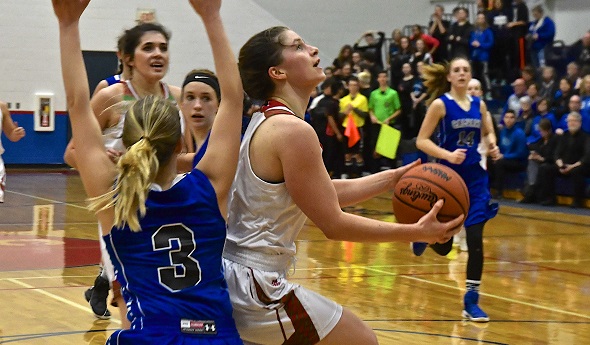
PHOTO: Mount Pleasant Sacred Heart's Grace Reetz drives past a defender during her team's Regional championship win last week. (Click for more from HighSchoolSportsScene.com.)