

Martinez Back on Point for John Glenn
December 14, 2015
By Bill Khan
Special for Second Half
BANGOR TOWNSHIP — Laying on the basketball court in pain, Kalle Martinez didn't need a medical opinion to know she was in trouble.

"I knew that the pain I felt I'd never felt before, so I knew something was definitely wrong," she said.
The diagnosis: A torn anterior cruciate ligament in her knee.
What followed was one of the toughest periods in Martinez's young life — life without basketball.
The injury happened during a team camp at Central Michigan University during the summer of 2014, putting her sophomore season at Bay City John Glenn in jeopardy.
While going through rehab was physically and emotionally challenging, she approached the grind of getting healthy with the same work ethic that made Martinez a star as a freshman on a strong varsity team.
"It just gave me motivation when I found out what happened to get better and keep playing like I know how," said Martinez, who said she first picked up a basketball at age 4.
As a result, she was back on the court by mid-January, well ahead of schedule for someone with a torn ACL. She played in 13 out of the Bobcats' 19 games, averaging 10 points a game after putting up 18.8 per game as a freshman.
"Basketball is her life," John Glenn coach Cory Snider said. "When a huge portion of your life gets taken away from you, it's pretty tough. I tell you what, the same way she plays basketball, she attacked her rehab. She came back in 7½, 8 months from an ACL, which is normally a full year's recovery time. She wasn't herself, obviously, for those first couple months, but we kept saying 60 percent of Kalle is better than no Kalle."
"I was not 100 percent at all, but I wanted to play with my friends," the 5-foot-6 point guard said. "I knew I wasn't able to do what I used to do, so I worked with what I had and built from there."
Unable to physically work on her game during her rehab, Martinez tried to improve herself in other ways.
"I watched a lot of film," said Martinez, who received all-state honorable mention as a freshman. "I really just paid attention to detail and how to correct myself."
"She's back to where she was athletically her freshman year," Snider said. "She looks the same. However, she's become a much more intelligent basketball player, which is a huge difference. She sees the floor so much better. That was part of the process of going through that injury last year. She was forced to learn how to play the game instead of just beating everybody."
Martinez was healthy enough by summer to impress the staff at Central Michigan, which offered her a scholarship before the start of her junior year. Martinez accepted, removing the pressure of the recruiting process for her final two years of high school.
"It's a good feeling," she said. "I feel I made the right decision going there. I feel I'm going to fit in really well. It's kind of a relief to know I don't have to go to this camp to get noticed. I feel at home at CMU."
She also feels more like her old self at John Glenn, leading the Bobcats to a 5-0 start that included a 53-44 victory over a Southfield-Lathrup team ranked No. 1 regardless of class in several preseason polls. Martinez had 18 points in that game, hitting five 3-pointers.
"I feel good," Martinez said. "I feel 100 percent now. I'm blessed, because not everyone can say they came back completely."
Martinez doesn't need to fill up the net every night, because she runs an offense that includes Grand Valley State University recruits Jenai LaPorte and Cassidy Boensch.
LaPorte is a three-time honorable mention all-state pick who is John Glenn's all-time leading scorer with 1,223 career points. She averages 14.2 points per game this season, and Martinez adds 12.6. The 6-foot-3 Boensch averages 15.8 points and 8.3 rebounds. Jamie Brisson averages 8.3 points.
"This is the best team we've had by far," LaPorte said. "Just the way we've been playing together for some people four years, for some three years. We have a lot of experience. We know what everyone likes to do."
It's an experienced lineup that has its sights set on winning John Glenn's first District championship since 1991 — and more.
The Bobcats have been a District championship-caliber team in recent years, but were eliminated by Midland Bullock Creek the past three seasons. Bullock Creek reached the MHSAA Class B Semifinals in 2013 and 2014 and was ranked No. 1 last year when it won a 40-39 overtime thriller against John Glenn in the District Semifinals. The Bobcats reached the District Final four straight years before losing in the semis last season.
In order to be better prepared for the postseason, John Glenn loaded up its nonconference schedule. The first five games included Class A contenders Southfield-Lathrup and Detroit Renaissance, 26-time District champion Frankenmuth and Class A Midland. The Bobcats face five-time MHSAA champion Saginaw Nouvel on Wednesday.
"Coming into the year, our mindset was we'd rather go 15-5 and make a deep run in the playoffs than go 20-0 and possibly not be ready for tournament time," Snider said. "We want to make sure we're battle-tested and ready to go once that tournament rolls around. This first two weeks for us has been killer."
 Bill Khan served as a sportswriter at The Flint Journal from 1981-2011 and currently contributes to the State Champs! Sports Network. He can be reached at [email protected] with story ideas for Genesee, Lapeer, St. Clair, Sanilac, Huron, Tuscola, Saginaw, Bay, Arenac, Midland and Gladwin counties.
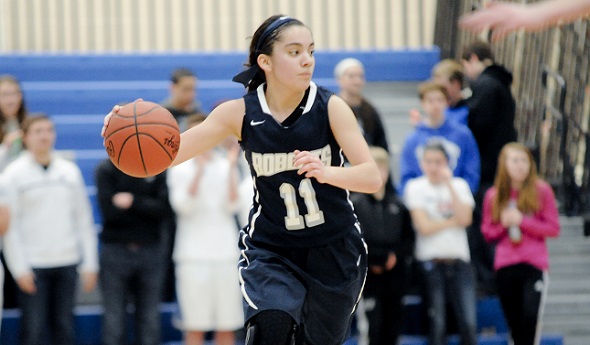
PHOTO: Kalle Martinez sets up Bay City John Glenn's offense during last season's game against Saginaw Nouvel. (Click for more from HighSchoolSportsScene.com.)
Country Day Adds to Coach's 50th Run
March 17, 2017
By Geoff Kimmerly
Second Half editor
EAST LANSING – Frank Orlando’s 50th season as a high school coach has been much like many of them – he’s enjoyed another championship contender, led by multiple all-staters, and he’ll bring that team into the final day of the season once again.
But there could be something a little special as Detroit Country Day’s longtime girls basketball leader closes a half century on the bench.
Orlando couldn’t hold back every tear talking about it briefly Friday, after a few laughs when star Destiny Pitts hushed him for giving away the team’s defensive secrets, and as the Yellowjackets decompressed from eliminating reigning Class B champion Marshall 46-42 in their Semifinal matchup.
They’ll face either Freeland or Ypsilanti Arbor Prep in Saturday’s championship game at the Breslin Center, seeking a 12th MHSAA title over Orlando’s 36 seasons leading the program – another piece of hardware to add to a tradition this latest group has maintained.
“I don’t know if you remember last year, but I told you we’d be back here,” recalled Pitts, referencing her prediction after the Yellowjackets fell in a Semifinal in 2016. “Coach O’s 50th year is just so important to us, and getting the tradition instilled in our seniors so we can pass it down to the juniors and sophomores and freshmen. … It’s important to bring (the title) back to our friends, our school and our teachers, because they all believe in us.”
Friday’s Semifinal wasn’t decided until the final minute, something that might’ve seemed to favor Marshall after it won its Semifinal last season with two last-second free throws on the way to claiming the program’s first MHSAA title the next day.
But it was Country Day’s turn after the 2015 champ fell two wins short a year ago.
After Marshall led most of the second quarter, the Yellowjackets (25-1) led most of the third and fourth.
Redhawks senior Jill Konkle – one of four returning starters from last season’s team – scored with 1:48 to play to give Marshall a two-point edge. But the rest belonged to the Yellowjackets.
Junior guard Kaela Webb scored and then made two free throws to give her team a two-point lead with 44 seconds to play. Pitts added two more free throws for the final margin. In between, senior Tylar Bennett and junior Maxine Moore blocked Marshall shots, ending this season’s attempt at last-minute drama.
 “They never quit, they kept their heads up and they kept playing hard, and that’s all I can say – they never gave up ever once,” Orlando said. “We worked hard on blocking. When they were coming, we told (our players) to wait, wait, wait, and then block. But don’t go after them right away because they are too good at what they do (with head fakes).”
The defensive stand characterized one of the key changes Webb described from last season’s team. In addition to more aggressiveness on that side of the court, these Yellowjackets also have shared the ball more, averaging more than 15 assists per game even as they had just 10 Friday.
It truly was strength on strength, as Country Day used only two subs for a total of eight minutes and Marshall used one sub for nine. Pitts led the Yellowjackets with 13 points and five assists and Bennett added 10 points as all five starters scored at least five.
Konkle and senior forward Nikki Tucker both scored 13 points to lead Marshall (23-3), and junior guard Natalie Tucker had nine points, 10 rebounds and six assists.
The Redhawks’ loss brought to an end a two-season 49-4 run that made a nice statement on the value of team basketball in a class where contenders often have one or more stars.
“I think the biggest thing is last year we proved to a lot of people that you don’t need DI (college) players,” said Tucker, who will play Division II hoops next season. “We aren’t a team that’s extra tall. We’re not a team that super quick. We’re not a team that’s crazy athletic. But we work together and we move the ball and we make shots when we need to make shots, and that’s all you need to do to play basketball. I don’t need a million DI commits when I have a great team.”
Marshall graduates five seniors who have been touted in their community since elementary school, and proved those high expectations correct last season. Redhawks coach Sal Konkle – also Jill’s mother – thought that was heaping a bit much on the youngsters at the time, but in the end this truly was a defining group.
“They have really instilled a work ethic in this program – we’ve always worked hard, but this is an extra special group that works extremely hard,” Sal Konkle said. “They just plain and simple do what you ask them to do, and they do it 100 miles an hour and with 100 percent effort all the time.
“What’s they’ve done is left a legacy for our team in the future here. The freshmen and the sophomores and the juniors on our team this year, they know how hard you have to work to get results, and they know how hard you have to work to reach your goals. We will still have lofty goals next year, and they’re going to have to work hard like these kids did.”
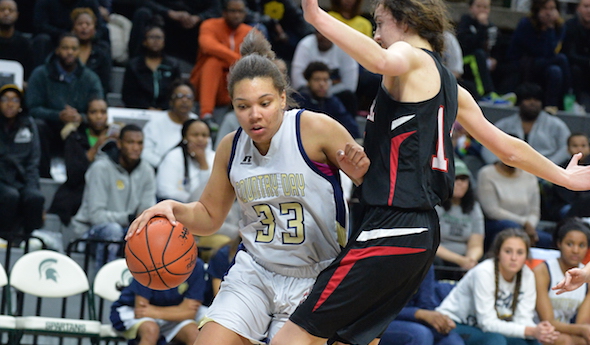
PHOTOS: (Top) Country Day’s Destiny Pitts works to get past Marshall’s Georgianna Pratley during Friday’s Class B Semifinal. (Middle) Redhawks senior Nikki Tucker drives to the basket.