

'Me to We' Kingsley Could Make History
February 1, 2018
By Dennis Chase
Special for Second Half
KINGSLEY – It might have been the most thrilling shot of the season for the Kingsley girls basketball team.
 It was certainly the most telling.
The memorable moment happened a couple weeks ago when junior guard Jacie King hit a buzzer-beating, half-court shot to give Kingsley an 11-10 lead over Maple City Glen Lake after the first quarter.
Kingsley went on to capture the battle of unbeatens, 61-45.
“They didn’t beat us one quarter (because of that shot),” King said.
Well, nobody has beaten 14-0 Kingsley in a quarter this season. Heading into Thursday’s contest with Onekama, that was 56 quarters and counting.
Not surprisingly, Kingsley, ranked No. 2 in this week’s Associated Press Class B poll, had won 13 of its first 14 games by 34 points or more.
“We’ve been pretty dominant,” said Matt Schelich, now in his 20th season as head coach.
With three weeks to go, Kingsley is within reach of what would be the program’s first 20-0 regular season.
The schedule ahead includes a rematch with once-beaten and reigning Northwest Conference champion Glen Lake, this time on the road Feb. 20.
But the Stags are more concerned about the present than the future.
“We’re taking a one day at a time approach,” Schelich said. “I tell the kids try to win every day, whether it’s in the classroom, at practice, whatever. Keep focused and win every day.”
That’s what his players are doing.
Schelich, who led Kingsley to the Class C Semifinals in 2008, returned the nucleus of last season’s 18-4 squad. It was a season that ended in the District Finals with a loss to Kalkaska, a team the Stags had beaten during the regular season.
“Last year ended in disappointment,” Schelich said. “We felt we had a legitimate shot to win the league and the District. In the long run, it might have been the best thing that happened. It was eye-opening. We didn’t have a focus on what was right in front of us.”
Schelich went to work in the offseason to change the team mindset from “me to we.” His intent was to get his players on the same page and help them “learn to play together,” senior guard Kelsie Bies said.
“If we use all our resources, all our talent, we can be that much better,” Bies said. “I love that about this team. We’ve learned how to trust each other.”
“Nothing we do is for ourselves,” junior forward Marie Pierson added. “It’s about team and how much better we can get (working together). Our motto is “All Heart.” We have to love each other, trust each other because we’re all in it together. We’re working really well together.”
It helps that there’s a strong chemistry between the players.
“What makes this team so special, so awesome, is that we all get along,” King said. “There’s hardly any arguments.”
Schelich rotates as many as eight players – Jalynn Brumfield, Lindsey Boyajian, Brittany Bowman, Bekah Crosby, Maddie Bies, Kelsie Bies, Jacie King and Marie Pierson. Brumfield has signed with Ferris State University, Boyajian with Lakeland University in Wisconsin.
“A majority of these kids could be averaging 20 a game, here or anywhere else,” Schelich said. “Basically, what we have, are eight kids averaging 8 to 12 a game.
“Balance is hard to beat. Balance with depth is really hard to beat. The kids have bought into the we. They don’t worry about who is getting credit.”
Schelich admits it’s a “competitive” group, and often practices are tougher than the games, especially when he can also draw from a 13-1 JV team.
 “We divide our kids so we have two good varsity teams going at it in practice,” he said. “How many coaches can divide their team up, have it be competitive and have their players get better? Not many. Most teams, boys and girls, have two or three kids that have to get it done for the team to have a chance.”
The players like the competitive challenge at practice.
“We don’t go easy on each other,” Bies said. “We push each other. Most of the time, our games are not as intense as our practices.”
For Kingsley, it all starts with pressure defense.
“We create a lot of offense with our defense,” Schelich said. “As a group, we are very athletic. I talk about playing defense in waves. That first wave, well, it’s a pain to play against our guards. They are quick and relentless. If you think you’ve got one beat, here comes another one.”
Kelsie Bies is the catalyst on the press.
“She can really move her feet and make people uncomfortable,” Schelich said. “She can go baseline to baseline to make plays. It’s like a beagle on a bunny. It’s her defensive energy, tenacity, that gets us going.”
Bies has stepped up her offensive game as well. Through the first 10 games, she was hitting 49 percent of her 3-pointers.
Kingsley is currently without Boyajian, who has been battling knee injuries.
“She’s had both knees repaired, and one is acting up right now,” Schelich said. “She just had an MRI. We hope to have her back soon.”
But that’s where the depth pays off.
“It’s been a luxury,” Schelich admitted.
Much to the chagrin of opposing coaches.
Frankfort coach Tim Reznich, who has led the Panthers to two Class D titles, is a believer.
“They’re good,” he said. “They have a legitimate shot at being a Final Four team. They have great depth. I think (Schelich) has 9 or 10 kids that could start on any given night. When he’s making substitutions, it’s nothing to look forward to as an opposing coach. They keep the pressure on and, in some cases, turn it up more.
“They have all the tools. They have good perimeter play, solid posts, and they’re good in transition. If you slow them down, they have girls who score in the halfcourt set. It’s a complete team.
“I told Matt (earlier in the season) that he has a special group and to enjoy them while he can. They’re making the best of it. They’re all in rhythm on the court. It’s a fun team to watch.”
And it’s also a team that is starting to get more recognition in the polls.
“It’s definitely exciting to be ranked that high because most people don’t even know where Kingsley is,” Bies said. “But we don’t talk about it. We don’t focus on it.”
Instead, the focus is on improving every day.
“It’s February – we have to get better (for the MHSAA tournament),” Schelich said. “We can’t be content.”
That’s not good news for opponents in the north, especially since this run could last awhile.
“Our 10th, 11th and 12th grades are loaded,” Schelich said. “Three groups in a row, it’s awesome.”
Schelich has two sophomores on varsity in Bowman and Maddie Bies. Plus, more are on the way.
That’s not what opposing coaches want to hear.
“There will be a learning curve for some of the young players when they get there (to varsity),” Reznich said. “But, no question, they’re just reloading the next couple years.”
 Dennis Chase worked 32 years as a sportswriter at the Traverse City Record-Eagle, including as sports editor from 2000-14. He can be reached at [email protected] with story ideas for Manistee, Wexford, Missaukee, Roscommon, Ogemaw, Iosco, Alcona, Oscoda, Crawford, Kalkaska, Grand Traverse, Benzie, Leelanau, Antrim, Otsego, Montmorency, Alpena, Presque Isle, Cheboygan, Charlevoix and Emmet counties.
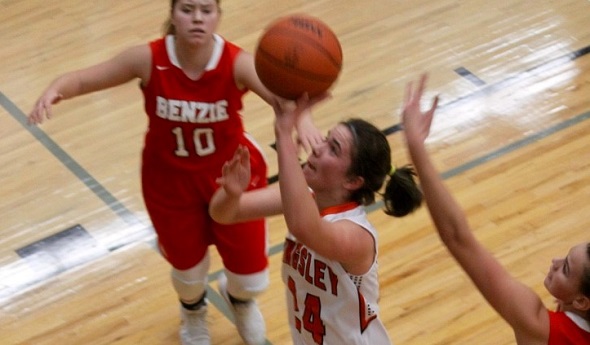
PHOTOS: (Top) Kingsley’s Marie Pierson drives to the basket against Benzie Central last month. (Middle) Jalynn Brumfield cuts through defenders in the Stags’ 67-30 win over the Huskies, who are 12-2. (Photos by Ron Stremlow.)
DeBoer Looks to Steer Sailors to Breslin
February 18, 2016
By Dean Holzwarth
Special for Second Half
CUTLERVILLE – Jenn DeBoer remembers the thrill of playing in the MHSAA Class B Final when she was a sophomore.
 The South Christian standout would like nothing better than to revisit that feeling in her final season.
DeBoer, a 5-foot-7 point guard, is currently leading the Sailors toward what they hope is another extended postseason run.
South Christian is 16-1 with three games remaining in the regular season before Districts tip off in March.
“That was a lot of fun, and obviously it was different because I was a sophomore and I knew that I had two more years after that,” DeBoer said. “But this year it’s a big goal for all of us seniors. We’ve talked about how we want to get back there and end our senior season strong.”
Led by DeBoer and a cast of veteran senior teammates, the Sailors have displayed the potential to make some noise in the MHSAA tournament.
They’re seeking an Ottawa-Kent Conference Gold title and currently own a perfect 7-0 mark in league play. Their championship hopes hinge on upcoming showdowns with Wayland and Grand Rapids Catholic Central.
“It’s been a blast so far,” DeBoer said. “I couldn’t ask for a better senior season. Our team chemistry is so amazing, and the other seniors and I get along so well. Obviously, winning has been fun too, and it’s probably one of the best teams I’ve been on.”
DeBoer, a four-year varsity player who committed to Division II Grand Valley State University before her junior season, has been the floor general of this year’s squad.
She has contributed in every aspect of the game, averaging 16.8 points, 6.0 assists, 4.6 rebounds and 3.8 steals per contest.
First-year South Christian coach Kim Legge has watched DeBoer improve and mature throughout the past years.
“She has made strides because of her work ethic, and she always wants to learn,” said Legge, a longtime assistant under recently-retired coach Jim DeBruyn.
“She’s like a sponge, and she’s been to a point guard camp the past two summers. That has really helped with her decision-making and leadership skills.”
DeBoer recently established two new school records for her 3-point shooting prowess.
During a recent win over Hastings, she set a new mark for career 3-pointers that had stood since 2003 while also surpassing the single-season record.
DeBoer toppled Leah Pettinga’s career record of 93 3-pointers made. She currently has 45 on the season.
 “It’s a huge honor to have the record now,” DeBoer said. “I knew I was pretty close because I focus on shooting 3s. It’s my favorite thing to do, and that’s just what I do. I wasn’t sure if I would ever make it, so it is definitely really cool to know that I have the record now.”
Legge didn’t know DeBoer was approaching the milestone until a few weeks ago, but she wasn’t surprised by the accomplishment.
“Anything that girl puts her mind to she seems to get done,” Legge said. “I got clued in a couple games before that she was getting close, but she would have never said anything to me. That’s how she is. She is so humble. It was a goal of hers, but it never would’ve come out of her mouth.”
DeBoer said the transition from DeBruyn to Legge wasn’t a difficult one.
“They both have similar coaching styles, but coach Legge is a lot more centered on defense so our defense this year has really picked up,” she said. “We have done a lot of the same things we’ve been doing in the past.”
DeBoer’s early commitment to the Lakers has allowed her to enjoy a stress-free final two seasons. It’s allowed her to focus strictly on helping her team succeed instead of lamenting over which college to choose.
“The pressure has been off, and I’ve been able to focus on my last basketball season at South,” DeBoer said. “The last four years have gone by pretty fast, and it doesn’t feel like I’m a senior until I think about it and look at old pictures. In a couple months I will be graduating, but I’m trying to enjoy high school while I’m still here.”
DeBoer is anticipating the jump to college, but is committed to ending her career on a high note.
“I’m definitely looking forward to playing in college next year, but I would really like to have a good ending to this season,” DeBoer said. “If we keep working hard, then I think we will do pretty well in the postseason.”
Legge isn’t one to look ahead, but with a starting line-up consisting of all seniors, expectations are high for the remainder of the season.
“We have a hard road ahead of us the last week of conference (play) and I don’t feel like we have peaked,” she said. “I really focus on what my team needs to do to grow on a day-to-day basis. Every coach in the state hopes their team makes a tournament run, and at this point of the season, it’s a goal of ours.”
 Dean Holzwarth covered primarily high school sports for the Grand Rapids Press and MLive for 16 years and more recently served as sports editor of the Ionia Sentinel and as a sports photojournalist for WZZM. Contact him at [email protected] with story ideas for Allegan, Kent and Ottawa counties.
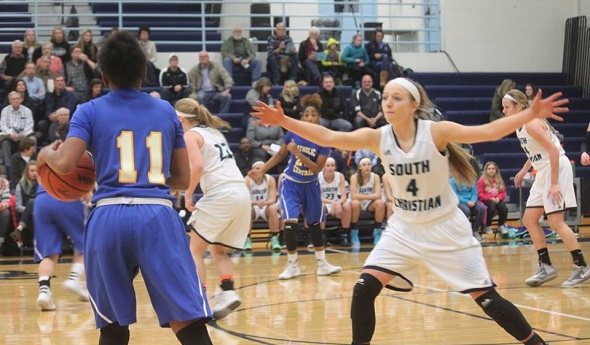
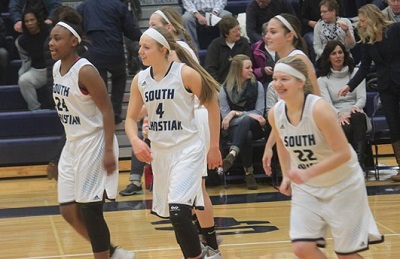
PHOTOS: (Top) Grand Rapids South Christian's Jenn DeBoer defends against Grand Rapids Catholic Central earlier this season. (Middle) DeBoer, 4, is one of a cast of experienced teammates hoping to finish with another Finals run; she takes the floor with Markayla Vander (24) and Sydney DeYoung (22). (Photos by Tracy DeYoung.)