

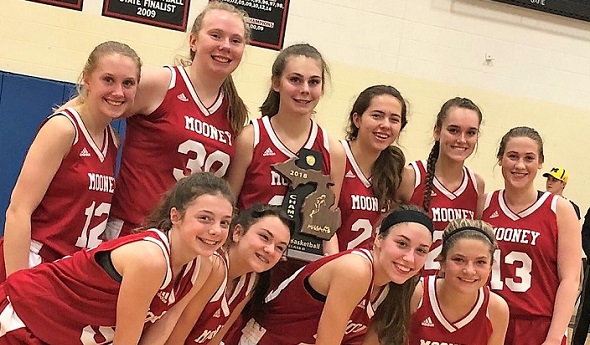
Mooney Girls Re-Ignite Proud Program
By
Paul Costanzo
Special for MHSAA.com
March 14, 2018
The Cardinal Mooney girls basketball season ended last week in the Regional Final with a loss to Waterford Our Lady of the Lakes.
 On the surface, for a program with Mooney’s rich history in the past decade-plus, it was disappointing – especially against a longtime rival that went on Tuesday to clinch a Semifinal berth.
But considering the Cardinals didn’t make it to Game 1 of the regular season two years ago, any disappointment was overshadowed by the massive steps forward the program has taken.
“This is about perspective,” Mooney coach Mike Lombard said. “Two years ago, we didn’t even have a varsity program. This year, we went to Allen Park Inter-City Baptist for a Regional Semifinal, were down 12 late and went on an 18-1 run to end the game. Everyone was upset (after the Regional Final loss), but there’s got to be perspective to say that the girls have come a long way.”
Mooney, which played in the Class D Final in 2009 and advanced to the Semifinals in 2008 and 2014, didn’t field a varsity team for the 2015-16 season because of a lack of players. With just seven, the vast majority underclassmen, the Cardinals opted to simply play a JV schedule.
“It was kind of crazy going from being coached by coach (Susan) Everhart, which was a really intense experience, to going backward,” said Lilly Wolf, who played varsity as a sophomore in 2014-15. “I think I kind of knew that eventually in my senior year there would be a varsity team, and it would be better for the program and myself to stick with it.”
It was a tough decision for a proud program, but it appears to have worked out. The Cardinals won the Detroit Catholic League Intersectional title in their first year back, and advanced to the District championship game before losing to Sterling Heights Parkway Christian.
Lombard gave a lot of the credit for that quick rebound to Wolf, who is now a freshman at Saginaw Valley State University.
“We were incredibly lucky that Lilly Wolf stayed with the program,” he said. “We played 22 games last year, and of those 22 games, Lilly would have been the best player on the floor in 17 of them. She bailed us out. We were able to have a little success because of Lilly Wolf, and to a lesser extent Lauren Luzynski and Molly Lombard. Those three girls really saved our bacon. They made basketball look attractive again.”
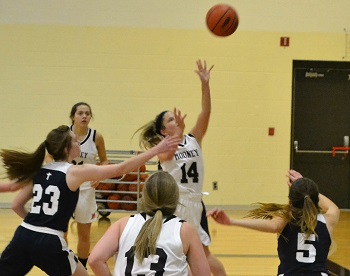 Mooney’s remaining players took advantage by getting to work in the offseason – not only on the court, but off it, recruiting their classmates to come out for the team.
“We tried to recruit those girls that we knew had played basketball in the past or that were just athletic,” Luzynski, a junior, said. “We just wanted to get people to come out for the team. We wanted to make Mooney great again.”
Building up numbers at a small Class D school was a major step for the program, and this season Mooney finished with 11 on the varsity team and eight on the JV, more than double the number of players in the program two years ago.
“We really had to say to ourselves that we have to start somewhere,” Molly Lombard, a senior, said. “With all of us working hard, we had to say that we have to start somewhere and build something up. I think people want to be part of something like that, and leave a mark on their school.”
Mooney won another Catholic League Intersectional title this season, won a District title and finished 18-6. It was the type of season nobody saw coming two years ago.
“Yeah, it was definitely unexpected,” Luzynski said. “When I came in my freshman year, we barely even had a JV team. We barely had enough girls to have a basketball team. Making such a strong comeback in these last two years was very unexpected.”
There is certainly room still to grow, and the loss to Lakes showed that. It was also a call back to the past, when Mooney and Lakes would battle seemingly every postseason.
“There was some symbolism there, but also I think a dash of realism for the girls who are going to stay in the program,” Mike Lombard said. “That Lakes team puts in a lot of work as Lakes teams always do. Mooney teams have to do the same thing. So I think it was a look to the past, but also a look to the future to see where they want to be and where to get back to.”
Putting in the work should be nothing new for this group of Cardinals, and those who enter the program will have a good example to look to thanks to the teams from the past few years.
“I watched the girls play at Mooney when I was in eighth grade -- I was at their camp in seventh and eighth grade,” Molly Lombard said. “I knew how good they were, and I was hoping to bring that back to Mooney. I feel like we did bring that back to Mooney. We have a JV team now; we have a varsity. We have a new legacy going on at Mooney, and it’s great to be a part of it.”
 Paul Costanzo served as a sportswriter at The Port Huron Times Herald from 2006-15, including three years as lead sportswriter, and prior to that as sports editor at the Hillsdale Daily News from 2005-06. He can be reached at [email protected] with story ideas for Genesee, Lapeer, St. Clair, Sanilac, Huron, Tuscola, Saginaw, Bay, Arenac, Midland and Gladwin counties.
PHOTOS: (Top) Marine City Cardinal Mooney players stand with their Class D District trophy won two weeks ago. (Middle) Junior Casey Rice puts up a shot this season. (Photos courtesy of the Cardinal Mooney girls basketball program).
Breslin Bound: Girls Report Week 3
December 17, 2012
By Geoff Kimmerly
Second Half editor
As a general rule, basketball teams evolve plenty between the first games of December through the final regular-season contests in February.
But these pre-break matchups matter just as much in the win-loss columns. And a number of games are being played right now that will surely make a difference as this season draws to a close.
This week's report includes some of the teams that have came out on the winning ends of key December battles. (Results and records based on those reported to Score Center at MHSAA.com)
1. Inkster (4-0) – The Vikings are a regular at Breslin Center and made the Class A Semifinals last season, so another great start is hardly surprising. But it's proof why Inkster remains a force – last week’s wins were 51-45 over improved Detroit Mumford and 57-51 over always-powerful Detroit Pershing.
2. Waterford Our Lady (3-1) – The reigning Class D champion has bounced back quickly from an opening-night loss to West Bloomfield. Last week, Our Lady beat Livonia Ladywood 50-38 and Mount Pleasant Sacred Heart by the same score.
3. Detroit Martin Luther King (3-0) – This is another team always in the Class A mix, and it got a big win Saturday – 56-48 over returning Class A Semifinalist Ann Arbor Huron, which earlier in the week had defeated Detroit Country Day 65-58. King also beat Detroit East English 61-7.
4. Johannesburg-Lewiston (5-0) – The Cardinals lost only two regular-season games last season, both times to Ski Valley Conference rival Gaylord St. Mary. But they got a little bit of revenge last week with a 50-48 win over St. Mary after also beating East Jordan 57-43.
5. Holt (5-0) – The Rams are again setting up nicely to contend in the strong Capital Area Activities Conference Blue. They beat nonleague foe St. Johns 52-48 and then Lansing Everett 48-39 to keep early pace with other frontrunners Grand Ledge and East Lansing.
6. Napoleon (5-1) – Napoleon’s 15-7 finish in 2011-12 included splits against Michigan Center and Grass Lake. The Pirates got an early upper hand on both last week, beating Michigan Center 49-45 and Grass Lake 47-42.
7. Traverse City St. Francis (4-1) – The Gladiators opened last season 14-1, with that lone loss to Cadillac – which they beat last week 55-50. St. Francis also defeated Kalkaska 44-36 on Friday.
8. Pewamo-Westphalia (3-2) – The Pirates got off to a rough start with opening-week losses to Class B Williamston and Lakewood. But back in familiar territory in the Central Michigan Athletic Conference, they've won three straight – including 51-42 last week over returning Class D Semifinalist Portland St. Patrick.
9. North Farmington (3-1) – The Raiders are coming off a 10-12 season that included a pair of losses to Pontiac. But North Farmington earned the early edge this time with a 59-58 win over Pontiac, followed by a 58-48 win over West Bloomfield.
10. Powers North Central (5-1) – After opening with a 13-point loss to returning Class D Semifinalist Crystal Falls Forest Park, North Central hasn't fallen again. The Jets beat Stephenson 62-51 and Munising 50-22 to get nearly halfway to last season’s win total of 11.
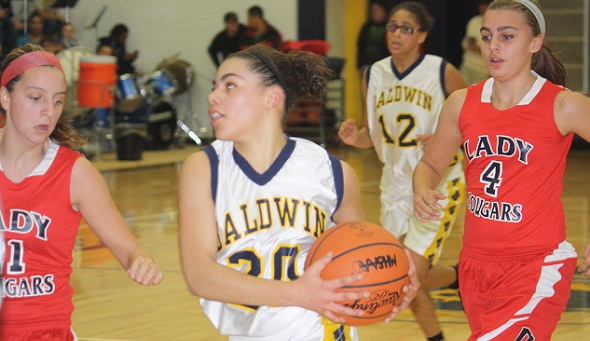
PHOTO: Big Rapids Crossroads (in red) defeated Baldwin on Thursday to move to 4-0 this season. (Click to see more at HighSchoolSportsScene.com.)