

P-W Earns Shot to Add to Title Collection
March 16, 2017
By Geoff Kimmerly
Second Half editor
EAST LANSING – Pewamo-Westphalia is enjoying a championship-caliber school year.
And now the Pirates girls basketball team wants its piece of MHSAA title success.
P-W can claim its third Finals title of 2016-17 on Saturday, thanks to the hoops team's 64-51 win over Maple City Glen Lake in Thursday’s second Class C Semifinal.
The Pirates girls can join the football and boys cross country teams as champions when they take on Detroit Edison Public School Academy in the 4 p.m. championship game. The Semifinal was P-W’s first since 2002, and the title game appearance will be the program’s first since finishing Class C runners-up in 1983 and 1984 – making it seem like all of this recent winning might be contagious.
“I think it’s just the community. Our community is so supportive, as you can see at any game and any championships – our community is there,” said P-W senior guard Brenna Wirth, herself a main cog on the school’s girls track & field Division 3 title winner in 2015. “I think we feed off that, and it keeps us going.
“I’ve been playing basketball for several years now, longer than I’ve been running, and basketball is really important to me and the community.”
How much it means to Wirth and her teammates came out especially over Thursday’s final 19 minutes.
Glen Lake (23-4) entered the regular season unranked but had already eliminated No. 2 Traverse City St. Francis and No. 7 St. Ignace before taking the floor against the No. 6 Pirates. The Lakers didn’t waste time going after another giant, taking as much as a nine-point lead into the final three minutes of the first half.
“Throughout the season, we tend to say the same thing over and over – you never win the game in the first four minutes,” P-W coach Steve Eklund said. “They were outhustling us; I’d say for the first 8 to 10 minutes they were outhustling us. Sometimes you have to adjust to your opponent. I think it took us a little time tonight to settle into the environment.”
“Obviously we had to fight back every little run they had,” junior forward Emily Spitzley added. “We just had in our minds to keep fighting. It’s just about confidence.”
 If the all-state second-teamer was lacking any, she found it as the comeback began.
Spitzley scored 20 of her game-high 24 points and grabbed eight of her 12 rebounds – and also blocked three shots – as the Pirates forced a 22-point swing.
P-W (24-2) closed the second quarter on an 8-0 run to get within 25-24 of Glen Lake by halftime. The Pirates then opened the third quarter on a 7-0 run to take a six-point lead.
Glen Lake got the advantage back twice with just under four minutes left in the third quarter, and after the Pirates rebuilt an eight-point lead got the deficit down to one again with 6:33 to play. But another P-W 8-0 run over the next three minutes finally put the game out of reach.
“We’ve had a lot of games where we had slow starts, but we’ve worked hard on coming out (strong) in the third quarter,” Glen Lake coach Jason Bradford said. “We just came out kinda slow on our heels and got away from what we usually do – pushing the ball, kicking it out. We were spinning our heels a little bit, and we got a little shell-shocked when the score started going the other way.”
Wirth added 13 points, and junior forward Kate Hengesbach added nine points, 12 rebounds and six steals off the bench in 20 minutes of play.
Junior guard Allie Bonzelet led three Lakers scoring in double figures with 14 points, and junior forward Jennifer LaCross had 13 and seven rebounds. Senior guard Kelly Bunek added 11 points and senior forward Sarah Carney finished her career grabbing nine rebounds.
P-W fans had about a 30-minute drive to fill their side of the Breslin stands Thursday, but Glen Lake had nearly as many fans – including three spectator bus loads – make a nearly four-hour trek.
“It’s just great to be able to put our name out there and show people all the hard work we’ve been putting in,” Carney said. “To just see the community come out and support us … it’s very rewarding to see the support we have.”
The Girls Basketball Finals are presented by Sparrow Health System.
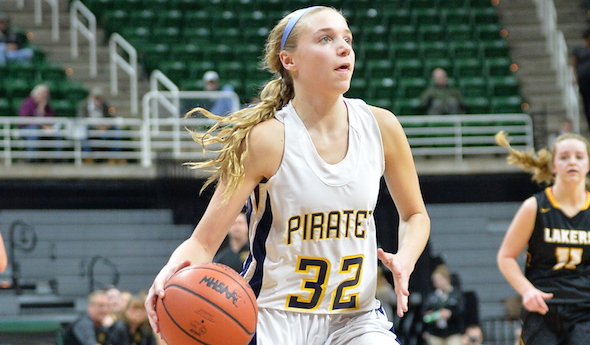
PHOTOS: (Top) P-W’s Emily Spitzley drives to the basket during Thursday’s Class C Semifinal win. (Middle) Glen Lake’s Savannah Peplinski (24) works to get past the Pirates’ Ellie Droste.
Breslin Bound: Girls Report Week 2
December 11, 2012
By Geoff Kimmerly
Second Half editor
We're only two weeks into this girls basketball season. But there are plenty of teams that already can take pride in strong starts that either are continuing on last season's success or showing a nice turnaround after a rough run.
Some of those are highlighted in this week's report. Remember, what's below isn't any sort of statewide ranking – merely a top-10 list of notables from last week.
Records and results are through Sunday and based on those found at MHSAA.com. Click on Score Center to follow scores throughout the week and enter those of the games you attend.
1. Concord (3-0) – Most of the key pieces to last season’s Class C Semifinalist team are back, and they earned a pair of close wins. Concord edged Michigan Center 36-32 – after also beating Michigan Center in overtime in the District opener last season – and then got past Homer 37-35.
2. L’Anse (4-0) – The Purple Hornets are again off to a nice start – with a bonus. According to the Houghton Daily Mining Gazette, L’Anse’s 60-56 win over Houghton gave Houghton its first loss to a team from the state’s four northernmost counties since Nov. 2, 1999. Click to read more from the Daily Mining Gazette.
3. Westland John Glenn (2-0) – The Rockets got off to a strong start with a 66-34 win over Grosse Pointe North and then a 63-56 victory over Dearborn Divine Child. Divine Child is coming off a trip to the Class B Semifinals.
4. Grand Rapids South Christian (3-0) – Two of the Sailors four losses last season came to Grand Rapids Catholic Central. They haven’t played GRCC yet, but did edge Grand Rapids Christian 50-46 just three days after the Eagles beat GRCC by six.
5. Marshall (3-1) – This returning Class B Quarterfinalist added a strong week to a solid start. First, Marshall topped Richland Gull Lake 48-44 – Gull Lake won its Class A District last year – and then the Redhawks finished the week with a 46-33 win over Battle Creek Central.
6. Pontiac (2-0) – The Phoenix were a .500 team last season, but are off to a quick start thanks to two close wins. Pontiac beat Waterford Mott 49-45 and then Harper Woods Chandler Park 57-55.
7. Manchester (4-0) – The Flying Dutchmen have beaten every opponent by at least 10 points this season, including Onsted 59-40 and Napoleon 64-34 last week. Napoleon entered 3-0.
8. Bloomfield Hills Marian (2-0) – Marian is off to a solid start after beating annual Class A power Canton 44-30. Marian opened by beating Grosse Pointe North two weeks ago.
9. Athens (3-0) – The reigning Class D runner-up is off to a fast start again. Athens opened last week by beating Climax-Scotts 55-44, then survived a close one against Reading, 37-31.
10. Saginaw Heritage (2-2) – The Hawks bounced back from two losses during the first week to even their record by beating Arthur Hill 54-35 and Bay City Western 51-14. Heritage lost to Arthur Hill by 17 in their game last season.
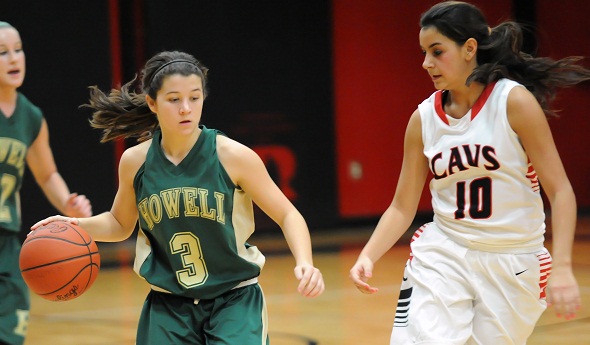
PHOTO: Howell junior Meredith Wood works to get around a defender as the Highlanders pushed toward their first win of the season, 60-48 over Carrollton on Thursday. (Click to see more at HighSchoolSportsScene.com.)