

Performance: Cousino's Kierra Fletcher
March 24, 2016
 Kierra Fletcher
Warren Cousino junior – Girls Basketball
It’s fair to say that few outside of Macomb County and perhaps the Greater Detroit area knew much about Warren Cousino girls basketball and Kierra Fletcher in particular before last weekend. But in scoring a combined 64 points over two games and leading the unranked Patriots to their first MHSAA championship, Fletcher became a possible Miss Basketball Award contender for 2017 and earned the Michigan National Guard Performance of the Week.
The 5-foot-9 guard made 14 of 20 shots for 37 points and added nine rebounds and five assists in Cousino’s Class A 60-45 Semifinal win over Hudsonville, then made 9 of 13 shots for 27 points with eight rebounds and five more assists in the 67-65 upset of Detroit Martin Luther King in the championship game. Fletcher managed her high scoring totals by attacking the basket; in fact, she didn’t take a 3-pointer over eight postseason games. She finished with season averages of 22.3 points and five assists per game and made more than 50 percent of her shots from the floor. Cousino finished 23-4 and also shared the Macomb Area Conference Red title.
 Fletcher is a strong student, carrying a 3.97 grade-point average, and a thoughtful teammate as well. She dedicated this season to her best friend Erin McArthur, who previously has shared the backcourt with her but tore a knee ligament during the team’s second practice and was forced to miss the season.
Coach Mike Lee said: “We have had great basketball players, DI players, and leaders, but Kierra has taken it to the next level and as a result of that has taken the team to the next level. On May 21, 2015, she texted me after a rough AAU practice and said, ‘Coach, for whatever reason something clicked tonight and all the things you preach hit home a lot harder, and I am making you a promise that next season is Breslin or bust.’ And after we won on Saturday, she sent me a pic of the text from that day and said, ‘I told you so.’ She is such an amazing kid with a burning passion for the game. You guys only see the basketball player side, but she is a tremendous role model, 3.9 GPA, great friend, watches my own kids. She is what is right, true and pure about high school sports – a homegrown kid that just wants her school and team to be proud.”
Performance Point: “I think I showed people I can play basketball. People don’t really know who I am, which is fine. I guess since I just played on statewide television that people (might say), ‘Oh, that’s Kierra Fletcher.’ It’s going to be humbling (next year). The rankings to us don’t really matter. Just as long as we know who we are, inside the program, that’s all that matters.”
My game: “I don’t shoot 3s. I’m more of a mid-range, pull-up type person. Three-point shots to me, they’re not very high percentage, so I just try to go in closer, because the closer you are to the basket, the more likely you are to go in. … Defense, I just love it. The length of my body and getting steals and breakaway layups is just fun. I like defense more than offense.”
 Sharing the rock: “I just want to have a high basketball IQ. It doesn’t really matter how much I score. If I score, I score. If I don’t, I can get my ball to my teammates. I just do whatever I have to do to get the win. … I’m just not a selfish player at all. Sometimes (Coach) Lee tells me I need to be more selfish, but that’s just not who I am. I get hyped when another person on my team makes a play, because it gets me going. Because if I’m getting the layup, it’s just a layup. But if I’m getting someone else the opportunity to score, that’s what matters most to me.”
Investigating her future: If pro basketball doesn’t work out, then I want to major in sociology and narrow it down to criminology and become an FBI agent. I just like to help people. The FBI, it’s different from a police standpoint; it’s more investigative work, being with people and talking with people. I think I’m a people person. That’s something that I like to do.”
Macomb County power: “I think it’s great for Cousino … because everyone knows who Cousino is now. It says a lot because we do have great players in Macomb County. Now, since a team in Macomb County just won a state championship, it gives a whole little watch list for the Macomb County teams. It’s great, because now we’re the poster children of Macomb County.”
– Geoff Kimmerly, Second Half editor
Every week during the 2015-16 school year, Second Half and the Michigan National Guard will recognize a “Performance of the Week" from among the MHSAA's 750 member high schools.
The Michigan Army National Guard provides trained and ready forces in support of the National Military Strategy, and responds as needed to state, local, and regional emergencies to ensure peace, order, and public safety. The Guard adds value to our communities through continuous interaction. National Guard soldiers are part of the local community. Guardsmen typically train one weekend per month and two weeks in the summer. This training maintains readiness when needed, be it either to defend our nation's freedom, or protecting lives and property of Michigan citizens during a local natural disaster.
Previous 2015-16 honorees
March 16: Jacob Montague, Grosse Pointe South swimming & diving - Read
March 9: Kyle Tuttle, St. Charles boys bowling - Read
March 2: Brittney Schnicke, Caledonia girls bowling - Read
Feb. 24: Kamari Newman, Detroit East English boys basketball - Read
Feb. 17: Jason Whitens, Powers North Central boys basketball - Read
Feb. 10: Rachel Hogan, Grand Ledge gymnastics - Read
Feb. 3: Nehemiah Mork, Midland Dow swimming & diving - Read
Jan. 27: Mardrekia Cook, Muskegon girls basketball - Read
Jan. 20: Sage Castillo, Hartland wrestling - Read
Jan. 13: Rob Zofchak, Dexter swimming & diving - Read
Jan. 6: Tyler Deming, Caro wrestling – Read
Dec. 15: Jordan Weber, East Jordan boys basketball – Read
Dec. 8: Kaitlyn Geers, Kent City girls basketball – Read
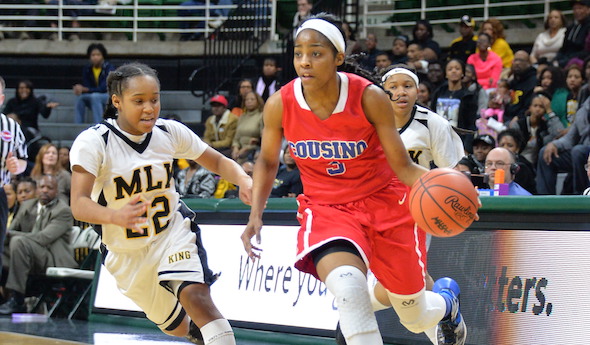
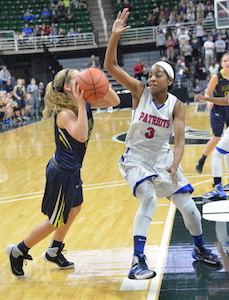
PHOTOS: (Top) Kierra Fletcher (3) makes a move to the basket during Saturday’s Class A Final against Detroit Martin Luther King. (Middle) Fletcher defends during the Semifinal win against Hudsonville.
Breslin Bound: 2022-23 Girls Quarterfinal Preview
By
Geoff Kimmerly
MHSAA.com senior editor
March 14, 2023
By the end of tonight, we’ll know which 16 girls basketball teams are Breslin Bound this weekend.

Below is a glance at all 16 Quarterfinals across four divisions, with all games tipping off today at 7 p.m. unless noted.
We’ll come back Thursday with more detailed looks at the teams making the trip to East Lansing.
“Breslin Bound” is powered by MI Student Aid.
Division 1
Salem (20-6) vs. Riverview (23-3) at Ypsilanti Lincoln
Riverview is playing in its first Quarterfinal, and Salem its first since 1990. The Rocks are paced by junior Madison Morson (22.4 points, 7.6 rebounds per game). Seniors Elyssa Kincaid (16.8 ppg) and Cadence Kaminske (14.7 ppg) lead Riverview, which won both of its Regional games by a point.
Flint Carman-Ainsworth (23-0) vs. West Bloomfield (24-2) at Bay City Central
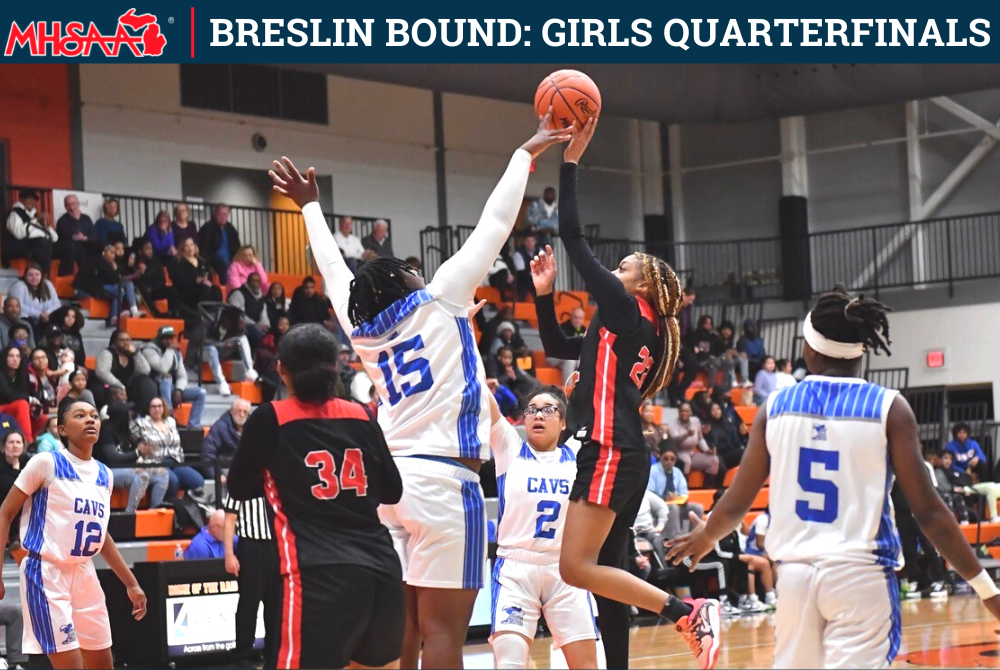
The Cavaliers bring a perfect record and five players averaging double-digit scoring into this meeting with the reigning Division 1 champion. Senior Armonie Smith and junior Ravyn Guy lead at 15 ppg, and senior DeAndrea’ Smith provides 12.6 points, 12 rebounds and five assists per contest. West Bloomfield has three starters back from its title-winning lineup – junior twins Summer Davis (19.1 ppg, 74 3-pointers) and Indya Davis (15.6 ppg, 8.7 rpg) and senior Sydney Hendrix (10.6 ppg).
Detroit Renaissance (22-1) vs. Grosse Pointe North (23-2) at University of Detroit Mercy
The Phoenix are a one-point overtime loss to Ann Arbor Father Gabriel Richard from perfection this winter and defeated Farmington Hills Mercy (22-4) to reach this week. North’s only losses were to Lake Fenton and Utica Eisenhower, the latter by a point. Three players average double-digit scoring for the Norsemen, led by senior Annabel Ayrault at 14 ppg. Junior Christian Sanders (14.1 ppg) leads four Renaissance players averaging at least 11 points per contest.
Rockford (25-1) vs. Holt (22-4) at Kalamazoo Loy Norrix
The Rams were a three-point Semifinal loss to West Bloomfield from playing for last year’s Division 1 title, and their only loss this time was to still-undefeated Grand Rapids West Catholic. Sophomore Anna Wypych (14.2 ppg) is the leading scorer for a team that’s connected on 231 3-pointers. Holt is coached by Tori Brooks, who made the Finals as a player with DeWitt in 2009 and East Lansing in 2008, and the Rams are keyed by senior Janae Tyler (18.1 ppg, 12.2 rpg).
Division 2
Houghton (21-5) vs. Frankenmuth (23-2) at Gaylord, 5 p.m.
The Gremlins have defeated league champions two of their last three games to reach this week and feature for senior starters including leading scorer Meghan Trewhella (16.1 ppg). Frankenmuth earned its second-straight Regional title and has won 11 straight games, with 6-foot-1 Lexi Boyke (13 ppg, 8.5 rpg) the lone senior in the Eagles’ starting lineup.
Warren Regina (10-12) vs. Goodrich (23-3) at University of Detroit Mercy, 5:30 p.m.
Regina is playing in its first Quarterfinal since 2011 after handing Warren Fitzgerald its lone loss 52-19 in the Regional Final. Junior Maddy Mlynarek (6.2 ppg, 6.3 rpg) is the leading scorer and rebounder for a balanced lineup. Goodrich built on its one-point win over rival Lake Fenton in the District Final with a triple-overtime victory over Detroit Country Day in the Regional championship game. Senior Riley Place leads at 13.2 ppg.
Grand Rapids West Catholic (25-0) vs. Holland Christian (19-7) at Hopkins
Last season’s Division 2 runner-up West Catholic hasn’t lost since, led by senior Miss Basketball Award finalist Cadence Dykstra (13.8 ppg, 5.4 rpg, 5.0 apg). The Falcons defeated Holland Christian by 17 and 32 during the regular season. The Maroons won their first Regional title since 2009, and sophomore Camryn VandenBosch (11.5 ppg) leads four starters averaging at least six points per game.
Lansing Catholic (21-5) vs. Redford Westfield Prep (16-8) at Chelsea
Both of these teams have earned stunning victories this postseason, Westfield over reigning Division 2 champion Detroit Edison 57-54 in the Regional Final and Lansing Catholic handing second and final losses to Haslett in the District and Chelsea in the Regional. Senior guard Shamya Reid is Westfield’s leading scorer at 15.5 ppg, while junior twins Anna and Leah Richards pace the Cougars at 12.2 and 10.3 ppg, respectively.
Division 3
Sandusky (23-3) vs. Madison Heights Bishop Foley (20-6) at West Bloomfield
Sandusky earned its first Regional championship since 1999, avenging an overtime regular-season loss to Cass City to advance. Senior Morgan Taege averages 12.6 ppg with 50 3-pointers. Bishop Foley has won three straight Regional championships and this time is led by junior Ryan Moorer (11.5 ppg, 6.5 rpg) and four seniors filling out the rest of the starting lineup.
Blissfield (25-1) vs. Ovid-Elsie (22-4) at Springport
The Royals defeated reigning Division 3 champion Ypsilanti Arbor Prep 50-38 in a Regional Final to return to the season’s final week. Five players average between 5.9 and 11 ppg, with junior Avery Collins that leading scorer and also pace-setter with 4.5 assists and four steals per contest. Ovid-Elsie won its first Regional title since 1984 and starts four juniors including Ava Bates, who leads at 12.6 points, 5.7 rpg and 1.4 blocks per game.
Elk Rapids (21-3) vs. Hemlock (23-3) at Gaylord
Elk Rapids will play in its first Quarterfinal since 1993, with wins over Harbor Springs and Negaunee highlighting the Elks’ tournament path. Junior Kendall Standfest has been a force averaging 16.7 ppg and 11.2 rpg. Hemlock has won 14 straight and follows a pair of big-time shooters in seniors Regan Finkbeiner (17.1 ppg, 60 3-pointers) and Chloe Watson (14.1 ppg, 71 3-pointers).
Hart (23-3) vs. Buchanan (23-1) at Bangor
Hart avenged a regular-season loss to 2022 Division 3 runner-up Kent City to win its first Regional championship, with leading scorers Abby Hicks (14.5 ppg) and Addi Hovey (16.4 ppg) surrounded by three seniors in the starting lineup. Buchanan’s first Quarterfinal trip since 2001 has been paced by 6-4 Miss Basketball finalist Faith Carson at 20.4 points and 12.4 rebounds per game. The Bucks have won 23 straight since falling to Vicksburg in their season opener.
Division 4
Baraga (21-5) vs. Mackinaw City (25-1)
Baraga is back after making the Division 4 Semifinals last season, in part thanks to avenging regular-season losses to Lake Linden-Hubbell and Ewen-Trout Creek during the playoffs. Corina Jahfetson is among the standouts again, this time with a team-leading 18 ppg and 90 3-pointers. Mackinaw City broke through with its first Regional title, with seniors Madison Smith (16.1 ppg, 10 rpg) and Marlie Pastula (15.8) leading four players averaging double-digit scoring.
Fowler (19-7) vs. Kingston (25-1)
The Eagles have won the last two Division 4 championships and prepped this time with another strong schedule; their only Division 4 loss was to Portland St. Patrick and was avenged twice. Senior Emma Riley has plenty of Breslin experience and leads at 15.1 ppg. Kingston’s lone loss came to Division 2 Saginaw Swan Valley, and nine of the team’s last 10 wins were over opponents with winning records. Junior Delaney St. George paces the Cardinals at 15.8 ppg with 91 3-pointers.
Maple City Glen Lake (23-2) vs. St. Charles (24-2)
Glen Lake won its third-straight Regional title but this time in Division 4 after advancing in Division 3 the last two seasons. Senior guard Ruby Hogan (19.1 ppg, 5.2 apg) will direct the offense as the Lakers attempt to reach the Semifinals for the second-straight March. St. Charles was another first-time Regional champion last week and is keyed by a balanced lineup with three starters averaging between 9-10 ppg, led by Emily Zelinko at 9.8.
Kalamazoo Hackett Catholic Prep (18-8) vs. Adrian Lenawee Christian (17-10)
Hackett made its first Quarterfinal with a 35-29 victory over 21-win Colon in the Regional Final. Junior Alyse Baughman (13.6 ppg) is the leading scorer for a lineup with only one senior starter. Lenawee Christian is making a return trip to the Quarterfinals, following another distance-shooting ace in senior Avery Sluss (14.1 ppg, 56 3-pointers).
MHSAA.com's weekly “Breslin Bound” previews and reviews are powered by MI Student Aid, a part of the Office of Postsecondary Financial Planning located within the Michigan Department of Treasury. MI Student Aid encourages students to pursue postsecondary education by providing access to student financial resources and information. MI Student Aid administers the state’s 529 college savings programs (MET/MESP), as well as scholarship and grant programs that help make college Accessible, Affordable and Attainable for you. Connect with MI Student Aid at www.michigan.gov/mistudentaid and find more information on Facebook and Twitter @mistudentaid.
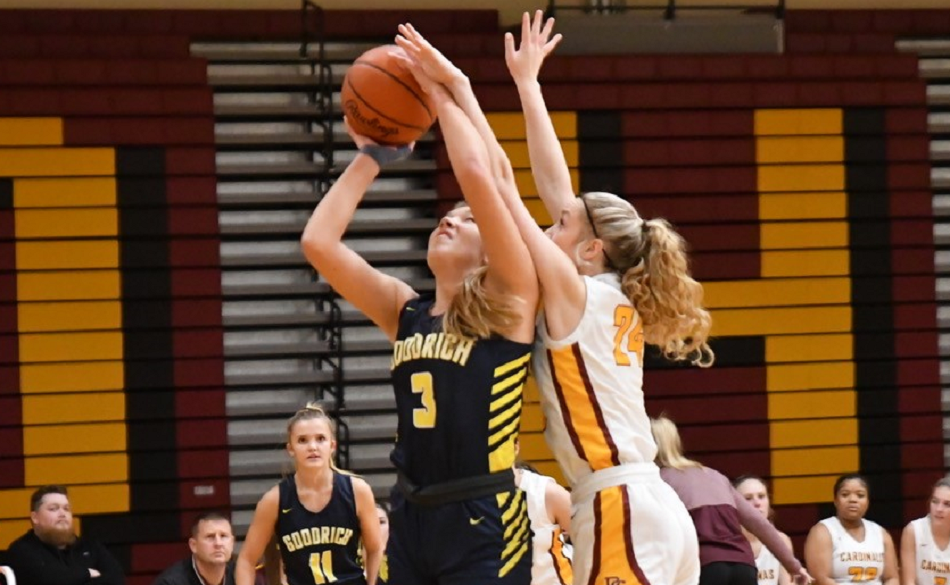
PHOTOS (Top) Carman-Ainsworth’s Armoni Strozier (15) gets a hand on a shot during a District win over Flushing. (Middle) Kalen Williams (3) gets a shot up for Goodrich against Davison earlier this season. (Photos by Terry Lyons.)