

Plan Plays Out Well for Cousino Standout
By
Tom Markowski
Special for Second Half
December 1, 2016
WARREN – As a teacher at Carter Middle School, Mike Lee, the varsity girls basketball coach at Warren Cousino, was approached by one of his students who made a rather boisterous statement.
 “There was this girl,” Lee said. “She was in the sixth grade and she came up to me and said, ‘I’m going to play for you as a freshman.’ No, I didn’t believe her. She was long, but she was a bean pole.”
Intrigued, Lee went to watch this skinny 10-year-old play and was impressed but not yet sold.
This girl is now one of the state’s best basketball players. Her name is Kierra Fletcher, and she won the hearts of everyone in the Warren Consolidated School system – which includes high schools Cousino, Mott and Sterling Heights – by leading the Patriots, and the Warren district as a whole, to their first girls MHSAA Finals basketball title.
By the time Fletcher was in the eighth grade, Lee knew Fletcher’s bold statement would come to fruition. She was that good.
“She was still skinny,” Lee said. “It wasn’t until her junior year that she bulked up.
“Obviously, she’s talented. I am pretty lucky to have someone like Fletch. But it’s what she does for the other players that makes her special. She makes them better. She puts them in spots to succeed. They want to play faster. There’s a higher energy. On the defensive side, you know she’s out there, getting steals and such. The others feed off of her.”
Fletcher, 16, is 5-foot-9 and a bundle of energy. And that energy was there from the start.
“I was out in (first grade) early,” Fletcher said. “My mom said I was talking all of the time. The teachers (in preschool) told her I was way ahead of the other kids.”
Born and raised in Detroit, Fletcher attended Dove Academy until the third grade, when her family moved to Warren. She attended Siersma Elementary within the Warren Consolidated district and then went to Carter.
Fletcher was also ahead of the curve when it came to basketball. She started playing competitively in the Warren recreation leagues, but before that she got the itch playing in her grandmother’s driveway.
“She had a basket in her backyard,” Fletcher said. “I would play by myself, and sometimes I’d play with an older cousin and my dad (Anthony Fletcher). My dad used to be really good. He played in college and he could have gone pro, but he had a bad heart and had to stop playing.”
Fletcher began playing AAU basketball in the fifth grade. It took less than a week for the coaches to move Fletcher up to play with the sixth grade team. That was nothing new for her. And she said it’s one reason why she continued to improve.
“I had been playing up for a while,” she said. “I always played with older kids. They had more experience, and I learned from it. What I learned was it doesn’t matter how old or how big you are. I’d play well and they wouldn’t know I was younger, and they’d tell me to keep playing and that made me feel good.”
 Fletcher was on the bench for her first varsity game as a freshman, but she didn’t stay there long. Lee put her in the game in the first quarter, much to Fletcher’s surprise.
“I’ll never forget it,” she said. “It was against Romeo, and it was our home opener. I was nervous. I didn’t want to mess up.”
That nervousness and her coming off the bench didn’t last long. Soon she was in the starting lineup gaining more confidence as the season progressed.
As a sophomore she was one of the top players in the Detroit area, as she averaged 25 points and 12 rebounds per game. That fine season placed her in at least one publication’s 2015-16 preseason top 25 (State Champs! ranked her No. 14), and soon everyone who followed the sport knew about her.
Fletcher averaged 23 points, 10 rebounds, 9.4 assists and 5.5 steals as Cousino (23-4) made its run on the way to eventually defeating Detroit Martin Luther King, 67-65, in the Class A Final to complete a remarkable season for the Patriots and Fletcher.
Fletcher saved her best for last, as she had 37 points, nine rebounds and five assists in the Semifinal (a 60-45 win over Hudsonville), and had 27 points, eight rebounds and five assists against King.
“I love to compete,” she said. “I love the friendships. I’ve met a lot of people playing basketball. Sports teaches you discipline, in the way you live life. Sports has a way of bringing people together.”
Fletcher turned down a number of other college scholarship offers, including one from University of Michigan, to sign with Georgia Tech. She has a 3.7 grade-point average and plans on majoring in public policy and working for the U.S. Government.
“I also have aspirations of playing professionally,” she said. “Overseas or in the WNBA.”
 Tom Markowski is a columnist and directs website coverage for the State Champs! Sports Network. He previously covered primarily high school sports for the The Detroit News from 1984-2014, focusing on the Detroit area and contributing to statewide coverage of football and basketball. Contact him at [email protected] with story ideas for Oakland, Macomb and Wayne counties.
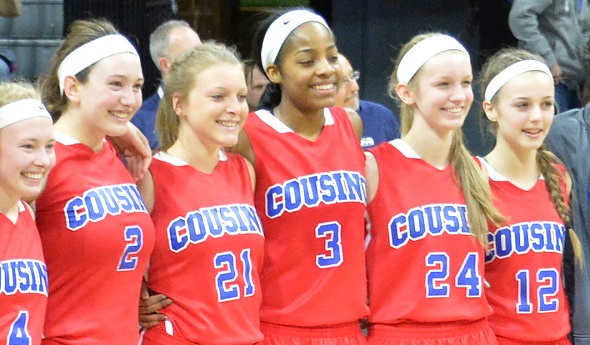
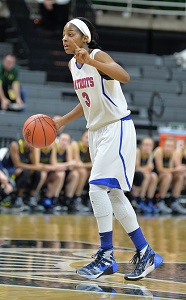
PHOTOS: (Top) Kierra Fletcher (3) poses for a photo with her teammates after Warren Cousino won last season’s Class A championship. (Middle) Fletcher brings the ball up the court during her team’s Semifinal win over Hudsonville.
D2 Preview: Past Powers, New Hopefuls Bring Stories to Breslin
By
Geoff Kimmerly
MHSAA.com senior editor
March 16, 2022
This weekend’s Division 2 Finals bracket might have the most pre-packaged storylines of any of the four divisions that will celebrate girls champions this weekend at Breslin Center.
Detroit Edison returns after the last two seasons were cut short, seeking to add a fourth title in six years with another Miss Basketball leading the way. Detroit Country Day owns the most Finals championships in girls basketball history and is seeking its first since 2018.
Grand Rapids West Catholic hopes to follow the Miss Basketball runner-up to its first championship in more than three decades. And Ludington, making its first appearance at Finals weekend, is looking to add more firsts to a historic run.
DIVISON 2 Semifinals – Friday
Grand Rapids West Catholic (24-1) vs. Detroit Country Day (14-7), 5:30 p.m.
Detroit Edison (17-3) vs. Ludington (20-5), 7:30 p.m.
FINAL – Saturday – 6:15 p.m.
Tickets for this weekend’s games are $12 for both Semifinals and Finals and are available via the Breslin Center ticket office. All Semifinals will be broadcast and viewable with subscription to MHSAA.tv, and all four Finals will air live Saturday on Bally Sports Detroit’s primary channel as well as on the BSD website and app. Audio broadcasts of all Semifinals and Finals will be available free of charge from the MHSAA Network.
Here’s a look at the four Division 2 semifinals (with rankings by MPR and statistics through Regional Finals):
DETROIT COUNTRY DAY
Record/rank: 13-7, No. 28
League finish: Does not play in a league.
Coach: Jerica Williams, second season (28-10)
Championship history: Thirteen MHSAA titles (most recent 2018), four runner-up finishes.
Best wins: 59-55 over Marysville in Quarterfinal, 54-39 over St. Clair Shores Lakeview, 47-45 over Division 4 No. 11 Allen Park Inter-City Baptist.
Players to watch: Jaidyn Elam, soph F (13.6 ppg, 6.8 rpg, 3.2 spg); Emma Arico, soph. G (8.9 ppg, 3.4 apg); Ari’Yana Wiggins, fr. F (9.7 ppg, 5.9 rpg).
Outlook: Four starters are back from the team that made last season’s Semifinals, with Elam and Arico joined by junior guard Aysia Yokely (8.6 ppg) and sophomore forward Peja Liles (4.8 ppg, 5.4 rpg). The Yellowjackets have all of that experience and still no seniors, with Elam also having made the all-state second team last season and Arico earning an honorable mention. Country Day saw its share of tough opponents, with six of its seven losses coming against teams that ended up with 14 or more wins.
DETROIT EDISON
Record/rank: 17-3, No. 1
League finish: Does not play in a league.
Coach: Monique Brown, 10th season (177-40)
Championship history: Three MHSAA titles (most recent 2019).
Best wins: 53-35 over No. 3 Portland in Quarterfinal, 85-43 over No. 2 Redford Westfield Prep, 67-44 over Division 1 No. 3 Farmington Hills Mercy, 60-32 over Division 1 No. 13 Bloomfield Hills Marian, 60-47 over Division 1 No. 11 Parma Western, 68-30 over Division 1 No. 14 East Lansing, 67-48 over Division 1 No. 1 Hudsonville, 60-52 over Division 3 No. 1 Ypsilanti Arbor Prep.
Players to watch: Ruby Whitehorn, 6-0 sr. G (23.9 ppg, 12.1 rpg, 3.9 apg, 4.5 spg, 2.1 bpg); NaKiya Bonner, 5-6 soph. G (8.2 ppg, 5.5 apg); Madisen Wardell, 6-1 sr. F (13.5 ppg, 6.1 rpg).
Outlook: After last season’s undefeated team was sidelined during Districts by COVID-19, Edison is back looking to add to its three straight Finals championships won from 2017-19. Whitehorn, who has signed with Clemson, gave her program its fourth-straight Miss Basketball Award winner earlier this week, and Wardell will continue her career at DePaul. Edison’s only losses were to Division 1 semifinalist West Bloomfield, Indiana state champion South Bend Washington and Illinois power Joliet West. All but one of the Pioneers’ in-state opponents finished with a winning record this winter.
GRAND RAPIDS WEST CATHOLIC
Record/rank: 24-1, No. 8
League finish: First in Ottawa-Kent Conference Blue
Coach: Jill VanderEnde, eighth season (119-69)
Championship history: Two MHSAA titles (most recent 1990), one runner-up finish.
Best wins: 82-27 over No. 6 Edwardsburg in Quarterfinal, 55-29 over No. 20 Newaygo in Regional Final, 55-43 over Grand Rapids Christian in Regional Semifinal, 64-29 over Grand Rapids Catholic Central in District Final, 63-23 over No. 13 Sparta.
Players to watch: Abbey Kimball, 5-10 sr. G (25.1 ppg, 97 3-pointers, 3.0 apg, 4.4 spg); Cadence Dykstra, 5-9 jr. G (8.2 ppg, 4.5 apg); Elisha Dykstra, 5-10 fr. F (8.3 ppg).
Outlook: West Catholic is returning to the Semifinals for the first time since 1995, when it finished Class B runner-up. Kimball was the Miss Basketball runner-up and added three more 3-pointers Tuesday – the Michigan State signee’s 100 are tied for second-most in a single season in MHSAA history and five off the record. Freshman guard Anna Ignatoski adds 7.8 points off the bench and was the team’s leading scorer in the Quarterfinal win over the Eddies. The team’s only loss was Dec. 23 to Division 1 semifinalist Rockford.
LUDINGTON
Record/rank: 20-5, No. 45
League finish: Tied for first in the Lakes 8 Activities Conference.
Coach: Warren Stowe, second season (34-10)
Championship history: Has never played in an MHSAA Final.
Best wins: 30-27 over No. 5 Frankenmuth in Quarterfinal, 34-31 over Negaunee in Regional Final, 54-36 over Standish-Sterling in Regional Semifinal, 38-33 over Muskegon Western Michigan Christian.
Players to watch: Keelyn Laird, 6-3 jr. F (10.7 ppg, 7.4 rpg, 3.2 apg); RyAnn Rohrer, 5-10 sr. F (10.7 ppg, 7.9 rpg, 3.2 apg, 3.3 spg); Abi Bandstra, 5-9 sr. G (4.5 ppg, 2.8 spg).
Outlook: Ludington will be playing in its first Semifinal since 2004 and has won 17 of its last 18 games. The Orioles avenged an early defeat to league rival WMC and also got good early prep in losses to eventual Division 1 semifinalists Hartland and West Bloomfield, and Muskegon Reeths-Puffer. Only one opponent has put up more than 40 points during the 18-game run – Cadillac, which scored 47 in handing Ludington the lone loss over that stretch. Junior forward Olivia Lynn adds 7.5 points off the bench.
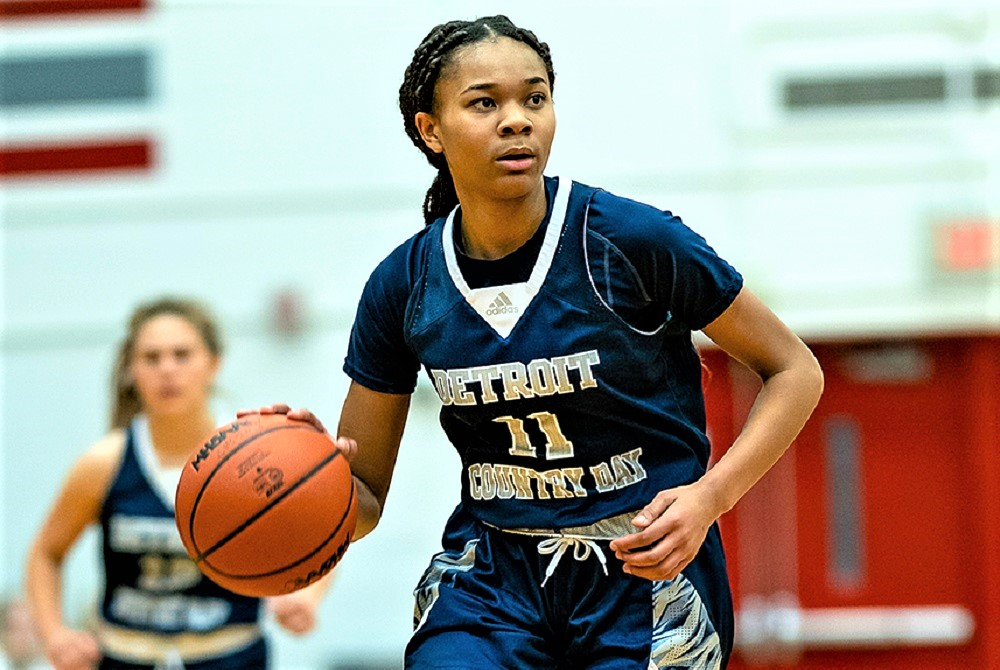
PHOTO Detroit Country Day’s Jaidyn Elam brings the ball upcourt during last week’s Regional Semifinal win over Livonia Clarenceville. (Photo by Douglas Bargerstock.)