

Renaissance Rises Again in Detroit PSL
By
Tom Markowski
Special for Second Half
February 16, 2017
DETROIT – Detroit Renaissance has had one of the top girls basketball programs in the Detroit Public School League for some time.
 The Phoenix reached an MHSAA Final (Class B) for the first time in 1996. In 2005, Renaissance won its only title (also in Class B) with Diane Jones serving as head coach and current head coach Kiwan Ward a member of her staff. Renaissance reached the Class A Final in 2010 and 2011, also with Ward as an assistant coach.
The Phoenix are 14-3 this winter, having lost to Detroit Martin Luther King in a PSL semifinal 56-47 on Feb. 8. They are enjoying another successful season even after graduating one of the top players in the state in 2015-16, now-Penn State freshman Siyeh Frazier, and despite the challenges of a changing landscape in PSL girls hoops.
While Ward believes the distance between the PSL’s most and least successful programs has grown in recent years, Renaissance remains stable. In her sixth season as head coach, Ward has 11 varsity players and continues to field a competitive junior varsity while others in the league are having a tough time doing the same.
“We have good chemistry,” senior Victoria Wright said of this year’s team. “It’s our defense that helps us win. The bond we have on and off the court is special. We always have a good time together.”
All eight of the Phoenix's league wins this winter were by double figures, and in six of those wins they held opponents to 25 or fewer points.
Renaissance’s only other losses this season were twice to Detroit Mumford, which will play King for the PSL title Saturday. (Renaissance and Mumford both finished 8-2 in league play to tie for first in the PSL West Division 1, but Mumford because of its sweep of the Phoenix earned the league title and a top seed in the PSL Big D Tournament.)
 Despite graduating Frazier, the Phoenix returned three starters from last season’s 14-5 team and are more balanced this winter. They are led by seniors Wright and Nina Reynolds; Wright is averaging 14 points and eight rebounds per game, and Reynolds is averaging 12 points and 10 rebounds.
In addition to its PSL success, Renaissance also owns a 15-point win from December over Southfield Arts & Technology, the leader in the Oakland Activities Association Red and another expected Class A contender.
A game of that caliber has helped the Phoenix as the degree of parity in girls basketball in the PSL has shifted of late, creating challenges for some of the strongest programs.
It’s the drop-off in many others that has hurt teams like Renaissance, Detroit Cass Tech, Detroit King and Detroit Mumford that remain the most competitive. There are just four PSL programs that sponsor a junior varsity, which leads to scheduling difficulties, as Ward has seen players leave for schools outside the city.
Ward said she doesn’t blame parents for sending their children to other Wayne County schools with open enrollment. Ward said uncertainty within the Detroit Public Schools as to which schools will remain open and which will close has parents on edge.
It’s reported that as many as 24 schools in DPS will close this year. Rumors abound which schools will close, but at this time they are just that: rumors.
“Look at it from a broader point of view,” Ward said. “The talent is watered down (in the PSL). I remember when I (played) at Detroit Benedictine. We looked forward to playing PSL teams. Every game was competitive. No disrespect to anyone, but it’s hard for the girls to get geeked-up when you beat someone 74-11.”
That was the score when Renaissance won in the first round of the PSL playoffs, defeating a former league power now in the midst of a tough run.
It’s different for the boys, where competition remains high. Sure, there aren’t powerhouse teams like Detroit Southwestern and Detroit Cooley of the late 1980s and early 1990s (although Detroit Western and Henry Ford both won their first MHSAA boys titles over the last two seasons), but there aren’t nearly the number of one-sided games in league play as there are for the girls.
 “There are eight to 10 teams on the boys side that are good,” Ward said. “With Cass Tech being down this year, we have like three good teams.”
Wright said she hopes to continue playing at the next level, possibly at Coastal Carolina. She said playing teams like King, Mumford and Southfield Arts & Technology brings out the best in her and her teammates.
Last season King defeated Renaissance in the PSL final, 68-66, to win its fifth consecutive league title.
“When you win by so much, it’s tough to play those games,” she said. “The competitive nature just isn’t there. It’s not that we’re not trying hard.
"It makes a big difference when you play those tougher teams."
Still, the top of the PSL remains strong – Renaissance included. King is expected to contend for its sixth Class A title under coach William Winfield and after finishing runner-up a year ago. Mumford also could make noise again in Class B.
Ward isn’t concerned about her program. It’s the others she’s worried about.
The Phoenix will finish their regular season next week against Detroit Country Day and Romulus before starting District play.
“The future in the PSL is uncertain,” Ward said. “For us, we’ll continue to get better.”
 Tom Markowski is a columnist and directs website coverage for the State Champs! Sports Network. He previously covered primarily high school sports for the The Detroit News from 1984-2014, focusing on the Detroit area and contributing to statewide coverage of football and basketball. Contact him at [email protected] with story ideas for Oakland, Macomb and Wayne counties.
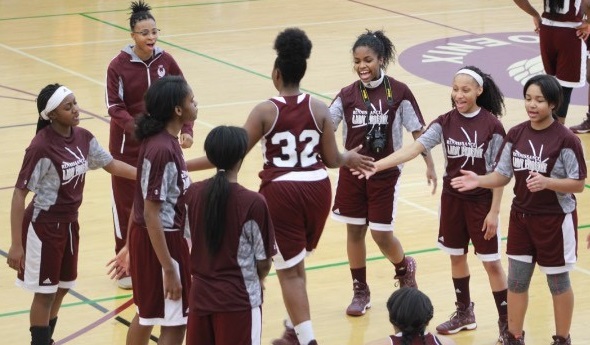
PHOTOS: (Top) Detroit Renaissance starters are introduced during a game this season. (Middle) Nina Reynolds (left) and Victoria Wright. (Below) The Phoenix set up their defense. (Photos courtesy of the Detroit Renaissance girls basketball program.)

Breslin Bound: Girls Report Week 6
January 14, 2020
By Geoff Kimmerly
Second Half editor
This week will see the midpoint of this 2019-20 girls basketball season, a logical time to take a look at who has done what with half the schedule played for many teams.
 But there’s little time to pause with a number of potential league-shaping games coming up over the next five days. Some are noted below in our “Can’t-Miss Contests,” while another 5-6 surely will guide which teams we feature in next week’s report.
“Breslin Bound” is powered by MI Student Aid and based on results and schedules posted for each school at MHSAA.com. Send corrections or missing scores to [email protected].
Week in Review
The countdown of last week’s five most intriguing results:
1. Detroit Edison 65, East Lansing 48 – These two could again end up at Finals weekend in March in Divisions 2 and 1, respectively, and reigning D2 champ Edison pulled away in this one to hand the Trojans their lone defeat.
2. Farmington Hills Mercy 46, Bloomfield Hills Marian 34 – The Marlins handed rival Marian its first Detroit Catholic League Central loss since 2017-18, taking a slight lead in the league standings with the rematch Jan. 28.
3. Manton 58, Maple City Glen Lake 54 – The Rangers moved to 8-0 and also got a look at another top Division 3 team they may see again at tournament time.
4. Frankenmuth 58, Essexville Garber 22 – Frankenmuth reached 900 wins as a program, going back to 1973, and with another win Friday the Eagles moved to 901-179 all-time midway through their 47th season.
5. Saline 40, Dexter 18 – These two may both end up Southeastern Conference champions in separate divisions, and Dexter’s was the first loss between them this winter.
Watch List
With an eye toward March, here are two teams in each division making sparks:
DIVISION 1
Macomb Dakota (8-0) The Macomb Area Conference Red annually is considered one of the most competitive leagues statewide. Dakota has a slight hold on first place thanks to playing one more league game than Grosse Pointe South so far and also after a 52-45 win over contender Utica Eisenhower on Friday. Dakota plays Grosse Pointe South for the first time this Friday.
West Bloomfield (7-2) The Lakers were Oakland Activities Association White champions last season, and after changing divisions have taken the higher-regarded OAA Red by storm. West Bloomfield last week handed first league losses this season to reigning Red champion Southfield Arts & Technology and third-place Clarkston, and can finish the first half of the league schedule undefeated with a win this Friday over reigning Red runner-up Royal Oak.
DIVISION 2
Frankenmuth (7-1) The Eagles, coming off a third-place finish in the Tri-Valley Conference East last season, are first in the new-look league this winter and coming off a milestone win (see above). They’ve dealt the only loss this winter to one of the second-place teams, Standish-Sterling, and take on the other second-place team Freeland on Friday. Frankenmuth’s lone loss was 59-52 to Division 1 power DeWitt.
Marine City (8-1) After finishing third in the Macomb Area Conference Gold last season, as St. Clair won the league title, Marine City is making a move as it leads the league coming off Friday’s 54-28 win over the Saints. The Mariners could equal last season’s 13 wins by the end of this month – and their lone loss was to MAC Blue leader Macomb L’Anse Creuse North a month ago.
DIVISION 3
Centreville (8-0) The Bulldogs have won 45 straight regular-season games and three straight league titles, and have opened up a one-game lead on Decatur and Bloomingdale this winter in the Southwest 10 Conference. Centreville defeated Bloomingdale 44-33 last week and sees Decatur for the first of two meetings Tuesday. That 11-point win over the Cardinals was the closest any of the first six league opponents has come to catching the Bulldogs.
Schoolcraft (5-1) These Eagles opened with a loss to now one-loss Edwardsburg, but haven’t fallen since and handed first league defeats last week to both Kalamazoo Hackett and Kalamazoo Christian. Schoolcraft has won 25 straight Southwestern Athletic Conference Valley games going back to 2016-17 and including four total so far this winter.
DIVISION 4
Ewen-Trout Creek (7-1) The Panthers have won seven straight since falling 49-47 to Calumet in their season opener. Along the way they’ve handed the lone loss to Baraga and last Thursday beat L’Anse 61-53 to take over first place alone in the Copper Mountain Conference Porcupine Mountain division. E-TC is aiming for a fourth-straight league title and also won its District last season.
Pittsford (9-0) First-year coach Aaron Davis has Pittsford looking like it has much of the last decade, with a run of double-digit wins and sitting first in the Southern Central Athletic Association East. Only Reading, in the Wildcats’ first game back from a two-week break, has come closer than 12 points – with Pittsford holding on for a 43-40 nonleague win. The Wildcats have won six straight league titles.
Can't-Miss Contests
Be on the lookout for results of these games coming up:
Tuesday – Saline (8-0) at Temperance Bedford (7-0) – The Southeastern Conference Red opener features two undefeated teams.
Wednesday – St. Ignace (5-1) at Pickford (9-0) – Avenging last season’s 84-41 District loss to reigning Division 4 runner-up St. Ignace would be another giant step for surging Pickford.
Friday – Manton (9-0) at Lake City (7-1) – They are tied for first in the Highland Conference; last season Manton won the league but Lake City made the Division 3 Semifinals.
Friday – Eaton Rapids (7-1) at Portland (7-1) – These two are tied for first in the Capital Area Activities Conference White as they near the midpoint of the league schedule.
Saturday – Detroit Edison (8-0) at Adrian Lenawee Christian (7-1) – The reigning Division 4 champion hosts the reigning title winner from Division 2, and Edison’s Gabrielle Elliott vs. Lenawee Christian’s Bree Salenbien should be one of the best individual matchups statewide this season.
Second Half’s weekly “Breslin Bound” reports are powered by MI Student Aid, a part of the Office of Postsecondary Financial Planning located within the Michigan Department of Treasury. MI Student Aid encourages students to pursue postsecondary education by providing access to student financial resources and information. MI Student Aid administers the state’s 529 college savings programs (MET/MESP), as well as scholarship and grant programs that help make college Accessible, Affordable and Attainable for you. Connect with MI Student Aid at www.michigan.gov/mistudentaid and find more information on Facebook and Twitter @mistudentaid.
PHOTO: Frankenmuth defeated Saginaw Swan Valley on Friday for win No. 901 in program history. (Photo by Terry Lyons.)