

Saints Finish Perfect Run with 4th Title
March 16, 2013
By Geoff Kimmerly
Second Half editor
EAST LANSING – Saturday’s Class D Final at the Breslin Center lined up to finish with another celebration for Waterford Our Lady of the Lakes, and one that would be etched into MHSAA history as the Lakers aspired for a fourth-straight title.
But St. Ignace also has been a regular in East Lansing the last four seasons. And the Saints had a little bit of history to contend with as well.
St. Ignace, owners of three MHSAA titles, had never finished a season perfect – until Saturday, when the Saints outlasted the Lakers for a 59-44 win to finish this winter 27-0.
“I kinda had a little worry there because we’ve never been a state championship team with an undefeated season,” St. Ignace senior Sarah Cullip said. “We’ve always had that pain of a loss, and we didn’t want that to happen again. We had a lot of inspiration from outside ourselves, and even within ourselves, I think.”
St. Ignace entered the postseason ranked No. 1 in The Associated Press’ Class D poll, while Our Lady (21-5) was No. 9. This was the Saints’ fourth straight trip to East Lansing; they made the Class C Semifinals a year ago, beat Grosse Pointe Woods University Liggett for the title in 2011 and lost to Flint Hamady in overtime in the 2010 Final.
In fact, St. Ignace was the only team in East Lansing this weekend that could match Breslin experience with the Lakers. Cullip played in her seventh tournament game at MSU, while senior Morgan LaVake and juniors Kelley Wright and Emily Hinsman all played in their fifth Saturday.
Coach Dorene Ingalls has coached all four champions during her 14 seasons running the program.
“Any time you win, it’s like the first time,” she said. “It’s a new group, with different reasons, different themes. It’s just like the first time. It’s been a journey. We’ve all grown together. I’m just thankful.”
Waterford Our Lady finished 21-5 and 88-19 over the last four seasons. Seniors Lexie Robak and Ava Doetsch started for all four of those teams, and in all four Breslin championship game appearances.
For much of Saturday’s game and especially the start, it looked like they and their teammates would join Flint Northern’s 1978-81 teams as the only ones to win four straight MHSAA girls hoops titles.
The Lakers opened in a fullcourt press that forced four straight turnovers to start the game. Robak hit two 3-pointers and senior Jessica Parry completed a three-point play as Our Lady jumped to a 9-5 lead a little more than five minutes in.
But St. Ignace soon figured out the press – and responded with a similar strategy that eventually would lead to the Lakers’ undoing.
A few plays in particular got Ingalls thrusting a fist in the air. The first came on the last shot of the first quarter. The Saints broke the press, and Wright found Cullip crossing to the basket behind the defense for an easy lay-in. St. Ignace ended the first quarter up 15-12.
 The next came 3:35 into the third quarter. Hinsman broke through the defense, scored, was fouled and finished the three-point play while Ingalls gave an approving nod from the bench. Those points pulled the Saints within one of the lead, and Hinsman’s bucket a minute later gave them their first lead since the first minute of the second quarter.
“They’re good at what they do. They’re here for the fourth time for a reason,” Ingalls said of Our Lady’s defense. “We were trying to get Emily to come to the middle and execute strong. When we tried to get up the right side and pass it up the right, it didn’t turn out well for us.
“The kids were able to keep their composure, keep at it.”
And turn the tide. Riding a matchup zone with halfcourt pressure, St. Ignace made it 38-38 with a quarter to play and then opened the fourth on a 9-0 run. The Lakers never recovered.
For the game, St. Ignace had only 11 turnovers to Our Lady’s 27, and scored 30 points off those turnovers to Our Lady’s 11 after takeaways.
“Looking at my players, they didn’t necessarily look open. That was the pressure they were putting on me,” said Doetsch, who mostly ran the point. “I didn’t have to pass, but nobody looked open. So it made it difficult to get the offense going.”
Hinsman finished with 20 points for St. Ignace, with Cullip adding 16 and grabbing nine rebounds and Wright scoring 10 and dishing five assists.
Lexie Robak led the Lakers with 25 points, including six 3-pointers – which tied her for second-most in an MHSAA girls basketball championship game. Parry added 10 points and six rebounds.
She also played in all four championship games, and the rest of the team’s six seniors – Brianna Topolewski, Marina Anderson and Haley Howell – all made their second title game appearances Saturday.
“My shot was going in, so I was kinda happy throughout the game. We had a good four years,” Robak said. “I just wanted to come out and have fun, and that’s what I did. It was a good last game with these cats.”
“That’s what it comes down to,” Our Lady coach Steve Robak agreed. “Of course, we all wanted to win. We left our hearts out there in the fourth quarter, gave it everything we had. At some point there are some tears, and you’re upset. But I feel a lot like Lexie; while it’s sad we didn’t win, and I wish we’d done some things differently, I’m just so proud of this group.
“To get here four times in a row, and win three, I don’t know how you could feel too much sadness for too long.”
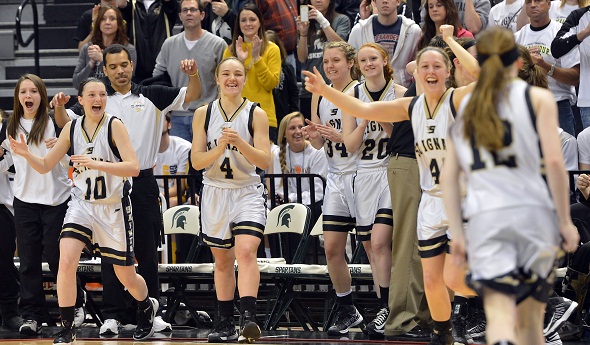
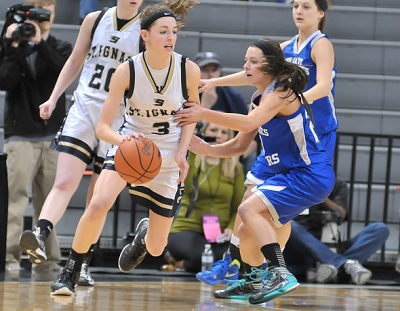
PHOTOS: (Top) St. Ignace players celebrate during the final seconds of their Class D championship game win over Waterford Our Lady. (Middle) St. Ignace's Sarah Cullip (left) attempts to drive around the Lakers' Ava Doetsch. (Top photo by HighSchoolSportsScene.com; middle photo by Hockey Weekly Action Photos.)
Newaygo Eyeing Another Playoff Run Led by Crew That's Been There
By
Tom Kendra
Special for MHSAA.com
December 2, 2021
NEWAYGO - Newaygo made a “Hoosiers”-like run to the Division 2 girls basketball championship game in April, but in its first game back Tuesday, the Lions found themselves trailing at halftime.
 Time for seventh-year Newaygo coach Nate Thomasma to peel the paint off the locker room walls?
Nah.
“We were in there about three minutes,” laughed Thomasma, who returns five of the eight players from last year’s magical team. “I just told them we need to do this, this and this and, if we do, then our shots will start falling.”
The Lions must have done those three things, as they outscored visiting Shelby 29-7 in the second half to turn a one-point halftime deficit into a comfortable 47-26 nonleague victory.
Over the final 16 minutes, the Lions looked like a team that could make another tournament run like last season’s, which didn’t end until a 52-32 Finals loss to Portland at Michigan State University’s Breslin Center.
Newaygo got the state’s attention in 2020 with a stunning upset of No. 5-ranked Grand Rapids Christian in the Regional Semifinals on a long-range, 3-pointer from then-sophomore Jaxi Long with six seconds remaining. That excitement was wiped away quickly, as the season ended abruptly the next day due to the COVID pandemic.
The “Little Lions” with their eight-player roster picked up right where they left off last postseason, knocking off perennial powers Grand Rapid West Catholic in Regionals and Detroit Country Day in the Semifinals at Van Andel Arena, before running out of gas in the championship game.
It was a ride to remember for the town of 2,471 residents, located about 30 miles northwest of Grand Rapids, which has just two state championships in school history – won by the back-to-back Class C girls basketball champions in 1985 and 1986.
 The Lions are back at it again with a 10-player roster, including five starters who were part of last year’s team – senior forwards Emmerson Goodin, Kayla Fisk and Lily Swinehart, senior guard Jaxi Long and junior guard Grace Painter.
“I really think we have a chance to go just as far,” said Long, whose older sister Jaylee was the star last year and is now getting increasing minutes on the varsity team as a freshman at Cornerstone University in Grand Rapids. “We need to play great defense, rely on each other and trust our abilities.”
Jaxi Long showed the ability to heat up from long range, nailing five 3-pointers and scoring 16 of her game-high 24 points to key the second-half run and bring the excited student section in “The Jungle” to its feet. Long added six rebounds and three steals.
As good as Long was after halftime, it was the 5-foot-10 Goodin who kept Newaygo close in the first half, scoring 10 of her 15 points before the break. Goodin grabbed a game-high nine rebounds (putting her over the 500-career rebounds plateau), along with three blocked shots.
Long and Goodin are the captains and unquestioned leaders of this year’s team, which played elevated competition this summer after the Finals appearance, including a demanding week at Grand Valley State’s team camp.
“It felt like we had a target on our backs and that everyone was coming for us,” said Goodin, who was also one of the standouts on Newaygo’s volleyball team this fall, which won a District championship. “We learned how to fight back. It made us a lot better playing those bigger teams that we are not supposed to be able to beat.”
Goodin is the team’s top returning scorer (13 points per game) and rebounder (nine per game). Long averaged 11 points, five assists and four rebounds last year.
Fisk could be the “X factor” on this year’s Newaygo team, with her 5-10 height and long wingspan making her a disruptive force on defense, particularly on the point of the Lions’ halfcourt trap. Fisk finished Tuesday’s game with six points, six steals and four rebounds.
Thomasma, who received honorable mention Division 2 Coach of the Year recognition last season, knows he has a seasoned, veteran team this fall – with four of the team’s five starters being seniors – while all five players on the bench are underclassmen.
“He is positive, and his criticism is always constructive criticism,” said Goodin. “He gets after us, but he doesn’t just yell at us for no reason.”
Newaygo entered last year’s postseason unranked, before reeling off a series of upsets. The Lions finished 14-0 in the Central State Activities Association Gold and 21-2 overall, with both losses coming against Portland.
Newaygo celebrated its runner-up finish with a new banner for the gymnasium, which was unveiled before a football game Sept. 24. Since that time, Thomasma has tried not to look back.
“These girls are confident because of the success we’ve had the past two years,” said Thomasma, who is assisted by Dan Maki. “But this is a new season. We’re going to attack it and make our own legacy.”
 Tom Kendra worked 23 years at The Muskegon Chronicle, including five as assistant sports editor and the final six as sports editor through 2011. E-mail him at [email protected] with story ideas for Muskegon, Oceana, Mason, Lake, Oceola, Mecosta and Newaygo counties.
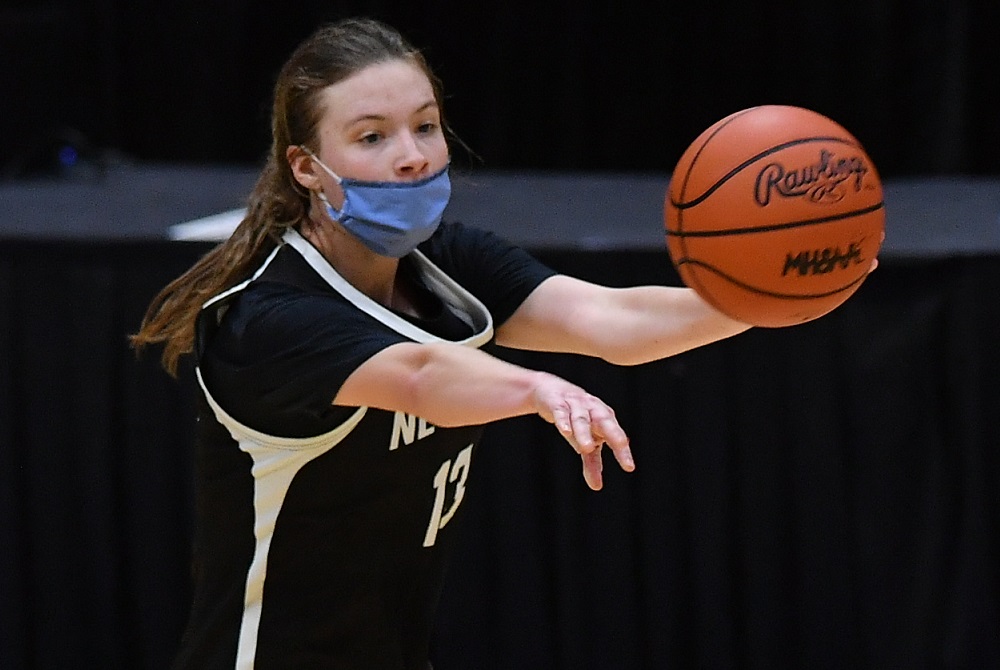
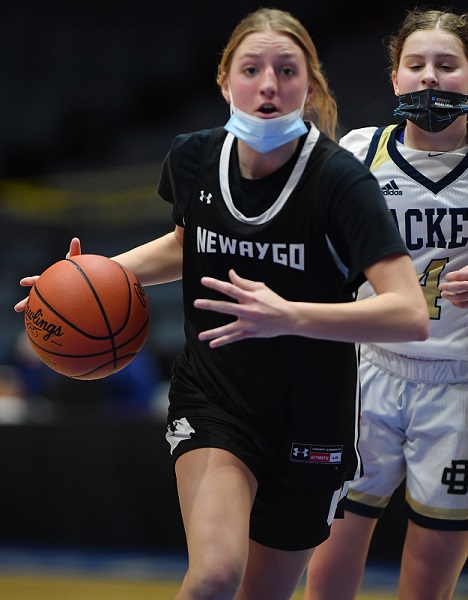
PHOTOS Newaygo's Jaxi Long (13) directs her teammates during last season's Division 2 Semifinal win over Detroit Country Day. (Middle) Kayla Fisk brings the ball up court at the Breslin Center. (Photos by Hockey Weekly Action Photos.)