

Seniors Come Up Big Again as Arbor Prep Clinches 1st Title since 2016
By
Paul Costanzo
Special for MHSAA.com
March 19, 2022
EAST LANSING – Kent City never lost hope Saturday that it could come back and knock off Ypsilanti Arbor Prep in the Division 3 Girls Basketball Final.
With less than a minute to play, the Eagles’ hope turned into a legitimate chance to do just that, as they had the ball and trailed by just four.
But Kari Woods took it all away.
The Arbor Prep senior guard stole a pass near midcourt and raced for a layup to extend her team’s lead to six points with 30 seconds to play, ending Kent City’s last, best chance, and sealing what ended up a 54-50 win for the Gators.
“I knew the game was tight, and we had been practicing up the line, all day, every day, every practice,” Woods said. “I knew I was there. I saw it and went for it.”
It was the second title for Arbor Prep, which also won in 2016 before finishing as runner-up each of the next two years.
 This was the Gators’ first trip back to the season’s final day since 2018, and they made sure to make the most of it.
“It’s difficult to get here,” Arbor Prep coach Scott Stine said. “Six years ago, we won on March 19, 2016, the same day. Six years ago, you would have never told me it was going to take six years to get another one. It is difficult. COVID has played a part in that. For our kids coming back, we just have to keep getting better. They know what it takes.”
That group learned from a small but vital senior class that included Woods, Texas A&M-bound Mya Petticord and forward Jazmin Chupp.
“(Kent City) is a great program,” Stine said. “They’re going to be back here again next year. Our goal for the rest of the girls in that locker room is to get good enough to improve enough that we can play them again next year. But I’m just happy. The seniors, all three of these girls at some point made plays to put us where we’re at. Mya, offensively, did what we know she’s capable of. Jazmin made some plays on both ends of the court. Kari Woods made arguably the most important defensive play of the game when she blew up that handoff and took it for a layup. That was a huge play. That’s what she does. Proud of all three of these girls.”
Petticord led the Gators (25-2) with 27 points. She had 20 points at halftime after connecting on seven of her first nine shots, and each of her first three 3-point attempts.
“It was really all about my focus,” Petticord said. “My nerves didn’t get the best of me today. Knowing this was my last high school basketball game, I just had to end it off with a lot of focus. Knowing it was my state championship game for the team – yeah, I was just focused.”
Woods added nine points and four steals, including the big one at the end. She played airtight defense all game against dangerous Kent City guard Lexie Bowers, who finished with nine points and nine rebounds. Bowers came into the Final averaging 17 points per game. Stine credited Woods, calling her the best perimeter defender in the state.
 “I think they play really tight, so (Bowers) had a hard time getting herself open off of that,” Kent City coach Aleah Holcomb said.
Arbor Prep’s tight defense frustrated Kent City (26-1) throughout the game, and the team that averages 26 3-point attempts per game could get off only 11 on Saturday. The Gators also forced 15 turnovers.
“I thought we had a difficult time handling their pressure,” Holcomb said. “They really made it difficult for us to get into our offense.”
Arbor Prep led by as many as 11 points late in the second quarter, and held at least a two-possession lead for nearly the entire second half.
But the Eagles never let the Gators fully get away, and cut the lead to as few as three when Madelyn Geers, who totaled a team-high 27 points, scored with 2:15 to play.
They never got the ball with a chance to tie or take the lead, however.
It was the second-straight runner-up finish for Kent City, which lost 52-50 against Grass Lake in last year’s Final.
“It’s frustrating, but I think we worked our butts off this season,” Kent City senior Taryn Preston said. “Obviously God got us here for a reason. I think he’s gifted every single person on the team, and we worked hard to get the best that we can out of our abilities. That’s just something that’s really, really cool to see as a member of the team. So, yeah, it’s frustrating at times, but I know that we worked our butts off to get here.”
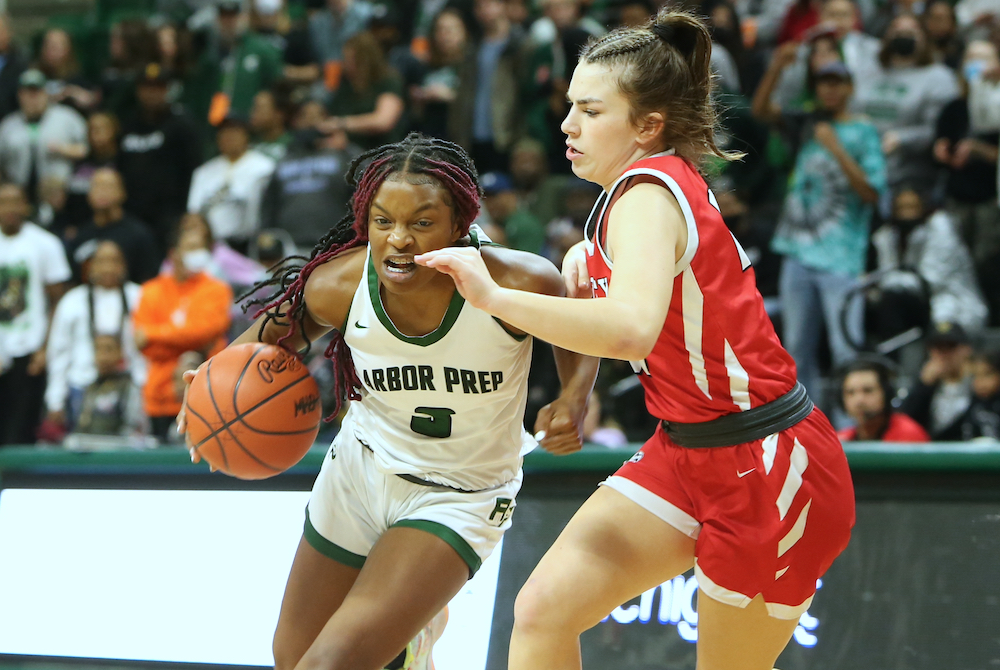
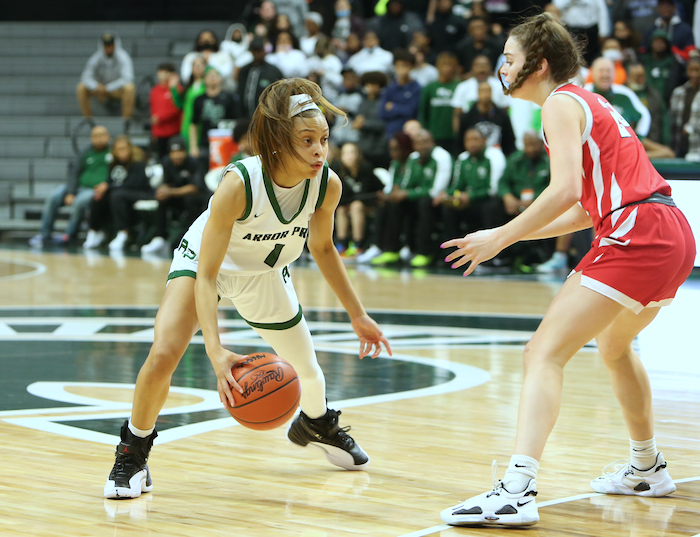
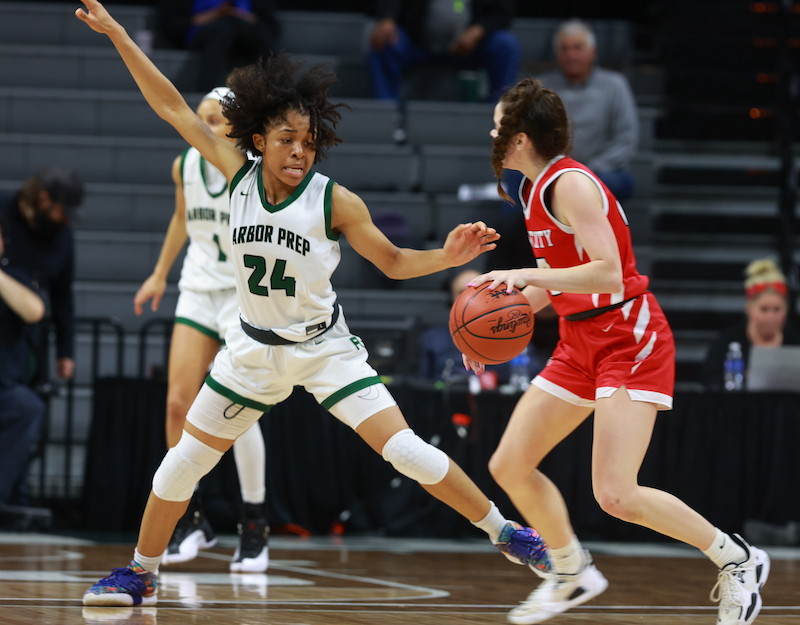
PHOTOS (Top) Arbor Prep’s Karianna Woods (3) drives with Kent City’s Lexie Bowers defending. (Middle) The Gators’ Mya Petticord (1) prepares to make her next move. (Below) Stacy Utomi (24) defends against Bowers. (Click for more from Hockey Weekly Action Photos.)
Record-Chasing Pittsford Again 20-0
February 23, 2018
By Doug Donnelly
Special for Second Half
Chris Hodos is up for a challenge. In fact, he and his Pittsford girls basketball have been preparing for it for weeks.
 The Wildcats on Thursday completed their fourth consecutive 20-0 regular season. Overall, they have won 75 consecutive games, just three shy of the MHSAA record in girls basketball.
If they are going to break the state consecutive wins record and take a third consecutive MHSAA championship trophy home to Hillsdale County next month, they are going to have to do it a rung higher on Michigan’s girls basketball ladder. The Wildcats are Class C this year after claiming Class D titles the last two seasons.
Hodos knows the road will be tougher.
“I expected to go 20-0,” he said. “We lost two all-staters, and people saw that and figured there was no way we’d go 20-0 again. But, I knew what we had coming back.”
Chief among those returning Wildcats is 5-foot-7 senior guard Marissa Shaw, the team’s leading scorer at 13.6 points per game – and something of a thief. The Jackson College signee has nearly 400 steals in her career.
“She set our school record with 15 steals in a game this year,” Hodos said. “She’s had two triple-doubles with points, steals and assists. She’s been in double figures in assists four times. She’s a real aggressive player.”
Shaw has been on the varsity since her freshman year, playing three minutes in the 2015 Class D Final loss to St. Ignace. That was the last time Pittsford lost a game. All five starters this year have played in multiple MHSAA championship games.
It’s likely no team in the state can match that type of big-game experience.
“All five of my starters have been on the team for three years,” Hodos said. “They’ve been to the Breslin Center through all of this. They know about what it takes to get there and what it’s like to play there. They all have experience. That’s something you can’t teach.”
The deep tournament runs have meant several more weeks of practice than a typical high schooler will play. Pittsford’s played 15 postseason games over the past two seasons alone.
That big-game experience probably played a hand in one of Pittsford’s biggest regular-season wins this year – a 68-56 win over Tri-County Conference champion Morenci. The Class D Bulldogs – who feature a pair of 1,000-point scorers in Mady Schmitz and Daelyn Merillat – were up 10 at halftime. Hodos made a defensive adjustment. and the comeback was on. Pittsford forged a tie at 44-44 going into the fourth quarter and outscored Morenci by 12 during the final eight minutes.
“They are so disciplined,” Morenci coach Larry Bruce said. “They are never out of position on defense. I watched the tape on them four or five times. The girls are never out of position. They made a really good adjustment at halftime, and their depth got to us. They are solid.”
Pittsford won the Southern Central Athletic Association East by six games, going 17-0 in league play. But, that’s all over now. It’s time for the MHSAA tournament. The last time Pittsford played in Class C was 2014-15 when it was erased in the District Final by Adrian Madison.
This year’s Class C tournament starts Monday for Pittsford when it goes on the road to play Clinton, the District host.
As the saying goes, the 101-1 record over the past 102 games is thrown out the window when the tournament starts.
 “We’ll run into some good teams,” Hodos said. “I have probably four or five potential teams that we could play on film. I like breaking down film and staying up all night.”
If any potential opponents are staying up all night watching Pittsford on film, they’ll notice something very familiar about the Wildcats’ offense. It’s the same one Hodos has used for at least a decade.
“I run a Bill Self offense, a high-low game,” he said, referring to the Kansas men’s basketball coach. “I’ve ran that since I was a JV coach, and it’s worked. We run it every year. People say you have to change things up or run something different, but, why, if its works?
"We get all kinds of different looks out of it, but that’s what it starts with. The girls know where to be. The repetition helps us. You see a lot of times where basketball players make bad passes. Often, it’s because they don’t know where someone is going to. They get lost in the play. We run the same thing. The girls know where each other will be.”
Besides Shaw, the other seniors for Pittsford are Hannah Patterson and Sydni Brunette, a 3-point sharpshooter. Junior Kennedy Chesney is a 53-percent field goal shooter averaging nearly eight points a game. Junior Alison Toner averages just under double figures. Hodos has three sophomores on the varsity, too.
“We do it more by committee this season,” he said. “We have a lot of girls contributing. That’s how I knew we’d be pretty good.”
Bruce, who’s coached off-and-on for 50 years, was impressed with what he saw in Pittsford last year and this season.
“They won’t embarrass themselves, I’m sure of that,” Bruce said. “People will have trouble with them. Shaw is really good, but after that there is no drop off for the next seven or eight girls. They all play well.”
Hodos is a Pittsford graduate who played football at Adrian College and returned to Hillsdale County to teach and coach. He currently works with students at the Hillsdale County Youth Home. He sometimes leans on his old college coach or other friends in the business for advice or just to talk about coaching. He’s been an assistant coach for more than 15 years with the Pittsford football team, running the defense.
“I try to get my knowledge from everywhere,” he said.
The record consecutive victory streak for boys basketball in Michigan ended this season when Powers North Central – winners of 84 straight – lost in December to Rapid River. The Jets’ is the longest streak in Michigan prep basketball history.
By beating Camden-Frontier on Thursday, Pittsford became tied with Flint Northern for second place on the all-time girls consecutive victory list with 75 straight wins. To tie Carney-Nadeau’s record of 78 straight, Pittsford will have to win the District. To break the record, they’ll have to win a Regional game.
That’s a long way off, but Hodos isn’t worried about it. He’s embracing it.
“It’s going to be a challenge,” he said. “It’s something different. I’m excited about it. I like scheduling different teams every year. A couple of years ago we played a couple of Class A schools that I found that would play us. It’s exciting.”
 Doug Donnelly has served as a sports and news reporter and city editor over 25 years, writing for the Daily Chief-Union in Upper Sandusky, Ohio from 1992-1995, the Monroe Evening News from 1995-2012 and the Adrian Daily Telegram since 2013. He's also written a book on high school basketball in Monroe County and compiles record books for various schools in southeast Michigan. E-mail him at [email protected] with story ideas for Lenawee and Monroe counties.
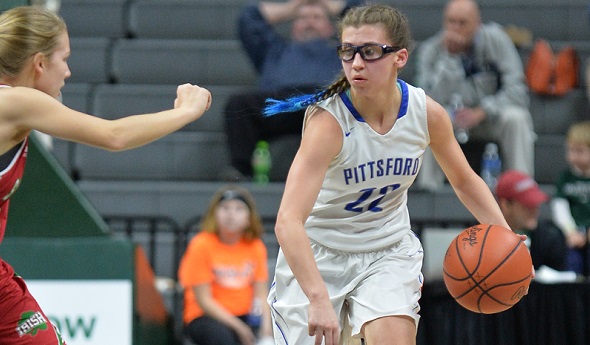
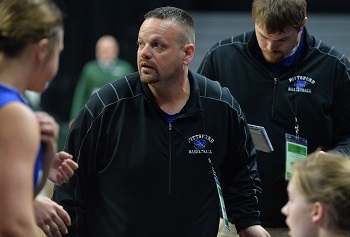
PHOTOS: (Top) Pittsford’s Marissa Shaw brings the ball upcourt during last season’s Class D Semifinal win over Mount Pleasant Sacred Heart. (Middle) Wildcats coach Chris Hodos talks things over with his team during the championship game victory against Saginaw Michigan Lutheran Seminary.