

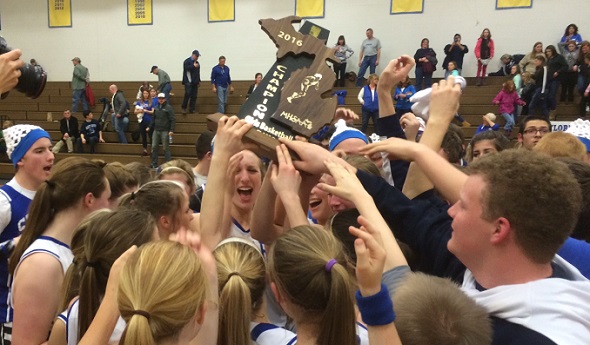
St Mary Shows it 'Can Play with Anybody'
March 14, 2016
By Dennis Chase
Special for Second Half
GAYLORD – Jim Myler played basketball at Mount Pleasant Sacred Heart.
 Still a fan of the Irish, his allegiance will be with another Catholic school tonight as Gaylord St. Mary takes on Sacred Heart in an MHSAA Class D girls basketball Quarterfinal. Myler’s daughters, Bekah and Emily, are key contributors on a 22-3 St. Mary team that beat Frankfort and Fairview last week to capture the Regional championship at Buckley.
“I’m all about my daughters, my family,” Myler said. “They mean the world.”
Bekah Myler, a senior center, averaged 16 points in leading St. Mary to its third Regional title in five years – surprising Frankfort along the way. The Panthers, led by Central Michigan-bound Mackenna Kelly, won the Regional the two previous years and advanced to the Semifinals a year ago.
The Snowbirds will be in an underdog role again Tuesday. Sacred Heart (22-1) beat St. Mary by 12 points in an early January nonleague contest.
“We’re going to go into that (Quarterfinal) game with the same mentality we had against Frankfort – that we can play with anybody,” Bekah Myler said. “We definitely have a fire burning in our hearts.”
Sophomore point guard Alex Hunter agreed.
“Frankfort was one of the best games we’ve played all year, hands down,” she said. “Everything clicked. We definitely have to bring it like that (Tuesday). We’ll have that underdog mentality. We feel we have something to prove. We know we can beat them. We just have to go out there and play hard.”
The Snowbirds breezed past Fairview 56-27 in the Regional Final. St. Mary held the Eagles without a field goal for more than nine minutes to open the game. However, it was the 54-41 win over Frankfort that drew attention, leading St. Mary coach Dan Smith to proclaim, “We’re back.”
It’s not that St. Mary had become a non-factor. The Snowbirds were 18-5 a year ago without a senior in the lineup. But District losses to Bellaire the last two years left an empty feeling. The Snowbirds made amends this season, topping Bellaire in the District Final.
“When I said ‘we’re back’ I meant we’re back deep into the tournament,” Smith said. “That’s where we want to be. That’s our goal every year – to compete for a Regional championship. It’s never easy, but we’ve got some kids that can play basketball.”
Young kids, too. The Snowbirds start two seniors, a junior and two sophomores. The two sophomores, guards Hunter and Averi Bebble, started on varsity as freshmen.
“We knew our sophomores had room to grow, but they’re talented kids,” Smith said. “They play a lot of basketball, probably 100 games a year (between high school and offseason teams). Their growing pains were felt last year. They came into this season in a much better position. Their confidence was at a B level at the start of the season. We’re closing in on the A level right now.”
Smith calls Hunter one of the best guards in northern Michigan.
“She’s very quick, plays outstanding on-the-ball defense and has a sweet shot,” he said. “We’re excited about our backcourt.”
Hunter and Bebble stood out in the Regional. It was their ability to handle Frankfort’s defensive pressure that limited the Panthers’ ability to create turnovers and transition scoring opportunities. The two then applied pressure of their own, attacking the basket on the offensive end.
“Bekah’s tough in the post and usually draws a double team, so that leaves cracks for Averi and Alex to penetrate,” Smith said. “They’re both quick, great ballhandlers, and they’ve got a good first step to the basket. If they see daylight, they’re going to get to the rim. If they get shut down, they’ll dish to Bekah.”
 The versatile Myler, who has scored nearly 1,200 career points, is the top option offensively. She can score in the post or on the perimeter.
“She does a lot of good things for us,” Smith said. “She allows our guards to do what they do because she draws a lot of attention in the middle.”
St. Mary showed some depth in the Regional, too. Myler netted 14 points, junior Gabby Schultz 11 and Hunter and Bebble nine each in the win over Frankfort. Myler came back with 18 points, senior Giorgi Nowicki 10, freshman Olivea Jeffers nine and Bebble eight in the title game with Fairview. Sophomore Emily Myler pulled down a team-high nine rebounds while Hunter added five assists in the Regional finale.
The play of the underclassmen, especially the sophomores, has not shocked Bekah Myler, who played on the Snowbirds Quarterfinal team in 2013.
“Those girls have put in so much work during the offseason,” she said. “Basketball is a year-round sport for half of our team. I’m not surprised. They put in the work. They deserve a moment like this.”
The Snowbirds finished second in the Ski Valley Conference to Johannesburg-Lewiston (19-2). It was a close second as St. Mary dropped a pair of two-point games to the Cardinals.
“The fact we lost those two games (to Johannesburg-Lewiston) actually helped us keep our edge,” Smith said. “It was a gift in disguise. It gave us the energy to work towards the rest of the season and point to the tournament because that would be our time.”
That’s proven to be the case. Now, though, the stakes get higher with Sacred Heart looming.
“We’ll have a little bit of a chip on our shoulder,” Smith said. “We’re going to bring everything we’ve got. They’re a great program. I have a lot of respect for (Sacred Heart coach) Damon Brown. He does an excellent job. But our team is far improved. We’re not the same team that we were earlier in the season when we faced them. We’re very excited about the opportunity.”
Bekah Myler will draw a tough defensive assignment, guarding 6-3 Averi Gamble, her AAU teammate during the offseason. Gamble scored 24 points, grabbed 24 rebounds and blocked four shots in Sacred Heart’s Regional championship win over Portland St. Patrick.
The Snowbirds would like to reverse a recent trend. St. Mary narrowly lost its last two Quarterfinal appearances – 42-40 to Climax-Scotts in 2013 and 59-57 to Crystal Falls Forest Park in 2012.
“It’s a pretty big deal for us to be here right now,” Bebble said. “But we want to break through (that barrier) and get to the Breslin.”
 Dennis Chase worked 32 years as a sportswriter at the Traverse City Record-Eagle, including as sports editor from 2000-14. He can be reached at [email protected] with story ideas for Manistee, Wexford, Missaukee, Roscommon, Ogemaw, Iosco, Alcona, Oscoda, Crawford, Kalkaska, Grand Traverse, Benzie, Leelanau, Antrim, Otsego, Montmorency, Alpena, Presque Isle, Cheboygan, Charlevoix and Emmet counties.
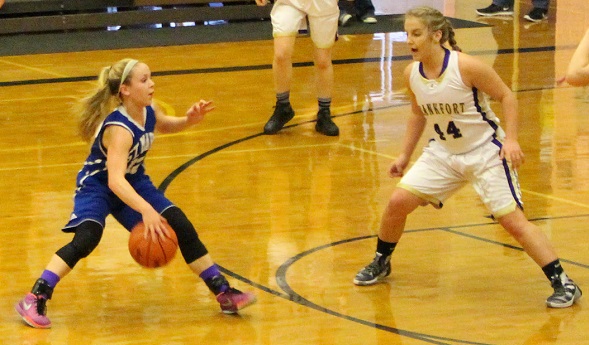
PHOTOS: (Top) Gaylord St. Mary celebrates its Regional Final win last week. (Middle) Alex Hunter sets up the offense for the Snowbirds against Frankfort during the Regional Semifinal. (Top photo by Denny Chase; middle photo courtesy of Gaylord St. Mary athletic department.)
Eagles' Ace Has Scoring Record in Sight
February 8, 2018
By Doug Donnelly
Special for Second Half
ERIE – The Liedel family barn in Erie has been home to some great basketball battles the past few years.
 It’s also the home court for soon-to-be all-time Monroe County Region scoring champ Mary Liedel.
A senior, Liedel is in her fourth season playing for Erie Mason. She will enter Friday’s scheduled game against Onsted with 1,657 career points – just eight points shy of the all-time Monroe County Region record of 1,665 points set by Petersburg-Summerfield’s Melissa Taylor during the 1990s.
It’s ironic the 5-foot-10 senior guard could set the record against Onsted. It’s against the Wildcats that she scored 51 points in a game last year to break the Monroe County single game mark.
“I just love the game,” Liedel said. “There is just something about it. God gave me the talent to go out and play basketball, and I want to return the favor for Him. I just play my heart out for Him.”
Those games in her barn, against some of her nine siblings, helped turn Liedel into a superstar scorer.
“In our barn, we always play one-on-one,” Mary said. “My brother, Joey, and I play a lot of one-on-one. He’s really helped my game.”
Joey is a sophomore and the leading scorer on the Eagles boys basketball team. Mary has led the Eagles in scoring since her freshman year. After averaging 8.8 points a game that season, her scoring average ballooned to 24.2 points a game as a sophomore. Still, she saw room for improvement.
“My shooting percentage wasn’t where I wanted it to be,” she said. “I worked hard on that all summer. My game has grown tremendously. Even last year I didn’t shoot very well on 3-pointers. I worked hard all summer shooting to get that percentage up.”
Her junior year, she scored 585 points and was named Player of the Year by The Monroe News and second team all-state by The Associated Press. She was held below double figures just once all season. Besides the 51-point outburst, she had games of 44, 33, 32 and 30 – all while shooting 40.1 percent from the floor and 66.1 percent from the free throw line. She got to the free throw line 242 times. Three times she attempted at least 20 free throws in a game.
Blissfield head coach Ryan Gilbert called her the “ultimate competitor.”
“She’s a very humble person,” Gilbert said. “Her ability to finish around the rim and through contact is the best I have seen since I have been here.”
Another area of her game that she wanted to improve was rebounding. That mission was accomplished as she had 14 double-doubles as a junior, including a career-high 22 rebounds in one game.
Onsted head coach Brandon Arnold said that 51-point game was remarkable. Liedel was 23-for-29 from the free throw line and made 13 field goals.
 “On that night she was un-guardable,” he said. “She was hitting from the 3-point line as well as her shots in the paint. She put her team on her back. She finished well, used her body to create contact, and made a lot of free throws.”
This season started out with an impressive 46-point performance against Ypsilanti Lincoln when she made all seven of her 3-point attempts. While averaging 22.5 points a game, she has increased her rebounding to 11.5 a game and also leads the team in steals, blocked shots and assists.
“I think I’m stronger and I jump higher, and I’m playing down low a lot more,” she said of her rebounding.
Tuesday, against Hillsdale, Liedel had what might be her best all-around game. She recorded her first ever triple-double with 30 points, 13 steals and 10 rebounds.
“I think it was for sure one of my best games,” she said. “I had a good defensive game with a lot of steals.”
Erie Mason head coach Josh Sweigert called it one of her most complete games.
“That game just shows what a complete player she is,” he said. “Not only did she score 30 points, but she also accumulated 13 steals by being in the right place and using her great understanding of the game to make those plays.”
Liedel is the fourth player in Monroe County Region history to pass 1,600 career points. Taylor scored two more points than Whiteford’s Karen Hubbard totaled during the 1970s, and Kiara Kudron also scored more than 1,600 points for New Boston Huron. With at least five games remaining, Liedel is likely to set a new standard that will be hard for any athlete to catch.
The Eagles have steadily improved as a team during Liedel’s time on the court, from three wins her sophomore year to a 12-4 record this season. Erie Mason won’t win the Lenawee County Athletic Association crown – Ida has already wrapped it up – but is focused on winning a District.
“That would definitely be cool,” she said. “We have a good team and a good chance. We’re really focused on that. It’s been really fun this season.”
Liedel has been in contact with some small colleges in Michigan as she considers continuing her playing career.
“I for sure want to play at the next level,” she said. “I’m just undecided where right now.”
Sweigert has had a front row seat to watch Liedel as the Eagles head coach. He continues to be impressed by her talent and work ethic.
“Mary is one of the hardest working players I have ever seen,” he said. “She is the first one in the gym and the last one to leave. She pushes herself and her teammates during practices to be the best that they can be. It would be very easy to be satisfied with where she is due to the success that she has had, but that is just not how she is. She wants to be the best player that she can be.”
As for becoming the career scoring leader in Monroe County, Liedel says that isn’t something she’s concentrating on.
“I could care less about the stats, or points or breaking records,” she said. “I just go out and try and do everything I can for us to win as a team. I’d do anything for the team.”
 Doug Donnelly has served as a sports and news reporter and city editor over 25 years, writing for the Daily Chief-Union in Upper Sandusky, Ohio from 1992-1995, the Monroe Evening News from 1995-2012 and the Adrian Daily Telegram since 2013. He's also written a book on high school basketball in Monroe County and compiles record books for various schools in southeast Michigan. E-mail him at [email protected] with story ideas for Jackson, Washtenaw, Hillsdale, Lenawee and Monroe counties.
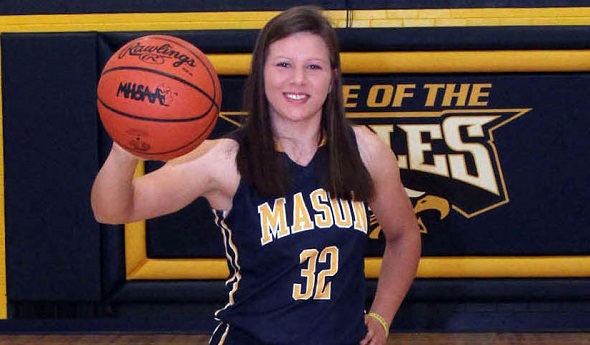
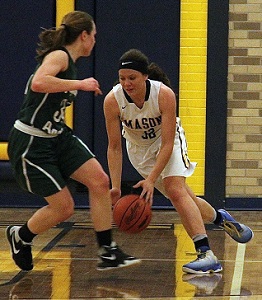
PHOTOS: (Top) Erie Mason’s Mary Liedel is drawing closer to setting her area’s career scoring record. (Middle) Liedel works to get past a defender. (Photos by Angie Ayers.)