

#TBT: Redettes Bring Home Class A Title
March 31, 2016
The following tells the story of the 1976 Marquette girls basketball team, still the only Upper Peninsula team to win an MHSAA Class A girls basketball championship. This piece, by MHSAA historian Ron Pesch, served as the story behind the ceremony from a “Legends of the Games” program celebrating the Redettes.
If you never have dreams, they can never come true.
For coach Barb Crill and the girls basketball team from Marquette, the dream was to win an MHSAA basketball crown.
“Barb said to us as incoming freshmen that we would win the state,” said Karen Levandoski Helmila, recalling her days as a Redette.
The girls had come close early in Crill’s tenure. In three years, Crill's squads had compiled a 52-4 record, including a 16-2 mark in 1973, a 19-1 record in 1974 and 17 straight victories the following year.
In 1974, Grand Rapids Christian eliminated the Redettes in the Regional Final. In 1975, the team averaged 68 points a game to 25.9 for the opponents. In the MHSAA District Final, Marquette downed Sault Ste. Marie, 109-16, then brushed aside Portage Central, 72-18, in the Class A Quarterfinals. However, the voyage ended abruptly in the Semifinals with a loss to Farmington Our Lady of Mercy, 62-57.
The nucleus was in place for another run at the title in the fall of 1976. The team had lost all-U.P. players Jean Moratti and Laurie Niles, but had strong replacements. The Levandoski twins, Karen and Kay, Cheryl Aho, Janet Hopkins, Sue Belanger and Caron Krueger were all seniors, and Katie Miller, a senior transfer from Eau Claire, Wis., had joined the team. Forward Shelly Chapman, a junior, also had won all-U.P. honors. Sophomores Cynde Cory and Chris Moran were expected to be the first off the bench. Sue Micklow, Kate Jennings, Lisa Coombs, Mary Erspamer, Cathy Niles and Sue Lakanen rounded out the squad. Karen Meyers, the leading scorer on Northern Michigan University's basketball team and former Redette, was returning for her fifth year as Crill's assistant.
But time was running out for the squad to achieve their coach's prophecy.
“Over the years we had played every good team in the U.P.,” said Crill. “The girls needed more.”
So on Labor Day weekend, 1976, the Redettes prepared for a trip to Detroit – their coach's old stomping grounds. Crill had arranged scrimmages against some old friends in the Motor City; among them Detroit Dominican, coached by Sue Kruszewski and winner of the Class A title in 1973 and 1974, and Harper Woods Bishop Gallagher, which had made it to the Quarterfinals in 1973.
The Marquette squad responded to the challenge, playing well in the workouts.
“The girls came back in shape from summer vacation,” Crill told the media after the trip. “Most had done a lot of work on their own, while others stayed active playing other sports.”
A native of Allen Park, Crill had started coaching and teaching in Ann Arbor Public Schools in 1959. She instituted Marquette's girls program during the 1969-70 season. “We started here before there was any MHSAA (sanctioned) ball,” said Crill. “The girls provided their own uniforms. The principal, Paul Kotila, provided a bus and driver. We played everyone with a team. It promoted a lot of the interest.”
Back in the U.P., it was business as usual. In the home opener, Marquette trounced Gladstone, 71-19, as 14 girls saw time on the court. Next, they downed Negaunee, 87-21.
Through 17 additional regular-season games, the result was the same. Omitting a 2-0 forfeit by Harbor Springs, the Redettes improved their average from 1975 to 80.8 points per contest, while decreasing their opponents’ average to 25.2 per game.
The squad dumped Escanaba, 71-29, before a crowd of about 100 for the District title at Escanaba. Shelly Chapman led the team with a season-high 33 points. In Grand Rapids for the Regionals, the Big Red Machine defeat Benton Harbor, 64-55. Leading at the half by 25 points, Crill went to the bench. Again, Chapman led all scorers with 21 points, while Krueger added 16 and Hopkins added 13.
In the Regional Final, the Redettes faced a taller Grand Rapids Union squad. Despite the partisan Union crowd and a slim three-point lead at the end of the third quarter, Marquette pulled away for a 48-34 win.
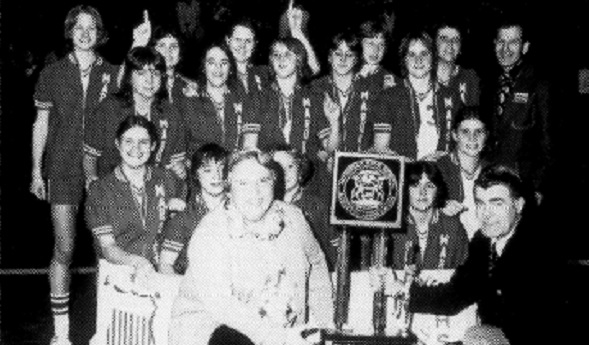
With another victory in the bag, the Redettes congratulated one another in a familiar postgame scene during the 1976 championship run. True to her words, Crill and her Marquette cagers would have a season to remember and scrapbooks to compile following their impressive run to the MHSAA title. In the Quarterfinals, the team defeated Lansing Eastern, 67-37, then disposed of Flushing, 62-46, in the Semifinals. All that remained was a rematch with Farmington Our Lady of Mercy.
This time Marquette would not be denied, downing the reigning champs, 68-41. Chapman finished with 23, Hopkins poured in 19, and Krueger hit for 14 as Crill's starting five went the entire game without a substitution.
“I was impressed with the ladies’ positive attitude as we prepared for the championship game,” said Crill, reflecting on the matchup. “They seemed quiet, very determined, very patient with one another and quite business like. I had coached many games by the fall of 1976, but I never remember another game where we planned together what to do to win, and they followed our plan perfectly.”
The team was the first Class A school from Michigan's Upper Peninsula to win an MHSAA basketball championship, a feat that has not been repeated since.
“The strength that our team held through the entire game was so strong,” said Aho Reynolds. “That's the way I felt. The more baskets we made the more we wanted. The offense and defense combined everything that night.”
“The crowd was so large for the Final game,” recalled Levandoski Helmila. “There were thousands of people watching and it seemed like only 50 cheering for us. We were glad to face the team that knocked us out of the tournament the year before. We worked together for so long to reach our goal.”
“We wanted that victory not only for the members of the team, but for our coaches, parents and community,” echoed Levandoski Angeli. “We were not only a team, but a family. Our coaches made it clear and instilled in us that no individual was a star alone.”
“Wow! It was fun,” said Hopkins, “a great ending to four years of high school basketball. We dominated the game. We were the underdog, yet we were confident and played to our strengths. Each year I played, the team improved its skill level. In my senior year everything came together and we were unstoppable! Each team member contributed to the outcome, whether it was during practice, or a game. We were focused and determined to succeed.”
“Cheryl Aho's incredible defense stands out in my mind,” remembered Coombs Gerou. “She stopped one of the leading scorers in the state. Our team defense really stood out. “Everyone played, and on any given night someone off the bench would score as much as someone who started. We all treated each other with respect and worked together as a team. Coach Crill taught me that anything was possible if you worked and prepared for it.
“Another memory was our singing on the bus, even those of us who couldn't carry a tune.”
It was one of the longer bus rides that set the foundation for that championship year.
“I think that trip (to Detroit) was the biggest difference,” said Crill. “It gave them more experience playing the type of teams they would meet in the tournament. They could see they were talented enough. They had already played the best there was. They realized they could beat them again.”
Hartland Sets Sights on Unprecedented Heights
January 14, 2020
By Geoff Kimmerly
Second Half editor
This season isn’t half over for the Hartland girls basketball team. And as impressive as they’ve performed over the first six weeks, there are lessons from the last few seasons they must continue to recall with expectations high this winter.
 Take last week’s 50-40 win over Plymouth. The Eagles trailed early 14-1 – reinforcing coach Don Palmer’s message that every opponent is aiming to bring its best against a Hartland team with championship aspirations.
“I think a lot of times they’ve very focused and excited,” Palmer said of his team. “But … being teenagers, sometimes they’re complacent and take it for granted – and that’s just natural. That’s when we get upset, so we just kinda battle that a little bit.”
The hope is winning those prepares the Eagles for an unprecedented opportunity at the end of March.
The Hartland girls basketball team is the MHSAA/Applebee’s “Team of the Month” for December, opening with four wins including victories over a pair of reigning MHSAA Finals champions – Division 4 Adrian Lenawee Christian (61-40) and Division 1 Saginaw Heritage (37-26) in the Eagles’ first two games. They closed the month with double-digit wins over Okemos and Bay City John Glenn, two more programs with high hopes this winter, and have since moved to 6-0 heading into Tuesday’s game against Howell.
Palmer has coached high school varsity basketball a combined 71 seasons, leading teams to 963 wins through Friday – the most in Michigan high school history. So when he says this season’s Hartland girls basketball team is the most talented he’s coached, that carries significant weight.
Palmer ranks seventh in MHSAA girls basketball history with a 616-311 record after leading Milford from 1977-2009 and then the Eagles since 2009-10. He quickly can recount the three athletes he sent on to Division I college athletics during those first three decades – before then offering context by describing how this Hartland team is led by University of Michigan recruit Whitney Sollom with at least five more players holding or on the verge of opportunities at the next level.
 So talent isn’t a question. But will this also turn out to be Palmer’s best team?
Hartland has made the Class A/Division 1 Quarterfinals the last two seasons, finishing 22-4 a year ago. Sollom, a 6-foot-3 post, has been on varsity all four of her seasons, with the team a combined 70-12 during that time.
A likely Miss Basketball candidate, Sollom was averaging 11.4 points and 12 rebounds per game entering last Friday’s 44-point win over Salem. Leading the team in scoring is Nikki Dompierre at 12.6 ppg, while Madi Moyer adds 8.2 and 7.4 rebounds per game. All three are senior captains.
Junior Syd Caddell and sophomore Amanda Roach also are back as the team returned its entire starting lineup this winter.
The challenges will start locally. Undefeated Brighton and the one-loss Highlanders also both play in the Kensington Lakes Activities Association West. Howell also is in Hartland’s District.
Palmer said his team’s unselfishness and support of one another have impressed him most. But of course there’s a long way to go this season – and the team is hoping to build to a big finish as it seeks its first MHSAA Finals championship in this sport.
“We’re really in a great cycle,” Palmer said. “When I got the job at Hartland, I had been in the same league at Milford, and we were beating their varsity by 1-2 points. But the lower levels, we could just seeing it coming. My comment to my staff is we’ll have no excuses for not winning.
“I’m very happy and thrilled about the success, but I also knew we’d have players.”
Past Teams of the Month, 2019-20
November: Bridgman girls cross country - Report
October: Allegan boys tennis - Report
September: Ishpeming Westwood girls tennis - Report
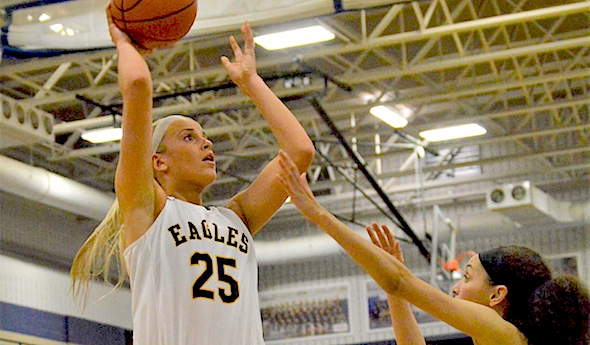
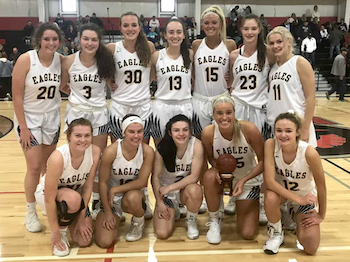
PHOTOS: (Top) Hartland's Whitney Sollom puts up a shot during a December win over Okemos. (Middle) The Eagles celebrate with a team photo after the win over Bay City John Glenn. (Top photo courtesy of State Champs Sports Network; middle photo courtesy of the Hartland girls basketball program.)