


Thompson Erases Doubt, Makes History
By
Paul Costanzo
Special for MHSAA.com
February 14, 2017
 When Jacara Thompson tore the anterior cruciate ligament in her left knee this past summer, she thought she was done playing basketball.
The fact it was the second torn ACL of her high school career, along with the timing of the injury, had the Swartz Creek superstar doubting her future.
“I thought I wasn’t going to play basketball anymore,” Thompson said. “This is my second knee blowout and I need to be done – that was my first thought. I was going to miss my whole senior year, and that was really hard.”
Thompson proved her initial thoughts wrong, however, and is back on the court making history. Recently, she broke a school record that had stood since 1979, setting the all-time mark for scoring at Swartz Creek. She had scored 1,179 career points through Feb. 10, now well ahead of the former mark of 1,087.
“I don’t even know how to explain it,” Thompson said of setting the record. “Nobody in my family has ever broken a big record like that or anything. It really didn’t hit me until people started telling me congratulations.”
Those congratulations would have been well deserved for any player hitting that mark. For those who have watched Thompson overcome two major knee surgeries and break the record despite missing 17 games, the moment was even more special.
“I was extremely proud,” Swartz Creek girls basketball coach Adrian Trzebiatowski said. “As a player, you have a tremendous amount of respect for anyone that achieves that goal. As a coach, to see a young woman grow up, to blossom, to develop into a very good basketball player and an amazing person, it is an extreme sense of pride and admiration for what she’s gone through.”
It was in Trzebiatowski’s second season at Swartz Creek that Thompson entered high school, and the slashing guard was making an impact on the varsity team as a freshman. But her debut lasted only six games as Thompson’s first torn ACL, in her right knee, came early in her career.
She came back with a strong sophomore campaign, and as a junior joined the state’s elite, averaging 25 points per game and totaling 501. She was named Class A all-state second-team by The Associated Press.
“Early in her career she was a slasher – she could take a bump or two or three and still get to the basket,” Trzebiatowski said. “Last year we really committed to lifting weights, and she could finish with contact. She was able to get herself to the line and finish layups. I wish there was a stat column for how many and-ones she has. She was a strong player who could really plow and weave her way to the basket.”
Thompson also was developing a stronger mid-range game and working on her outside shot to keep defenders even more off-balance. Before she could showcase her advancing skills and build on the momentum of her junior season, she suffered her second ACL tear.
While an initial doubt she could return again was in her own mind, it was something her coach never saw.
“She knew how to rehab, and knew what she had to do to get back,” Trzebiatowski said. “As far as mental toughness, Jacara overcoming this is probably one of the toughest athletes I’ll ever coach.”
As Thompson worked her way back again, she said it was her Swartz Creek teammates who helped her get to the right place mentally.
 “I finally got over it when I started to practice with my team,” Thompson said. “I couldn’t scrimmage with them, but they made me feel even better, that you’re going to be even stronger when you come back.”
Trzebiatowski said the team had to learn to play without Thompson over the summer, but despite that, Thompson’s impact on the young Dragons squad remained strong.
“Everybody looked at her as a leader, but I don’t think she’s always felt that way until this year,” Trzebiatowski said. “When we actually voted for team captains, the team decided before we even voted that Jacara would unanimously receive the vote for team captain. That’s never happened to me.”
Thompson missed the first two games of the season, but has come back strong. She’s averaging 17 points per game and has now added a more dangerous 3-point shot to her repertoire, something she said already has caused opposing defenders to take notice.
“I kind of always knew I had to get better at it,” she said. “Shooting wasn’t really my big thing. I always loved driving and getting to the basket and to the free throw line, but I knew I had to add an outside game. I feel like (defenders) look for me to go the basket every time, but now that I have an outside shot, they’re going to have to check me. They’ve caught on. They call me a shooter now.”
She said she feels like her old self now, although it took a while to get there.
“I’d say probably about 90 percent of it is mental, really,” Thompson said. “Because you have to think about what move am I going to do? Am I going to tear my ACL again? You think about every move you do when you’ve been through two ACL surgeries.”
Thompson is undecided on her basketball future, but said she wants to play at the college level. Her injuries have helped her to focus on her off-court future, however. No matter where basketball takes her, Thompson wants to study to become a physical therapist.
“I had always thought about going overseas and even trying to make it to the WNBA,” she said. “I don’t think I want that anymore. I want to do something to help people with ACL injuries.”
 Paul Costanzo served as a sportswriter at The Port Huron Times Herald from 2006-15, including three years as lead sportswriter, and prior to that as sports editor at the Hillsdale Daily News from 2005-06. He can be reached at [email protected] with story ideas for Genesee, Lapeer, St. Clair, Sanilac, Huron, Tuscola, Saginaw, Bay, Arenac, Midland and Gladwin counties.
PHOTOS: (Top) Swartz Creek's Jacara Thompson prepares to shoot a free throw. (Middle) Thompson, back this season after multiple knee surgeries during her career, looks to get past a defender. (Photos courtesy of the Swartz Creek girls basketball program.)
Eagles' Ace Has Scoring Record in Sight
February 8, 2018
By Doug Donnelly
Special for Second Half
ERIE – The Liedel family barn in Erie has been home to some great basketball battles the past few years.
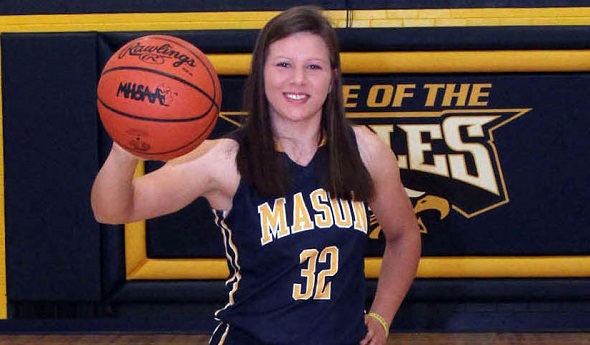
 It’s also the home court for soon-to-be all-time Monroe County Region scoring champ Mary Liedel.
A senior, Liedel is in her fourth season playing for Erie Mason. She will enter Friday’s scheduled game against Onsted with 1,657 career points – just eight points shy of the all-time Monroe County Region record of 1,665 points set by Petersburg-Summerfield’s Melissa Taylor during the 1990s.
It’s ironic the 5-foot-10 senior guard could set the record against Onsted. It’s against the Wildcats that she scored 51 points in a game last year to break the Monroe County single game mark.
“I just love the game,” Liedel said. “There is just something about it. God gave me the talent to go out and play basketball, and I want to return the favor for Him. I just play my heart out for Him.”
Those games in her barn, against some of her nine siblings, helped turn Liedel into a superstar scorer.
“In our barn, we always play one-on-one,” Mary said. “My brother, Joey, and I play a lot of one-on-one. He’s really helped my game.”
Joey is a sophomore and the leading scorer on the Eagles boys basketball team. Mary has led the Eagles in scoring since her freshman year. After averaging 8.8 points a game that season, her scoring average ballooned to 24.2 points a game as a sophomore. Still, she saw room for improvement.
“My shooting percentage wasn’t where I wanted it to be,” she said. “I worked hard on that all summer. My game has grown tremendously. Even last year I didn’t shoot very well on 3-pointers. I worked hard all summer shooting to get that percentage up.”
Her junior year, she scored 585 points and was named Player of the Year by The Monroe News and second team all-state by The Associated Press. She was held below double figures just once all season. Besides the 51-point outburst, she had games of 44, 33, 32 and 30 – all while shooting 40.1 percent from the floor and 66.1 percent from the free throw line. She got to the free throw line 242 times. Three times she attempted at least 20 free throws in a game.
Blissfield head coach Ryan Gilbert called her the “ultimate competitor.”
“She’s a very humble person,” Gilbert said. “Her ability to finish around the rim and through contact is the best I have seen since I have been here.”
Another area of her game that she wanted to improve was rebounding. That mission was accomplished as she had 14 double-doubles as a junior, including a career-high 22 rebounds in one game.
Onsted head coach Brandon Arnold said that 51-point game was remarkable. Liedel was 23-for-29 from the free throw line and made 13 field goals.
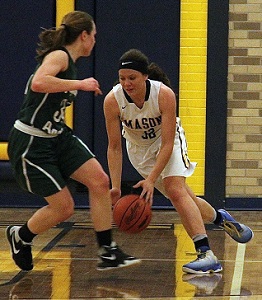 “On that night she was un-guardable,” he said. “She was hitting from the 3-point line as well as her shots in the paint. She put her team on her back. She finished well, used her body to create contact, and made a lot of free throws.”
This season started out with an impressive 46-point performance against Ypsilanti Lincoln when she made all seven of her 3-point attempts. While averaging 22.5 points a game, she has increased her rebounding to 11.5 a game and also leads the team in steals, blocked shots and assists.
“I think I’m stronger and I jump higher, and I’m playing down low a lot more,” she said of her rebounding.
Tuesday, against Hillsdale, Liedel had what might be her best all-around game. She recorded her first ever triple-double with 30 points, 13 steals and 10 rebounds.
“I think it was for sure one of my best games,” she said. “I had a good defensive game with a lot of steals.”
Erie Mason head coach Josh Sweigert called it one of her most complete games.
“That game just shows what a complete player she is,” he said. “Not only did she score 30 points, but she also accumulated 13 steals by being in the right place and using her great understanding of the game to make those plays.”
Liedel is the fourth player in Monroe County Region history to pass 1,600 career points. Taylor scored two more points than Whiteford’s Karen Hubbard totaled during the 1970s, and Kiara Kudron also scored more than 1,600 points for New Boston Huron. With at least five games remaining, Liedel is likely to set a new standard that will be hard for any athlete to catch.
The Eagles have steadily improved as a team during Liedel’s time on the court, from three wins her sophomore year to a 12-4 record this season. Erie Mason won’t win the Lenawee County Athletic Association crown – Ida has already wrapped it up – but is focused on winning a District.
“That would definitely be cool,” she said. “We have a good team and a good chance. We’re really focused on that. It’s been really fun this season.”
Liedel has been in contact with some small colleges in Michigan as she considers continuing her playing career.
“I for sure want to play at the next level,” she said. “I’m just undecided where right now.”
Sweigert has had a front row seat to watch Liedel as the Eagles head coach. He continues to be impressed by her talent and work ethic.
“Mary is one of the hardest working players I have ever seen,” he said. “She is the first one in the gym and the last one to leave. She pushes herself and her teammates during practices to be the best that they can be. It would be very easy to be satisfied with where she is due to the success that she has had, but that is just not how she is. She wants to be the best player that she can be.”
As for becoming the career scoring leader in Monroe County, Liedel says that isn’t something she’s concentrating on.
“I could care less about the stats, or points or breaking records,” she said. “I just go out and try and do everything I can for us to win as a team. I’d do anything for the team.”
 Doug Donnelly has served as a sports and news reporter and city editor over 25 years, writing for the Daily Chief-Union in Upper Sandusky, Ohio from 1992-1995, the Monroe Evening News from 1995-2012 and the Adrian Daily Telegram since 2013. He's also written a book on high school basketball in Monroe County and compiles record books for various schools in southeast Michigan. E-mail him at [email protected] with story ideas for Jackson, Washtenaw, Hillsdale, Lenawee and Monroe counties.
PHOTOS: (Top) Erie Mason’s Mary Liedel is drawing closer to setting her area’s career scoring record. (Middle) Liedel works to get past a defender. (Photos by Angie Ayers.)