

History in the Making - New and Old
By
Geoff Kimmerly
MHSAA.com senior editor
October 24, 2013
Last week’s MHSAA Lower Peninsula Girls Golf Finals marked the 42nd anniversary of the association’s sponsorship of the sport, and we've been researching some of the first and finest performances from the tournament's history – coincidentally, as a current player added a small touch with a big shot Saturday.
 Read on to learn more about that feat and the first team to hoist an MHSAA girls golf championship trophy. And speaking of trophies, we've also got the story behind one of the oldest football traveling prizes still making the rounds in the Upper Peninsula.
An Ace Arrives
Fenton’s Madi Shegos finished her 2013 Finals by making history at Michigan State’s University’s Forest Akers East, a frequent MHSAA Finals site over the last two decades.
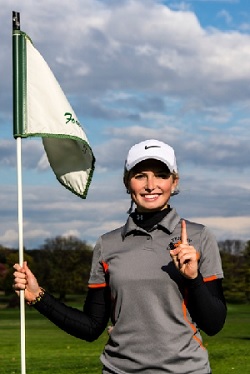 The course redesigned its 18th hole from a short par-4 to a par-3 this season. And Shegos became the first to score it a hole-in-one, doing so during the second round of the Division 2 Final.
Retired longtime East Lansing coach George Jones, also a longtime assistant at the Finals and the taker of the photo at right, added: “Madi Shegos did something almost every golfer around the world never gets a chance to do or if given the chance, doesn't do.
“Sure, every par three at Forest Akers and nearly every other par three around the world has had an ace, but on Friday Madi was the very first to accomplish this on the newly-constructed 18th hole on the East Course. No one else will ever be the first. This honor goes to Madi Shegos, a sophomore at Fenton High School.”
Shegos improved six strokes during her second round to shoot a 103 on Saturday as Fenton finished fifth in Division 2 for the second straight season.
First to Reign
Although Lower Peninsula girls golf was played during the spring for its first 35 years, and Upper Peninsula girls golf remains in the spring to this day, the first girls MHSAA championship tournament actually took place during the fall of the 1972-73 school year – with Pickford claiming the first title by winning the Upper Peninsula Final by three strokes over Escanaba on an October day at Lake Bluff Country Club.
Thanks to some quick work by Pickford athletic director Chuck Bennin and one of the four players on that championship team who now teaches at the high school, we'll soon be adding results of that tournament to our growing archives at MHSAA.com.
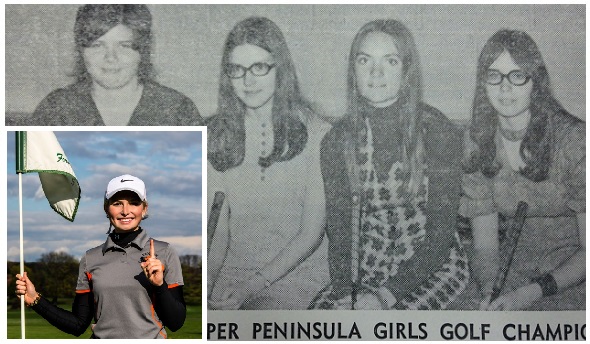
Here's a quick flashback from that inaugural 9-hole event: The Panthers were led by Patsy Nayback’s 49, which was good for second place individually. Joni Hamilton and sisters Bonnie and Kathleen MacDonald rounded out the lineup and are pictured above. Ishpeming’s Marge Farley shot a 44 to finish as medalist.
Another fun fact from that October day: The Escanaba Daily Press reported that in the boys MHSAA Final, Pickford’s Kevin Hamilton recorded an eagle on the par-5, 472-yard third hole, with his second shot running through a sand trap, up the green and into the cup.
The Lower Peninsula Girls Finals teed off for the first time the following spring, with Bloomfield Hills Lahser defeating East Grand Rapids by a stroke at Grand Ledge’s Troy Hills Golf Course.
Wanted: More Finals Archives
For the majority of MHSAA sports, we’ve published on MHSAA.com results, box scores, etc., for most of our Finals dating to at least the late 1990s. For years prior, we've begun filling in with what we can gather from our formerly-published Books of Champions and MHSAA Bulletins.
But realizing there are complete copies of results out there in scrap books, trophy cases, newspaper archives and the like, we’d love to gather as many as possible to add to the site.
If you’ve got results from an MHSAA Finals in any sport that aren't showing at MHSAA.com or that can augment our current collection, please email me at [email protected].
First of many
Certainly the most prevalent prize awarded for winners of Michigan’s high school football trophy games is some version of a “little brown jug.” And this weekend, the oldest of the jugs will be on the line when Newberry faces Sault Ste. Marie.
They first played for the trophy in 1925, with the original jug replaced by the current version in 1934. Sault Ste. Marie leads the series 58-33-5 including 46-28-5 in games for the Jug.
Below is an excerpt from a brief history of the trophy researched by Ron Pesch:
In the state’s Upper Peninsula, Newberry High School first played Sault Ste. Marie on the gridiron in 1911 and, for the most part, they have squared off annually since 1923. To commemorate the battle between these schools, legend has it that in 1925, a Newberry druggist donated a Jug to serve as a trophy. The prize was to be retained by the winning team until the next meeting would determine ownership. The idea, of course, came from the Michigan-Minnesota rivalry.
In 1934, for reasons unknown, a new jug debuted. Fittingly, that game between the rivals ended in a 7-7 tie.
Over the years, the rivalry has generated many classic contests between the larger school from the Soo and the smaller Newberry district. The series was interrupted in 1940 and 1959, and then went on a five-year hiatus between 1999 and 2003. As school officials recognized the importance of the series to the residents of the area, the rivalry was resumed in 2004 when the Blue Devils joined Newberry in the Straits Area Conference.
PHOTOS: (Background) The members of the 1972 Pickford girls golf team, as they appeared in the January 1973 MHSAA Bulletin. (Foreground and below) Fenton’s Madi Shegos stands with the flag after drilling the first hole-in-one at the redesigned No. 18 at Forest Akers East during last weekend’s Lower Peninsula Division 2 Final.
NFHS Voice: 'New Normal' Sportsmanship
May 20, 2020
By Karissa Niehoff
NFHS Executive Director
The “new normal” is one of the many terms we hear repeatedly as the country begins its return to normal activities from the COVID-19 pandemic. Keeping six feet apart from other people, wearing a mask and frequent washing of hands are three of those important warnings.
And then there is the new “no-no” that cuts at the heart of high school sports – the handshake. Shaking hands has been a part of our culture for centuries and a mainstream of high school sports forever. It is hard to imagine high school sports without handshakes.
In addition to emotional displays among team members involving handshakes, high-fives and hugs, the handshake has been a way of demonstrating good sportsmanship toward the opponent.
In wrestling, for instance, shaking hands before a match is actually a part of the rules, which, of course, will have to be relaxed for the coming season. There are handshakes at the coin toss in football and before the opening jump ball in basketball.
After a hard-fought, back-and-forth tennis match, players meet at the net to shake hands – congratulating each other for their efforts. The actions are the same after golfers battle each other for 18 holes – removing the cap and shaking hands.
These age-old practices demonstrate respect for the opponent, and in the case of post-game handshakes, graciousness in victory or defeat.
The emotions in high school sports are often off the chart, with end-of-game celebrations by players, coaches and fans involving handshakes, high-fives and hugs. So, as the early phases of return to sports occur this fall, how do we meet social distance guidelines and continue to exhibit emotions and emphasize sportsmanship, which typically have involved touching between individuals?
While the social-distancing and no-contact guidelines are necessary – at least for the short term – to diminish the spread of the virus, they should not dampen the enthusiasm and emotion by everyone involved with high school sports. We hope these types of restrictions will be lifted at some point down the road, but for now, this is our “new normal.”
The absence of these time-honored ways to express respect for the opponent does not diminish the importance of displaying sportsmanship in high school sports. In fact, we believe concern for fairness and displays of kindness, respect and graciousness will be more pronounced once high school sports resume; however, the methods of sharing these feelings will be different.
Although perhaps not as endearing as a handshake, high-five or hug, there are other ways to express these feelings and emotions – for the opponent as well as teammates.
Some alternatives to consider are a slight bow with the palms pressed together, an air high-five, a smile and quick wave, a double-tap of the right hand across the heart and a wink with the thumbs up. Certainly, there are other possibilities – in fact, teams could develop their own methods for demonstrating sportsmanship to their opponents and celebrating big plays or victories with teammates. Through their resilience and great spirit, we look forward to how the millions of participants in high school sports and activities will accept this challenge.
There will be many concessions necessary to resume athletic competition, and shaking hands is one that must cease – at least for now. However, let’s view this change as an opportunity to find new ways to showcase sportsmanship in high school sports.
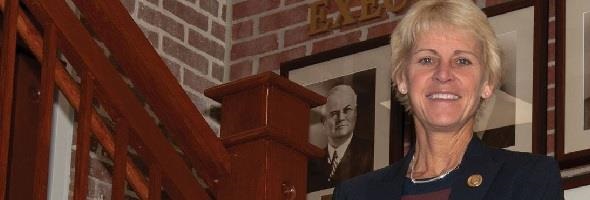
Dr. Karissa L. Niehoff is in her second year as executive director of the National Federation of State High School Associations (NFHS) in Indianapolis, Indiana. She is the first female to head the national leadership organization for high school athletics and performing arts activities and the sixth full-time executive director of the NFHS, which celebrated its 100th year of service during the 2018-19 school year. She previously was executive director of the Connecticut Association of Schools-Connecticut Interscholastic Athletic Conference for seven years.