

History in the Making - New and Old
By
Geoff Kimmerly
MHSAA.com senior editor
October 24, 2013
Last week’s MHSAA Lower Peninsula Girls Golf Finals marked the 42nd anniversary of the association’s sponsorship of the sport, and we've been researching some of the first and finest performances from the tournament's history – coincidentally, as a current player added a small touch with a big shot Saturday.
 Read on to learn more about that feat and the first team to hoist an MHSAA girls golf championship trophy. And speaking of trophies, we've also got the story behind one of the oldest football traveling prizes still making the rounds in the Upper Peninsula.
An Ace Arrives
Fenton’s Madi Shegos finished her 2013 Finals by making history at Michigan State’s University’s Forest Akers East, a frequent MHSAA Finals site over the last two decades.
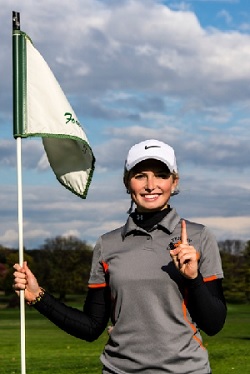 The course redesigned its 18th hole from a short par-4 to a par-3 this season. And Shegos became the first to score it a hole-in-one, doing so during the second round of the Division 2 Final.
Retired longtime East Lansing coach George Jones, also a longtime assistant at the Finals and the taker of the photo at right, added: “Madi Shegos did something almost every golfer around the world never gets a chance to do or if given the chance, doesn't do.
“Sure, every par three at Forest Akers and nearly every other par three around the world has had an ace, but on Friday Madi was the very first to accomplish this on the newly-constructed 18th hole on the East Course. No one else will ever be the first. This honor goes to Madi Shegos, a sophomore at Fenton High School.”
Shegos improved six strokes during her second round to shoot a 103 on Saturday as Fenton finished fifth in Division 2 for the second straight season.
First to Reign
Although Lower Peninsula girls golf was played during the spring for its first 35 years, and Upper Peninsula girls golf remains in the spring to this day, the first girls MHSAA championship tournament actually took place during the fall of the 1972-73 school year – with Pickford claiming the first title by winning the Upper Peninsula Final by three strokes over Escanaba on an October day at Lake Bluff Country Club.
Thanks to some quick work by Pickford athletic director Chuck Bennin and one of the four players on that championship team who now teaches at the high school, we'll soon be adding results of that tournament to our growing archives at MHSAA.com.
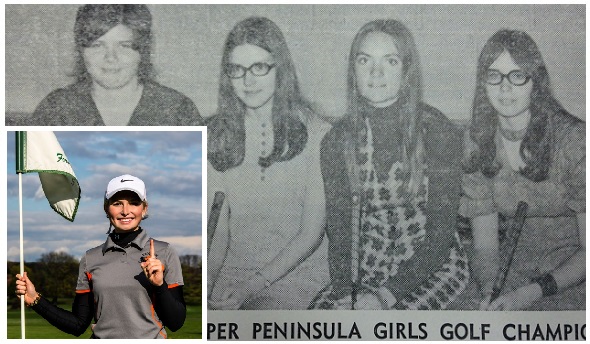
Here's a quick flashback from that inaugural 9-hole event: The Panthers were led by Patsy Nayback’s 49, which was good for second place individually. Joni Hamilton and sisters Bonnie and Kathleen MacDonald rounded out the lineup and are pictured above. Ishpeming’s Marge Farley shot a 44 to finish as medalist.
Another fun fact from that October day: The Escanaba Daily Press reported that in the boys MHSAA Final, Pickford’s Kevin Hamilton recorded an eagle on the par-5, 472-yard third hole, with his second shot running through a sand trap, up the green and into the cup.
The Lower Peninsula Girls Finals teed off for the first time the following spring, with Bloomfield Hills Lahser defeating East Grand Rapids by a stroke at Grand Ledge’s Troy Hills Golf Course.
Wanted: More Finals Archives
For the majority of MHSAA sports, we’ve published on MHSAA.com results, box scores, etc., for most of our Finals dating to at least the late 1990s. For years prior, we've begun filling in with what we can gather from our formerly-published Books of Champions and MHSAA Bulletins.
But realizing there are complete copies of results out there in scrap books, trophy cases, newspaper archives and the like, we’d love to gather as many as possible to add to the site.
If you’ve got results from an MHSAA Finals in any sport that aren't showing at MHSAA.com or that can augment our current collection, please email me at [email protected].
First of many
Certainly the most prevalent prize awarded for winners of Michigan’s high school football trophy games is some version of a “little brown jug.” And this weekend, the oldest of the jugs will be on the line when Newberry faces Sault Ste. Marie.
They first played for the trophy in 1925, with the original jug replaced by the current version in 1934. Sault Ste. Marie leads the series 58-33-5 including 46-28-5 in games for the Jug.
Below is an excerpt from a brief history of the trophy researched by Ron Pesch:
In the state’s Upper Peninsula, Newberry High School first played Sault Ste. Marie on the gridiron in 1911 and, for the most part, they have squared off annually since 1923. To commemorate the battle between these schools, legend has it that in 1925, a Newberry druggist donated a Jug to serve as a trophy. The prize was to be retained by the winning team until the next meeting would determine ownership. The idea, of course, came from the Michigan-Minnesota rivalry.
In 1934, for reasons unknown, a new jug debuted. Fittingly, that game between the rivals ended in a 7-7 tie.
Over the years, the rivalry has generated many classic contests between the larger school from the Soo and the smaller Newberry district. The series was interrupted in 1940 and 1959, and then went on a five-year hiatus between 1999 and 2003. As school officials recognized the importance of the series to the residents of the area, the rivalry was resumed in 2004 when the Blue Devils joined Newberry in the Straits Area Conference.
PHOTOS: (Background) The members of the 1972 Pickford girls golf team, as they appeared in the January 1973 MHSAA Bulletin. (Foreground and below) Fenton’s Madi Shegos stands with the flag after drilling the first hole-in-one at the redesigned No. 18 at Forest Akers East during last weekend’s Lower Peninsula Division 2 Final.
One Word for 2015-16: Partnership
August 20, 2015
 By Kevin Wolma
Hudsonville athletic director
One word. Every year before the school year starts I choose one word to help me focus on what is important and shed all the other clutter in my life. I try to choose a word that will help me in my professional and personal life.
The word I choose for the 2015-16 school year is partnership. After choosing my word, I realized the word partnership can further enhance our already strong athletic program too.
Often roadblocks are put up in athletic programs that do not allow the program to reach its fullest potential. This creates a separation within a program where all the partners involved detach themselves from the goals/values set by the organization. We see this in every organization, but this article is going to specifically discuss the partnerships between parents, coaches, student athletes and officials.
When I first started coaching basketball, I encountered a situation where parents were unhappy about what they thought was a reduced role for their student athlete on the team. He was a starter his sophomore and junior year, but the dynamics of the team his senior year required that I move him because he was one of my best offensive players that could help the second unit. He would play about the same number of minutes, but his role would change.
As a coaching staff, we believed this change helped the team and the student athlete by allowing him to use his strengths as an offensive player. He would have more opportunities to score than he would have if he was a starter. We were trying to do what was best for the team and individual but the parents did not see it that way.
Reasoning only made the situation worse as they felt he was entitled to start. They did not appreciate the fact that we were trying to give him more opportunities to reach his fullest potential. The parents went as far as starting a petition to remove me as head coach along with telling anyone who would listen how bad I was as a coach. This lack of partnership hurt our team. The student athlete complained openly to other players on the team, which created a negative atmosphere in the locker room, and the parents created a negative atmosphere in the stands. Needless to say that was a tough season to build a cohesive group.
This story provides insight on how one isolated incident can have an impact on so many other partnerships. The parent/coach partnership was strained along with the player/coach partnership. This inhibited the growth of the team to become the best it could because of the negative culture created. The parent/child partnership was also directly affected because the parents took on the role of an agent or defender and not one of a supporter or advisor. Just think if the parents talked to their child and said, “This is a great opportunity for you and your team. You could see a lot of benefit by supplying the scoring load off the bench. If this makes the team better, you should embrace it.” The outcome and season could have had an entirely different feel by handling the situation differently.
During the season there is going to be some adversity and “why” moments, but having an open and positive communication line with the coach and your child is the key to forming positive partnerships. You don’t have to always agree with the decisions, but how you handle the “why” moments will have a profound impact on your child and the team he or she plays on.
The other type of partnership that is not described in my story, but is becoming more and more fractured every year, is the parent/fan/official partnership. Last year I had a group of officials ask me to sit in the stands of an opposing team section because of how degrading those fans were toward the officials. On more than one occasion I had to talk to a group of fans and ask them to keep it positive. Most of the time they looked at me as if to say, “You can’t tell me what I can and can’t say.”
The one thing that people do not understand is that yelling at an official has no bearing on the game. An official has never changed a call based on what a fan has to say. In the last two years there has been a steady decline of officials leaving the profession and very few officials entering the profession. Do you blame them? Who wants to work 2-3 days a week and get yelled at for two hours.
Let's be different. To improve this partnership, let’s give them applause when the officials are introduced for each contest. After the game thank them for their time and efforts. I encourage anyone out there who has an interest in officiating to give it a try. You can have a powerful impact on student athletes.
Partnership is a very important part of high school athletics. I encourage everyone to make my word for 2015-2016 a part of your experience with high school sports as well. Together, let’s cheer on your teams and make this the best year yet.
Wolma has served as Hudsonville's athletic director since 2011 and previously coached boys varsity basketball and girls varsity golf among other teams. He also previously taught physical education and health.