

Gull Lake Returns to State's Elite
June 15, 2013
By Geoff Kimmerly
Second Half editor
WILLIAMSTON – Can one save change a soccer season?
It certainly can alter a championship game, as junior Maggie Harma and Richland Gull Lake found out Saturday afternoon in Williamston.
Bloomfield Hills Marian fired 27 shots during the double-overtime MHSAA Division 2 Final. Harma, the keeper, had to save 13.
But the shot she stopped 30 seconds into the 100-minute game might’ve saved the Blue Devils’ first championship run since 1992, one they finished with a 1-0 victory over the reigning champion Mustangs.
“If it had gone in, our team would’ve been down the whole game trying to come back,” Harma said. “Because I saved it, it kinda gave us the little push we needed: We are here, we deserve to be here, we’re not here by luck. We’re here because we’re good, and we can win this.”
Gull Lake (21-1-1) was a Finals regular during the 1990s. But the current players were either still figuring out how to run or maybe even how to walk when the Blue Devils played in their most recent championship game in 1999.
Marian’s story is nearly the opposite. The Mustangs (17-3-4) have won five titles over the last 11 seasons, including three of the last five in Division 2.
Gull Lake second-year coach Jeff Corstange was plenty familiar with his program’s previous success, having graduated from the school in 1996.
 “That’s one of the things when I came into this coaching role two years ago; I knew what it took to get there,” Corstange said. “These girls were young. They didn’t really know what it was. But I wanted to bring excitement back to Gull Lake.
“The whole community supported us tonight, and they get energy off of that.”
Harma admitted her team was a bit intimidated when Marian first arrived Saturday. But Corstange had emphasized to his players that they deserved to be in the Final, and the numbers said the same.
Gull Lake entered the postseason ranked No. 3, just one spot behind Marian. The Blue Devils gave up only eight goals this season – and including Saturday, not one during the MHSAA tournament.
“It starts with their keeper. She’s a really good keeper. And the four in the back are really good,” Marian coach Barry Brodsky said. “Just for whatever reason, we couldn’t get that last little inch it takes to get it into the goal. I thought we were going to get it the first 30 seconds of the game. Sometimes when you don’t get that goal you think you should, that’s the game right there.”
Gull Lake didn’t get its goal until 3:56 into the first overtime. Sophomore forward Amanda Pavletic, who had 15 goals this season although she wasn’t a starter, found the back of the net and sent the Blue Devils’ supporters into a frenzy.
Like it had in a 1-0 overtime Semifinal win over Spring Lake in the Semifinal, Gull Lake’s defense held strong over the final 16 minutes to secure the win.
“We worked really hard in the preseason, and we knew what we were capable of doing this year,” Corstange said. “All that hard work and determination ... this goes to show we can battle with anybody, being a small school. We welcome the battle. We have a lot of talent out there.”
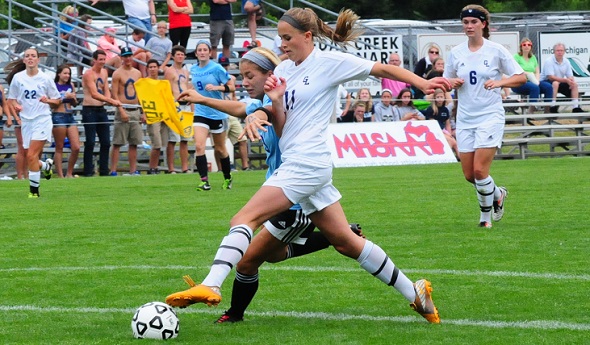
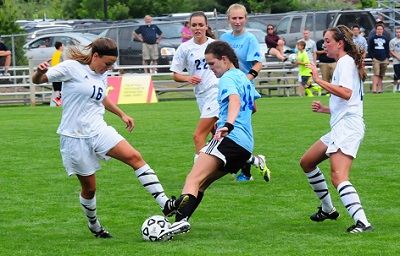
PHOTOS: (Top) Gull Lake freshman Kenzie Harney (11) battles with a Bloomfield Hills Marian player for possession during Saturday’s Division 2 Final. (Middle) Marian sophomore Kelly Sweeney (11) pushes the ball past the outstretched foot of Gull Lake’s Olivia Sullivan. (Click to see more from Hockey Weekly Action Photos.)
Northville = Perfection in D1 Soccer
June 14, 2014
By Mark Meyer
Special for Second Half
WILLIAMSTON – Good things come in twos for Northville girls soccer, but even better in fours.
Like MHSAA championships in 1984, 2004 and now 2014.
The Mustangs completed their perfect 23-0 march to the Division 1 crown Saturday afternoon with a 2-1 victory over Utica Eisenhower.
As they have all season, the Northville senior forward tandem of Megan Buckingham and Jamie Cheslik provided the scoring punch: Buckingham in the first half with assist from Cheslik, who scored unassisted early in the second half after gaining possession deep in the Eagles’ zone.
The Northville defense – which had held opponents to only four goals all season – was perfect until the 31:58 mark of the second half when Eisenhower junior forward Paige Duda cut the lead in half on a shot from just outside the 18-yard line.
The last eight minutes provided a few tense moments for fifth-year Northville coach Eric Brucker, who was an assistant on the 2004 team.
“I told them at halftime that one goal wasn’t going to win it,” Brucker said. “They’ve been scoring four or five per game throughout the playoffs, so we weren’t expecting a 1-0 game.
“We don’t get scored on often, but we’re mentally tough enough to make sure it didn’t happen again.”
 Defensively, the Mustangs relied on midfielders Suzie Redick and Alissa Moore to mark Eisenhower forward Isabella Palazzolo, whom Brucker felt was a player who had to be controlled for Northville to be successful.
“We had different players in different roles, and they stepped up to do what needed to be done,” Brucker said. “Our scouting report showed that Palazzolo would be a factor on the left side, and normally it’s hard to mark someone on the outside mid. But Suzie and Alissa did an outstanding job swapping back and forth, trying to take her out of the play.”
The instant offense of Buckingham (23 goals) and Cheslik (33) – both Division I college recruits – was something that made Eisenhower coach Mehrdad Nekoogar uncomfortable.
“They are both great players and knew that we could not afford to make mistakes against them – they would make us pay,” said Nekoogar, whose team finished the season 18-3-1. “That’s what hurt us, a couple of mistakes.
“But we came back, scored and were in it to the end. I expect us to be back next year because we have almost everyone coming back.”
Northville senior captain Ashley Peper, a stalwart on defense for the Mustangs, said the team was loose and relaxed on the bus ride to the game.
“We were all singing; nobody was nervous,” Peper said. “We were so ready for it. We were pumped.
“We’re a second-half team; we know how to use our speed up front to our advantage. We needed to keep going hard. We knew they had come back before and had the ability to score quickly.”
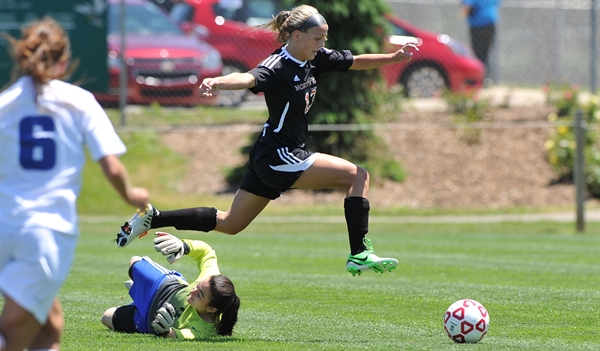
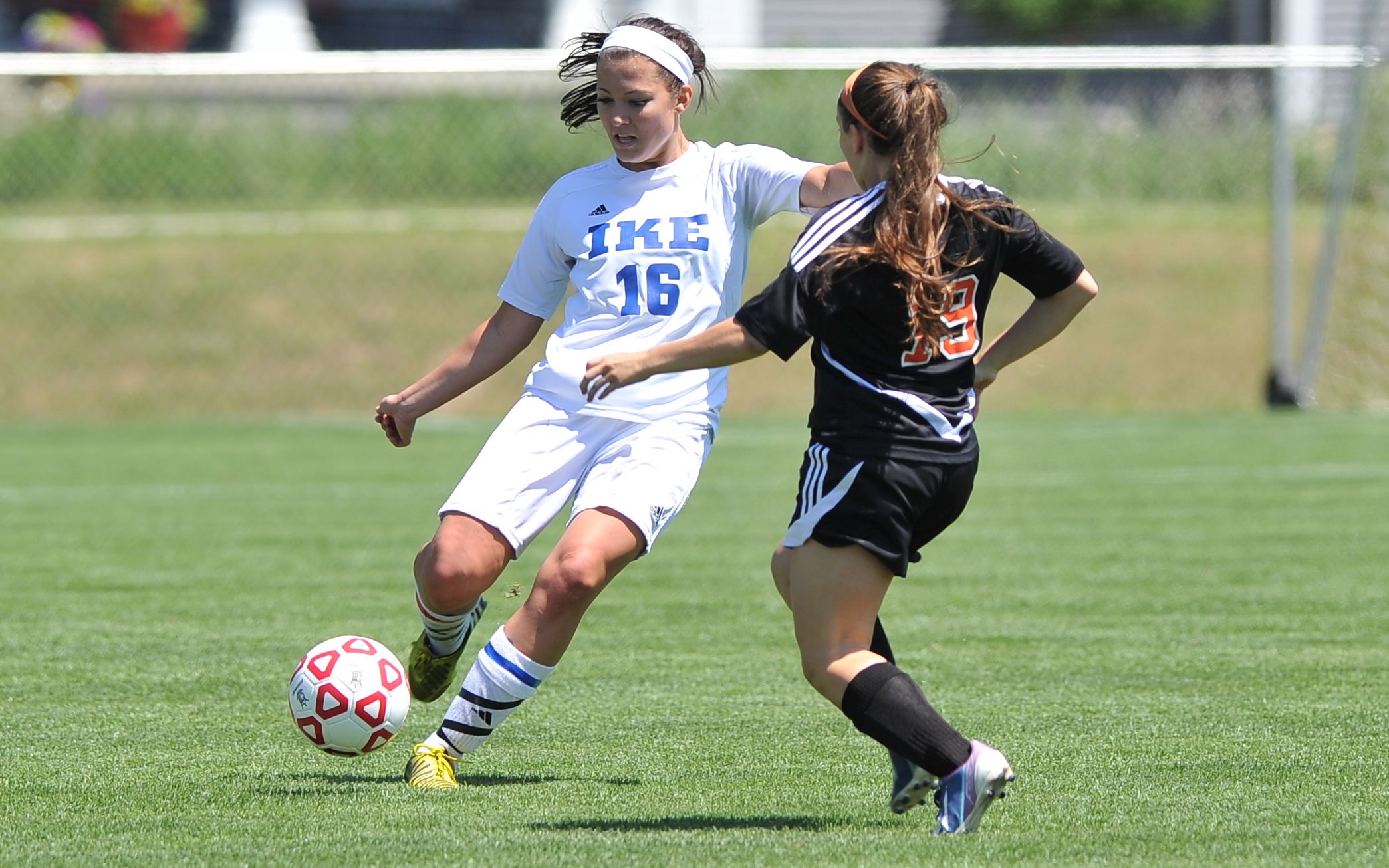
PHOTOS: (Top) Northville’s Jamie Cheslik leaps over the Utica Eisenhower keeper while controlling the ball during Saturday’s Division 1 Final. (Middle) Eisenhower’s Julia Henning (16) works to move the ball past Northville’s Kyra Dahring.