

Headed Toward A History-Making Finish
June 12, 2012
By Geoff Kimmerly
Second Half editor
Nine Grandville Calvin Christian seniors faced their final high school season this spring, and with it exciting possibilities.
Their team had won four straight league titles and looked good for a fifth. The Squires also had moved into a different MHSAA division, with new playoff opponents and new championship opportunities.
It would've been easy to look far ahead. But those seniors knew better than to look past the first steps that have brought them to the season's final week for the second time in school history.
Calvin Christian knocked out two ranked teams in last week’s Regional – first No. 8 St. Joseph Lake Michigan Catholic 7-0 and then No. 2 Kalamazoo Christian 7-2. At No. 4, the Squires are the highest-ranked team left in Division 4 with only two more wins needed for a first MHSAA championship.
“We’ve known from the beginning that something special could be in order. Not in terms of advancing far in the tournament, but in having a capable team and taking every opportunity to play together,” Calvin Christian coach Tim TerHaar said. “What these seniors have done, they haven’t been consumed with a tournament run all season. They’re focused on going out and enjoying playing with each other.”
The Squires (23-2-1) can earn one more game together by defeating Muskegon Western Michigan Christian in Wednesday’s Semifinal at East Kentwood High School. Calvin Christian has never advanced to an MHSAA Final; this is the second time the Squires have made it this far, matching their Division 4 run in 2000. (Click for all Semifinal pairings.)
 Don’t assume this run has been a product of merely moving into Division 4 (the team also played in Division 4 during TerHaar’s first two years, 2001 and 2002). Calvin Christian has won its league in 11 of TerHaar’s 12 seasons – although the Squires then frequently ran into six-time Division 3 champion Hudsonville Unity Christian or Grand Rapids South Christian during the tournament.
But the Division 4 road is tough as well, with obstacles like four-time MHSAA champion Kalamazoo Christian, which Calvin Christian lost to 2-1 after a 6-0 start this spring. The Squires were missing one of their best scorers for that game, but also had trouble capitalizing on offensive opportunities that did present themselves.
“Having played them and lost to them was a huge motivating factor for all of us,” TerHaar said. “In some ways, it could’ve been a blessing.”
Seniors Katie Klunder, Jenny Holsem, Riley Gortsema and Morgan Noordyke have played on the varsity all four seasons and bring a 73-14-5 career record into this week.
Klunder – who has signed with reigning Division II national runner-up Grand Valley State – has scored 51 goals this spring, tied for sixth in the MHSAA record book for one season. Her 75 points is third. The team has outscored its postseason opponents 36-2 and put a ball in net during the first five minutes of all five playoff games.
The team’s defense has been similarly record-setting. Calvin Christian has 21 shutouts – including 20 by senior goalkeeper Lydia VerStrate, with that total tied for third in the MHSAA record book for one season. In front of her are seniors Gortsema and Noordyke and freshman Morgan Buursma, and a strong midfield led in part by Holsem.
The Kalamazoo Christian loss taught them and their teammates a lesson about the importance of mental sharpness. And that was evident in the rematch Thursday, when the Squires immediately brought the attack.
“I think it speaks to the fact that we have nine seniors, and this is their chance – their last chance, really,” TerHaar said. “I’m pleased that haven’t taken anything for granted. They’ve made the most of every opportunity.”
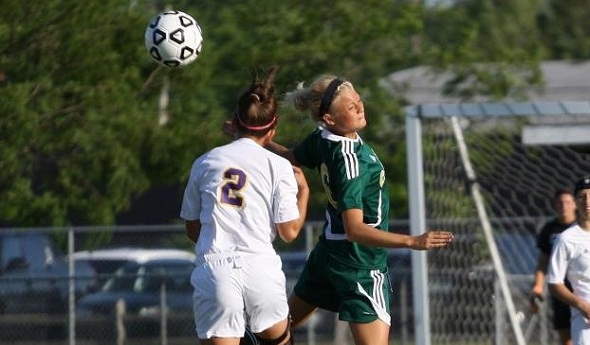
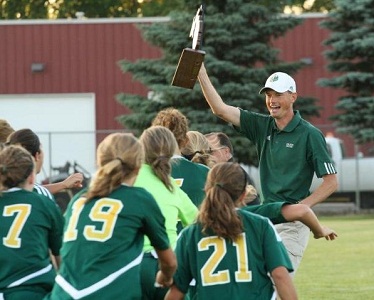
PHOTOS: (Top) Calvin Christian senior Jenny Holsem (6) deflects the ball during Thursday’s Regional Final against Kalamazoo Christian. (Middle) Squires coach Tim TerHaar presents the trophy to his team after the 7-2 win over the Comets. (Photos courtesy of Calvin Christian soccer.)
Gull Lake Embraces 2nd Straight Title
June 14, 2014
By Mark Meyer
Special for Second Half
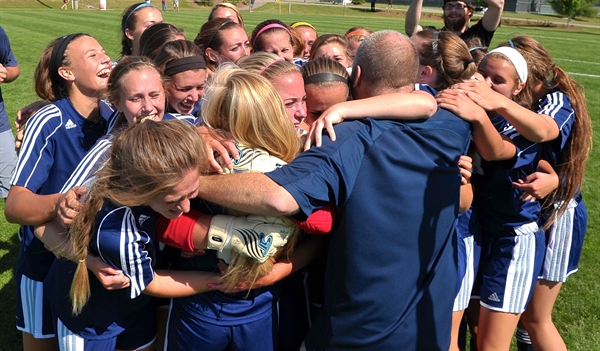
WILLIAMSTON – The postgame victory hugs late Saturday afternoon were twice as tight this time around and lasted just a little bit longer.
Junior midfielder Mickey Hostetler received hers from coach Jeff Corstange, as did junior defender Hayley Buckhout, senior goalkeeper Maggie Harma and sophomore midfielder Riley Wisser. Senior captains Tabitha Boze and Rachel Fouts savored theirs as did the rest of the victorious Blue Devils, who defeated Bloomfield Hills Marian 2-1 in the title game for the second straight season to finish 24-1-1.
Gull Lake won the 2013 title 1-0 in overtime over Marian, the 2012 champion.
“It’s an honor to represent the west side of the state in a game like this,” Corstange said. “The east side schools play a physical brand of soccer, and I felt like we answered that challenge. We were able to execute our game plan to the fullest.”
The intensity of this year’s rematch was evident throughout as the top-ranked teams (No. 1 Marian, No. 2 Gull Lake) traded excellent scoring opportunities throughout the game. Marian keeper Megan Bricely denied Blue Devils forward Kirsten Taylor three times in the first half from close range – twice on the same play when Taylor recovered the first shot only to be stopped on the rebound attempt.
“Last year we carried the play to them,” said Marian coach Barry Brodsky. “This year they had us back on our heels.”
 Wisser opened the scoring for Gull Lake at 16:52 of the first half on a left corner kick that hooked sharply through a wall of Marian defenders.
“The key was to pressure their defenders,” Corstange said. “We wanted to be on the attack at all times and make sure they didn’t have an opening to get started.”
Marian’s Ellie Deconinck tied the game at 4:54 of the second half on a strong pass into the middle from Jaclyn Engel, who had recovered a corner kick block by Gull Lake’s Annie Walbridge. Engel dribbled along the left end line and connected with Deconinck, who found an opening inside the 6-yard box.
“I thought we had regained some of the momentum when we scored to tie it up,” Brodsky said, “but they were just deeper than us. They kept coming after us; they’re a very fit team.”
Senior forward Sydney Nikitas broke the tie at 19:43 by converting at short range after a driving pass from the right corner by junior forward Amanda Pavletic, hero of last year’s overtime triumph, to Boze, who pushed the ball to Nikitas in front of the goal.
“Unbelievable feeling to win it two straight years,” said Corstange, who has compiled a 58-7-3 mark in three seasons, to go along with his back-to-back titles. “This is an unselfish group. We use a lot of players, and they all know their roles. Great, great way to end the season.”
Marian finished the season 19-1-1 and allowed only seven goals all spring.
“Tough way to end it,” Brodsky said, “but’s let give credit (to Gull Lake). They earned it.”
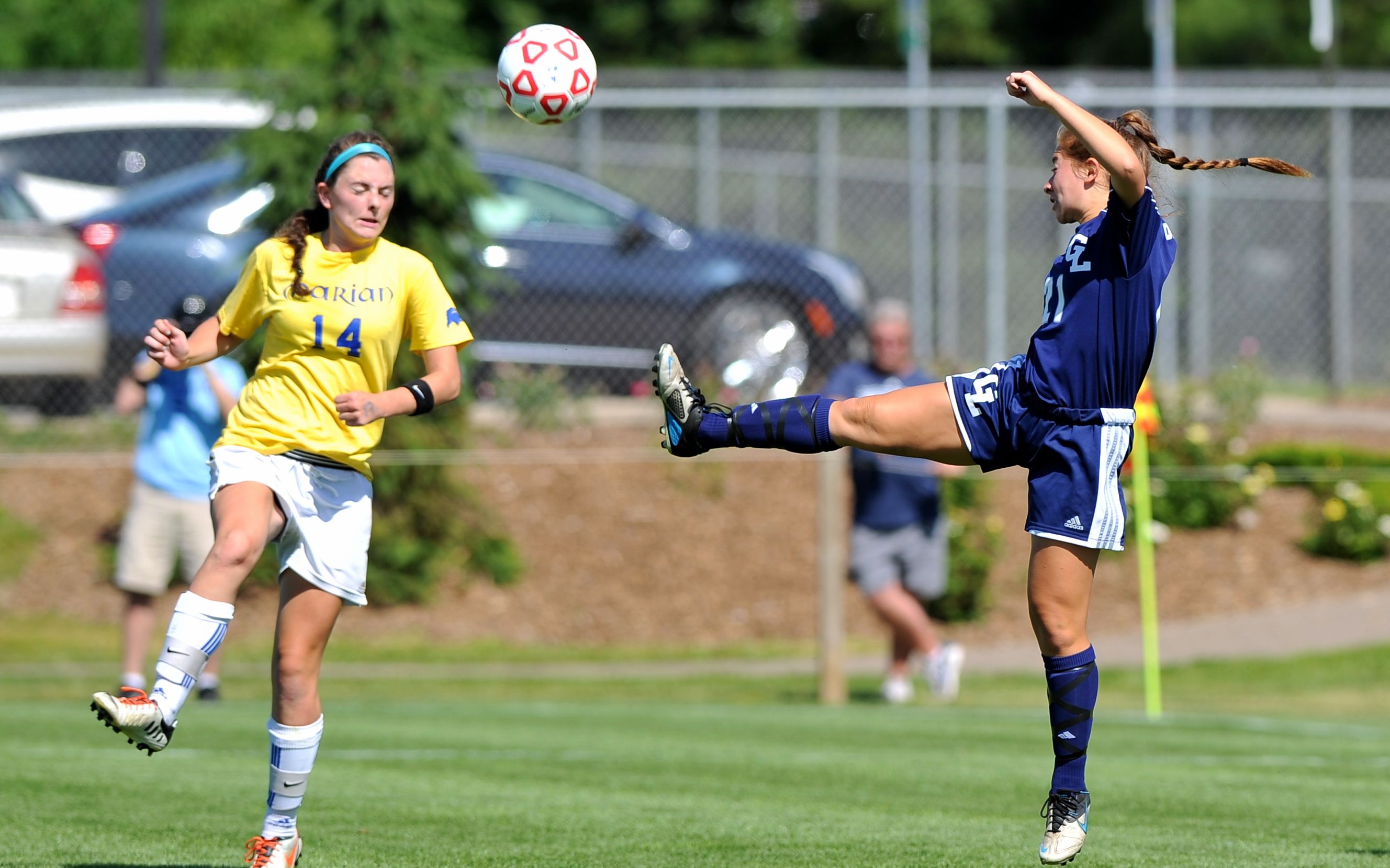
PHOTOS: (Top) Richland Gull Lake players and coach Jeff Corstange embrace after securing their second straight Division 2 championship. (Middle) Marian’s Amy Stroud (14) and Gull Lake’s Hannah Phommavongsa work to control a loose ball Saturday.