


MHSA(Q&)A: Soccer Coaches President Zach Jonker
September 21, 2012
By Geoff Kimmerly
Second Half editor
Zach Jonker has had his hands – or, perhaps, feet – on just about every facet of soccer in this state over the last 20 years.
 He played on a Class B Semifinalist at Petoskey before graduating in 1995, then earned four letters and served as a captain at Hope College. He came back home to teach social studies and became coach of both boys and girls varsities that are regularly among the northern Lower Peninsula's elite, but also are highly-regarded statewide. And this fall, he began the first of a two-year term as president of the Michigan High School Soccer Coaches Association.
So he can speak first-hand on the benefits of playing high school soccer in Michigan, which is good news to get out perhaps now more than ever. Michigan high school soccer is facing a predicament unlike any it has tackled before – the creation by U.S. Soccer of its Development Academy, a set of travel teams all over the country that train nearly year-round and are meant to eventually fuel the men's national team. That opportunity has drawn a number of top Michigan players out of high school soccer.
Jonker and his coaching brethren are monitoring that situation closely, while continuing to lead their teams into the second half of this fall boys season. His Northmen are 6-7-1 overall this fall, but have faced three of the top-five ranked teams in Division 1 and another from Division 2.
Despite your location near the tip of the Lower Peninsula, you still manage to schedule strong competition. How do you make it work?
We’re in a really nice spot. Traverse City hosts a tournament during the regular season with Traverse City Central, Traverse City West and Petoskey, and then they invite three schools from downstate that have generally been (Warren) DeLaSalle, Clarkston and Ann Arbor Skyline. The following weekend, we host a similar format with Rochester Hills Stoney Creek and Bloomfield Hills Lahser. We get six really good games at the start of the season with two tournaments. It’s early in the season and teams love coming up, making a weekend out of it, hitting the beach and doing some bonding. And the fields at Traverse City and Petoskey are both beautiful, which helps teams commit, plus the three of us are very competitive.
We’re coming down next weekend to play East Lansing, and we always schedule a couple of those. Last year, Mason came up here. It’s definitely a commitment in terms of travel during the course of the year, but from a Petoskey standpoint, I don’t care about our nonleague record. We’re using those games to get better for our league and better for the (MHSAA) tournament. The only tough thing is putting that in perspective for the kids.
What is something happening in high school soccer that the coaches association is proudest about right now?
We’re always looking at it from the other side, what we want to make better. But one of our main goals as an association is to properly recognize players. And I think the process we have in place for giving all-district, all-regional and all-state recognition and ultimately the selection of the Dream Team, I think that’s a very good model that enables us as an association to truly recognize players who put the work in and had a successful season. We also redesigned our web site this past season, and we’ve done a lot of the all-state process online, which a lot of coaches really liked because it cut down travel time for meetings.
Is anything new on the horizon?
A lot of coaches are really interested in seeing what the long-term impact of the (U.S.) Academy ruling is. Everyone’s initial take is we’re seeing increased parity round the state as the result of 120 kids electing not to play high school soccer this year. Obviously, all of those players are good players playing at a high level, and people are interested in seeing at the end of the season if kids are going to have missed playing in front of their communities, and if kids are going to migrate back to high school soccer. There’s talk of U.S. Soccer adding a U-14 academy. They’re trying to expand.
What has been the reaction so far to the U.S. Academy?
For certain players, the academy makes sense. They’re in a professional training environment 10 months out of the year. But those guys not on the professional track would be equally served by playing high school soccer and playing club like we always have. (U.S. Soccer) is doing a lot of this to benefit the top one percent of players. It’s the main frustration from the coaches.
Everyone kind of understands why U.S. Soccer is headed down that path, and it impacted each (high school) team differently. Some programs lost upwards of 8-10 kids as a result. Some didn’t lose any.
In terms of geographic parity, we’re already seeing that. Two years ago, west side teams won all four championships. Last year, Detroit teams won all four. Now we’re going to see more parity within districts, within conferences. And I think we’ll see scores closer than in the past.
What role should high school soccer play compared to club, the academy, etc.?
I equate it as playing for your national team. When you put your school colors on, go out with your friends that you’ve played with since kindergarten, it’s really special. They can’t even begin to match the rivalries we have with high school soccer, the amount of passion that exists within our game and the number of fans that show up at these games. At an academy game, you might have a handful of parents on the sideline, that’s it, and a few college coaches watching. But you can’t match the high school experience and the passion that exists. Kids are going to miss that, and we’ll get kids back because of that.
Do your players see an MHSAA championship differently because so many elite players aren’t participating in high school?
It doesn’t even register with these guys. The (MHSAA) championships are going to be awarded in November, and for whoever wins this year, it will be just as meaningful for these guys as the guys who won last year.
Does soccer get a bump from U.S. national team success like swimming or gymnastics might during Olympic years?
Any time it’s a World Cup year, men’s or women’s, the players get really excited about the experience. It gets them enthused to get out and train. I don’t think kids watch enough soccer in this country, and that’s one of the big issues we have. Ultimately, what’s holding us back at the national team level is kids are not growing up in a culture of soccer on television like in other countries against which we compete. In a World Cup year, kids get excited, and they watch more soccer, and the play is better on the field.
How much has high school soccer changed since you played?
There are just so many more layers of sophistication, tactically. We had good athletes playing at that point, and we have good athletes playing now. But as a country, we’ve evolved from a coaching standpoint. The kids are getting better technical training at a younger age, and are much better tactically. There are many more teams now emphasizing more possession-based (play). What else has helped the evolution is getting off playing on football fields. During the (19)80s and 90s, a lot of games were played on them, and it made it hard to possess the ball when the turf was chewed up. Soccer-specific fields have helped the game evolve.
What will Michigan high school soccer look like five years from now?
I like the path we’re headed down. The number one thing going forward is seeing what happens with the evolution of the academy program – do kids come back, or does the academy program grow? Regardless, the kids playing high school soccer are going to have a great experience, and there are a lot of really good coaches in high school soccer, a lot of really great referees and administrators. That makes the game special. I see us continuing to have the best going forward.
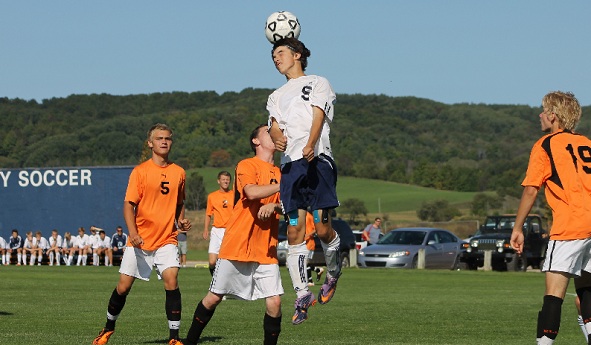
PHOTO: Petoskey senior Noah Honaker goes high while surrounded by defenders to head a ball during a game this season. (Photo courtesy of Dean Viles.)
Puzzle Coming Together as Goodrich Aims to Claim School's 1st Girls Soccer Title
By
Paul Costanzo
Special for MHSAA.com
May 6, 2026
Baylor Lauinger just can’t get enough of winning at Goodrich.
 The junior has earned a pair of Finals titles with the Martians, as part of the Division 2 girls cross country champion in 2024 and the Division 2 girls basketball champion this past March.
Now, Lauinger and her Goodrich soccer teammates are looking to add to the school’s overflowing trophy case.
“I mean, it’s hard not to do all three of them when all three teams are very successful,” Lauinger said. “That’s just something that you want to be part of when you have a winning culture like we do. If you see a team having that success, I feel like other girls would want to join that. And it makes us push harder when we see all these other teams in our school that are winning.”
Behind a strong core of returning players in the midfield and back end who have been joined by a talented group of newcomers up front, Goodrich is off to a 10-2-1 start to the season and ranked No. 1 in the latest Michigan High School Soccer Coaches Association Division 3 poll.
That combination of talent and the depth of his roster have Goodrich coach Josh Back excited about the opportunities ahead.
“I always say I have all my puzzle pieces,” Back said. “This is the fifth year I’ve had (the program), and I have lots of puzzle pieces that I get to play with.”
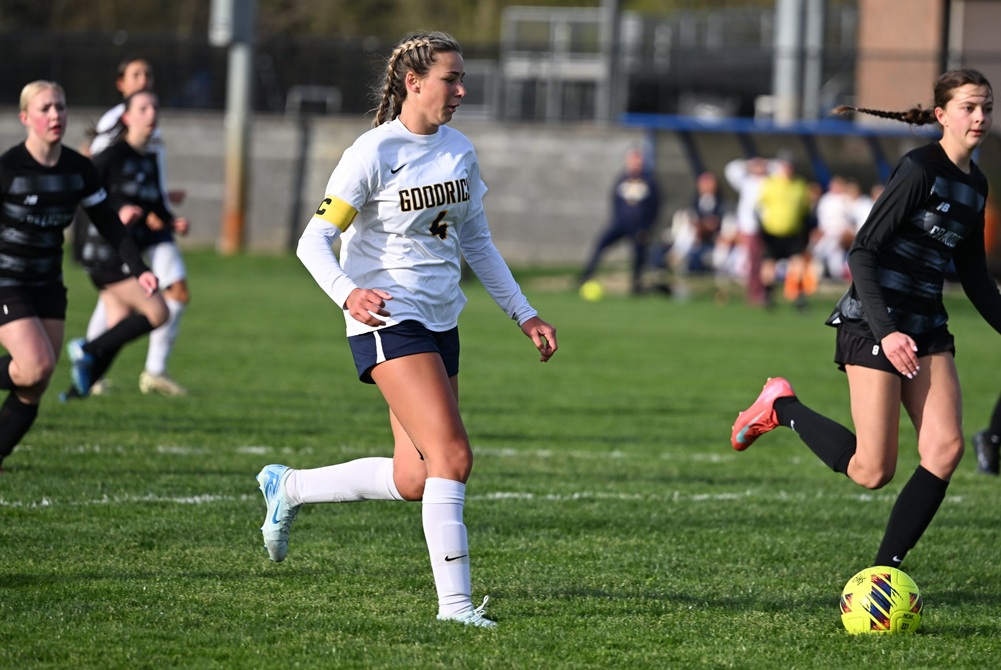
Lauinger leads that returning group as an attacking midfielder. She’s already dished out 13 assists despite missing four of the Martians’ 13 matches, including both of their losses (Clarkston and Oxford).
“Last year, she was our goal scorer,” Back said. “She’s an awesome leader. These younger kids that come in, it doesn’t faze her one bit that the other girls are doing the scoring. She just wants to win.”
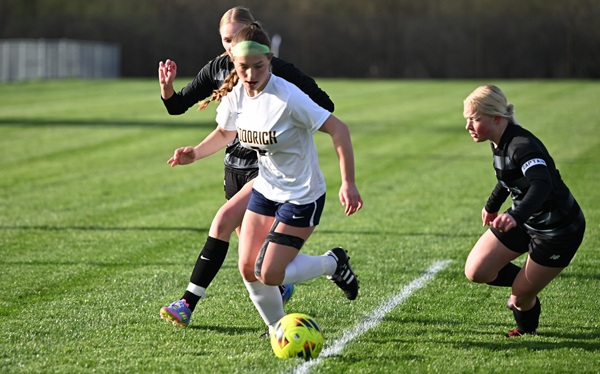 She’s finding success playing the ball forward to a completely new starting front line for Goodrich, which features freshmen Elliana Back and Sydney Place, as well as sophomore Bristol Cook.
Back has 18 goals and eight assists already, while Place has added seven goals. All three have years of club experience.
“This is the most soccer-savvy group I’ve had,” Josh Back said. “At times, there’s a learning curve with freshmen, but this year, they’ve stepped right in. They have that savviness and understanding of the game at the highest level. We lost our whole offense last year, and those two came in with our sophomore (Cook). As young as they are, the experience is there.”
The varsity experience is behind them, particularly at center back where Goodrich starts a pair of seniors in Lily May and Kaylee Eickhoff. They lead a defense in front of sophomore keeper Abigail Gagnon, who Josh Back called a “rockstar who doesn’t get enough praise,” who has allowed just eight goals through 13 games and has eight shutouts.
“They’re very important,” Lauinger said. “They’re the foundation of our back line, and they keep us ready. I think those two have been playing together for a long time now. Honestly, their defense really helps us with the goals, too. Their defense translates to offense.”
The pieces didn’t have much time to come together before being thrown into the fire. Not only were the newcomers asked to get up to speed early, but six members of the basketball team – Lauinger, Eickhoff, May, Place, junior Olivia Millerd and freshman Katerina Frederick – were playing in the season opener two days after claiming their Finals title at the Breslin Center.
And it wasn’t exactly a warm-up.
The Martians opened against Pontiac Notre Dame Prep, the No. 6-ranked team in Division 3, and followed that up with a trip two days later to Troy Athens, which is ranked No. 13 in Division 1.
They came out of their opening week 1-0-1, defeating NDP 6-0 and playing Athens to a 1-1 draw.
“I just think those two games were kind of like a wake-up call to show what we can do,” Lauinger said. “It shows how we can compete with high-level teams and shows the state what we are able to do. It definitely gets us ready for later.”
Later is coming up quickly, as the District tournament begins May 26 at Lake Fenton. Goodrich has won four straight District titles after not having won one since 2004. But Josh Back knows this team is capable of taking the next step, as all of the last four years ended with Regional losses, including shootout defeats against DeWitt both of the past two years.
“Hopefully this could be the first state title for Goodrich (in girls soccer),” he said. “But we have to get through the Districts and Regionals first – just one game at a time. The kids, they’re focused on the next one up. They just worry about tomorrow’s game. But I still think our goal of a state title is well within reach.”
 Paul Costanzo served as a sportswriter at The Port Huron Times Herald from 2006-15, including three years as lead sportswriter, and prior to that as sports editor at the Hillsdale Daily News from 2005-06. He can be reached at [email protected] with story ideas for Genesee, Lapeer, St. Clair, Sanilac, Huron, Tuscola, Saginaw, Bay, Arenac, Midland and Gladwin counties.
PHOTOS (Top) Goodrich’s Baylor Lauinger (4) leads a rush downfield during a game this season against Ortonville Brandon. (Middle) The Martians’ Elliana Back (4) makes a move toward the net. (Photos by Tonya Wyczalek.)