

Top-Ranked Rangers Finish Run to #1
June 17, 2017
By Keith Dunlap
Special for Second Half
WILLIAMSTON – Grand Rapids Forest Hills Central girls soccer coach Jeremy Stacy technically had an MHSAA championship on his coaching resume before Saturday, but he wasn’t there that day to experience it.
In his first year leading the Rangers’ program back in 2008, Stacy got married on the same day they won the Division 2 title.
On Saturday though, no wedding vows or cake cutting prevented him from experiencing what it was like to win the ultimate prize.
Behind second-half goals from senior Bailey Korhorn and sophomore Ashley Ward, Forest Hills Central won its first-ever Division 1 championship with a 2-0 win over Grand Blanc.
Forest Hills Central had previously won Division 2 championships in 2005, 2007 and 2008.
Adding to the title for Stacy was that the victory came on his wife’s birthday, three days after his wedding anniversary and a day before he planned on celebrating Father’s Day with his four children.
“It feels really good,” Stacy said. “It was cool to see the atmosphere here. Regardless of the result, it is fun to be in a state final. But it is much cooler to be on the winning end, that’s for sure.”
The championship also capped off a season where Forest Hills Central had to carry the target of being the state’s No. 1-ranked team for a majority of it.
“It was kind of a struggle sometimes,” Stacy said. “We had so much pressure that we weren’t having as much fun as we needed to have to get better. We had a little talk about that midseason. We had more fun and got better in the process.”
After a first half that featured few scoring chances, Forest Hills Central opened the scoring 10 minutes into the second on a goal by Korhorn, who has signed to continue her career at University of Cincinnati.
 Korhorn got the ball at the top of the box, turned and fired a laser into the left corner of the net to make it 1-0 Rangers.
“I took a touch and shot it top-left,” Korhorn said. “As soon as I saw it hit the back of the net, it was unreal. It was the best feeling of my life.
“What a great four years I’ve had here at Central. I’ll miss it so much.”
Forest Hills Central (21-0-4) then added an insurance goal with 5:48 remaining when Ward headed in a chance in front of the goal after a prior opportunity hit the crossbar.
“It was a great game and great opponent,” Grand Blanc coach Greg Kehler said. “They finished their chances, and we didn’t. It’s not like we didn’t have good opportunities. Hats off to them.”
Grand Blanc was attempting to win its first MHSAA title following losses in the 2015 and 2004 title games, and saw its season end with a 22-3-4 record.
“I’m the Bud Grant and Marv Levy of high school soccer,” Kehler joked, referring to former NFL coaches who lost a combined eight Super Bowls. “They lost four and I’ve lost (three). But it’s a battle to get here, and we’ll keep battling to get back. It will turn over one day.”
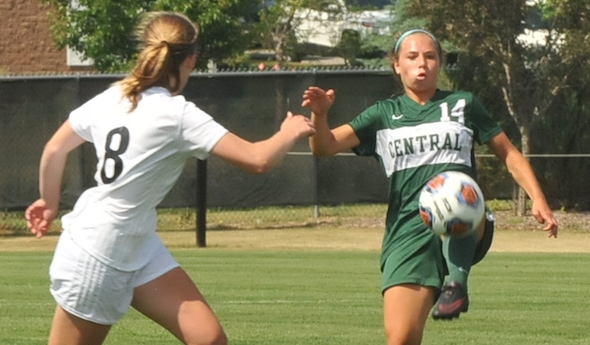
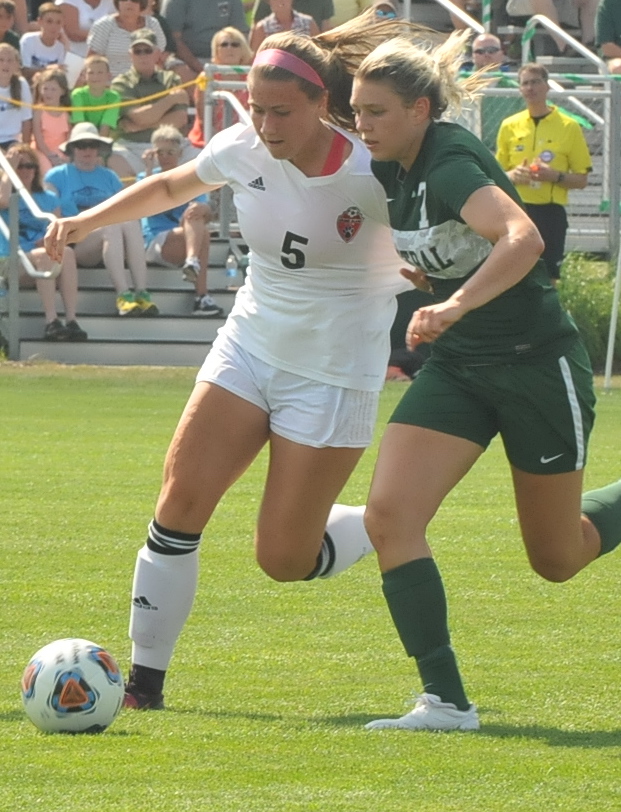
PHOTOS: (Top) Forest Hills Central’s Stephanie Curry (14) maintains possession while Grand Blanc’s Samantha Lewis defends. (Middle) Grand Blanc’s Lara Wheeler (5) and the Rangers’ Madison Donley battle for control of the ball.
Northville = Perfection in D1 Soccer
June 14, 2014
By Mark Meyer
Special for Second Half
WILLIAMSTON – Good things come in twos for Northville girls soccer, but even better in fours.
Like MHSAA championships in 1984, 2004 and now 2014.
The Mustangs completed their perfect 23-0 march to the Division 1 crown Saturday afternoon with a 2-1 victory over Utica Eisenhower.
As they have all season, the Northville senior forward tandem of Megan Buckingham and Jamie Cheslik provided the scoring punch: Buckingham in the first half with assist from Cheslik, who scored unassisted early in the second half after gaining possession deep in the Eagles’ zone.
The Northville defense – which had held opponents to only four goals all season – was perfect until the 31:58 mark of the second half when Eisenhower junior forward Paige Duda cut the lead in half on a shot from just outside the 18-yard line.
The last eight minutes provided a few tense moments for fifth-year Northville coach Eric Brucker, who was an assistant on the 2004 team.
“I told them at halftime that one goal wasn’t going to win it,” Brucker said. “They’ve been scoring four or five per game throughout the playoffs, so we weren’t expecting a 1-0 game.
“We don’t get scored on often, but we’re mentally tough enough to make sure it didn’t happen again.”
 Defensively, the Mustangs relied on midfielders Suzie Redick and Alissa Moore to mark Eisenhower forward Isabella Palazzolo, whom Brucker felt was a player who had to be controlled for Northville to be successful.
“We had different players in different roles, and they stepped up to do what needed to be done,” Brucker said. “Our scouting report showed that Palazzolo would be a factor on the left side, and normally it’s hard to mark someone on the outside mid. But Suzie and Alissa did an outstanding job swapping back and forth, trying to take her out of the play.”
The instant offense of Buckingham (23 goals) and Cheslik (33) – both Division I college recruits – was something that made Eisenhower coach Mehrdad Nekoogar uncomfortable.
“They are both great players and knew that we could not afford to make mistakes against them – they would make us pay,” said Nekoogar, whose team finished the season 18-3-1. “That’s what hurt us, a couple of mistakes.
“But we came back, scored and were in it to the end. I expect us to be back next year because we have almost everyone coming back.”
Northville senior captain Ashley Peper, a stalwart on defense for the Mustangs, said the team was loose and relaxed on the bus ride to the game.
“We were all singing; nobody was nervous,” Peper said. “We were so ready for it. We were pumped.
“We’re a second-half team; we know how to use our speed up front to our advantage. We needed to keep going hard. We knew they had come back before and had the ability to score quickly.”
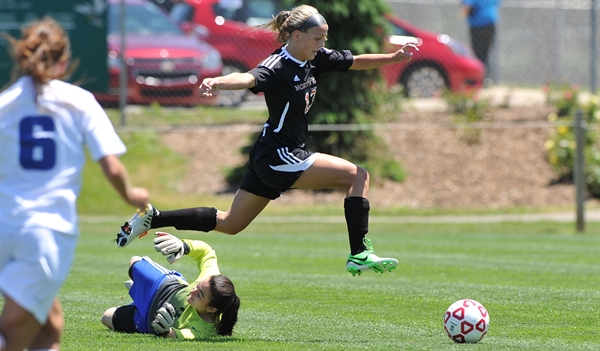
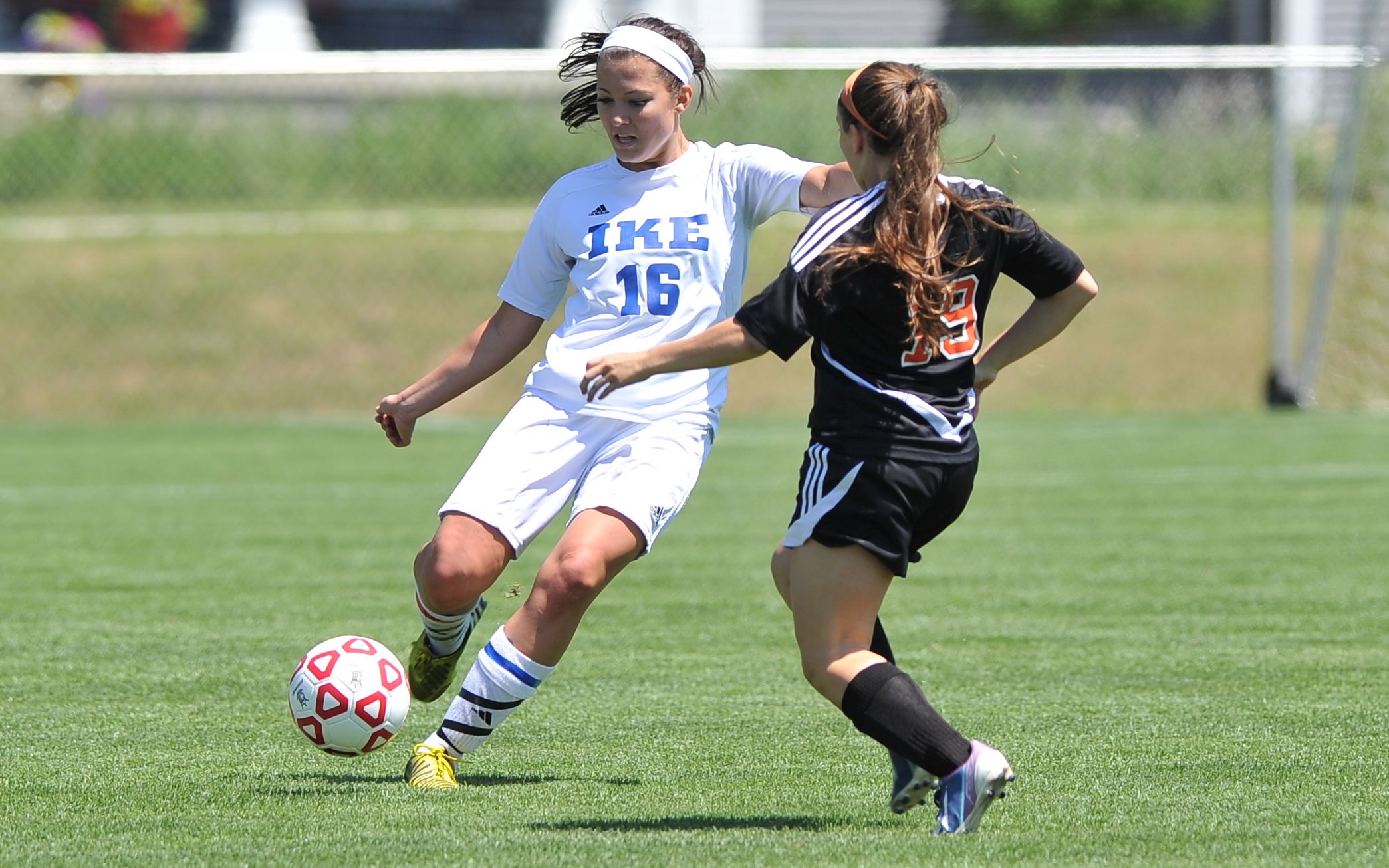
PHOTOS: (Top) Northville’s Jamie Cheslik leaps over the Utica Eisenhower keeper while controlling the ball during Saturday’s Division 1 Final. (Middle) Eisenhower’s Julia Henning (16) works to move the ball past Northville’s Kyra Dahring.