

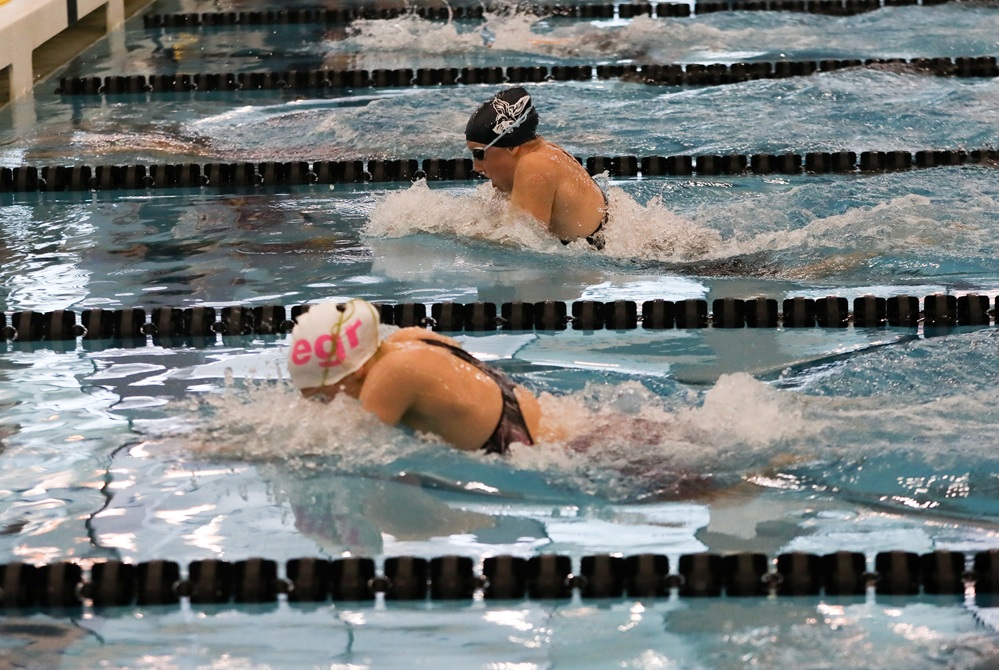
Be the Referee: Simultaneous Wall Touch
By
Paige Winne
MHSAA Director of Brand Management
November 17, 2026
Be The Referee is a series of short messages designed to help educate people on the rules of different sports, to help them better understand the art of officiating, and to recruit officials.
Below is this week's segment – Simultaneous Wall Touch - Listen
Are you familiar with the rules for touching the wall during the breaststroke in high school swimming? Let’s find out.
During a race, a swimmer approaches the wall to finish the breaststroke. The swimmer reaches out with both hands, touching the wall at the same time. However, one hand touches higher on the wall than the other.
Is this a legal finish? Yes, it is.
Under National Federation rules, swimmers competing in the breaststroke must touch the wall with both hands simultaneously. However, the hands do not have to be at the same level.
One hand can be higher than the other, and the touch can occur above, at, or below the water's surface. But if one hand touches the wall before the other, the swimmer is disqualified.
Previous 2026-27 editions
Nov. 10: Illegal Attack - Listen
Nov. 3: Pass Interference - Listen
Oct. 27: Field Hockey Substitutions - Listen
Oct. 20: Foot Save in Volleyball - Listen
Oct. 13: Soccer Advantage - Listen
Oct. 6: Defensive Holding - Listen
Sept. 29: Minimum Number of Volleyball Players - Listen
Sept 22: Soccer Changes - Listen
Sept: 15: Dead Ball Penalty - Listen
Sept. 8: Libero Ejected - Listen
Sept. 1: Soccer Foul After Shot on Goal - Listen
Aug. 25: Fumble Out of Bounds - Listen

The Official View: The Couple That Officiates Together
By
Brent Rice
MHSAA Assistant Director
October 8, 2018
By Brent Rice
MHSAA Assistant Director
This key to a long and happy marriage is officiating school sports.
Richard and Christine Lee from Brown City are proof. Richard has been officiating with the MHSAA for 42 years, and Christine has been an MHSAA official for 23 years. And this spring they celebrated their 45th wedding anniversary!
Of course, they celebrated in part by working a meet together, as seen in the photo above.
It’s Official!
Rules Meetings: With winter sports just around the corner, many of you already have begun getting into officiating shape and studying up on rules and mechanics in preparation of another great MHSAA season. Don’t forget to tend to the administrative requirements for postseason tournament consideration. The first Winter Online Rules Meetings become available starting today.
Here is the schedule for this year:
Oct. 8 – Basketball, Ice Hockey, Competitive Cheer and Wrestling
Oct. 15 – Gymnastics and Swimming
All Online Rules Meetings will close Dec. 13 at 11:59 pm. Don’t miss out on postseason opportunities because you put off (then forget) these requirements.
Rule of the Week
CROSS COUNTRY As A1 reaches the 3,000-meter mark, the umpire notices that the runner has multi-color compression shorts with a manufacturer’s logo that extends beneath the runner’s shorts but above her knees.
Ruling: There is no violation and no warning should be given. New NFHS cross country rule 4-3-1 provides that any visible garment(s) worn underneath the uniform top and/or bottom are considered a foundation garment. A foundation garment is any item worn under the uniform top and/or bottom and is not subject to logo/trademark/reference or color restrictions.
It’s Your Call
FOOTBALL On this play, the right guard pulls as the running back receives the handoff. The play results in a half-yard loss, but is there more to this play? What’s the call?
Last Week’s IYC Ruling: In order for the first contact to be considered a “block,” some part of the player’s hands must extend higher than the top of the net. This is a very close call as to whether her hands meet this – probably too close to consider them “below.” (Click to see the video from last week.)
The more pertinent aspect that applies to this play is whether she is still a blocker based on her playing action. One thing we should look at to determine whether this is a defensive or offensive play is arm swing. When the player in the clip takes a swing at the ball, this becomes an attack. As a result, the second contact by the front row member of Team R should be called a double hit violation.