

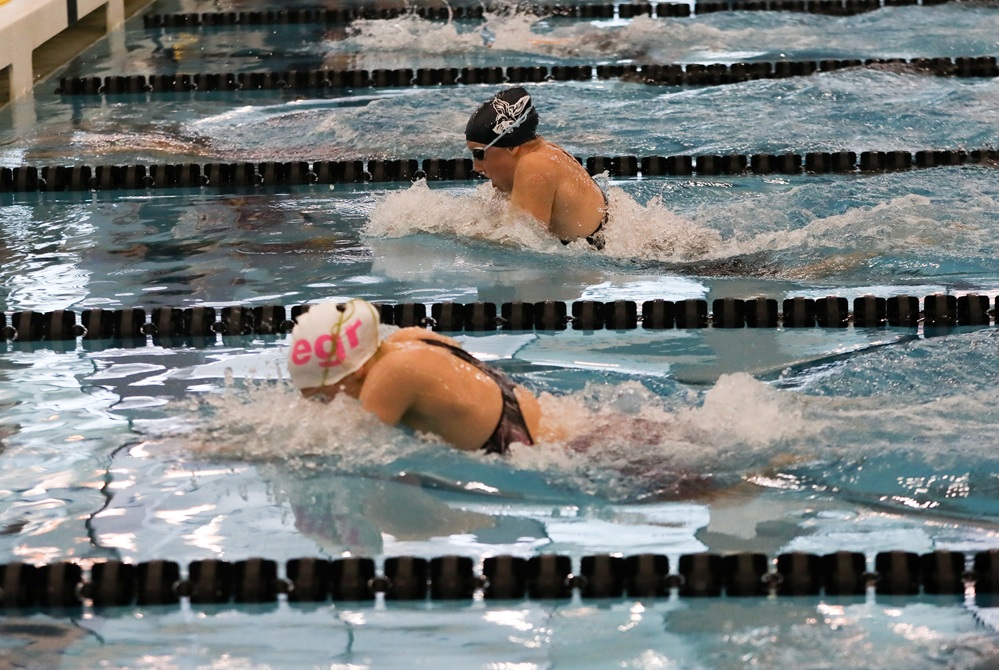
Be the Referee: Simultaneous Wall Touch
By
Paige Winne
MHSAA Director of Brand Management
November 17, 2026
Be The Referee is a series of short messages designed to help educate people on the rules of different sports, to help them better understand the art of officiating, and to recruit officials.
Below is this week's segment – Simultaneous Wall Touch - Listen
Are you familiar with the rules for touching the wall during the breaststroke in high school swimming? Let’s find out.
During a race, a swimmer approaches the wall to finish the breaststroke. The swimmer reaches out with both hands, touching the wall at the same time. However, one hand touches higher on the wall than the other.
Is this a legal finish? Yes, it is.
Under National Federation rules, swimmers competing in the breaststroke must touch the wall with both hands simultaneously. However, the hands do not have to be at the same level.
One hand can be higher than the other, and the touch can occur above, at, or below the water's surface. But if one hand touches the wall before the other, the swimmer is disqualified.
Previous 2026-27 editions
Nov. 10: Illegal Attack - Listen
Nov. 3: Pass Interference - Listen
Oct. 27: Field Hockey Substitutions - Listen
Oct. 20: Foot Save in Volleyball - Listen
Oct. 13: Soccer Advantage - Listen
Oct. 6: Defensive Holding - Listen
Sept. 29: Minimum Number of Volleyball Players - Listen
Sept 22: Soccer Changes - Listen
Sept: 15: Dead Ball Penalty - Listen
Sept. 8: Libero Ejected - Listen
Sept. 1: Soccer Foul After Shot on Goal - Listen
Aug. 25: Fumble Out of Bounds - Listen

Official Results
August 15, 2017
We enjoy some privileges serving on the Michigan High school Athletic Association staff. However, one privilege we do not have is to ignore rules when we don’t enjoy their application.
One of the rules of Michigan school sports for very many years is that there is no protest of or appeal to the decisions of contest officials. Whether it is a traveling call in basketball, a safe/out call in baseball or softball, a five-yard illegal motion call, a 10-yard holding call, or a 15-yard unsportsmanlike conduct call in football with player or coach ejection, the call is final; and if the penalty calls for next-game disqualification, that is final too.
If after a contest, an official wishes he or she could take back a call, it’s too late. If after a contest, folks pressure an official to rescind the next-game disqualification, the outcome is unchanged: ejection from one contest for unsportsmanlike conduct requires suspension from the next day of competition.
The finality of high school officials’ calls has been challenged multiple times in courts across the country – twice in Michigan – and the nearly unanimous result nationwide has been that judges will not allow themselves to become super-referees, second guessing onsite contest officials.
On some higher levels of sports – e.g., college and professional – where there are dozens of cameras covering a handful of contests each week, league offices may review some decisions. But our level of sports lacks sophisticated cameras positioned at all angles, and it involves many hundreds of contests in several different sports every week. We have neither the time nor the technology at every venue to be involved in reviewing the calls of contest officials.
Last school year, there were nearly 1,000 player ejections and more than 200 coach ejections. School sports is not equipped to review 30 to 40 of these situations that arise each week; nor should we do so.
Officials see a play and make an instantaneous decision. Their calls are final; and living with the outcome is one of the valuable lessons we try to teach and learn in school-based sports.