

1970s Pioneers Took 1st Track Strides
May 16, 2017
By Ron Pesch
Special for Second Half
Between 1982 and 1987, Sue Latter-Addison was considered among the top 10 women runners for the 1,500 meters/Mile according to Track and Field News.
In 1986, she became only the eighth female in U.S. history to break 4:30 in the mile with a time of 4:23:93 at the Nikaia meet in Nice, France. Over the years, she ran with and against some of the greatest of all-time, including Mary Decker-Slaney. As a junior at Michigan State in 1977, she earned All-American honors in the outdoor 800 meters.
As a coach, she was named NCAA Division III Midwest Region Women’s Cross Country Coach of the Year in 1999, in her third season at Wheaton College. Her previous coaching stops included stints at Brown University, Colorado, Florida State, and most recently at Hope College. Running professionally for Reebok and Nike, she competed around the world.
“We were fortunate to come along when we did,” said Latter-Addison, recalling some of the track trailblazers and a time when participating in high school sports was not a possibility for girls. “If we had been born a couple of years before, we wouldn’t have had the opportunities that we did.”
Sue Latter was a 16-year old junior at Clarkston High School in January 1973 when the 6th U.S. Circuit Court of Appeals upheld a 1972 ruling that allowed girls to compete in varsity, non-contact sports with boys in Michigan. Since her high school didn’t have a girls track team, she joined the boys team.
“(Running with the boys) had advantages and disadvantages,” she said a few years later to the Lansing State Journal while running for MSU. “It did make me work harder, and my teammates were always encouraging me.”
The arrival of the first MHSAA Girls Track and Field championships in 1973, won by Marquette in the Upper Peninsula and by Lincoln Park in the Lower Peninsula, was the culmination of many things.
 The nation’s view of the female in society was rapidly changing. In many cases, the battle for the chance to compete against others was led by parents who believed in the educational value of athletics, and saw that opportunity denied because of gender. Thanks to their efforts, walls that prevented girls from enjoying opportunities that once were exclusively reserved for males began to crumble. Among those barriers were rules that prevented girls from competing athletically. Title IX, along with other lesser known lawsuits, meant rapid expansion of sports in Michigan and across the United States.
A survey of MHSAA member schools during the 1969-70 school year found 59 districts offered track for girls. A year later, 69 schools offered the sport. In April of 1972, the MHSAA announced plans to expand girls state tournaments to five sports – Tennis, Swimming, Gymnastics, Golf, and Track – during the 1972-73 school year. One year previous, gymnastics was the only one offered, beside skiing regionals that allowed teams containing males and females.
With the announcement, the number of girls prep track programs shot up to 150. However, Clarkston wasn’t amongst them.
A new sport called Powerball – a version of competitive volleyball – was added to the athletic menu at Clarkston during the 1972-73 school year. The girls converted from six-girl basketball to a five-girl team during the 1969-70 school year. The “ball” sports were the only athletic options, outside of cheerleading and skiing, that were offered by the Clarkston district for girls during the 1972-73 season.
“I liked competing and enjoyed running and realized I was pretty fast,” recalled Latter-Addison. “Obviously there wasn’t much to choose from. I liked individual sports, where you’re responsible for yourself and your own success. Coach, (Errol) Solley gave me a chance.”
“She had a lot of talent,” said Solley, now a resident of Florida who returns to Michigan for the summers. “She wanted to run. We didn’t have a girls team at the time. It was a time when things were changing and changing fast.”
A few other girls had joined Latter on the team, but by the 1973 track season’s end, she was the only female still working out with the boys. Solley entered her in the girls regional state meet at Madison Heights, where she won the 880 and 440-yard dashes. With the wins, Latter advanced to the state meet, hosted at East Lansing High School.
She was one of 366 entrants from 119 schools at the Lower Peninsula meet, open to all schools regardless of enrollment classification in that first year. In the Upper Peninsula, 29 teams competed at Iron Mountain for U.P. honors. In 1974, the L.P. girls event was split into two, one for Class A and B schools and a second for Class C and D schools. In 1975, events were run for each of the state’s enrollment classifications. In the U.P., the event was segmented into Class A-B, Class C and Class D beginning in 1974.
And, like many others, Latter was the only qualifier present to represent her high school. According to the State Journal, Latter’s clocked time of 57.1 seconds set a national schoolgirl record in the 440-yard dash that year. She also won the 880 run with a time of 2:17.7.
Solley proudly relayed word to the Clarkston News that the University of Michigan girls coach had said he “hadn’t seen anything like her comeback from 880 to the 440 within an hour.”
“She opened up a lot of eyes,” recalled the coach more than 40 years later. “When you have a girl win two state championships, that will happen.”
 Running second in the 880 was Sue Parks of Ypsilanti High School, who finished at 2:18.3. Park’s father Bob was head coach of Eastern Michigan University’s men’s track and field and cross country teams for 34 years. Like others, he had fought hard for his daughter’s right to run, and the 1971-72 school year found her practicing with the track team at Ypsilanti.
Anita Lee of Detroit Cass Tech was the day’s other double winner. In 1970 as a 12-year-old, Lee’s name landed in “Faces in the Crowd,” still a feature of every issue of Sports Illustrated, for setting “her seventh world age-group record with a long jump of 18'6¼" at the U.S. Youth Games in New York.” According to the magazine, she already held the 10-, 11- and 12-year-old girls world records in both the long and high jumps.
A sophomore in 1973, Lee won both the long and high jump in the MHSAA’s open meet. A year later at the Class A-B track championships, she won the long jump, the 80-yard hurdles, then ran the opening leg of the 880 relay, also won by Cass Tech. As a senior in 1975, Lee grabbed the top medals in both the long jump and high jump at the Class A championships. Like Latter, she would compete at Michigan State after graduation. There, she would post jump records that would last for years.
“When you have success, it is addicting,” said Latter-Addison.
Unfortunately, Latter’s success didn’t translate into a girls track team. Clarkston still didn’t sponsor a girls squad in 1974, her senior year. So she and some other female classmates accepted their only option and ran with the boys squad. Now running the 100 and 220, Latter was Oakland County champ in both events at the first county meet, held at West Bloomfield High School. Ready to return to statewide competition, suddenly a roadblock appeared.
“A question of Sue’s eligibility arose last weekend as she and three other Clarkston High School girls prepared to run in the regional meet” at Madison Heights Madison, stated the Clarkston News that May.
“Because Clarkston did not field enough girls for a girls track team, the co-eds had practiced with the boys’ team and ran practice in their meets. They … ran afoul of a new athletic rule which says that a boy or girl must elect which team they will enter competition with.”
As explained by a school official, “if a girl decides to play with the boys’ tennis team, for instance, she cannot play with the girls team.”
 Since there was not a girls team at Clarkston, officials were unable to present a clear ruling on eligibility, and it was initially decided that the girls would not be allowed to run in the qualifying regional.
“I was very emotional,” said Latter-Addison, recalling the incident.
Clarkston school officials had said they had no intent of violating state rules. Unable to get a clear cut decision, ultimately Latter and her three female teammates, Vadna Seyler, Judy Henderson and Nancy McAlevy, were allowed to compete. Latter was the only Clarkston girl to qualify for a trip to the state finals, but at the conclusion of the meet, it remained uncertain if there had been a violation.
Similar occurrences happened around the state, and confusion reigned. Ultimately, it was decided that the rule needed to be re-examined. The performances were accepted and Latter was cleared to run at the state meet, held in Grand Rapids in 1974.
There, she finished second in both the 100 and 220 to Josephine Hobbs of Detroit Central. Hobbs would win both events again in 1975 and 1976, and then run for Delaware State.
All were pioneers, shattering pre-conceived notions about girls and athletics. While it may seem a clichéd phrase, those early participants truly paved the way for today’s female athletes.
For Sue Parks, the freedom to run competitively led to a fabulous college cross country career at Eastern Michigan University, as well as a bachelor’s degree in 1980 and a master’s degree in 1988.
During her college days in Ypsilanti, she served as head girls track coach at Ann Arbor Gabriel Richard High School in 1982 and head girls cross country coach at Ann Arbor Huron from 1979 to 1983. That was followed by a coaching career that included years at the University of Michigan, Michigan State, the University of Arizona, and Ball State before returning in 2006 to EMU.
There, she still heads the women’s track and field and cross country coaching staff.
“Look how far it’s come,” stated Latter-Addison, remembering the challenges and opportunities that came from the chance to compete.
Her daughters with husband Ron Addison, an All-American runner at the University of Tennessee, earned MHSAA state championships while at Grand Haven High School. Both Becca and Laura Addison later ran for the University of Michigan.
“I wasn’t awarded an athletic scholarship at Michigan State until my junior year,’ Latter-Addison said. “They simply didn’t exist for girls. Back then, you had to be happy with a free pair of shoes. Today, the opportunities are there.”
 Ron Pesch has taken an active role in researching the history of MHSAA events since 1985 and began writing for MHSAA Finals programs in 1986, adding additional features and "flashbacks" in 1992. He inherited the title of MHSAA historian from the late Dick Kishpaugh following the 1993-94 school year, and resides in Muskegon. Contact him at [email protected] with ideas for historical articles.
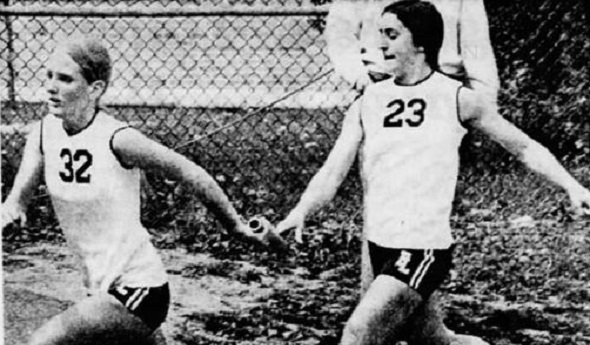
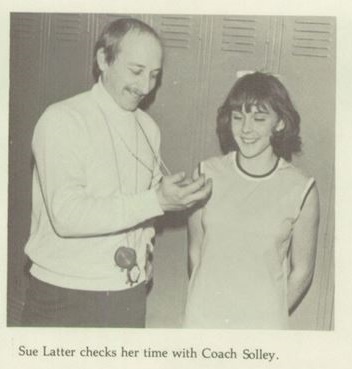
PHOTOS: (Top) East Lansing's Betsy Leverich takes the baton from Cathy Mueller (right) during the first MHSAA Girls Track & Field Finals in 1973, as captured by the Lansing State Journal. (Middle top) Clarkston's Sue Latter stands for a photo with coach Errol Solley. (Middle below) Detroit Cass Tech's Anita Lee was among the earliest Michigan high school female track stars. (Below) Sue Parks also was an early star and the daughter of a collegiate coach who went on to compete at the next level. (Photos provided by Ron Pesch.)
TC Central's Zielinski Eying Finals Records, U-M Stardom, Olympic Aspirations
By
Tom Spencer
Special for MHSAA.com
May 29, 2026
Lorelai Zielinski may be on the verge of winning her second-straight MHSAA Finals championships in both the discus and shot put as she prepares to compete at Saturday’s Lower Peninsula Division 1 Track & Field Finals in Rockford.
 And, while being named a champion again would be an honor for the Traverse City Central junior star, she’s quick to put it in perspective.
“One thing that I always tell myself, the point of track & field is not to win — it’s all that hard work that you have done to build up to that point, and winning is just part of it all,” the University of Michigan commit said. “It's just the effect of everything that you do, and it definitely is a great accomplishment because it’s ‘states’ and some people's biggest meet of the year. Having state champion next to your name, especially more than once, and more than one event, is amazing.”
Zielinski won last year’s titles as a sophomore with throws of 46 feet, 11¾ inches in the shot put and 155-1 in the discus. She has dominated the competition so much the last couple years that local media often report her success as a winning “by a long way again.”
Her personal records, both set this spring, are 52-6 in the shot put and 168-5 in the discus. Both would set MHSAA Finals records for all divisions if she replicates them Saturday.
To Paul Anderson, Central’s head coach, Zielinski is in a category all by herself. Anderson has been around high school track in New Mexico and Michigan for 30 years. He’s coached a couple of nationally recognized names over the years, but noted Zielinski really stands out.
At Central, Anderson also coached recent Stanford graduate Julia Flynn, who made national headlines when she became the first prep girl during the 2020 season to run a 5K faster than 17 minutes. In New Mexico at Los Alamos High School, Anderson coached Chase Jackson (then Chase Ealey), currently a dominant global force in track & field. Jackson made history as the first American woman to win a shot put world title, claiming outdoor gold in 2022 and 2023.
“Lorelai is a thrower, a strong woman, and is just a great person,” Anderson said. “She is probably one of the highest-rated high school athletes that I've ever coached. It’s not just her consistency, but dominance.”
During Zielinski’s early days in the sport she was coached by her mother, Amanda. Lorelai competed in shot put as a sixth grader for Traverse City East Middle School.
Zielinski, who remains the sixth, seventh and eighth-grade record-holder at East, started exploring throwing discus the summer after seventh grade.
“Lorelai started learning about and following the sport very early, but not obsessively,” Anderson said. “She loves it — but it's not owning her — it doesn't mean that’s who she is. It’s like, ‘This is what I do, and I'm not going to be like anybody else.’ Everybody talks about what a good person she is and then being an athlete — then being a thrower — gives a nice dimension.”
Zielinski has high hopes for success in college sports and quite possibly, and most likely, as onlookers say, for the national team someday.
She has her eyes on the throwing qualifying standards for the 2028 U.S. Olympic Trials, and she realizes 2032 might be a more obtainable goal. She’s planning to focus on shot put and discus while exploring the javelin, hammer and weight throws while competing for the Wolverines and pursuing studies in physical therapy or audiology.
 But for now, she is celebrating having an impact on young female athletes. She recalls her younger sports days looking up to basketball and track athletes, including current teammates.
“Obviously, track is about performing and all that, but I wanted to be able to be a role model for these younger girls,” said Zielinski, who also plays basketball for the Trojans. “I wanted to be able to inspire younger girls. It's definitely a great feeling that other people look to me for inspiration.”
Zielinski is a recognized figure around middle school and elementary track meets as she volunteers to help with events including shot put. She’s enjoyed watching anecdotal evidence of growth in the sport’s numbers and talent as well as in the presence of high school coaches helping out middle school throwers in particular.
As further evidence of Zielinski’s impact, earlier this week Traverse City kids swept the shot put podium at the MHSAA Middle School Regional in Cadillac. West’s Anna Hornacek, the school’s sixth, seventh and eighth-grade record-holder, took first with a 40-2 throw. East’s Delaney Neveau, a sixth grader, was second at 33-5, and West’s Eilley Dwyer, the second-leading sixth and seventh-grade thrower all-time, was third at 32-11.
Zielinski and Anderson are thrilled to have field events coach Chad Norton guiding her success. Zielinski especially appreciates Norton’s constant reminders that “practice doesn’t make perfection – practice makes progress.”
Norton’s been especially helpful with the mental aspects of throwing, something with which Zielinski admits she has often struggled.
“One thing Coach Doug always tells me is to breathe and have fun,” she said. “Getting in my head or setting my standards too high, I won't be having fun, and the point of it is to have fun.”
Anderson, now in his 10th year at the helm of the Trojans’ track program, is quick to point out the pride Norton has in Zielinski’s success. Anderson also points to the development of freshman thrower Nora Jensen, who already has found success under Zielinski’s mentorship.
“Doug avoids the spotlight and he’s very much honed into knowing what he had with Lorelai and his responsibility,” Anderson said. “I love Chad as a coach, because not only does he work with Lorelai, but then he takes as much time, or more, with the new shot putters. It's a great community that he has going there.”
Zielinski, who is hoping to have Norton train with her over the summer and next winter, has her freshman year MHSAA Finals in the back of her mind as she prepares for this year’s meet.
She finished second in both shot put and discus two years ago to then senior Abigail Russell of Allen Park. But she’s since exceeded Russell’s distances as she looks to become a teammate to Russell at Michigan.
Zielinski bettered Russell’s distances, in fact, at this year’s Regional Meet in Mount Pleasant. The Trojan stellar throw topped the 50-foot mark in the shot put and exceeded 161 feet in the discus.
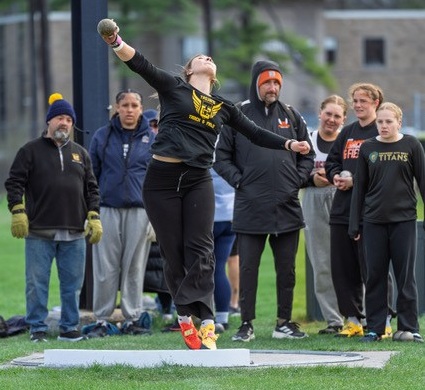
Expect Zielinski to be wearing her trademark different-colored shoes again at the Finals. She’s worn two colors since entering high school, and this time she’ll be sporting a new pair of yellow and orange Nikes. She introduced them this week at the Traverse City Record-Eagle Honor Roll Meet.
Zielinski must replace the shoes during the season because she wears out the bottom of her right one.
“So I buy two pair of shoes for that reason, as well as my freshman year when I started doing it I felt a little bit superstitious. So I always have different-colored shoes as a tradition,” Zielinski said. “I also write different affirmations on each of my shoes such as ‘Have fun,’ ‘Breathe,’ ‘Control,’ and ‘Be the one thing in life you can control.’”
 Tom Spencer is a longtime MHSAA-registered basketball and soccer official, and former softball and baseball official, and he also has coached in the northern Lower Peninsula area. He previously has written for the Saginaw News, Bay County Sports Page and Midland Daily News. He can be reached at [email protected] with story ideas for Manistee, Wexford, Missaukee, Roscommon, Ogemaw, Iosco, Alcona, Oscoda, Crawford, Kalkaska, Grand Traverse, Benzie, Leelanau, Antrim, Otsego, Montmorency, Alpena, Presque Isle, Cheboygan, Charlevoix and Emmet counties.
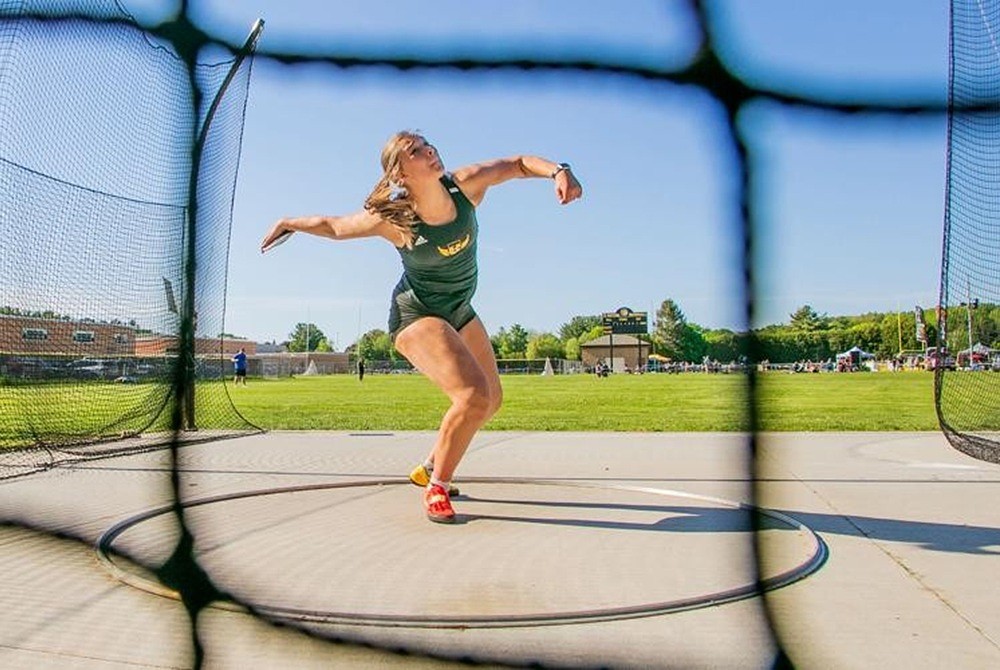
PHOTOS (Top) Traverse City Central’s Loralei Zielinski winds up during a discus throw. (Middle) Zielinski launches the shot while a gathered crowd watches. (Top photo by Jan Michael Stump/Traverse City Record-Eagle. Middle photo by TC Rick Sports Photography.)