

Coach Predicts Title, Ithaca Girls Answer
June 13, 2016
By Geoff Kimmerly
Second Half editor
There’s a clear difference between prediction and expectation. But the Ithaca girls track & field team had to decide which way coach Gene Lebron was leaning when he told his athletes they’d win an MHSAA championship this spring.
 Erica Sheahan knew it was more than a pep talk.
Lebron had called his cross country team’s 2014 championship as well – and that gave this spring’s Yellowjackets plenty of faith in their coach’s fearless forecast.
Ithaca’s girls track & field team – the Applebee’s Team of the Month for May – dominated its Tri-Valley Conference West competition at last month’s league meet and also won its Division 3 Regional for the second straight year – and second time total in program history.
and it’s impossible to overlook what the Yellowjackets then accomplished four days after May ended – win the first MHSAA Finals championship in program history, scoring 57½ points to edge Adrian Madison by 3½ at the Lower Peninsula Division 3 meet at Comstock Park.
“This group of seniors, we accomplished a lot together and we set our goals high,” said Sheahan, who repeated as LP Division 3 long jump champion. “Coach told us this would be the year, and we stuck to it and did the best we could to make it happen.”
At the MHSAA postseason level, that first step came at the May 20 Regional at Shepherd, which Ithaca won by 52 points over the runner-up Bluejays. The Yellowjackets then won their league meet on May 25 with 215 points, doubling up the field while finishing first in seven individual races, two field events and all four relays.
Ithaca also started May with a 12½-point win at the Shepherd Invitational over Cadillac, which went on to tie for 17th in LP Division 2 this month, and third-place Fowler, which won the LP Division 4 championship. Ithaca also won the Division 3 portion of the Alma College Scottie Classic on May 14.
By the end of this season, Ithaca had broken school records in every relay, long jump, the 200, 800, 1,600 and 300 hurdles. Lebron said the relay records might not be approached for some time.
“Those records were already set really high, and these girls really performed at a high level this year,” Lebron said. “They really took a stride.They fed off that (2014) championship in cross country. We sent 10 girls to the MHSAA state meet, and six of those girls ran at the (cross country) state meet when we won. When we won in 2014 in cross country, we came back that track season and placed fourth. They kinda knew the writing was on the wall.
"They were disappointed with the state meet in cross country this year; they finished fifth and I thought they should’ve been higher, and they did too. They felt they let one get away, but they came in more motivated than ever for track.”
Sheahan was the only Ithaca girl to win a Finals championship. But she also won the 100 and 200 at the Regional, where junior Courtney Allen won the 800, junior Emily Foster won the 300 hurdles, and some combination of Sheahan, Foster, Allen, Mikayla Fairchild, Kara Kindel, Morgan Most, Blaire Showers, Amelia Freestone, Kurstin Kalisek and Alyssa Mankey won all four relays.
 Counting every team Ithaca finished ahead of at an invitational or postseason event, the Yellowjackets were an incredible 145-2 this season, finishing third at the Michigan Interscholastic Track Coaches Association meet but winning every other time they competed.
Lebron has been around plenty of championship teams. In addition to his, Ithaca is best-known for its football team that’s won five of the last six Division 6 titles. He sees every day the sacrifices made by athletes hoping to reach the highest level.
But to him, the level of commitment by the girls on this spring’s team still stood out. Some played volleyball in the past, but switched the cross country to better prepare for track season. As a team, they lifted weights during the offseason three times a week at 6:30 a.m., and informally the distance runners and some sprinters would get together every Sunday for a long run.
Equally “extraordinary,” the Yellowjackets have a cumulative grade-point average of 3.755.
Indeed, football does enjoy most of the statewide shine for the community of 3,000 about 45 miles north of Lansing. But the girls running program has made a reputation as well the last two school years.
“They’re diehard with football. They’re all friends with those guys. But they want their own success,” Lebron said of his athletes. “Every team at Ithaca lives in the shadow of Ithaca football. But I don’t think that’s a negative thing all together. I think our girls are motivated by them. We’re going to cast our own shadow.
"Football is football; it’s America. But these girls have done a good job making a name for themselves.”
Past Teams of the Month, 2015-16:
April: Lake Orion boys lacrosse – Report
March: Hancock ice hockey – Report
February: Petoskey boys skiing – Report
January: Spring Lake boys swimming & diving – Report
December: Saginaw Heritage girls basketball – Report
November: Ann Arbor Gabriel Richard volleyball – Report
October: Benton Harbor football – Report
September: Mason and Okemos boys soccer – Report
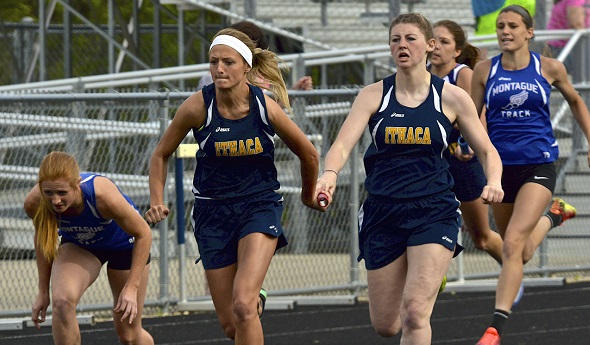
PHOTOS: (Top) A pair of Ithaca runners complete a handoff during their Regional meet May 20 at Shepherd. (Middle) The Yellowjackets pose with the first MHSAA Finals championship trophy won in program history. (Click to see more from HighSchoolSportsScene.com.)
Preview: LP Girls Finals Lineup Loaded with Past Champs, Potential Record-Setters
By
Geoff Kimmerly
MHSAA.com senior editor
May 29, 2026
Years from now, or perhaps much sooner, this weekend’s MHSAA Lower Peninsula Girls Track & Field Finals might be remembered as one of the most star-studded we’ve seen in some time.
Returning qualifiers have won a combined 29 individual Finals championships over the last three seasons, and at least a few meet records are in danger of being rewritten Saturday as athletes compete at four Grand Rapids-area sites.
All four LP Finals will begin with pole vault and long jump beginning at 9 a.m., followed by race semifinals and the 3,200 relay at 10 a.m. and the rest of the running finals starting at noon. Tickets cost $11 and are available digitally only via GoFan.
MHSAA.tv will live-stream all four meets beginning at 10 a.m., viewable with subscription. Check out the Girls Track & Field page for meet information for all four sites and lists of all qualifiers. Those described as "seeded" below have received those seeds based on Regional performances or meeting early qualification standards. (Although not noted for most, several individuals below also will run on contending relays.)
Below is a glance at team contenders and individuals to watch in all four divisions:
Division 1 at Rockford
Team forecast: Oak Park has won the last three Division 1 championships, and Detroit Renaissance has finished second two of the last three seasons after claiming the title in 2022. Oak Park is certainly the favorite again Saturday, but Detroit Cass Tech might offer the greatest challenge this time, with 2024 runner-up Ann Arbor Pioneer another school to watch for at the top.
Nevaeh Burns, Oak Park junior: She’s won the 400 both of her first two seasons and run on five relay champs as well, and enters this weekend seeded first in the 400 (54.21), running the 100 and 200 and as part of the top-seeded 800 relay (1:38.62).
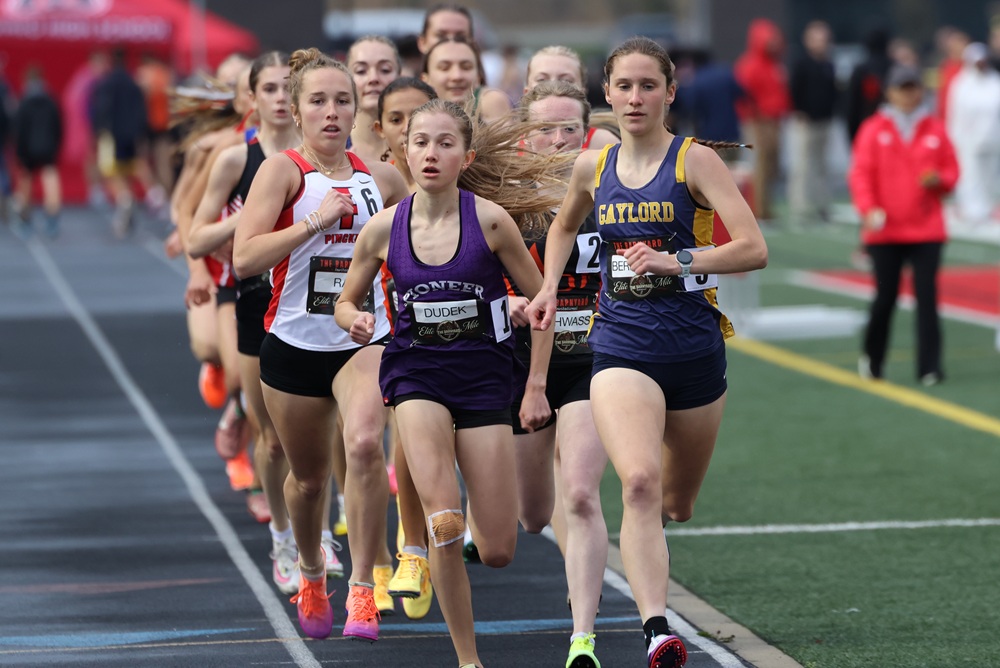
Natasza Dudek, Ann Arbor Pioneer sophomore: The Division 1 cross country record-setting champion this past fall will attempt to build on her second place in the 3,200 and fourth in the 1,600 last spring, seeded first in the 3,200 (10:01.05) and running on the top-seeded 3,200 relay (9:08.39) after scratching from the 800 and 1,600 despite being the top seed in the latter as well.
Payton Gee, Oak Park sophomore: She was part of two relay champions last year, and could add to that haul seeded first in the 100 hurdles (13.88) and 300 hurdles (44.49), slated to run on two top-seeded relays but also qualified in the 100, 200 and 400.
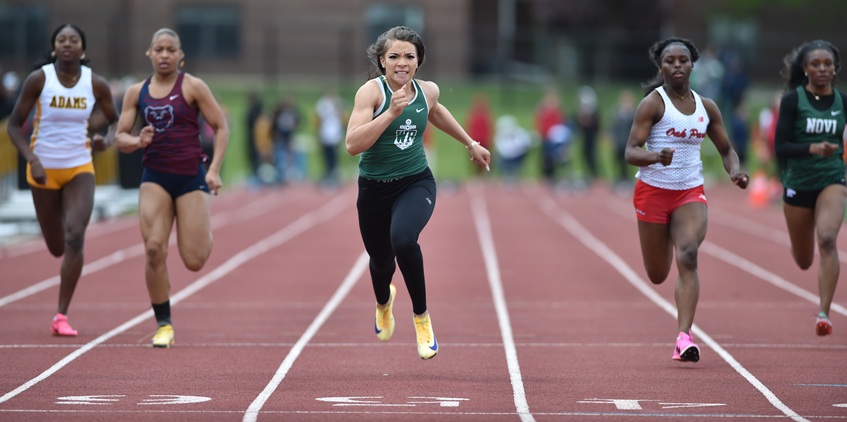
Kamryn Tatum, West Bloomfield senior: She’ll close a celebrated high school career seeking a fourth championship in the 200 and second-straight in the 100. She’s seeded first in the 200 (23.68) and second in the 100 (11.77) and could also run on two relays after scratching as the third seed in the 400, which she won as a freshman.
Collette Wierks, Holland West Ottawa junior: The reigning champion in the 800 also has run on two 3,200 relay winners and enters this weekend seeded second in the 800 (2:11.31) and running on 3,200 and 1,600 relays.
Lorelai Zielinski, Traverse City Central junior: The all-Finals records for shot put and discus could fall to the Trojans’ standout, whose top-seeded tosses of 52-6 and 167 feet, respectively, would be all-time bests. She swept the throws last season.
Division 2 at Hamilton
Team forecast: Sturgis claimed its first Finals championship last season, and Spring Lake is among contenders with a chance to do the same. Sturgis should be heard from again, and 2024 champion Dearborn Divine Child also has the capability to follow its standouts back to the top.
Evie Mathis, Wayland senior: The reigning pole vault champion posted a Regional-best 13-0 and will also run on two relays.
Eliza Schwass, Ludington freshman: She’s enjoyed an incredible first season and enters her first Finals seeded first in the 800 (2:08.61) by almost three seconds, first in the 1,600 (4:40.34) by nearly nine and first in the 3,200 by nearly 14.
Macy Subka, Spring Lake junior: She finished third in the 300 hurdles and 17th in the 100 hurdle prelims last season, and enters this weekend seeded second in the 100 hurdles (14.91), first in the 300 (44.13) and likely to run on two top-seeded relays.
Leigha Whitman, Stevensville Lakeshore junior: The reigning long jump champion is seeded first (18-10½) and likely to run on two relays as well.
Aubrey Wilson, Dearborn Divine Child junior: She’ll pursue her third 100-meter title and second-straight in the 200, and is seeded first in those two races (11.52 and 23.77, respectively) and the 400 (56.14) and could also long jump or run a relay.
Division 3 at Kent City
Team forecast: Olivet broke through last season for its first Finals team championship, and the Eagles have entries seeded at or near the top in every running event as they pursue a repeat. Lansing Catholic is seeking its first girls track championship and has the potential to put up major points in the distance open races and relays. Traverse City St. Francis and Pewamo-Westphalia are others to watch.
Julia Hughes, Ida senior: The reigning 100 hurdles champion is seeded first in that race (14.60) and second in the 300 hurdles (46.03).
Giuliana Nastale, Erie Mason senior: She’s seeking repeats in both the 100 and 200 dashes, and she’s a contender in three races seeded fourth in the 100 (12.25), third in the 200 (25.58) and second in the 400 (58.88).
Emily Peters, Olivet senior: She’s running for a fourth 300 hurdles championship and seeded first in that race (45.32) and third in the 100 hurdles (15.17) with opportunities as well to run the 100 and long jump (in which she’s seeded fourth) or on any of three contending relays.
Addyson Stiverson, Montrose junior: She swept the throws last season and won shot put as a freshman as well, and her Regional shot put of 51-10 also would break the all-Finals record this weekend. She’s seeded second in the discus (145-5).
Grace Wonch, Lansing Catholic junior: She’s seeded first in the 1,600 (4:59.96) and 3,200 (10:37.02) and second in the 800 (2:18.96) after finishing eighth in the 3,200 but running on the winning 3,200 relay in 2025.
Division 4 at Hudsonville Baldwin
Team forecast: Fowler has won the last two Division 4 team titles, and the Eagles remain in the conversation with potential point scorers all over this meet. But last season’s runner-up Frankfort may be the team to watch as it runs for a first championship, entering with three top-seeded relays plus contenders in sprints and pole vault. Kalamazoo Hackett Catholic Prep also is seeking a first Finals win and has possible contributors spread among several events.
Ryleigh Ewald, Unionville-Sebewaing senior: The reigning discus champion had the top Regional throw of 124-8 and also will compete in shot put.
Kaylie Livingston, Whitmore Lake junior: She’s won two Division 4 cross country championships plus the 3,200 the last two springs, and she’s seeded first in that race (11:01.75) and the 1,600 (5:07.55) and fourth in the 800 (2:23.01).
Claire Long, Saginaw Nouvel Catholic Central junior: She won the 400 and finished third in the 200 a year ago, and this time she’s seeded first in the 400 (57.32), fifth in the 200 (25.77) and seventh in the 100.
Annie Saenz, Concord sophomore: The reigning high jump champion had the highest Regional jump this spring (5-7) by four inches and also could run on two contending relays.
Clara Slattery, Kalamazoo Hackett Catholic Prep junior: She finished second in the 200 and 100 hurdles and third in the 300 hurdles during a strong 2025 meet, and could follow that up substantially seeded first in the 200 (25.01) and 300 hurdles (43.86) and second in the 400 (58.12) and 100 hurdles (15.51).
PHOTOS (Top) Ann Arbor Pioneer’s Natasza Dudek, front left, and Gaylord’s Kate Berkshire take the early lead in the Diamond 1,600 at Romeo’s Barnyard Invitational this season. (Middle) West Bloomfield’s Kamryn Tatum, middle, sprints to an Oakland County championship Friday. (Photos by Dave McCauley, at Oakland County, and John Brabbs at Romeo/RunMichigan.com.)