

Diabetes, Missed COVID Season Can't Slow Renaissance Record Setter
By
Tom Markowski
Special for Second Half
May 13, 2021
Kaila Jackson knew something was wrong.
 Less than two months had passed since she competed, as an eighth grader, in the 2018 Michigan High School Indoor State Track Championships in Saginaw, where she set a meet and age group (indoor) record in the 60-yard dash of 7.56 seconds. And her body was sending her confusing signals.
“My times were getting slower,” she said. “I was out of breath.”
Her parents, Anthony and Kimberlee Jackson, weren’t taking any chances with the youngest of their two children. They took Kaila to their family pediatrician and, after receiving the shocking results, she was immediately taken to Beaumont Hospital.
At age 13, Jackson was diagnosed with Type 1 diabetes.
The self-pity, depression or additional physical and/or emotional difficulties Kaila experienced upon receiving the news didn’t last long. That August she won the AAU 100-meter national championship at North Carolina A&T before entering her freshman year at Detroit Renaissance.
“It did take time to get (physically) better,” she said. “After a few days, me and my dad, we said let’s get on the track and see what happens. And I did pretty good. I was surprised.”
The more Jackson runs, the more she wins and the more the records fall. That first season at Renaissance, at the MHSAA Lower Peninsula Division 1 Track & Field Championships, Jackson won the 200-meter dash, placed second in the 100, and her sprint relay teams won both the 400 and 800.
The pandemic cut short the 2020 track season, but it didn’t stop Jackson. She continued to train with her three coaches – her father, Renaissance girls track coach Calvin Johnson, and Olympic gold medalist Darnell Hall, who serves as the Renaissance boys track coach. Unofficially, all three coach both squads. With their help, Jackson continues to improve her standing in the world of track & field.
 At the Ypsilanti Lincoln Spring Indoor Classic on April 10, Jackson won the 100 and 200-meter dashes with the times of 11.82 and 24.04, respectively. The time in the 100 set a national high school indoor record.
It’s been a quick rise to the top for Jackson, and her ability as a track athlete came out of the blue. Her older sister, Tailar, is an accomplished volleyball player who will graduate from Winston-Salem State (NC) on May 21 after competing in that sport for four years.
Her parents were also fine athletes. Kimberlee played volleyball at Detroit Pershing, and Anthony played basketball and was the starting quarterback on the 1988 Detroit dePoress Class C championship team. Anthony Jackson went to Cincinnati and started as a receiver, but was forced to leave school after his sophomore season due to a family illness.
Kaila Jackson’s entry into track began with a phone call from a gym teacher at her school, Bates Academy in Detroit.
“He calls me up and says, she’s (running faster than) all the boys,” Anthony Jackson said. “So I gave Darnell, who I’ve known for years, a call and he said to bring my daughter to him. After he sees her run he says to me, ‘I think we got something here.’
“My wife and I were surprised. Track is not something we talked about. But one thing I will say: Kaila is a competitor. ”
And that continues, whether it’s competing against the sprinters next to her or battling the diabetes she lives with every day. That passion to compete, to excel, began early on.
In her second season competing on a national level, Jackson placed seventh in the 100-meter at the U-9 championships. As a 10-year-old, she placed second in the 100 and the 200.
Most recently, Renaissance took first place at Friday’s New Balance Invitational that featured 16 teams from Michigan hosted by Farmington High. Jackson was named MVP as she took first in the 100 (12.06) and 200 (24.95), and her sprint relay teams both placed first.
Her teammate and fellow junior, Olivia Jenkins, was second in the 100 (12.65). Another Renaissance junior, Leeah Burr, placed first in the 400 (57.26).
“As a freshman, (Jackson) was immature,” Johnson said. “Her maturation process has improved tenfold. She’s at that point … she’s extremely talented but extremely coachable. She doesn’t carry herself like she knows everything.
“Through the maturation process she’s working toward what I want her to do, and that’s the 400. It will extend her range. She really likes the 200, and (competing in the) 400 will give her more strength.”
Johnson is in his seventh season at Renaissance. His first head coaching stint was at Berkley (1988-98) before he moved on to Southfield High. A hurdles champion in high school in Georgia and at South Carolina State, Johnson said he and Hall are fortunate to be blessed with the top-level athletes under their wings. Johnson’s expertise is working with the hurdlers and the athletes who compete in the high and long jumps, but he’s involved with all facets of the program and team management of the deep and experienced lineup.
Renaissance as a team finished runner-up to Oak Park at the 2019 Division 1 Final, and Jackson surely will make the Phoenix a favorite again next month as it pursues its first championship since 2007.
Like all the athletes whose 2020 seasons were cut short by COVID-19, Jackson was disappointed she was unable to compete in school-sponsored meets. That said, Johnson said that left a bitter taste – with the result being Jackson is even more determined to excel.
Finishing first is but one goal. Others include being a leader and a role model. In the end it’s about being the best person she can be, as an athlete, a student (Jackson has a 3.8 GPA) and teammate. She achieves while also giving herself three insulin shots daily.
“We don’t want her to get too big-headed,” Anthony Jackson said. “She’s a humble kid who has an extreme love for the sport. She’s has great leadership skills and is a student (of the sport). She’s just 16. She’s special.”
It would be easy for Jackson to get ahead of herself, to look beyond this time of her life and imagine competing in college or internationally. As important as it is to have goals, it’s just as important to remain in the moment and work to improve on a day-to-day basis. Jackson knows she’s in a spotlight, and there’s a responsibility that goes along with being at the top.
“It’s about staying humble,” she said. “I don’t get a big head when I talk about (my accomplishments). I stay humble.
“My coaches tell me to run with a purpose. I realize people with diabetes will look up to me as a role model. When I could see I could get over it, maybe they can look and say, ‘I can get over it, too.'”
 Tom Markowski is a correspondent for the State Champs! Sports Network and previously directed its web coverage. He also covered primarily high school sports for the The Detroit News from 1984-2014, focusing on the Detroit area and contributing to statewide coverage of football and basketball. Contact him at [email protected] with story ideas for Oakland, Macomb and Wayne counties.
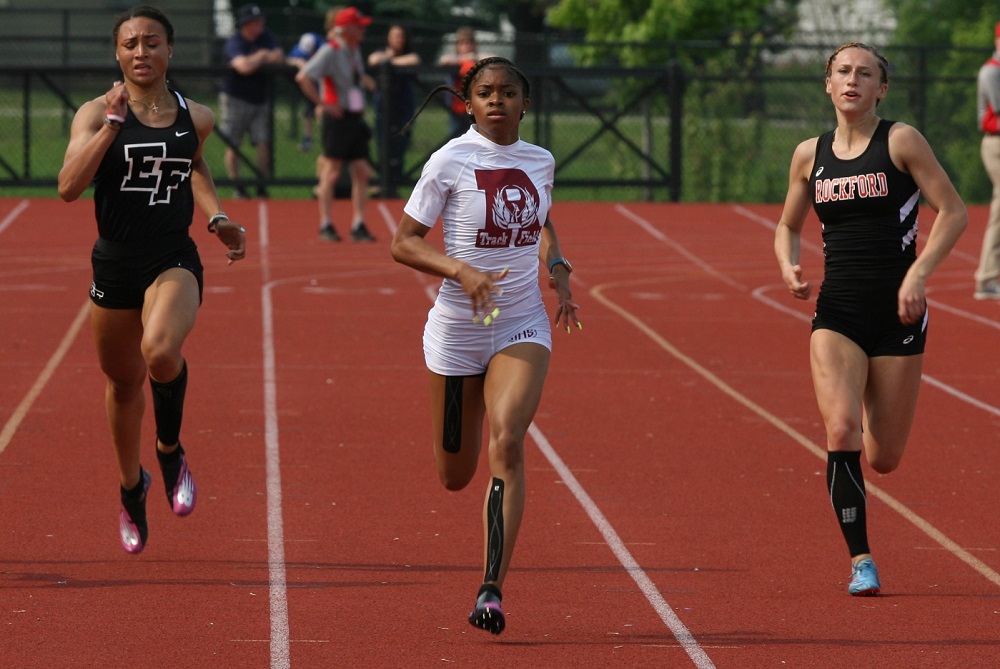
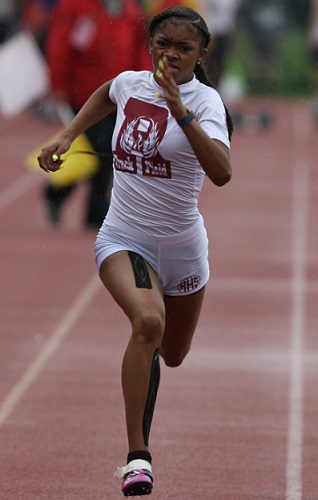
PHOTOS: (Top) Detroit Renaissance's Kaila Jackson, middle, paces the field on the way to winning the 200 meters at the 2019 MHSAA Lower Peninsula Division 1 Finals. (Middle) Jackson races through the final few steps of the 100 that day in finishing runner-up in that event. (Click for more from RunMichigan.com.)
Preview: LP Girls Finals Lineup Loaded with Past Champs, Potential Record-Setters
By
Geoff Kimmerly
MHSAA.com senior editor
May 29, 2026
Years from now, or perhaps much sooner, this weekend’s MHSAA Lower Peninsula Girls Track & Field Finals might be remembered as one of the most star-studded we’ve seen in some time.
Returning qualifiers have won a combined 29 individual Finals championships over the last three seasons, and at least a few meet records are in danger of being rewritten Saturday as athletes compete at four Grand Rapids-area sites.
All four LP Finals will begin with pole vault and long jump beginning at 9 a.m., followed by race semifinals and the 3,200 relay at 10 a.m. and the rest of the running finals starting at noon. Tickets cost $11 and are available digitally only via GoFan.
MHSAA.tv will live-stream all four meets beginning at 10 a.m., viewable with subscription. Check out the Girls Track & Field page for meet information for all four sites and lists of all qualifiers. Those described as "seeded" below have received those seeds based on Regional performances or meeting early qualification standards. (Although not noted for most, several individuals below also will run on contending relays.)
Below is a glance at team contenders and individuals to watch in all four divisions:
Division 1 at Rockford
Team forecast: Oak Park has won the last three Division 1 championships, and Detroit Renaissance has finished second two of the last three seasons after claiming the title in 2022. Oak Park is certainly the favorite again Saturday, but Detroit Cass Tech might offer the greatest challenge this time, with 2024 runner-up Ann Arbor Pioneer another school to watch for at the top.
Nevaeh Burns, Oak Park junior: She’s won the 400 both of her first two seasons and run on five relay champs as well, and enters this weekend seeded first in the 400 (54.21), running the 100 and 200 and as part of the top-seeded 800 relay (1:38.62).
Natasza Dudek, Ann Arbor Pioneer sophomore: The Division 1 cross country record-setting champion this past fall will attempt to build on her second place in the 3,200 and fourth in the 1,600 last spring, seeded first in the 3,200 (10:01.05) and running on the top-seeded 3,200 relay (9:08.39) after scratching from the 800 and 1,600 despite being the top seed in the latter as well.
Payton Gee, Oak Park sophomore: She was part of two relay champions last year, and could add to that haul seeded first in the 100 hurdles (13.88) and 300 hurdles (44.49), slated to run on two top-seeded relays but also qualified in the 100, 200 and 400.
Kamryn Tatum, West Bloomfield senior: She’ll close a celebrated high school career seeking a fourth championship in the 200 and second-straight in the 100. She’s seeded first in the 200 (23.68) and second in the 100 (11.77) and could also run on two relays after scratching as the third seed in the 400, which she won as a freshman.
Collette Wierks, Holland West Ottawa junior: The reigning champion in the 800 also has run on two 3,200 relay winners and enters this weekend seeded second in the 800 (2:11.31) and running on 3,200 and 1,600 relays.
Lorelai Zielinski, Traverse City Central junior: The all-Finals records for shot put and discus could fall to the Trojans’ standout, whose top-seeded tosses of 52-6 and 167 feet, respectively, would be all-time bests. She swept the throws last season.
Division 2 at Hamilton
Team forecast: Sturgis claimed its first Finals championship last season, and Spring Lake is among contenders with a chance to do the same. Sturgis should be heard from again, and 2024 champion Dearborn Divine Child also has the capability to follow its standouts back to the top.
Evie Mathis, Wayland senior: The reigning pole vault champion posted a Regional-best 13-0 and will also run on two relays.
Eliza Schwass, Ludington freshman: She’s enjoyed an incredible first season and enters her first Finals seeded first in the 800 (2:08.61) by almost three seconds, first in the 1,600 (4:40.34) by nearly nine and first in the 3,200 by nearly 14.
Macy Subka, Spring Lake junior: She finished third in the 300 hurdles and 17th in the 100 hurdle prelims last season, and enters this weekend seeded second in the 100 hurdles (14.91), first in the 300 (44.13) and likely to run on two top-seeded relays.
Leigha Whitman, Stevensville Lakeshore junior: The reigning long jump champion is seeded first (18-10½) and likely to run on two relays as well.
Aubrey Wilson, Dearborn Divine Child junior: She’ll pursue her third 100-meter title and second-straight in the 200, and is seeded first in those two races (11.52 and 23.77, respectively) and the 400 (56.14) and could also long jump or run a relay.
Division 3 at Kent City
Team forecast: Olivet broke through last season for its first Finals team championship, and the Eagles have entries seeded at or near the top in every running event as they pursue a repeat. Lansing Catholic is seeking its first girls track championship and has the potential to put up major points in the distance open races and relays. Traverse City St. Francis and Pewamo-Westphalia are others to watch.
Julia Hughes, Ida senior: The reigning 100 hurdles champion is seeded first in that race (14.60) and second in the 300 hurdles (46.03).
Giuliana Nastale, Erie Mason senior: She’s seeking repeats in both the 100 and 200 dashes, and she’s a contender in three races seeded fourth in the 100 (12.25), third in the 200 (25.58) and second in the 400 (58.88).
Emily Peters, Olivet senior: She’s running for a fourth 300 hurdles championship and seeded first in that race (45.32) and third in the 100 hurdles (15.17) with opportunities as well to run the 100 and long jump (in which she’s seeded fourth) or on any of three contending relays.
Addyson Stiverson, Montrose junior: She swept the throws last season and won shot put as a freshman as well, and her Regional shot put of 51-10 also would break the all-Finals record this weekend. She’s seeded second in the discus (145-5).
Grace Wonch, Lansing Catholic junior: She’s seeded first in the 1,600 (4:59.96) and 3,200 (10:37.02) and second in the 800 (2:18.96) after finishing eighth in the 3,200 but running on the winning 3,200 relay in 2025.
Division 4 at Hudsonville Baldwin
Team forecast: Fowler has won the last two Division 4 team titles, and the Eagles remain in the conversation with potential point scorers all over this meet. But last season’s runner-up Frankfort may be the team to watch as it runs for a first championship, entering with three top-seeded relays plus contenders in sprints and pole vault. Kalamazoo Hackett Catholic Prep also is seeking a first Finals win and has possible contributors spread among several events.
Ryleigh Ewald, Unionville-Sebewaing senior: The reigning discus champion had the top Regional throw of 124-8 and also will compete in shot put.
Kaylie Livingston, Whitmore Lake junior: She’s won two Division 4 cross country championships plus the 3,200 the last two springs, and she’s seeded first in that race (11:01.75) and the 1,600 (5:07.55) and fourth in the 800 (2:23.01).
Claire Long, Saginaw Nouvel Catholic Central junior: She won the 400 and finished third in the 200 a year ago, and this time she’s seeded first in the 400 (57.32), fifth in the 200 (25.77) and seventh in the 100.
Annie Saenz, Concord sophomore: The reigning high jump champion had the highest Regional jump this spring (5-7) by four inches and also could run on two contending relays.
Clara Slattery, Kalamazoo Hackett Catholic Prep junior: She finished second in the 200 and 100 hurdles and third in the 300 hurdles during a strong 2025 meet, and could follow that up substantially seeded first in the 200 (25.01) and 300 hurdles (43.86) and second in the 400 (58.12) and 100 hurdles (15.51).
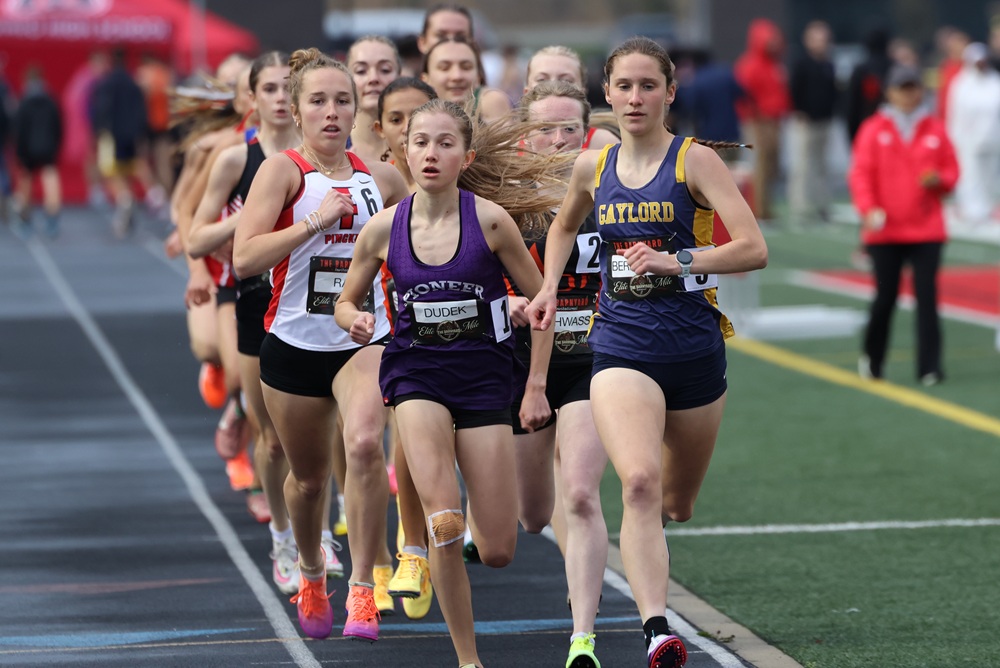
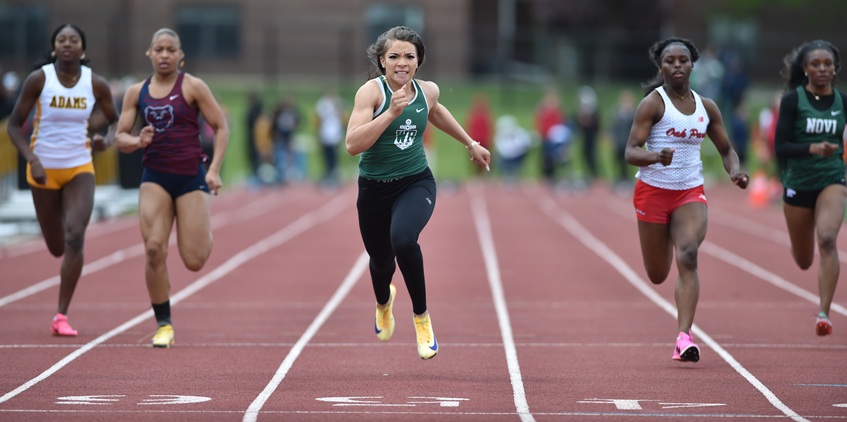
PHOTOS (Top) Ann Arbor Pioneer’s Natasza Dudek, front left, and Gaylord’s Kate Berkshire take the early lead in the Diamond 1,600 at Romeo’s Barnyard Invitational this season. (Middle) West Bloomfield’s Kamryn Tatum, middle, sprints to an Oakland County championship Friday. (Photos by Dave McCauley, at Oakland County, and John Brabbs at Romeo/RunMichigan.com.)