

Differing Paths Led East Kentwood Stars to Olympics, but All Included Finals Titles
By
Steve Vedder
Special for MHSAA.com
August 19, 2026
When one of his eighth-grade teachers trotted out an assignment to write down an ultimate goal, Brian Hyde didn't even flinch.
Even then, Hyde knew that one day he badly wanted to be an Olympian.
Eight years later, that's exactly what happened for the former East Kentwood distance runner. One of three Falcons to become Olympians, Hyde wound up starring at East Kentwood and William & Mary University before performing in the 1,500-meter run during 1996 Summer Games in Atlanta.
"I was in middle school when I first wrote that as a goal," said Hyde, now a pilot for the Utah-based Sky West Airlines. "Like a lot of people, I grew up watching the Olympics, and it was always a dream for me to run there. It was a long-term goal and there are a lot of things you have to go through to make that happen.
"But I think it's good to have goals for things you really want to do. You don't really have to share them, but it's good to have those goals."
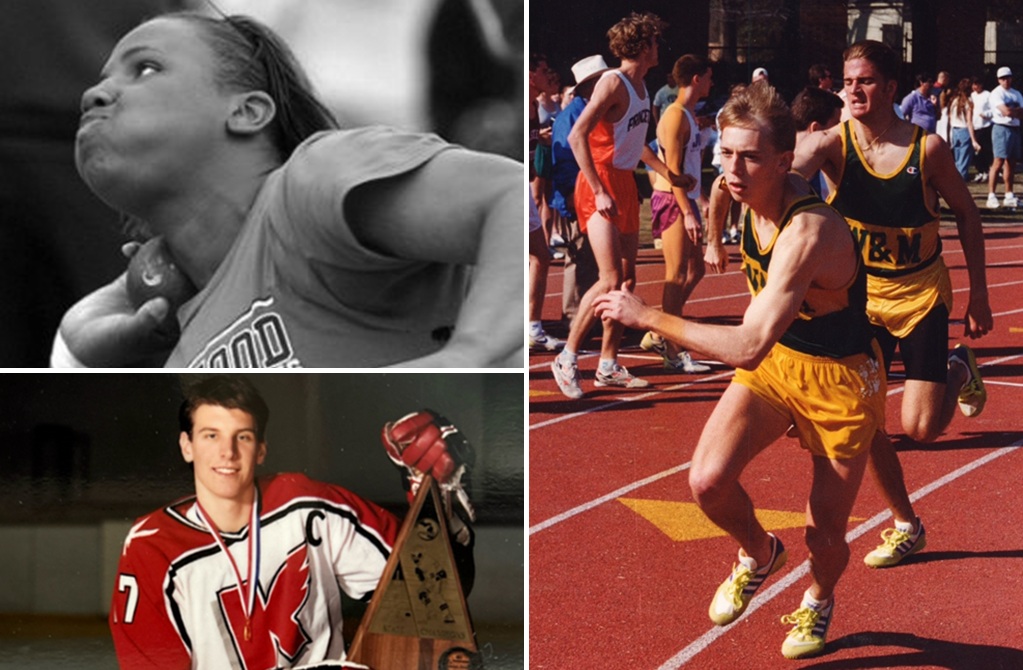
Hyde, a 1991 East Kentwood grad, joins hockey player Mike Knuble, who graduated in 1990, and shot putter Tia Brooks-Wannamacher, a 2008 graduate, as former Falcons who went on to the Olympics. What's unique about their stories isn't that they all became Olympians, but the radically different routes all three took to the Games.
All had major success in high school as Hyde won the 1991 Lower Peninsula Division 1 1,600-meter run (4:12.74), Brooks captured the 2008 shot put with a toss of 48-0.5 and Knuble scored 115 goals in 57 career games while helping the Falcons to the 1990 Class A title.
 All landed in the Olympics in different ways. For instance, Hyde said his No. 1 goal growing up was always to run in the Olympics. He trained fiercely with that in mind from an early age. While Brooks had designs of becoming a sprinter like her idol Marion Jones, East Kentwood coaches convinced the 6-foot Brooks that her track & field future was more likely as a thrower. A 34-year-old Knuble was on the backside of a 16-year NHL career when he finally earned the opportunity to skate in the 2006 Torino Winter Games in Italy.
Knuble said he had a "stick-to-it-ness" that led to his Olympic participation, Hyde said he grinded out long, solitary hours running on a track, and Brooks credits her Olympic story to a combination of natural athleticism and astute coaches who correctly saw her future more clearly than she did.
All took major steps toward the Olympics post-East Kentwood. Hyde went on to become the school record holder in the 1,500 and 1,000-meter runs at William & Mary, Brooks was a two-time NCAA champ in the shot at Oklahoma and Knuble tallied 96 goals over 114 games at Michigan before becoming the 76th player taken in the 1991 NHL draft.
Knuble said dates, age and even past resumes cannot define an athlete.
"Most Olympic athletes would be in their 20s," said Knuble, who would play 34 games with USA Hockey and scored a goal and had an assist in the Torino Games. "But there was a stick-to-it-ness for me. Guys can get written off – that's how I looked at it. You can get passed over when you're 30, and I didn't want to get written off. I wanted that door to stay open for me. I had kind of a career resurgence in my thirties."
Brooks, who retired from competitive track & field when she was 27, had exactly zero thoughts of becoming an Olympian until the January before the 2012 Summer Games in London. But after winning an NCAA shot put title in 2011 along with placing sixth at the Moscow World Cup and 13th in the world at Beijing's World Games, Brooks began considering London qualification.
"The coaches saw something in me and pushed me," said Brooks-Wannemacher, now a projects manager for the Grand Rapids-based Marvelous Style Outreach program. "They thought I had the potential of being an Olympian. I don't want to say it was happenstance, but I really didn't know much about the Olympics. I was competitive and grew up playing all sports and had a sibling rivalry with my brother where we would make up games to play."
Hyde said he became an Olympian through sheer hard work, dedication and sacrifice. He would miss Friday night Falcons football games, for example, because he was in bed making sure he had enough energy for a Saturday meet. Combine that sacrifice with a burning desire to make the Games and the talent he had as a runner, and Hyde said he was able to meet his personal goals.
"I loved to compete and trying to win," he said. "Sometimes there is a grind to it, but in running you're the only one out there. I would tell myself I'm doing this because I have a meet on Saturday and I want to win. You work, have these long-term goals because you tell yourself, 'I can do this.'
"I have no regrets for my career. You control the things you can control. You tell yourself no one is going to outrace you. It's not like you're not having fun, but I'd never miss a workout. Six days a week with Sunday being my rest day."
Knuble, Hyde and Brooks-Wannemacher agree that it's that work, dedication and looking big picture are keys. Lose sight of one, and it can have a domino effect.
"There are times when you're out there working and no one is watching, no one is paying attention," Knuble said. "But you have to put that work in. It's all about figuring out what you did wrong and then getting back at it."
Brooks-Wannemacher called the desire to become an elite athlete "watering a seed." In her case, the seed was the knowledge that the only way a young girl from a one-parent family was going to college was through an athletic scholarship. Places like Michigan and Michigan State had no interest, and the only offers came from Oklahoma and Central Michigan. While the dream was to emulate Marion Jones, Brooks bowed to the suggestions of East Kentwood coaches who said shot put was a ticket to a free education.
"I had a long talk with my mother and coaches, and they said this is the only way to college," she said. "So I started throwing the shot, broke the freshman record at Kentwood, became a Regional and state champ and I kept going. But people had to believe in me.
"It got so that I enjoyed the process. I had a natural talent, but I would push my body to the limit. But for me, the motivation was going to school for free."
Success aside, all overcame major hurdles to achieve it. Hyde suffered a swelling of the spine and terrible pain caused by a tightening of back muscles and wasn't able to finish a race five months before the summer Olympics. Brooks at one point suffered from a narrowing of the spine and bulging discs in her back amid suggestions from doctors she give up throwing a shot. Knuble was physically healthy, but he had to overcome the life-altering experience of dealing with the death of his father when he was 15.
But all say the dedication to athletics, the people they met along the way, great teammates and the will to succeed helped them to greater things.
"There are moments when it's just you and nobody else," Knuble said. "There's no person out there with you, no teammates telling you what to do, how to act, what to eat. For me, being on a team was structure.
"Timing for all of us is huge. You want to be at your peak when you're competing. You want to beat your best for that one race, that one throw, that one game. For me, I had a body of work to work from. I think the others did, too."
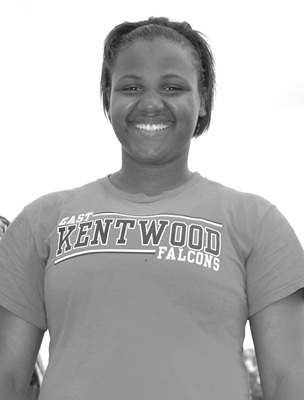
PHOTOS Clockwise from top left: East Kentwood’s Tia Brooks-Wannamacher prepares to launch the shot. Brian Hyde (front) takes a relay handoff for William & Mary. Mike Knuble holds up one of the many trophies the Falcons earned during his time on the ice. (Middle) Brooks-Wannamacher as a high school senior. (Knuble and Hyde photos courtesy of those individuals. Brooks-Wannamacher photo from MHSAA archives.)
The Last Time MHSAA Finals were Canceled
By
Ron Pesch
MHSAA historian
April 27, 2020
Historians trace the start of World War II to German dictator Adolph Hitler’s decision to invade Poland on September 1, 1939. The Empire of Japan’s involvement in the war became effective in September 1940 with the signing of the Tripartite Pact.
Until December 7, 1941, the United States avoided official involvement, declaring themselves “a neutral nation.” Then came Imperial Japan’s bombing of Pearl Harbor.
A labor shortage caused by World War I had taken out spring high school sports in Michigan in 1917. As noted in the Second Half article, “1918 Pandemic, WWI Threatened High School Sports,” the global spread of a devastating strain of influenza interrupted the football season in Michigan. Prep athletics would roar through the 1920s and survive the Great Depression before seeing another interruption.
That next disturbance had nothing to do with war’s insatiable desire for manpower. Rather, it was because of tires.
“When the Japanese bombed Pearl Harbor, rubber instantly became the most critical strategic material for making war,” wrote Stephen W. Sears in the October/November issue of American Heritage magazine in 1979. “Nine-tenths of the nation’s rubber came from the Far East, and it was painfully evident that nothing would now stop Japan from cutting off that source.”
Americans consumed nearly two-thirds of the world’s production of rubber. With only about a year’s worth of material on hand, “Just four days after Pearl Harbor a freeze was put on the sale of new passenger-car tires,” stated Sears, “and on December 27 tire rationing was authorized, to go into effect early in January, 1942. Sales of new cars also were halted.”
The MHSAA
The Michigan High School Athletic Association arrived in December 1924. It replaced the old Michigan Interscholastic Athletic Association which had served Michigan for 15 years.
The organization’s primary purpose was to standardize, interpret and administer rules, educate and guide officials, and regulate student eligibility within prep sports in Michigan. By the 1940s, it had evolved into an association that also managed postseason tournaments, designed to identify state champions in specific sports: swimming, cross country, golf, tennis, track, and the sport sponsored by the most high schools in the state, basketball.
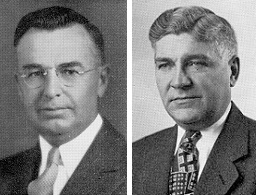 “The old MIAA had taken over the regulation of basketball tournaments in 1920. This had been done as a service to the schools and especially as a means of eliminating evils inherent in the invitational tournaments (that were hosted by various colleges around the state and the midwest),” wrote Lewis L. Forsythe in his book, Athletics in Michigan High Schools, recalling the first 100 years of prep sports in the state.
“In the last days of February 1942,” multiple Michigan schoolmen were in San Francisco to attend the annual meetings of Secondary School Principals, Superintendents and the National Federation of State High School Associations. “We were well aware that many of our boys in school would have to offer themselves in the service of their country,” noted Forsythe in his publication. “We fully realized that the quality of that service and, indeed, their own survival might well depend quite as much on their physical fitness as on their intellectual and spiritual resources. It was under those circumstances that we determined so to modify the emphasis of our athletic program as to make the largest possible contribution to the war effort. We recognized that the need in Michigan could not be met by our organization alone, and we therefore determined to encourage a general enrollment of all school groups in a united effort for promotion of physical fitness.”
Because of the “scarcity of tires and automobiles,” in April 1942 the MHSAA announced plans to curtail their upcoming annual golf and tennis events, eliminating a state championship round. Instead, the seasons were concluded with separate eastern and western sectional tournaments, hosted in Ann Arbor and Grand Rapids.
Early in May of 1942, MHSAA executive director Charlie Forsythe, nephew of Louis Forsythe, announced that the Association was “working on plans designed to make body-building exercises available to more young men and to spread recognition of sports achievements. He predicted substantial growth of intramural sports to include youngsters whose limited prowess might keep them from such interscholastic sports as football, baseball or basketball.”
Wire articles had told the story of how the running Battle of the Atlantic had impacted U.S. ocean transportation along the eastern seaboard. A Germany-mounted “campaign against American coastal shipping” by U-boats (submarines) was devastating “a section of America almost exclusively dependent upon ocean-point tankers for its petroleum products.” Without a viable alternative means to transport the products, on May 15, 1942, gasoline rationing began in 17 seaside states and the District of Columbia. It was hinted that gas rationing – specifically designed to save rubber – could roll out nationally. (Crude oil is the main ingredient in man-made rubber.)
The chances for restrictions in Michigan were a distinct possibility. According to P.J. Hoffmaster, the state’s supervisor of wells, the state consumed approximately 140,000 barrels of oil per day, but produced only 64,054 barrels. “This state has a shortage of at least 100,000 barrels on the basis of a regional demand,” he said, noting Michigan oil also supported needs outside the state. “When people say there can’t be rationing in Michigan because we have plenty of our own oil, they don’t have the true picture.”
Reverberations begin
When quizzed on the subject before the annual Lower Peninsula Track and Field championships, hosted at Michigan State College in May 1942, (Charlie) Forsythe, told The Associated Press he was unsure how rationing might affect the Association’s annual playoffs.
 “It is too early as yet to say exactly. … We are making every effort to maintain an adequate athletic program. Certainly where common carriers (busses and trains) will make it possible to get a team to a game, that means should be used,” Forsythe said. He added that the Association was “surprised to find the number of schools competing in this year’s tournaments practically equaled last year’s entries.”
A total of 162 schools had qualified individual contestants in the track championships, about 10 percent fewer than in 1941. However, L.L. Frimodig – the assistant director of college athletics at M.S.C. and acting director of the state track meet – felt “the actual field in the four-class carnival would be much smaller than the number eligible to compete,” considering the circumstances of travel. “Many coaches,” he said, “would think in terms of tires rather than trophies before embarking on any sizable journey to the meet.”
The threat of rationing was almost immediately seen within Michigan’s resorts and travel industry.
“July and August have been moved up into June,” wrote the Detroit Free Press. “This is the word that comes from various parts of the state. Evidently, determination to get the vacation over before gas rationing may be decreed is one of the factors that has stepped up the season. … Reports of heavy patronage at nearby resorts over Memorial Day week-end can be taken as an indication of the trend, or necessity in 1942 of holidays enjoyed close to home base.”
Come September, Joseph B. Eastman, national director of the office of war transportation, called for help in reducing consumption of natural resources: “We intend to solicit the help of colleges and universities in making arrangements for transfer of scheduled games to centers of population where as many people as possible will have an opportunity to attend football games without traveling.”
At the college level, the freshman eligibility rule was waived due to the loss of manpower tied to military enlistment and the enactment of the Selective Training and Service Act of 1940. Its passage required all men between ages 21 and 45 to register for the first peacetime draft in U.S. history. With entry into the war, in December 1941, it was amended to require all 18 to 64-year-olds to register, with starting age for likely draft lowered to 20.
“The seasons of 1942-45 turned the (college) game upside down, creating new juggernauts and decimating some old ones,” wrote Sports Illustrated in its 1971 article, “When Football Went to War.”
 “Michigan’s 85 high school athletic leagues are speculating on the effects of the office of defense transportation plan to whittle sports travel drastically,” stated an Associated Press (AP) article soon after Eastman’s announcement. The Southwestern Conference, comprised of Kalamazoo Central, Benton Harbor, Muskegon, Holland, Grand Haven and Muskegon Heights and one of the most widely spread major prep circuits in the state, was told by its regular bus company that its busses were not available for charter.
On Sept. 25, according to AP, “the state department of public instruction warned today that a threat of ‘no new tires’ will be held over rural schools which use their school busses to transport football players to and from games.”
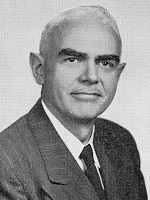
Julian W. Smith, named the interim director of the MHSAA when Charlie Forsythe went into military service, didn’t think the directive would have much impact on football schedules. “However, I believe the order will have a serious effect on basketball schedules this winter and on next year’s football schedule.”
“Four Gallons a Week for Most Drivers”
Two days later it was announced that nationwide gas rationing would go into effect at the beginning of December 1942. More immediately, compulsory tire inspections every 60 days and a “Victory Speed Limit” of 35 miles per hour, effective Oct. 1, were also enacted. “This is not a gasoline rationing program, but a rubber conservation program,” said William M. Jeffers, president of the Union Pacific Railroad, which had been placed in charge of the government’s struggle to alleviate the rubber shortage.
“The object is not to take cars off the road, but to keep them on the road. … The safe life of a tire at 50 miles per hour is only half as great as it is at 30 m.p.h.”
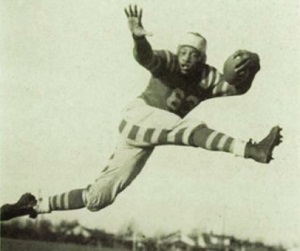 After initial announcements of game cancellations, the impact on high school football in Michigan in 1942 appears to have been minimal. Solutions were found to most challenges. In Bessemer, the high school superintendent announced that “enough persons have volunteered their automobiles to take the Speed Boy players to Calumet” for the game, scheduled for Saturday, Oct. 3. At season’s end, Flint Northern, Detroit Catholic Central, Muskegon, and Wyandotte each lay claim to a share of Michigan’s mythical football title.
But a hint of what was to follow came with an announcement concerning the annual Cross Country Finals. The state meet was cancelled to reduce travel, with honors instead awarded during October meets to which schools were assigned based on geography.
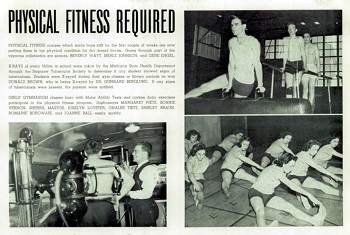
In its October 1942 bulletin, the MHSAA endorsed a commando-type “training plan drafted by the Minnesota branch of the office of civilian defense” to “step up scholastic physical fitness programs.” When plotted on a football field, the course bordered the playing area with 11 obstacles spaced 20 yards apart. The course required participants to jump a 4-foot fence, crawl under a 2-foot-high rope, then run between a maze of stakes and, later in the course, high-step through a series of open boxes. Students would scale a 7½-foot wall, walk on a 12-foot balance beam, swing across a broad jump pit from a rope that hung from above, then climb another rope hung from the crossbar of the goal posts. Once accomplished, the participant was to move, hand-over-hand, across the span of the crossbar before dropping to the ground.
At the end of October, the MHSAA’s Representative Council acknowledged the direct contribution that interscholastic sports had on the “lives of students and citizens of the communities in which they are offered” while recommending that they be “retained insofar as possible.”
The committee, however, also emphasized its belief “that physical fitness programs for all students, and intramural sports to offer opportunity for competition to all, should be stressed in the schools’ athletics program.
“In all probability,” it continued, “it will be necessary to modify the general plans of conducting tournaments.” The mechanics of modification would be hammered out at the next Council meeting to be held in December in Lansing.
Financial concerns also were expressed, as much of the Association’s operating budget came from a share of gate receipts of tournaments.
The Impact
“All over the state, athletic directors and coaches are tackling transportation problems. Instead of piling the athletes into privately owned automobiles or school busses, coaches have diligently studied timetables of regular train and bus lines with many satisfactory results,” stated the AP on Dec. 4.
That same day, the MHSAA announced that the upcoming basketball postseason would be altered due to rationing. The story was picked up by various newspapers across the Midwest.
“The association’s Representative Council last night stressed need for following a ‘principle of minimum travel’ in basketball play this winter and voted to dispense with the annual Lower Peninsula finals,” instead opting for a modified layout. Initial conversation related to a plan calling for sectional meets with the possibility of naming titles in the northern half of the Lower Peninsula, and in both the southern and eastern areas. An appointed basketball committee was also to consider combining enrollment classifications wherever necessary to localize tournament play.
From 1932-1947, inclusive, separate Lower and Upper Peninsula basketball champions were determined. The Upper Peninsula Athletic Committee announced a similar plan at its meeting in January of 1943. The committee expected to present winners of the U.P. events with certificates instead of the customary trophies due to shortage of materials prompted by the war.
According to a survey of its 40 member state associations by the National Federation of State High School Associations, Michigan was one of only four states, including Maine, Montana and Nevada, to eliminate naming basketball state champions come the winter of 1943, “since the distances within those states are too vast or transportation facilities are too limited. The same will prevail in track contests.”
 By mid-January, the MHSAA had polled its membership, and approximately 95 percent of the state’s high schools indicated a desire to participate in the replacement tournaments pitched by the Association. After examining the logistics, the plan previously discussed was modified. The Association then identified 51 Lower and 11 Upper Peninsula sites, based on availability to host the tournament and geographic suitability. The competition would run for two weeks, and end with what had previously equaled District championship contests.
In the meantime, the annual swim championships were reduced to a one-day meet. Hosted at the University of Michigan, the meet would tax the endurance of individual swimmers, “since officials … decided to conduct semi-final events additional to the customary qualifying trials and finals.” That meant a swimmer entered in two events could compete six times during the day, with qualifying events in the morning, semifinals in the afternoon and finals swum at night. Perennial powers Battle Creek Central and Ann Arbor University High emerged as champions.
“The war to date has proved one thing conclusively – athletics in all schools must go on, for they serve to properly condition our young men for the bigger task ahead,” said MHSAA interim director Smith, speaking at an “annual football and basketball ‘bust’ for Lakeview High School” in Battle Creek in February 1943. Smith had served as principal at the high school for 14 years before taking over at the MHSAA. He “expressed regret” that the MHSAA had altered the various formats of the annual championships. According to coverage of the gathering in the Battle Creek Enquirer, “he intimated that it, along with all other forms of statewide competition, would be restored before another school year begins.”
Continued Chaos
The cities of Lansing and Kalamazoo played host to the most contingents, with 25 teams across the four enrollment classifications playing games at recently completed Lansing Sexton – the rechristened Lansing Central High School – and the Lansing Boys Vocational School. A total of 23 schools squared off at Western Michigan College of Education (now Western Michigan University).
As previously stated, transportation considerations meant some schools played above or below their normal classification to make things work. Ecorse, normally a Class B school, battled in the Class A tournament hosted at Dearborn Fordson. Benton Harbor, with Class A enrollment numbers, competed in the Class B tournament played across the St. Joseph River at St. Joseph High School instead of at the Kalamazoo Area tournament against similarly-sized schools.
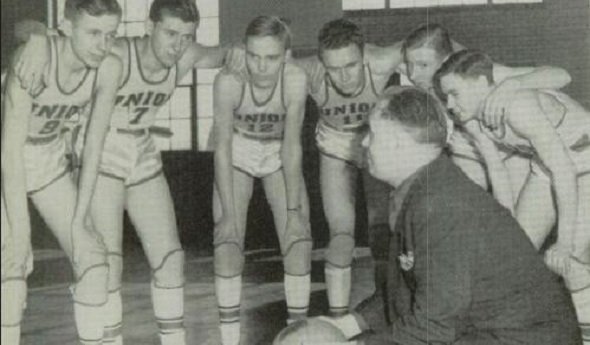
A total of 128 area titles were awarded across the state’s two peninsulas. Decatur, the Class C state champion in 1942 with a 25-0 record, was the only team titlist to repeat in 1943, emerging with one of the “Area” crowns and extending its streak of victories to 41 consecutive. Also among the winners was Grand Rapids Union, a “cellar team in the regular season.”
“Although Union stood seventh in the city tally, the Red Hawks won the Area Tournament Crown in three smashing, spine-tingling battles,” stated the sports editor in the 1943 Aurora - Union’s yearbook. “In fast games the Hawks overcame Catholic and beat the Creston Bears … as well as whipping Davis Tech for their final victory.”
In April, the MHSAA confirmed that competition would end with area, city or conference meets in track, and again in tennis and golf, because of transportation, participation issues, and the “prospects of closing of some of the schools early.”
Various fans and media members grumbled about the unsatisfying conclusion to the prep sports calendars.
Hope
The coaching ranks were heavily hit by the war, as numerous mentors were tapped by the armed forces to lead physical fitness programs. Despite initial concerns, few “of the state’s 400 football-playing prep schools” dropped the sport come the 1943-44 school year. As it would turn out, because of the travel constraints, attendance increased as more and more sports fans turned to high school competition for entertainment.
Smith stated in October that he had “yet to find anyone who is definitely against bringing the (basketball) championship tournament back to life. There seems to be overwhelming sentiment in favor of the revival. The schools right-about face on the state cage classic which annually drew 700 prep teams and 11,000 players is explained by the fact coaches now feel the federal government is strongly in favor of any attempt to encourage or extend athletics. Last year schoolmen were not certain what the government’s attitude on sports would be and were hesitant about continuing athletics in pre-war style.”
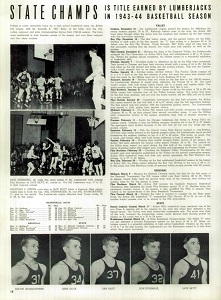 Only 258 of 614 schools replied to a questionnaire about restoring the winter basketball state championships, but 73 percent of respondents were in favor of such, and in December, the Representative Council voted to resume the final rounds of the tournaments.
Born October 1918 in St. Johns, Michigan at the peak of the “Spanish Flu” pandemic, Hal Schram was a 25-year-old sports reporter for the Lansing State Journal when he covered the restart.
“State championship basketball and track competition once more became a part of (the) Michigan high school athletic program when the Representative Council of the MHSAA voted to reinstate these two state-wide tournaments after a suspension of one year,” he wrote.
According to Schram, “It was believed that student working hours, transportation, scarcity of balls and general lack of interest” still necessitated cancellation of golf and tennis tournaments for the year. Conduction of a swimming championship was left “in the hands of a committee representing schools which sponsor the sport … subject to the approval of the representative committee.”
Plans were to return the final rounds of the basketball tournament to Jenison Field House on the campus of Michigan State, which had hosted those rounds from 1940-42. However, the facility was in use by Army trainees for a physical fitness program.
“We would like to have the finals staged here very much,” said MSC athletic director Ralph Young, “but our obligations to the army come first.”
“Despite the hitch, the executive committee opted to stay in Lansing, playing Class A and C semifinal contests at the Boys Vocational School fieldhouse, and Class B and D semi games at Sexton High School. Finals were held at the Vocational gym.
“Fifty-five hundred spectators jammed their way into every nook and cranny of the Boys Vocational school fieldhouse last night to see four high school teams (Saginaw Arthur Hill, Marshall, Lansing St. Mary, Benton Harbor St. John) win championships in the Lower Peninsula tournament finals. With all seats taken almost before the first game started, the big floor was completely encircled by people sitting and standing before the finish,” wrote State Journal sports editor George S. Alderton. “By 6 o’clock, when the Class D game started, all seats in the side bleachers had been filled and most of the end bleachers were gone. The last vacancy was occupied before the Class C game started at 7:15 o’clock and from that time on, those who came either stood or seized a seat left by some departing fan. In many instances two sat down when one departed. Corners of the court were seething masses of humanity …”
United Press International wire reports indicated that 8,500 in total saw the Finals, as fans shifted in and out of the venue in support of the participating teams. “Some people had to be turned away at the finals,” said Smith, “and that certainly shows that people need and want this kind of relaxation.” The previous three Finals at MSC had drawn between 6,000-7,000 fans, while the 1939 Finals at I.M.A in Flint drew 5,000 and the 1938 event at Grand Rapids Civic Auditorium saw 6,000 attend.
“Lighting was so poor in the press box Friday night for the semi-finals,” added Alderton, “that workers came equipped with candles for the finals on Saturday night and propped them against their typewriters.”
Ishpeming hosted the Upper Peninsula Finals, as Escanaba, Crystal Falls, Channing and Amasa swept titles, respectively, in Classes B, C, D and Class E – the state’s smallest classification, reserved only for the smallest U.P. schools based on enrollment.
“Only complaint,” noted the Marquette Mining Journal, “was from those who couldn’t get in or were caught in a jam of fans seeking general admission seats. … Probably another 100 to 200 could have been accommodated if they were permitted to sit on the floor all along the court lines, but this would have been hazardous to players and fans …”
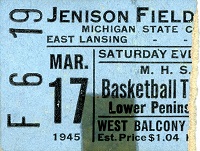 (The Lower Peninsula finals returned to Jenison in 1945 – where they stayed, uninterrupted, through 1970 – and were played before 7,833 spectators that first season back. Locals were delighted as they watched Lansing Sexton top Benton Harbor’s undefeated Tigers, 31-30. Michigan Governor Harry Kelly “personally presented the Class B championship trophy to Sturgis Capt. Tom Tobar, congratulated Capt. Larry Thomson of East Lansing and then shook hands with the captains of the Class A contest before the game started.”)
In mid-May, “some 800 Michigan prep trackmen, survivors of 40 regionals at 10 centers” headed to Michigan State College to determine statewide champs. Only Kalamazoo in Class A and Birmingham in Class B held the chance to “repeat” as team champions. Instead, Saginaw Arthur Hill capped a stellar sports year, earning its first Class A team track title to go with its recently-earned basketball crown. (Earlier in the school year, the Lumberjacks also had opened their own football field.)
East Grand Rapids earned its second track title, grabbing the Class B crown. Fowlerville and Glen Arbor Leelanau brought home titles in Class C and D, respectively.
All sports – including golf and tennis which had gone three years without competing in a true state title round – returned to their original formats with the start of the 1944-45 school year.
In May 1945, Germany surrendered to the Allies, followed by Imperial Japan’s surrender, announced in August.
Participation in prep sports and attendance numbers would explode across the state and the nation in the coming years, tied to multiple factors, including, of course, the baby boom that followed World War II.
 Ron Pesch has taken an active role in researching the history of MHSAA events since 1985 and began writing for MHSAA Finals programs in 1986, adding additional features and "flashbacks" in 1992. He inherited the title of MHSAA historian from the late Dick Kishpaugh following the 1993-94 school year, and resides in Muskegon. Contact him at [email protected] with ideas for historical articles.
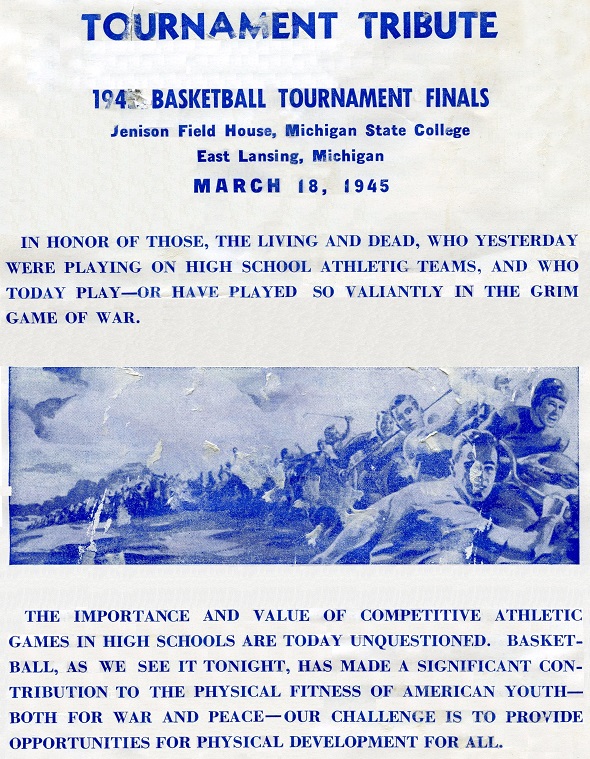
PHOTOS: (Top) Grand Rapids Union was among "Area" boys basketball champions in 1943. (2) Lewis Forsythe, left, and Charles Forsythe were among leaders during the MHSAA's first decades (3) The Saginaw Arthur Hill yearbook for 1944 tells of fitness training undertaken by students. (4) Julian W. Smith served as interim MHSAA executive director while Charles Forsythe was serving in the military. (5) Flint Northern's Bill Hamilton earned all-state honors in 1942. (6) Western Michigan College was among hosts of 1943 Area tournaments. (7) Arthur Hill's yearbook celebrates the 1943-44 boys basketball championship. (8) Basketball Finals returned to Jenison Field House in 1945. (9) The MHSAA paid tribute to World War II veterans in its 1945 Basketball Finals program.