

Differing Paths Led East Kentwood Stars to Olympics, but All Included Finals Titles
By
Steve Vedder
Special for MHSAA.com
August 19, 2026
When one of his eighth-grade teachers trotted out an assignment to write down an ultimate goal, Brian Hyde didn't even flinch.
Even then, Hyde knew that one day he badly wanted to be an Olympian.
Eight years later, that's exactly what happened for the former East Kentwood distance runner. One of three Falcons to become Olympians, Hyde wound up starring at East Kentwood and William & Mary University before performing in the 1,500-meter run during 1996 Summer Games in Atlanta.
"I was in middle school when I first wrote that as a goal," said Hyde, now a pilot for the Utah-based Sky West Airlines. "Like a lot of people, I grew up watching the Olympics, and it was always a dream for me to run there. It was a long-term goal and there are a lot of things you have to go through to make that happen.
"But I think it's good to have goals for things you really want to do. You don't really have to share them, but it's good to have those goals."
Hyde, a 1991 East Kentwood grad, joins hockey player Mike Knuble, who graduated in 1990, and shot putter Tia Brooks-Wannamacher, a 2008 graduate, as former Falcons who went on to the Olympics. What's unique about their stories isn't that they all became Olympians, but the radically different routes all three took to the Games.
All had major success in high school as Hyde won the 1991 Lower Peninsula Division 1 1,600-meter run (4:12.74), Brooks captured the 2008 shot put with a toss of 48-0.5 and Knuble scored 115 goals in 57 career games while helping the Falcons to the 1990 Class A title.
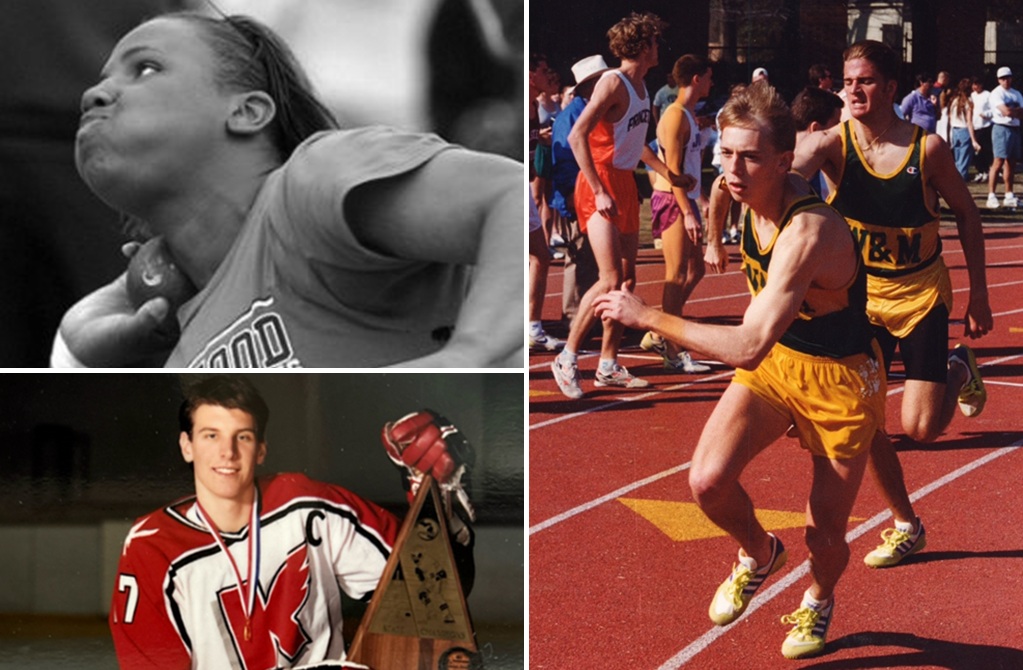
 All landed in the Olympics in different ways. For instance, Hyde said his No. 1 goal growing up was always to run in the Olympics. He trained fiercely with that in mind from an early age. While Brooks had designs of becoming a sprinter like her idol Marion Jones, East Kentwood coaches convinced the 6-foot Brooks that her track & field future was more likely as a thrower. A 34-year-old Knuble was on the backside of a 16-year NHL career when he finally earned the opportunity to skate in the 2006 Torino Winter Games in Italy.
Knuble said he had a "stick-to-it-ness" that led to his Olympic participation, Hyde said he grinded out long, solitary hours running on a track, and Brooks credits her Olympic story to a combination of natural athleticism and astute coaches who correctly saw her future more clearly than she did.
All took major steps toward the Olympics post-East Kentwood. Hyde went on to become the school record holder in the 1,500 and 1,000-meter runs at William & Mary, Brooks was a two-time NCAA champ in the shot at Oklahoma and Knuble tallied 96 goals over 114 games at Michigan before becoming the 76th player taken in the 1991 NHL draft.
Knuble said dates, age and even past resumes cannot define an athlete.
"Most Olympic athletes would be in their 20s," said Knuble, who would play 34 games with USA Hockey and scored a goal and had an assist in the Torino Games. "But there was a stick-to-it-ness for me. Guys can get written off – that's how I looked at it. You can get passed over when you're 30, and I didn't want to get written off. I wanted that door to stay open for me. I had kind of a career resurgence in my thirties."
Brooks, who retired from competitive track & field when she was 27, had exactly zero thoughts of becoming an Olympian until the January before the 2012 Summer Games in London. But after winning an NCAA shot put title in 2011 along with placing sixth at the Moscow World Cup and 13th in the world at Beijing's World Games, Brooks began considering London qualification.
"The coaches saw something in me and pushed me," said Brooks-Wannemacher, now a projects manager for the Grand Rapids-based Marvelous Style Outreach program. "They thought I had the potential of being an Olympian. I don't want to say it was happenstance, but I really didn't know much about the Olympics. I was competitive and grew up playing all sports and had a sibling rivalry with my brother where we would make up games to play."
Hyde said he became an Olympian through sheer hard work, dedication and sacrifice. He would miss Friday night Falcons football games, for example, because he was in bed making sure he had enough energy for a Saturday meet. Combine that sacrifice with a burning desire to make the Games and the talent he had as a runner, and Hyde said he was able to meet his personal goals.
"I loved to compete and trying to win," he said. "Sometimes there is a grind to it, but in running you're the only one out there. I would tell myself I'm doing this because I have a meet on Saturday and I want to win. You work, have these long-term goals because you tell yourself, 'I can do this.'
"I have no regrets for my career. You control the things you can control. You tell yourself no one is going to outrace you. It's not like you're not having fun, but I'd never miss a workout. Six days a week with Sunday being my rest day."
Knuble, Hyde and Brooks-Wannemacher agree that it's that work, dedication and looking big picture are keys. Lose sight of one, and it can have a domino effect.
"There are times when you're out there working and no one is watching, no one is paying attention," Knuble said. "But you have to put that work in. It's all about figuring out what you did wrong and then getting back at it."
Brooks-Wannemacher called the desire to become an elite athlete "watering a seed." In her case, the seed was the knowledge that the only way a young girl from a one-parent family was going to college was through an athletic scholarship. Places like Michigan and Michigan State had no interest, and the only offers came from Oklahoma and Central Michigan. While the dream was to emulate Marion Jones, Brooks bowed to the suggestions of East Kentwood coaches who said shot put was a ticket to a free education.
"I had a long talk with my mother and coaches, and they said this is the only way to college," she said. "So I started throwing the shot, broke the freshman record at Kentwood, became a Regional and state champ and I kept going. But people had to believe in me.
"It got so that I enjoyed the process. I had a natural talent, but I would push my body to the limit. But for me, the motivation was going to school for free."
Success aside, all overcame major hurdles to achieve it. Hyde suffered a swelling of the spine and terrible pain caused by a tightening of back muscles and wasn't able to finish a race five months before the summer Olympics. Brooks at one point suffered from a narrowing of the spine and bulging discs in her back amid suggestions from doctors she give up throwing a shot. Knuble was physically healthy, but he had to overcome the life-altering experience of dealing with the death of his father when he was 15.
But all say the dedication to athletics, the people they met along the way, great teammates and the will to succeed helped them to greater things.
"There are moments when it's just you and nobody else," Knuble said. "There's no person out there with you, no teammates telling you what to do, how to act, what to eat. For me, being on a team was structure.
"Timing for all of us is huge. You want to be at your peak when you're competing. You want to beat your best for that one race, that one throw, that one game. For me, I had a body of work to work from. I think the others did, too."
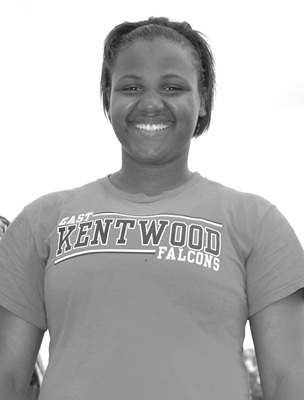
PHOTOS Clockwise from top left: East Kentwood’s Tia Brooks-Wannamacher prepares to launch the shot. Brian Hyde (front) takes a relay handoff for William & Mary. Mike Knuble holds up one of the many trophies the Falcons earned during his time on the ice. (Middle) Brooks-Wannamacher as a high school senior. (Knuble and Hyde photos courtesy of those individuals. Brooks-Wannamacher photo from MHSAA archives.)

Saginaw's Martin Leaps Into All-Time Elite
By
Paul Costanzo
Special for MHSAA.com
May 1, 2019
Sometimes greatness can come from random circumstance.
 One spring day after having their basketball taken away during lunch, then-Saginaw High sophomore Tony Martin and his friends improvised by playing the game without a ball. With one of his track coaches looking on, Martin received a “pass” from a teammate, ran to the free-throw line and took off, touching the rim before returning to the ground.
“You’re long jumping at our next meet,” the coach said, introducing a new event to the sprint specialist, and a star was born.
In the two years since that fake basketball game, Martin has become arguably the best long jumper in Michigan history. He recently leapt 26 feet, 6 inches, which according to michtrack.org smashed the previous record by a Michigan high schooler of 25-2½, set by Lansing Everett’s Marcel Richardson in 1988.
“I felt it when I hit the board, and when I was in the air, because I had more time in the air to move my legs and reach,” said Martin of his record-breaking jump, which he achieved April 25 in a home dual meet against Saginaw Arthur Hill. “I had more of a fold in my legs when I was landing. I felt it in my spine when I was stretching. My reaction was, I looked at it and it said 26-6, and I had to look again because it’s an unbelievable jump. I had to look at it again and again when they marked it.”
Martin, who opened his senior season at Saginaw by breaking the school’s 45-year-old long jump record, came into the year looking to set school and state records. As the calendar turns to May, he’s setting his sights farther.
“Right now, it would have to be me breaking the national record,” Martin said. “It has to be the national one now, because really there’s no other one. The only other thing I could think about is actually hitting the Olympic standard.”
The national high school record as regarded by the National Federation of State High School Associations (NFHS) is 26-4¾, jumped by Tulane Union, California’s James Stallworth in 1989. Others consider the national record to be 26-10, set in 2009 by current San Francisco 49ers wide receiver Marquise Goodwin while a high schooler at a USA Track & Field junior championships meet. The Olympic standard is 8.22 meters, which is a little more than 26-11½.
The MHSAA record book includes only Finals performances, and the MHSAA generally confirms records to the National Federation record committee that have occurred only during Finals, where officials are on hand to certify results and conditions including wind speed. (The MHSAA Finals record of 24-2¾ was set in 2017 at the Lower Peninsula Division 1 meet by Salem’s Mason Phillips.) However, an official will be on hand at Friday’s Bay City Western Invitational to monitor the long jump and certify the national record if Martin breaks it.
Martin’s 26-6 would tie for seventh all-time nationally, with only four people ever jumping farther at the high school level. Among them is United States Track & Field legend Carl Lewis, who had an official high school best of 26-8¼.
“I’ve watched him jump against Mike Powell every day,” Martin said of the epic 1991 showdown between Powell and Lewis at the 1991 World Championships, where Powell broke the world record. “That’s what I study, that video of Mike Powell breaking the record. That’s like my favorite track video ever (along with) videos of Usain Bolt. It’s definitely an honor joining somebody that I’ve watched.”
 Saginaw coach DeEddie Sanders believes Martin can reach those goals.
“He’s got the potential, if he keeps working hard, to make the Olympic team,” Sanders said. “That’s what he wants, and I know he’s going to keep working hard.”
Martin, who has signed to compete for Michigan State University, came into this season plenty accomplished. He is the reigning Division 2 MHSAA Finals champion in the long jump, and a returning state placer in the 100 (fourth) and 200 (third) meters. He was also part of Saginaw’s fifth-place 400 relay team.
Last season’s Finals were a high point for his career, but also something he saw as just the beginning.
“It was pretty exciting,” Martin said. “It was emotional, because I was really tired at the state meet my sophomore year from jumping. I was not ready for the state meet at all (as a sophomore), so I had to win something (as a junior). That’s my goal (this year); I have to win all three for me to be satisfied, really. That is my goal, and I feel like I really have a chance this year.”
Martin has official personal bests of 10.71 seconds in the 100 and 21.71 in the 200, although he’s been hand-timed at 10.25 and 21.5. He said his goal is to get under 10.5 and 21 officially (fully automatic time), which would certainly put him in the running for a sprint double at this year’s Finals.
He should be a heavy favorite in the long jump, of course, and a lot of that can be attributed to taking a longer approach. After lining up about 80 feet from the pit in past years, Martin was urged to move backward to about 100 feet by the coaches he spoke with on his college visits. That allows him to build up more speed before takeoff.
“Ever since I changed my mark from indoor to outdoor, because I got faster, every time I jump is a (personal record), or over my best from last year,” Martin said.
In his first meet of the season, Martin showed that off, jumping 24-¼ to eclipse his previous best of 23-4¾, and the Saginaw High record of 23-7¾ set by Larry Foster in 1974.
“That was something that I cherished for a long time,” said Foster, who went on to play football and basketball at Northern Illinois, and now lives in Atlanta. “I’m glad I was alive to see him break it. I didn’t think it was going to last 45 years. I thought maybe in the 80s or 90s, somebody would break it. But my daughter, she was born in ‘74, and when she turned 45, I realized that was a long time. I’m so proud of that young guy. He did a fantastic job.”
Foster, who said he went to school with Martin’s grandmother, said he was able to speak with Martin and congratulate him after the record was broken.
“In a way, I was hoping it would (last) a little longer,” Foster said. “But 45 years, that’s long enough for me. When he goes to college, I’m going to follow him. I’m very proud of him.”
What Foster will be following is an athlete who believes he can further tap into his potential at MSU – a potential that even amazes Martin himself.
“To me, it’s unbelievable, because I’m only in high school and I’ve only been jumping since my sophomore year,” Martin said. “I’m kind of surprising myself every meet. It’s kind of unreal.”
 Paul Costanzo served as a sportswriter at The Port Huron Times Herald from 2006-15, including three years as lead sportswriter, and prior to that as sports editor at the Hillsdale Daily News from 2005-06. He can be reached at [email protected] with story ideas for Genesee, Lapeer, St. Clair, Sanilac, Huron, Tuscola, Saginaw, Bay, Arenac, Midland and Gladwin counties.
PHOTOS: (Top) Saginaw High sprinter and long jumper Tony Martin prepares to launch. (Middle) Martin is taking aim this spring at MHSAA Finals and national records. (Photos by Scott Keyes.)