

Differing Paths Led East Kentwood Stars to Olympics, but All Included Finals Titles
By
Steve Vedder
Special for MHSAA.com
August 19, 2026
When one of his eighth-grade teachers trotted out an assignment to write down an ultimate goal, Brian Hyde didn't even flinch.
Even then, Hyde knew that one day he badly wanted to be an Olympian.
Eight years later, that's exactly what happened for the former East Kentwood distance runner. One of three Falcons to become Olympians, Hyde wound up starring at East Kentwood and William & Mary University before performing in the 1,500-meter run during 1996 Summer Games in Atlanta.
"I was in middle school when I first wrote that as a goal," said Hyde, now a pilot for the Utah-based Sky West Airlines. "Like a lot of people, I grew up watching the Olympics, and it was always a dream for me to run there. It was a long-term goal and there are a lot of things you have to go through to make that happen.
"But I think it's good to have goals for things you really want to do. You don't really have to share them, but it's good to have those goals."
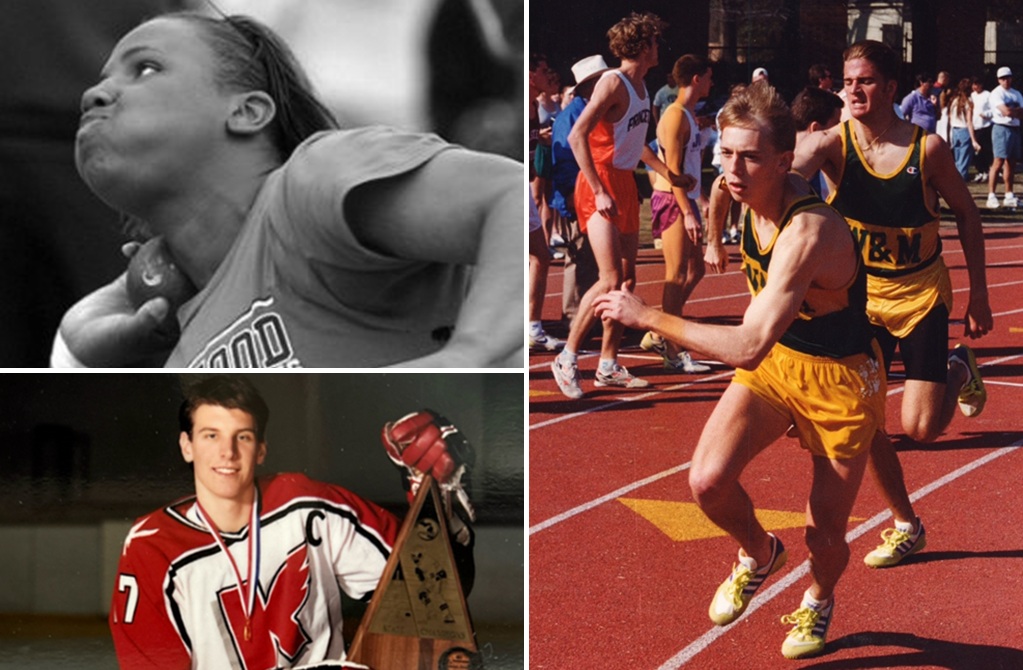
Hyde, a 1991 East Kentwood grad, joins hockey player Mike Knuble, who graduated in 1990, and shot putter Tia Brooks-Wannamacher, a 2008 graduate, as former Falcons who went on to the Olympics. What's unique about their stories isn't that they all became Olympians, but the radically different routes all three took to the Games.
All had major success in high school as Hyde won the 1991 Lower Peninsula Division 1 1,600-meter run (4:12.74), Brooks captured the 2008 shot put with a toss of 48-0.5 and Knuble scored 115 goals in 57 career games while helping the Falcons to the 1990 Class A title.
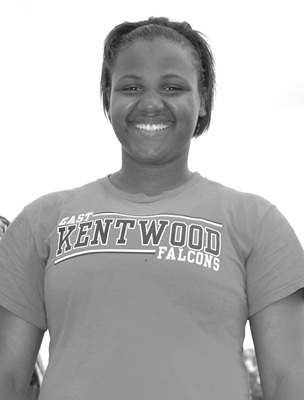 All landed in the Olympics in different ways. For instance, Hyde said his No. 1 goal growing up was always to run in the Olympics. He trained fiercely with that in mind from an early age. While Brooks had designs of becoming a sprinter like her idol Marion Jones, East Kentwood coaches convinced the 6-foot Brooks that her track & field future was more likely as a thrower. A 34-year-old Knuble was on the backside of a 16-year NHL career when he finally earned the opportunity to skate in the 2006 Torino Winter Games in Italy.
Knuble said he had a "stick-to-it-ness" that led to his Olympic participation, Hyde said he grinded out long, solitary hours running on a track, and Brooks credits her Olympic story to a combination of natural athleticism and astute coaches who correctly saw her future more clearly than she did.
All took major steps toward the Olympics post-East Kentwood. Hyde went on to become the school record holder in the 1,500 and 1,000-meter runs at William & Mary, Brooks was a two-time NCAA champ in the shot at Oklahoma and Knuble tallied 96 goals over 114 games at Michigan before becoming the 76th player taken in the 1991 NHL draft.
Knuble said dates, age and even past resumes cannot define an athlete.
"Most Olympic athletes would be in their 20s," said Knuble, who would play 34 games with USA Hockey and scored a goal and had an assist in the Torino Games. "But there was a stick-to-it-ness for me. Guys can get written off – that's how I looked at it. You can get passed over when you're 30, and I didn't want to get written off. I wanted that door to stay open for me. I had kind of a career resurgence in my thirties."
Brooks, who retired from competitive track & field when she was 27, had exactly zero thoughts of becoming an Olympian until the January before the 2012 Summer Games in London. But after winning an NCAA shot put title in 2011 along with placing sixth at the Moscow World Cup and 13th in the world at Beijing's World Games, Brooks began considering London qualification.
"The coaches saw something in me and pushed me," said Brooks-Wannemacher, now a projects manager for the Grand Rapids-based Marvelous Style Outreach program. "They thought I had the potential of being an Olympian. I don't want to say it was happenstance, but I really didn't know much about the Olympics. I was competitive and grew up playing all sports and had a sibling rivalry with my brother where we would make up games to play."
Hyde said he became an Olympian through sheer hard work, dedication and sacrifice. He would miss Friday night Falcons football games, for example, because he was in bed making sure he had enough energy for a Saturday meet. Combine that sacrifice with a burning desire to make the Games and the talent he had as a runner, and Hyde said he was able to meet his personal goals.
"I loved to compete and trying to win," he said. "Sometimes there is a grind to it, but in running you're the only one out there. I would tell myself I'm doing this because I have a meet on Saturday and I want to win. You work, have these long-term goals because you tell yourself, 'I can do this.'
"I have no regrets for my career. You control the things you can control. You tell yourself no one is going to outrace you. It's not like you're not having fun, but I'd never miss a workout. Six days a week with Sunday being my rest day."
Knuble, Hyde and Brooks-Wannemacher agree that it's that work, dedication and looking big picture are keys. Lose sight of one, and it can have a domino effect.
"There are times when you're out there working and no one is watching, no one is paying attention," Knuble said. "But you have to put that work in. It's all about figuring out what you did wrong and then getting back at it."
Brooks-Wannemacher called the desire to become an elite athlete "watering a seed." In her case, the seed was the knowledge that the only way a young girl from a one-parent family was going to college was through an athletic scholarship. Places like Michigan and Michigan State had no interest, and the only offers came from Oklahoma and Central Michigan. While the dream was to emulate Marion Jones, Brooks bowed to the suggestions of East Kentwood coaches who said shot put was a ticket to a free education.
"I had a long talk with my mother and coaches, and they said this is the only way to college," she said. "So I started throwing the shot, broke the freshman record at Kentwood, became a Regional and state champ and I kept going. But people had to believe in me.
"It got so that I enjoyed the process. I had a natural talent, but I would push my body to the limit. But for me, the motivation was going to school for free."
Success aside, all overcame major hurdles to achieve it. Hyde suffered a swelling of the spine and terrible pain caused by a tightening of back muscles and wasn't able to finish a race five months before the summer Olympics. Brooks at one point suffered from a narrowing of the spine and bulging discs in her back amid suggestions from doctors she give up throwing a shot. Knuble was physically healthy, but he had to overcome the life-altering experience of dealing with the death of his father when he was 15.
But all say the dedication to athletics, the people they met along the way, great teammates and the will to succeed helped them to greater things.
"There are moments when it's just you and nobody else," Knuble said. "There's no person out there with you, no teammates telling you what to do, how to act, what to eat. For me, being on a team was structure.
"Timing for all of us is huge. You want to be at your peak when you're competing. You want to beat your best for that one race, that one throw, that one game. For me, I had a body of work to work from. I think the others did, too."
PHOTOS Clockwise from top left: East Kentwood’s Tia Brooks-Wannamacher prepares to launch the shot. Brian Hyde (front) takes a relay handoff for William & Mary. Mike Knuble holds up one of the many trophies the Falcons earned during his time on the ice. (Middle) Brooks-Wannamacher as a high school senior. (Knuble and Hyde photos courtesy of those individuals. Brooks-Wannamacher photo from MHSAA archives.)
Brighton Trip North Always Unforgettable
January 22, 2018
By Tim Robinson
Special for Second Half
It starts before dawn on a chilly Thursday in Brighton.
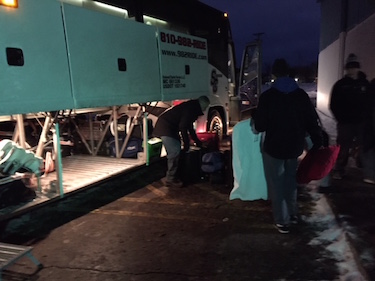
Cases of water and sports drinks, a bucket of pucks, water bottles, 20 hockey bags, five dozen or so sticks, luggage for players, parents, coaches and others, bags of oranges and apples – all are loaded in the belly of a chartered bus.
On the bus, computers are temporarily stowed away. Blankets, pillows, school books and a couple of coolers full of bottled water and sports drinks and another bag of nutritious snacks are loaded in the front seats for consumption on the 540-mile drive to Houghton.
The bus leaves at 7:45 a.m. on Thursday, Jan. 4, bound for Michigan’s Copper Country and returning Jan. 7. It’s a trip Brighton hockey teams have been making since the 2002 season.
THURSDAY
Hockey teams like to refer to themselves as family, but it was more traditional family ties that led to Brighton making the trips north in the first place.
Pete Sturos, who had three sons who played for Brighton at various times, went to coach Paul Moggach and asked if he had ever considered playing Houghton, Hancock or Calumet.
Moggach did some research and decided to follow up on Sturos’ suggestion in 2002.
The Bulldogs promptly were swept. But the time spent together by the players helped the team to gel that much faster, and the trip became a permanent part of the team’s schedule.
Until last year, Brighton and Novi went up every year, with Novi playing at Calumet on Friday and Brighton on Saturday.
Hancock and Houghton rotated facing the visitors each year until 2017, when Orchard Lake St. Mary was added, pitting three Lower Peninsula powers against the three Upper Peninsula schools.
 “It’s been an incredible experience,” Calumet athletic director Sean Jacques said. “The relationship has gone on so long with Brighton and (Bloomfield Hills) Cranbrook and (Detroit) U-D Jesuit. It’s been a great experience and always good hockey, and I think the fans appreciate seeing these top-notch programs on a given weekend.”
Birmingham Brother Rice has made a trip north this season as well, along with Rochester United and Traverse City Central.
The competition during this trip was as high-quality as ever. This week, Brighton is ranked No. 3 in Division 1, while Calumet is No. 3 and Houghton No. 4 in Division 3.
“Any time you get to play a strong team from below the (Mackinac) Bridge, everyone gets excited for that,” Houghton coach Corey Markham said. “We have some great competition with Hancock and Calumet, (but) it’s nice to play other teams and see how we stand with the top of the bunch.”
10:30 a.m.
The bus has stopped at a rest area south of Gaylord and unloads to allow passengers to use the bathroom.
The players, to varying levels of disgruntlement, make a jog of about a quarter-mile in temperatures of five below zero.
“It’s to get them off the bus and doing something, so we don’t sit on the bus and vegetate,” Moggach said. “It’s easier riding in a bus than a car, but it’s still a long trip. We’re coming off the Christmas break, and some of these guys didn’t have a lot of activity during the break.”
12:30 p.m.
The bus stops at the Cut River Inn, located in Epoufette along US-2 between St. Ignace and Engadine, and it marks the halfway point of the bus ride.
The itinerary has evolved over the years. The team used to stop in St. Ignace, and players were able to go to whichever fast food restaurant they preferred.
That ended when the team began to emphasize nutrition as part of its off-ice regimen. Players resisted at first, until the results were too obvious to overlook.
Moggach, a Northern Michigan University grad who vacations near Marquette each summer, put the restaurant on the itinerary about a decade ago. The first year there, a player offered this in prayer: “Lord, we thank you for this food, which I’ve been told is pretty good. ...”
Up to this point, the bus has made good time in sunny if cold weather.
Shortly after returning to the road, snow blows in from Lake Superior, covering the roads. The bus maintains a steady pace, winding its way on M-28 through Munising, where what appears to be a group of students is playing on the ice a few yards out from Munising High School. It’s a first glimpse of Lake Superior.
3 p.m.
Another stop, optional for non-players, mandatory for players, to stretch their legs along a section of old M-28 between Munising and Marquette.
Assistant coach Kurt Kivisto and his family, including his wife and two preschoolers, bound off the bus while Moggach keeps up with them.
The players take their time, with numerous snowball fights, added whooping and hollering.
One year, about a decade ago, the bus was covered in Pistons logos, with pictures of Allen Iverson, et al, on the side. When it stopped to discharge its passengers, some residents came out, wondering if it was a Pistons team bus that had taken a few wrong turns.
“The walk (along) Lake Superior is a hidden gem to me,” Moggach said. “I vacation there and I know that spot. Maybe I’m sharing with them the love I have for Lake Superior and the Upper Peninsula.”
 Moggach claims the walk is about three-quarters of a mile, and smiles a Cheshire Cat-like grin when a reporter challenges the claim, believing it’s longer. A subsequent Internet search finds no evidence one way or the other, but one conclusion is unassailable: It’s still cold.
6 p.m.
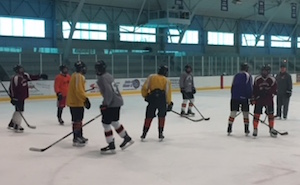
The bus arrives at the hotel in Houghton. Passengers unpack the bus, get settled in their rooms, and the players and a few others get back onto the bus for a skate at the MacInnes Student Events Center on the Michigan Tech campus.
“We’ve been doing this 2-3 years,” Moggach said. “It gets them off the bus with something to do. I think it’s an important start for when they get up there. These guys are hockey players. They love to skate. This is what they love to do. We get off the bus, (skate) and have pizza afterward. Those are two things they love and are rewarded with.”
While on the bus, the players did some studying, worked on a Brighton history quiz administered by Kivisto, and watched a movie on the DVD player.
In the early years of the trip, some Brighton teachers objected to student-athletes missing two days of school, but the team’s grade-point average, which is around 3.10, never suffered for it, and the objections faded away.
“There’s a player here or there who isn’t as academically gifted as others,” Moggach said. “But you want them to understand and be around those who put a lot into it and expect a lot from themselves. I think that experience, too, while understated, is really big, that they see how these other kids study. On a day-to-day basis, they come to practice, they do their off-ice conditioning, they go home and have dinner, they study by themselves. In this environment, they see others doing the same thing.”
FRIDAY
At 9 a.m., the team and several parents climb into the bus for the trip to the Calumet Colosseum, the second-oldest operating hockey arena in the U.S.
And it’s cold. Cold enough to where drops of water freeze as they run down your coat.
One of the team managers abandons all pretenses and wraps a blanket around her so tightly only her left eye is visible.
The Bulldogs will play in another icebox, the Dee Stadium, later that night when they take on Houghton.
“I think they’re two of the neatest rinks, with tradition and history, in high school hockey,” Kivisto said. “It’s a good experience for our guys to go into these rinks, these barns, to go against these teams that have been around a lot longer than the Brighton High School hockey program has. Hopefully someday in the future we’ll have the history these guys have up here. It’s a neat experience that a lot of high school programs don’t get to see on a year-to-year basis.”
11 a.m.
The skate lasts an hour, with a lunch served in a meeting room at the rink.
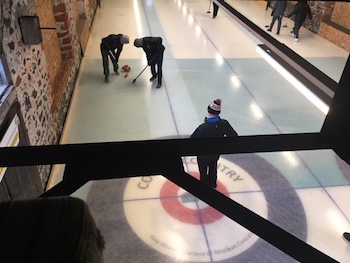 At the same time, parents are curling at the nearby Copper Country Curling Club’s rink in what is called The Drill House.
The building, which is more than 130 years old, once manufactured and maintained drills used in nearby copper mines. It’s drafty, like a barn, and except for an interior room built two years ago, is unheated.
Curling was added to the itinerary in 2011, when a parent spotted a sign and went to investigate. Such are traditions born.
The parents compete while the players skate, then adjourn to a nearby tavern while the players get their competition in.
In years past, long explanations of curling and its rules preceded the competition. These days, it’s a shorter explanation of dos and don’ts, and they let the players have at it.
“They aren’t listening anyway,” one of the CCCC representatives says with a smile.
No one is the worse for wear, and the bus returns them to the hotel.
“I think it’s especially good for the new guys,” Moggach said of the curling competition. “It gets them bonding again and having some activity, so it all fits.”
2 p.m.
The team has a study hall for a short time, and the players are then excused for a little down time.
“The change we’ve made this year is more nap time,” Moggach said. “This trip takes a lot out of you. It’s 10 hours on the bus with the walk and the run and the skate on Thursday night, and that’s before anything really starts. I’m learning, and by watching them I believe they need more rest and sleep.”
5 p.m.
After a pregame meal, the bus takes the team to the Dee Stadium, which was built on the site of the first professional hockey game in America played more than a century ago.
Before the game, bus driver Phil Haag drew a round of applause after he announced his daughter had given birth to his first grandchild.
While the players on their respective teams warm up, Moggach, Kivisto and Markham catch up, talking about their seasons and their outlooks for the second half of the season.
Markham is enthusiastic about having Brighton on his schedule.
“It means a lot to us,” he said. “To play an opponent the caliber of Brighton does nothing but help as we get ready for the second half of the season and for playoff time. You can’t say enough about how great a job Paul and Kurt do with the program they have. The state championships they’ve won states that. For us, we can’t ask for anything more than to play such a quality team on our home rink. It helps our program and helps our players get better.”
For Brighton, it’s a chance to get back on track. The team ended 2017 with a four-game winless streak, losing the last three and scoring only one goal over those three games.
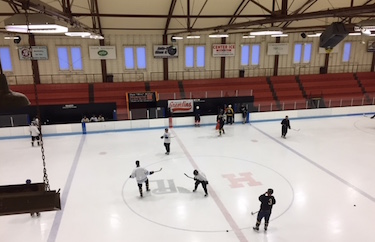 There’s an adage Moggach endorses that says scoring is contagious.
“I would like to see that happen,” he said. “I don’t care how it goes in. Just get it into the back of the net.”
Moggach, who usually wears a sports jacket, has on a thermal jacket for the game.
“But I do have a tie on,” he says, laughing.
After a scoreless first period, sophomore Will Jentz scores twice in the first period for Brighton, which goes on to a 5-1 win.
“It feels good,’ he said. “Our power play hadn’t been that good. We’d scored one goal in the last three games. It felt good to get five tonight.”
“It was huge to get our confidence back as an offensive unit,” senior captain Sam Brennan added.
It had snowed all day, and the traffic had helped pack it, making the roads slick.
That complicated things for Haag, who made progress up the hill from downtown Houghton to the hotel, only to have the bus slow to a stop.
After sitting for a few minutes, a Houghton County sand truck pulled up in front of the bus. Both vehicles backed up a short ways, then moved forward, and the traction provided by the sand was enough to get the bus going again, to another round of applause.
SATURDAY
11 a.m.
After breakfast and a study hall, the team gets back onto the bus for a morning skate at Michigan Tech.
But after about 20 minutes, all but two of the players are sent off the ice to help conserve energy,
“The thing is, they would have loved to stay out there,” Moggach said. “They would have stayed out there for two hours if we had two hours’ ice. But we had 50 minutes, and it’s pulling them back, so they get a taste of it. They got through a couple of things, and that’s all we needed.”
The two players who remained on the ice were goalie Cade Groman and forward Noah Stanko, who are sitting out the first semester due to the transfer rule. Kivisto stays with them on the ice and puts them through a workout.
“Kurt loves to compete himself,” Moggach said. “And he loves to let them compete, so he had them out there a good 15-20 minutes. They really worked hard. We have a goalie and a forward, and it worked out perfectly.”
After returning to the hotel, lunch was served and the team had another study/nap break.
The Bulldogs take their meals in a conference room at the hotel. They are coordinated, this year, by Mary Erkkila, whose son Tim is a defenseman on the team.
“I can’t give enough thanks to Mary Erkkila and her husband, Dave,” said Christa White, president of Brighton’s Blue Line Club, the organization in charge of the trip. ‘They have made our lives so much easier. They have family up here, and they know what food to order. It’s fabulous food. It’s hot. It’s ready, and it’s very enjoyable.”
It also disappears quickly, and leftovers are usually distributed to Brighton students, most of them former hockey players, who are studying at Michigan Tech.
4:45 p.m.
After a win the night before, the team is in a relaxed mood.
Everyone is on the bus except Moggach.
He arrives at 4:48, to some ribbing by adults up front. Then a voice pipes up from the back.
 “Coach?” the voice asks.
“Yes?” a grinning Moggach says.
“Bus is at 4:45,” the voice replies as players hoot and laugh.
With all aboard, the bus leaves for the Colosseum.
Brighton has played Calumet in all 17 trips it has made to Copper Country.
At first, the reception was a little frosty.
“Jim Crawford was the coach at Calumet for a lot of years,” Moggach said. “When we first went up there, we had no relationship. He was a cantankerous guy, but over time, we developed a relationship. He’s (retired), and the new coaches we have good relationships with.”
The success of the series has helped lure more schools north, which Jacques says has been a boon for the Copper Kings.
“It spices up the schedule quite a bit,” he said. “If you look at it year-to-year, a lot of the teams we see up here are the same teams playing for a state championship on a yearly basis.
“We’re incredibly happy it goes on,” Jacques added. “Every year I dread the phone call that maybe someone’s not coming, but every year teams keep coming back. I think it’s the experience of the trip and the snow and the old building and the tradition. Kids seem to love it, and we sure love having it.”
There also is the family factor.
Bob Erkkila, who has been active in Calumet hockey for decades, has a grandson playing for both teams – Tim, the Brighton defenseman mentioned above, and Sam, a forward for Calumet. Both are juniors who wear No. 8 for their teams.
“Bragging rights to next year; that’s a long time to wait to get back at ’em,” Bob Erkkila said. “So they play hard against each other. They’ve had that rivalry going since they were little kids. They know each other and have grown up together, even though they’re a long ways apart much of the year.”
A bit of wisdom, perhaps gained from past pick-up games in the Keweenaw Peninsula, pays off on this trip.
“Some of the boys were kidding Timmy Erkkila for switching from his bubble (mask) to a cage up here,” Kivisto said. “I think it was a smart move. He’s not getting the condensation, the frost on his mask like some others might. It’s a veteran move by Timmy.”
The Bulldogs never trail in the game, but have to hold off a furious flurry in the final minute when Calumet pulls its goalie for an extra skater. Brighton holds on for a 5-4 win.
10 p.m.
Back at the hotel, a final meal, and several players jump into their swimsuits and hit the pool.
As parents watch from the lobby, some players emerge, head outside with steam pouring off their bodies, and return with giant chunks of snow, to much whooping in the pool.
Moggach has suspended his curfew, sticking to a promise that the players could stay up as long as they wanted.
“It’s so much fun,” Brennan said on the bus ride home. “It’s kind of funny, but I look forward to the night after the second game almost as much as the games themselves. It’s just so much fun.”
The pool party ends when the lights go out a little before midnight.
SUNDAY
6 a.m.
The bus is loaded again for the drive home.
Players, some who were up all night, help pack the bus and then find sleeping spots on the floor.
Before the bus leaves Houghton, it’s mostly silent except for Moggach, who reviews a stat report compiled by team statistician Tom Brennan.
As the team begins its journey, it begins to snow again. Moggach checks with driver Haag, but mostly is lost in his own thoughts.
 “There were some nice surprises that we got, and some come-on-you-have-to-pick-it-up kind of things,” he said. “We came in not having won in our last four and we picked up two wins against two good teams. I think there’s a positive energy we’ll take back, which is really good. I take the first 100 miles, before we get to Marquette and the sun comes up, to think about everything.
“I love that time,” he continued. “It’s probably one of my favorite times of the year. I’m not by myself. I’m with people I love, but it’s a time I can reflect on them, on us, and life in general, so it’s a pretty cool time for me.”
A walk back to the restroom on the bus involves navigating a maze of legs and torsos of players sleeping on the floor, requiring care in foot placement reminiscent of the old game “Operation,” where you had to remove the body part without setting off a buzzer. Here, the idea is not to step on anyone.
The snow intensifies east of Marquette, and by the time the team makes a stop for brunch, visibility is about 100 yards.
But Haag, who has made several trips with the team, is up to the challenge.
The snow begins to let up as the bus reaches St. Ignace, and once back in the Lower Peninsula it fades away as passengers sleep, contemplate and read.
Despite the snowy conditions, the bus reaches the Kensington Valley Ice House about 4 p.m., and in the next half hour, the bus is unloaded and participants depart, with a couple of wins under their belts and another unforgettable weekend concluded.
Sam Brennan finished his fourth and final U.P trip.
“It just means I spend more time with the boys,” he said. “It gets more fun every year. This year is more special to me, because I’m a senior and last year I was injured. But every year, it gets more and more fun.”
“When you get 20 athletes together on a trip like this, especially when the parents are along and others like you and our bus driver, it’s all about the life experience that they have,” Moggach said. “I’ve been texting a couple of guys who are alumni of the trip, and they loved this trip. It’s a life experience they’ll never forget.”
Tim Robinson is a longtime radio voice of Livingston County athletics and the former longtime editor of the Livingston County Daily Press & Argus. He currently writes for the Livingston Post and contributes to Second Half.
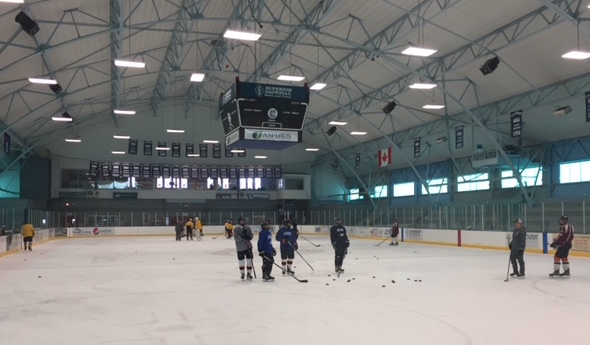
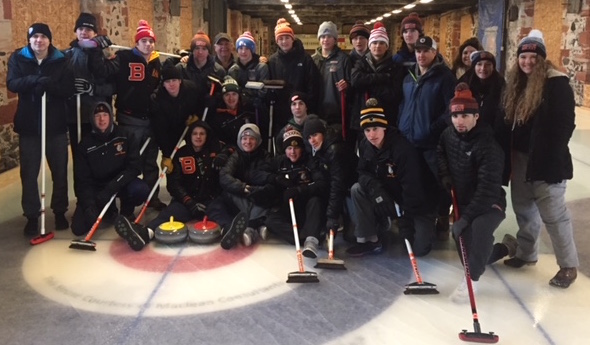
PHOTOS: (Top) Brighton assistant coach Kurt Kivisto runs his players through drills at the Calumet Colosseum. (2) The bus is loaded full of gear before the sun comes up. (3) Brighton takes in a quick skate at Michigan Tech. (4) The Bulldogs get some competition in against each other on the curling sheet. (5) An adult hockey game finishes up at Dee Stadium before Brighton takes on host Houghton. (6) Bulldogs coach Paul Moggach works with his defensemen at the Colosseum. (7) Brighton players, coaches and managers at the curling rink enjoy a break during their annual trip to Michigan’s Copper Country. (Photos by Tim Robinson.)