

Eastern Upper Peninsula Power Reigns in Girls Distance Races
By
John Vrancic
Special for MHSAA.com
May 8, 2025
PICKFORD — Girls distance runners don’t have to look far to find competition in the Eastern Upper Peninsula.
 That’s especially true in Division 3, where Pickford junior Talya Schreiber is setting the pace.
Last fall, Eastern U.P. runners grabbed the top four places at the U.P. Division 3 Cross Country Final at Munising. Schreiber won that race for the first time in 2023, followed by Newberry’s Samantha and Abby Taylor, then retained her title in October.
Abby Taylor was runner-up, with Samantha placing third and Engadine eighth-grader Molly NcNamara taking fourth in that most recent championship race.
“I started at a younger age,” Schreiber said after the Web Morrison Invite at Pickford on April 26. “I ran my first cross country meet in sixth grade. That was definitely a learning curve, but I got hooked on that feeling. The first meet went well.
“Once I got into seventh grade, I knew I wanted to make a future of it. In my freshman year, we moved from Cedarville to Pickford. It was quite an adjustment with new coaches and athletic program and being a bigger school.”
Schreiber won three individual events April 12 at the Yooper Indoor Invitational at Lake Superior State University in Sault Ste. Marie. She was clocked at 2:30.64 in the 800-meter run and took the 1,600 (5:15.55) and 3,200 (11:16.96), well ahead of her nearest competitor, Escanaba senior and Northern Michigan University recruit Alisha Mabie.
“That was a good experience,” Schreiber said. “Alisha is doing real well.
“After cross country, I started my track and field training. Every week I worked out at the LSSU track. I’m hoping to break five minutes in the 1,600 and go under 11 in the 3,200.”
At Pickford, Schreiber again posted winning times in the 800 (2:30.32), 1,600 (5:21.49) and 3,200 (11:27.79).
Abby Taylor was runner-up in the 400 (1:09.6) and 800 (2:41.01) and Samantha took second in the 1,600 (5:31.77) and 3,200 (11:52.25).
 “Abby and Sam are good athletes,” Schreiber said. “They push me and it results in better times, and Molly is going to be something special. Sam ran a nice 3,200 on our track, and Abby had some nice races.”
The Taylor sisters dominated last Thursday’s Rapid River Invitational, placing 1-2 in the 3,200. Samantha won in 12:12.59, and Abby was runner-up (12:29.35) in a steady cold rain.
Sam also won the 1,600 (5:28.44) and Abby finished first in the 800 (2:26.45). Both were also part of the winning 3,200 relay (10:39.42).
“It’s a family tradition,” Abby Taylor said. “I became interested in eighth grade. I knew it was something I wanted to do. There’s a lot more competition in our area. Although anywhere you go, you have competition.”
She said she trains about 30-40 miles a week.
“Running with these girls in cross country was good preparation for track,” she added. “Running with Talya helps a lot. She makes you better, and Molly draws the best out of you. Molly has a good future.”
They also train together quite often.
“We push each other in practice,” Samantha said. “I try to give Abby advice. She sometimes has a problem with that, but I see the potential in her. I want to see her do well.
“Talya is also a very good runner. We look up to her, and Molly is really good. We enjoy the competition.”
How did the Taylors overcome the elements at Rapid River?
“We went inside the school to do some stretching and stay warm between races,” Abby said. “Our team did really well. … The distances are a big part of our team.”
McNamara, who’s still doing middle school track, could compete with the varsity at the Regional at Rapid River on May 14. Engadine is headed to St. Ignace for an invitational tonight.
Newberry travels to Munising for Friday’s ‘Under the Lights’ Invitational.
 John Vrancic has covered high school sports in the Upper Peninsula since joining the Escanaba Daily Press staff in 1985. He is known most prominently across the peninsula for his extensive coverage of cross country and track & field that frequently appears in newspapers from the Wisconsin border to Lake Huron. He received the James Trethewey Award for Distinguished Service in 2015 from the Upper Peninsula Sportswriters and Sportscasters Association.
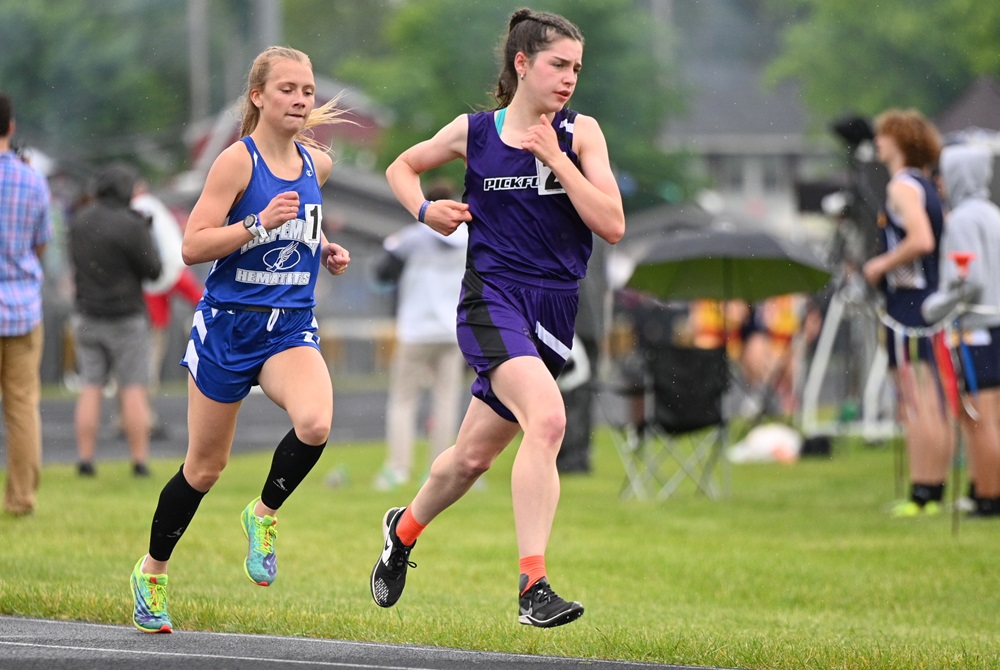
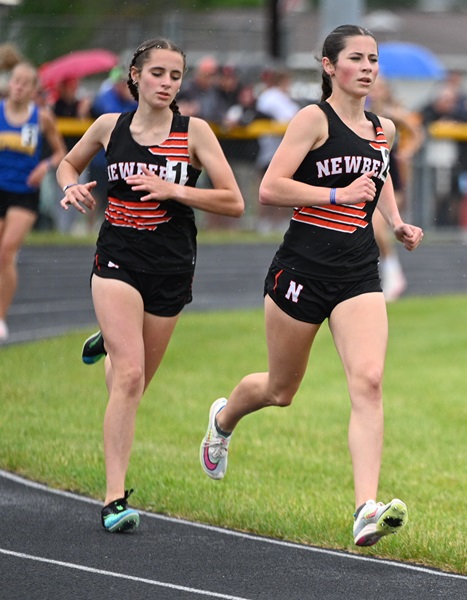
PHOTOS Pickford's Talya Schreiber leads Ishpeming's Lola Korpi on the way to winning the 1,600 during last season’s Upper Peninsula Division 2 Finals. (Middle) Newberry's Samantha Taylor leads sister Abby Taylor during last season’s 1,600 championship race in Division 3. (Photos by Cara Kamps.)
Performance of the Week: Saginaw Swan Valley's Sydney Kuhn
May 16, 2025
 Sydney Kuhn ♦ Saginaw Swan Valley
Senior ♦ Track & Field
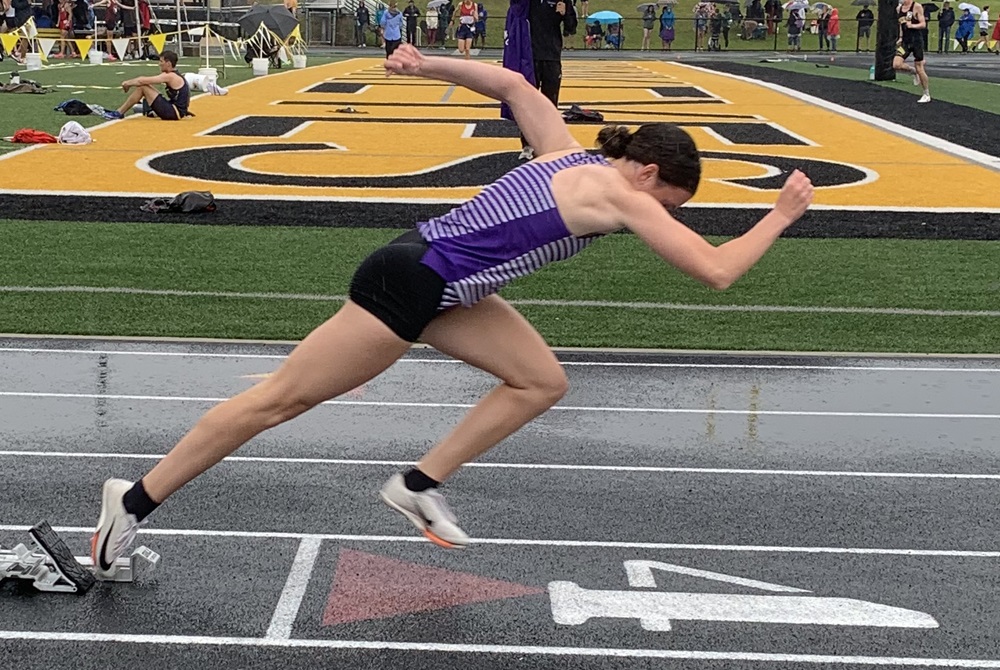
The reigning Lower Peninsula Division 2 Finals champion in the 200 and 400-meter races, Kuhn is undefeated across those two events and also the 100, 800 and 300 hurdles this spring. She ran the state's fastest 300 hurdles time this season (42.06) during last week's Tri-Valley Conference Red championship meet, winning that race by seven seconds, and she also won the 200 (24.63) by more than three seconds and ran on the first-place 1,600 relay.
Kuhn's top 400 time (53.90) also is the state's fastest in that event this season, and her best 800 (2:08.73) ranks second. She's planning to run the 200, 400, 300 hurdles and as part of the 1,600 relay at Friday's Regional at Cadillac, and notably also posted a combined three top-six Finals finishes as a freshman and a sophomore despite suffering stress fractures (one in each foot) during those first two high school seasons. Kuhn also played volleyball all four years of high school and basketball during her first two, earning all-state honorable mention and academic all-state in volleyball and all-league honorable mention in hoops. She will continue academically and on the track at University of Michigan, and intends to major in kinesiology as she studies to become a physician assistant.
@mhsaasports 🏃♀️➡️POW: Sydney Kuhn #track #undefeated #5events #swanvalley #vikings #part1 #highschoolsports #tiktalk #interview #performanceoftheweek #mistudentaid #fyp #MHSAA ♬ original sound - MHSAA
@mhsaasports 🏃♀️➡️POW: Sydney Kuhn #sourpatchkids #spaghetti #chipotle #cryinglaughing #criminalminds #juggle #part2 #performanceoftheweek #mistudentaid #fyp #MHSAA ♬ Monkeys Spinning Monkeys - Kevin MacLeod & Kevin The Monkey
Follow the MHSAA on TikTok.
MHSAA.com's "Performance of the Week" features are powered by MI Student Aid, a division within the Department of Lifelong Education, Advancement, and Potential (MiLEAP). MI Student Aid encourages students to pursue postsecondary education by providing access to student financial resources and information. MI Student Aid administers the state’s 529 college savings programs (MET/MESP), as well as scholarship and grant programs that help make college Accessible, Affordable and Attainable for you. Connect with MI Student Aid at www.michigan.gov/mistudentaid and find more information on Facebook and Twitter @mistudentaid.
Previous 2024-25 honorees
May 8: Ryan Bosch, Fruitport baseball - Report
May 1: Jackson Lam, Kalamazoo Loy Norrix track & field - Report
April 25: Isabelle Horvath, Bangor softball - Report
April 18: Presley Jones, Sterling Heights Stevenson soccer - Report
April 11: Olivia Jasniewicz, Troy soccer - Report
March 27: Katie Spicer, Fowler basketball - Report
March 21: Moses & Markus Blackwell; Warren Lincoln basketball - Report
March 13: Keyshawn Summerville, Lansing Sexton basketball - Report
March 6: Maggie Buurma, Fowlerville wrestling - Report
Feb. 28: Maren Studt, Pontiac Notre Dame Prep skiing - Report
Feb. 21: Olive Krueger, Marquette swimming - Report
Feb. 14: Hunter Lemmon, Fraser swimming - Report
Feb. 7: Aubrey Hillard, Rochester competitive cheer - Report
Jan. 31: Wyatt Spalo, Reed City wrestling - Report
Jan. 24: Olivia Flynn, Harbor Springs basketball - Report
Jan. 17: Levi Rozema, Holland Christian swimming - Report
Jan. 10: McRecco McFadden, Burton Bentley basketball - Report
Dec. 18: Nash Leonard, Bay City Western hockey - Report
Dec. 11: Blake Cosby, Dundee wrestling - Report
Dec. 4: Keaton Hendricks, Zeeland West football - Report
Nov. 29: Kate Simon, East Grand Rapids swimming - Report
Nov. 22: Ella Kokaly, Essexville Garber volleyball - Report
Nov. 15: Caroline Bryan, Grosse Pointe South swimming - Report
Nov. 8: Kaylie Livingston, Whitmore Lake cross country - Report
Oct. 25: Oliver Caldwell, Grand Rapids West Catholic tennis - Report
Oct. 18: Alex Graham, Detroit Cass Tech football - Report
Oct. 11: Victoria Garces, Midland Dow cross country - Report
Oct. 4: Asher Clark, Bay City John Glenn soccer - Report
Sept. 26: Campbell Flynn, Farmington Hills Mercy volleyball - Report
Sept. 19: TJ Hansen, Freeland cross country - Report
Sept. 12: Jordan Peters, Grayling soccer - Report
Sept. 6: Gabe Litzner, Sault Ste. Marie cross country - Report
Aug. 30: Grace Slocum, Traverse City St. Francis golf - Report