

Generations of Dedication, Pride Fuel Milford's 34-Year Regional Hosting Run
By
Steve Vedder
Special for MHSAA.com
May 22, 2026
It may seem a bit of a stretch on the surface, but it makes perfect sense to Brian Salyers.
How can planning a wedding feature work much along the same lines as a school hosting an MHSAA Lower Peninsula Regional track meet for 34 straight seasons?
Easy, contends Salyers. Both take an immeasurable amount of planning.
"I have a couple friends who planned a wedding," said Salyers, Milford's girls track coach. "I told them I'd hosted a track meet, and they're so much alike. There are so many things you entrust other people with. There is so much work to be done, you're hoping things go smoothly."
Like a wedding, Salyers said Milford takes great pride in the event's final outcome. The meet's philosophy includes more than being a stepping stone of funneling deserving athletes along to the MHSAA Finals. At Milford, Salyers said organizers have worked diligently for more than three decades to ensure the participants not only leave with lifelong memories, but also that the meet brings together an entire community.
Volunteers from the school work alongside Milford natives not connected in any way to a track program in a multitude of roles from timing races to rototilling and raking long jump pits, selling dogs and T-shirts and taking tickets. Alumni from up to 45 years ago faithfully return to the school to pitch in whenever needed while also taking a moment to rehash old memories with former track teammates.
 Put it all together, Salyers said, and the meet is special.
"It's a melting pot," Salyers said of the mostly unpaid volunteers who work the meet. "It's like, who can come and do it this year? It's not always a fluid list because we pull from such a large group."
The large group has been banding together since 1993. Started by former Mavericks track and cross country coach Gene Balawajder, the school hosted its first Regional in 1988. After moving to a nearby site for a couple years, the Regional landed back at Milford for keeps 34 years ago. Whether it was those first Regionals in the late 1980s or the three and a half decades since, Salyers said the school and community's philosophy hasn't wavered: Take care of the athletes foremost, but also bring the community together to ensure that care happens by organization, identifying issues and swiftly taking action to solve problems.
Milford athletic director James Marszalek said the school handily recruits about 30 people for various positions, only a "handful," he said, who are paid. He said the key to ensuring a smooth meet begins with the volunteers and longtime meet organizer Chris Ceresa, a former athletic director and current assistant coach.
"The No. 1 thing is making sure we have competent people in the right positions and that we make sure it's a day the kids will remember," he said. "But it definitely takes an army."
Ceresa said much of the meet's success comes down to planning and the unselfishness of alumni. For instance, at this year's meet there were five alumni working the long jump, four on the throwing events and two on both the high jump and pole vault as well as many involved as timers.
Ceresa begins recruiting for the following year's Regional at the current event. There he seeks commitments from officials and event workers 12 months in advance.
"We take it very personally; the staff is very committed to the meet," he said. "If you talked to our colleagues at other schools, I think they would tell you they love to come here. It's quite a spectacle, a matter of pride."
The meet even features an unofficial system of where and how volunteers are used. Meet newcomers typically start out in smaller roles, eventually working themselves into the meet's most prestigious position: being an official timer for races. Unfortunately, when the meet became the last Regional in the state to go to electric timing more than a dozen years ago, there was no need for about 20 volunteers who worked as hand timers at the finish line.
 Milford boys track coach Eric Hincka ran in the meet as a junior and senior before graduating in 1998. He said while some Regionals typically run more smoothly than others, because of the hours upon hours of organization and the quality of the volunteers, the Milford event annually draws praise from visiting coaches and participants. And that's no accident, he said.
"Every year you hear horror stories of meets which have problems," he said. "We try our best to see that everything is done right so we don't run into problems. We want to honor the kids – it's our philosophy and we take pride in it.
"At Milford, it's multi-generational. Gene as the founder set the standard, and we're just trying to follow in his footsteps."
The athletes notice, Milford senior distance runner Kyle O'Rourke said. Headed to run at Michigan State next season, O'Rourke's pedigree in the meet is three-generational. His grandfather has clerked and also made T-shirts for volunteers while O'Rourke has had an older brother and sister run at the Regional. His mother also ran in the meet.
"It's touching for me to see all the old alumni to come back and work; a highlight of the season," said O'Rourke, a six-time all-stater in track and cross country. "They treasured their time here, and now many of them are part of a community that unites to make this meet run well.
"Yeah, it comes in handy (competitive-wise) that this meet is home for us. But there is also a certain pride in us hosting it. I think we all take pride in how we conduct ourselves at the Regional."
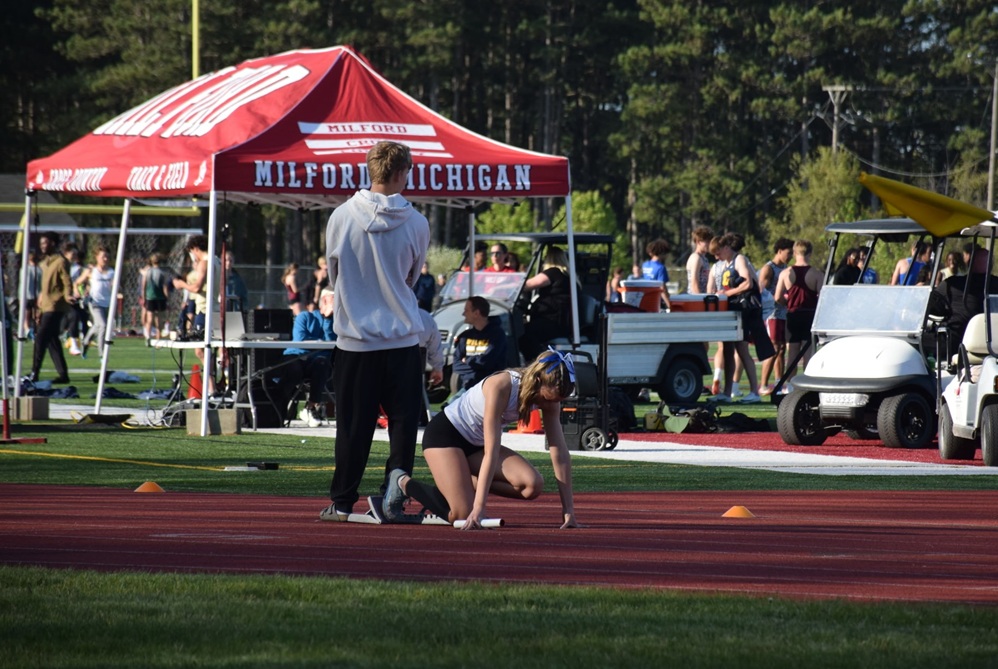
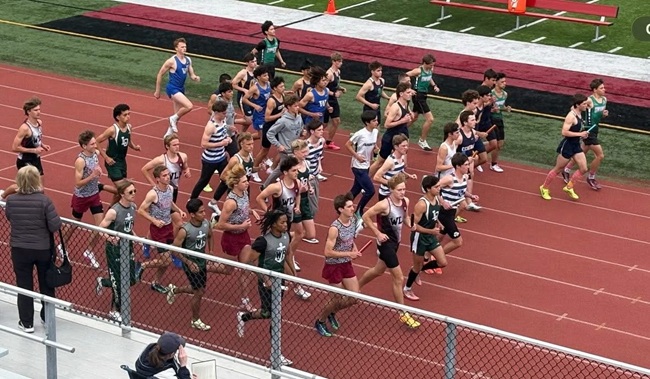
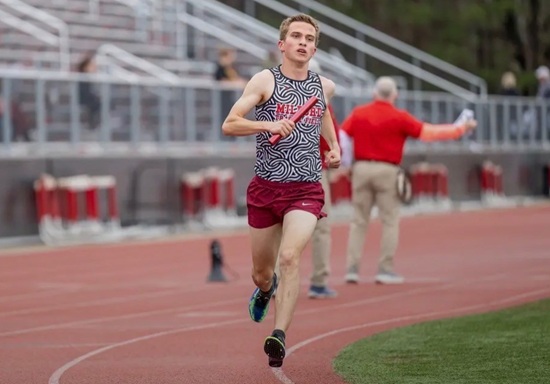
PHOTOS (Top) A relay runner sets up in a starting block during the Lower Peninsula Division 1 Regional hosted by Milford on May 15. (Middle) Runners move toward the starting line before their relay. (Below) Milford’s Kyle O’Rourke rounds a curve during a relay. (Photos courtesy of the Milford athletic department.)

Matelski Makes Own Path to Become Gaylord St. Mary's Long Jump Record Setter
By
Tom Spencer
Special for MHSAA.com
May 31, 2024
It wasn’t much of a long shot Rylan Matelski would become a school record holder this spring, according to Gaylord St. Mary track & field coaches.
 However, it came in the long jump — with a 21-foot, 8-inch leap at the Snowbirds’ first meet of the season at Indian River.
Despite the fact Matelski rarely had a true long jump runway to practice on, his coaches knew he was going to become a record holder. It might have something to do with a 21-foot leap he made as a junior, his first-ever experience with the sport of track. And to top it off, his record-setting performance this spring followed an offseason during which he experienced two seizures before the start of basketball this winter.
The Snowbirds’ previous school record was 21-3. Matelski will have another chance to break his own Saturday when he competes at the Lower Peninsula Division 4 Finals at Hudsonville Baldwin Middle School.
“I already had it in my head that we were going to have a record holder at some time during the course of the season,” said Brian Oliver, the St. Mary head track coach. “That early in the season was pretty impressive, particularly up here where we have limited time to practice with the weather and such.”
Matelski admitted he was a little surprised.
“I was just feeling myself that day,” the senior three-sport star said. “When they said ‘21-8’ I was just stunned — I didn’t really know what to say.”
Gaylord St. Mary does not have a long jump area that allows for Matelski to properly train for his approach, takeoff and landing. He practiced mostly on grass and during warm-ups at competitors’ venues. Occasionally he picked up some practice time at neighboring Gaylord High School when the Blue Devils were not using their facility.
But you will never hear Matelski – nor his coaches – complain.
 Another surprising factor in Matelski’s record-setting leap was that he was recovering from a hamstring injury at the time.
“It is because of his physicality and his work ethic and what he puts into what he does,” said Oliver. “You make what you do have available work, and not so much focus on not having the opportunities other kids do have on a day-in and day-out basis.”
Matelski qualified for the Finals with a 20-2½ leap and third-place finish at his Regional. He nearly qualified in the 200 meters as well.
Unfortunately, Matelski aggravated his hamstring this week at the Gaylord Meet of Champions. It is unknown how that will impact his Finals performance. Unofficially at the Champions meet he went over 21 feet on all three jumps, but officially he was a scratch on all three. The longest scratched jump this week was 21-10. Matelski had come within three inches of the school record at last year’s Meet of Champions.
Matelski, whose favorite sport is basketball, is focused on having fun on the track. Whatever happens at the Finals is just fine with the graduating senior, who also played football and basketball for St. Mary.
“I would love to get 22 feet, but if I don’t it’s okay because I just want to have fun,” said Matelski, who will head to North Central Michigan College this fall to play basketball. “Track is for fun, mainly.”
Oliver, now in his eighth year as the Snowbirds’ coach, has been amazed by Matelski’s senior year.
“These kids go from sport to sport with no break,” said Oliver, who is a chiropractor in Gaylord away from track. “Although multi-sport athletes are better athletes, they are more prone to injury. For him to make it through that and still have the fortitude to be where he is at, I think, is pretty cool.”
Matelski is the oldest of three children adopted by Gary and Alison Matelski. Gary serves as the long jump coach for the Snowbirds and as the assistant NCMC basketball coach. He was raking the pits on opening day, as he usually did, and was the first to congratulate the new record holder.
Coach and father Matelski is amazed too at what has occurred this spring.
“We don’t have a long jump pit to practice on,” Gary Matelski said. “When he’s doing all this stuff he’s basically doing it in a field — we don’t get to work on the approach much.
“Rylan is a good indicator of not dwelling on the things you don’t have but really looking at the things you do have,” Matelski continued. “He concentrated on what he does have and making the best out of that instead of worrying about what he didn’t have.”
Rylan Matelski rolls along with the obstacles for the most part. He’s determined to put his challenges behind him to compete Saturday.
“It makes me a little bit inconsistent compared to the other kids who are jumping farther than me,” he’s acknowledged. “I need to keep pushing through everything no matter what.”
 Tom Spencer is a longtime MHSAA-registered basketball and soccer official, and former softball and baseball official, and he also has coached in the northern Lower Peninsula area. He previously has written for the Saginaw News, Bay County Sports Page and Midland Daily News. He can be reached at [email protected] with story ideas for Manistee, Wexford, Missaukee, Roscommon, Ogemaw, Iosco, Alcona, Oscoda, Crawford, Kalkaska, Grand Traverse, Benzie, Leelanau, Antrim, Otsego, Montmorency, Alpena, Presque Isle, Cheboygan, Charlevoix and Emmet counties.
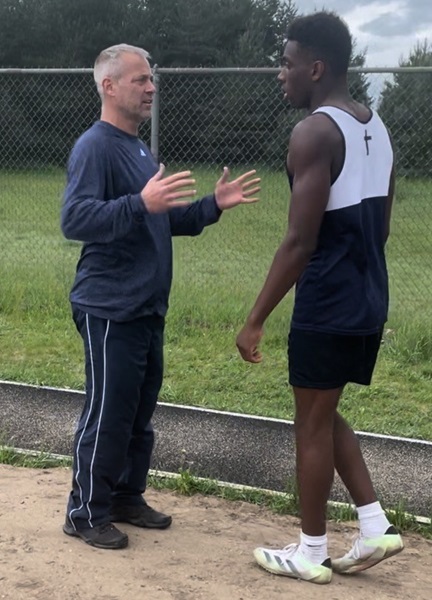
PHOTOS (Top) Gaylord St. Mary’s Rylan Matelski long jumps and runs a relay. (Middle) Matelski and father Gary Matelski confer in the long jump area. (Photos courtesy of the Matelski family.)