

Generations of Dedication, Pride Fuel Milford's 34-Year Regional Hosting Run
By
Steve Vedder
Special for MHSAA.com
May 22, 2026
It may seem a bit of a stretch on the surface, but it makes perfect sense to Brian Salyers.
How can planning a wedding feature work much along the same lines as a school hosting an MHSAA Lower Peninsula Regional track meet for 34 straight seasons?
Easy, contends Salyers. Both take an immeasurable amount of planning.
"I have a couple friends who planned a wedding," said Salyers, Milford's girls track coach. "I told them I'd hosted a track meet, and they're so much alike. There are so many things you entrust other people with. There is so much work to be done, you're hoping things go smoothly."
Like a wedding, Salyers said Milford takes great pride in the event's final outcome. The meet's philosophy includes more than being a stepping stone of funneling deserving athletes along to the MHSAA Finals. At Milford, Salyers said organizers have worked diligently for more than three decades to ensure the participants not only leave with lifelong memories, but also that the meet brings together an entire community.
Volunteers from the school work alongside Milford natives not connected in any way to a track program in a multitude of roles from timing races to rototilling and raking long jump pits, selling dogs and T-shirts and taking tickets. Alumni from up to 45 years ago faithfully return to the school to pitch in whenever needed while also taking a moment to rehash old memories with former track teammates.
 Put it all together, Salyers said, and the meet is special.
"It's a melting pot," Salyers said of the mostly unpaid volunteers who work the meet. "It's like, who can come and do it this year? It's not always a fluid list because we pull from such a large group."
The large group has been banding together since 1993. Started by former Mavericks track and cross country coach Gene Balawajder, the school hosted its first Regional in 1988. After moving to a nearby site for a couple years, the Regional landed back at Milford for keeps 34 years ago. Whether it was those first Regionals in the late 1980s or the three and a half decades since, Salyers said the school and community's philosophy hasn't wavered: Take care of the athletes foremost, but also bring the community together to ensure that care happens by organization, identifying issues and swiftly taking action to solve problems.
Milford athletic director James Marszalek said the school handily recruits about 30 people for various positions, only a "handful," he said, who are paid. He said the key to ensuring a smooth meet begins with the volunteers and longtime meet organizer Chris Ceresa, a former athletic director and current assistant coach.
"The No. 1 thing is making sure we have competent people in the right positions and that we make sure it's a day the kids will remember," he said. "But it definitely takes an army."
Ceresa said much of the meet's success comes down to planning and the unselfishness of alumni. For instance, at this year's meet there were five alumni working the long jump, four on the throwing events and two on both the high jump and pole vault as well as many involved as timers.
Ceresa begins recruiting for the following year's Regional at the current event. There he seeks commitments from officials and event workers 12 months in advance.
"We take it very personally; the staff is very committed to the meet," he said. "If you talked to our colleagues at other schools, I think they would tell you they love to come here. It's quite a spectacle, a matter of pride."
The meet even features an unofficial system of where and how volunteers are used. Meet newcomers typically start out in smaller roles, eventually working themselves into the meet's most prestigious position: being an official timer for races. Unfortunately, when the meet became the last Regional in the state to go to electric timing more than a dozen years ago, there was no need for about 20 volunteers who worked as hand timers at the finish line.
 Milford boys track coach Eric Hincka ran in the meet as a junior and senior before graduating in 1998. He said while some Regionals typically run more smoothly than others, because of the hours upon hours of organization and the quality of the volunteers, the Milford event annually draws praise from visiting coaches and participants. And that's no accident, he said.
"Every year you hear horror stories of meets which have problems," he said. "We try our best to see that everything is done right so we don't run into problems. We want to honor the kids – it's our philosophy and we take pride in it.
"At Milford, it's multi-generational. Gene as the founder set the standard, and we're just trying to follow in his footsteps."
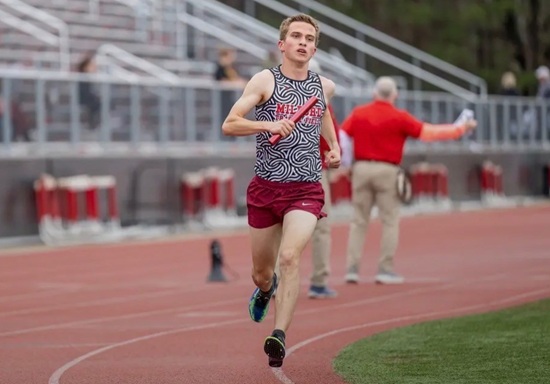
The athletes notice, Milford senior distance runner Kyle O'Rourke said. Headed to run at Michigan State next season, O'Rourke's pedigree in the meet is three-generational. His grandfather has clerked and also made T-shirts for volunteers while O'Rourke has had an older brother and sister run at the Regional. His mother also ran in the meet.
"It's touching for me to see all the old alumni to come back and work; a highlight of the season," said O'Rourke, a six-time all-stater in track and cross country. "They treasured their time here, and now many of them are part of a community that unites to make this meet run well.
"Yeah, it comes in handy (competitive-wise) that this meet is home for us. But there is also a certain pride in us hosting it. I think we all take pride in how we conduct ourselves at the Regional."
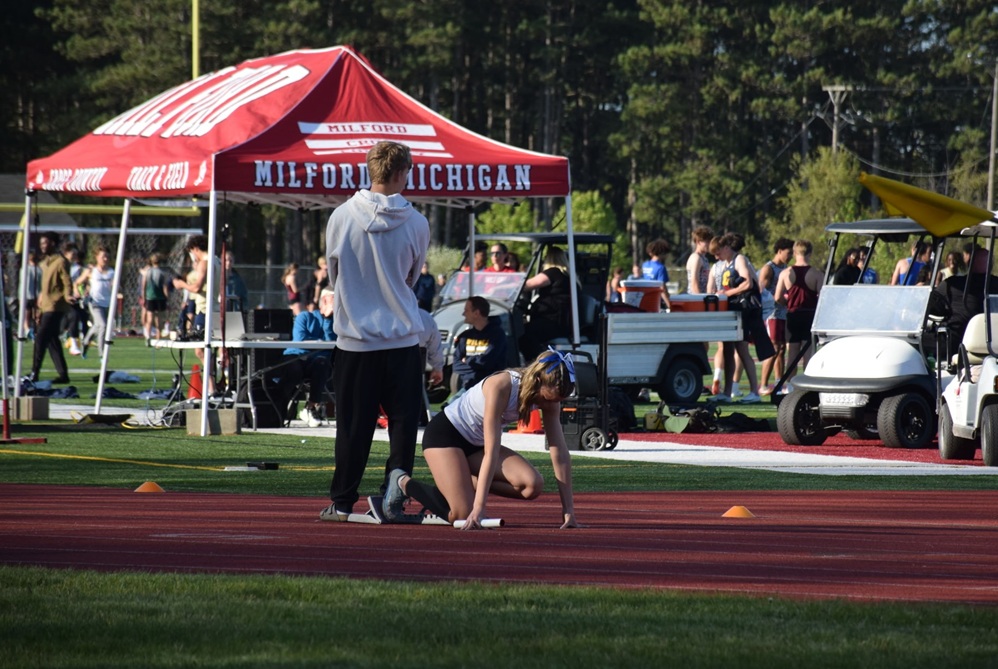
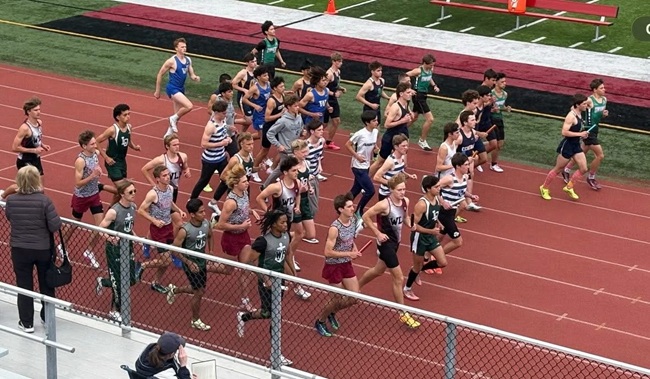
PHOTOS (Top) A relay runner sets up in a starting block during the Lower Peninsula Division 1 Regional hosted by Milford on May 15. (Middle) Runners move toward the starting line before their relay. (Below) Milford’s Kyle O’Rourke rounds a curve during a relay. (Photos courtesy of the Milford athletic department.)
McCarey Caps Niles Career Among School's All-Time Track Greats
By
Scott Hassinger
Special for MHSAA.com
June 3, 2025
NILES – For such a decorated athlete, Niles track & field star Ayden McCarey is as humble as they come.
 That one trait is what makes him such a joy to coach, says Tony Todd, the Vikings' longtime leader of the boys program.
Todd, a Flint Kearsley graduate and former participant himself in the oval sport, has seen many great performers during his 27 years directing Niles' program. But he contends that McCarey is one of the best he's ever coached.
McCarey, who has signed to run track at the Division II level at Grand Valley State University, capped off a glorious high school career during Saturday's Lower Peninsula Division 2 Finals in Hamilton.
McCarey returned home with all-state honors in two events, finishing second in the 110-meter high hurdles (14.43) and third-place in the 400-meter dash (49.27). His time in the 110s broke the school record. He has the second-fastest time at the school in the 400 dash, less than a second behind 2018 Niles grad Jordan Brown, currently the Vikings' sprint coach, who owns the record at 48.50.
McCarey also qualified in the 300 intermediate hurdles and ran anchor leg for the Vikings' 1,600 relay on Saturday.
"Ayden relishes the competition. The bigger the meet, the more he seems to rise to the occasion and perform well. When someone has a faster time, he can't wait to race against them. He gets excited over the chance to compete against someone faster," Todd said.
Also a standout defender for the Niles boys soccer team, McCarey finished runners-up in both the 110 highs and 400 his junior year. As a sophomore he placed sixth in the 110 and 10th in the 300. He began competing in the 400 midway through his sophomore season.
"It's just nice to know that all your hard work you put in got you to state. There's a lot of competition there. I am just happy to represent my school for a third time," McCarey said.
He credits an increase in distance workouts and his increased focus on the 400 as big reasons for his improvement in that event this season.
 "I try and focus on all my events, but it just so happened I spent the most time focusing on the 400 this season,” McCarey said. “You need a lot of stamina to run that event, and it also helps me in the longer hurdle race as well. I've been successful in the 110 highs because I concentrate on attacking it whereas most people sometimes hop over them and that slows them down and hurts their time. I get a good start, and I'm able to maintain my speed throughout the race."
McCarey owned the fastest time in the 400 among Lower Peninsula Division 2 competitors after the Regional meet. He was ranked second in the 110 highs and fourth in the 300 entering the Finals.
"Ayden goes non-stop and never complains. He's one of those kids that will run through a wall for you,” Todd said. “Sometimes I take advantage of that to get that extra effort out of him. He is very humble, and if you try and compliment him he just smiles and puts his head down and keeps going. I worry more than he does if he doesn't get the accolades that he should. He is a quiet kid who leads by example. His form in the hurdles has improved all four years."
McCarey went through his entire high school track career without an injury.
"That's a big thing. Coaches have to learn when to pull back. He's never had a serious injury that left him having to sit out a practice. You can attribute that to his extraordinary work ethic because if you slack off, that's one of the easiest ways to get hurt,” Todd said. “He stays in shape year round with his participation in soccer and track. He is very versatile and can compete at the state level in any event from the 100 up to the 400, along with the hurdles and relays.
"His conditioning and running that he does during his soccer practice builds his endurance for track. In turn, the speed he's developed in track helps him out on the soccer field."
McCarey is looking forward to competing in college.
"I decided to go to Grand Valley because they have a solid track program, and it’s not that far from home. I liked their business program there too," McCarey said.
Todd is looking forward to seeing what McCarey can do at the next level.
"The biggest thing that will make Ayden a valuable competitor in college is that he is a natural athlete. There is only so much you can coach,” Todd said. “It takes a good coach and a good athlete to make a champion. But 90 percent of that is the athlete. If they listen and do the workouts, they will succeed.
"I couldn't be more proud of his four-year high school career. He had the most outstanding track career ever at Niles High School, and he's a great human being and student. This young man is going to do great things at Grand Valley and in life. I'm proud to have been his coach for his entire high school career."
 Scott Hassinger is a contributing sportswriter for Leader Publications and previously served as the sports editor for the Three Rivers Commercial-News from 1994-2022. He can be reached at [email protected] with story ideas for Berrien, Cass, St. Joseph and Branch counties.
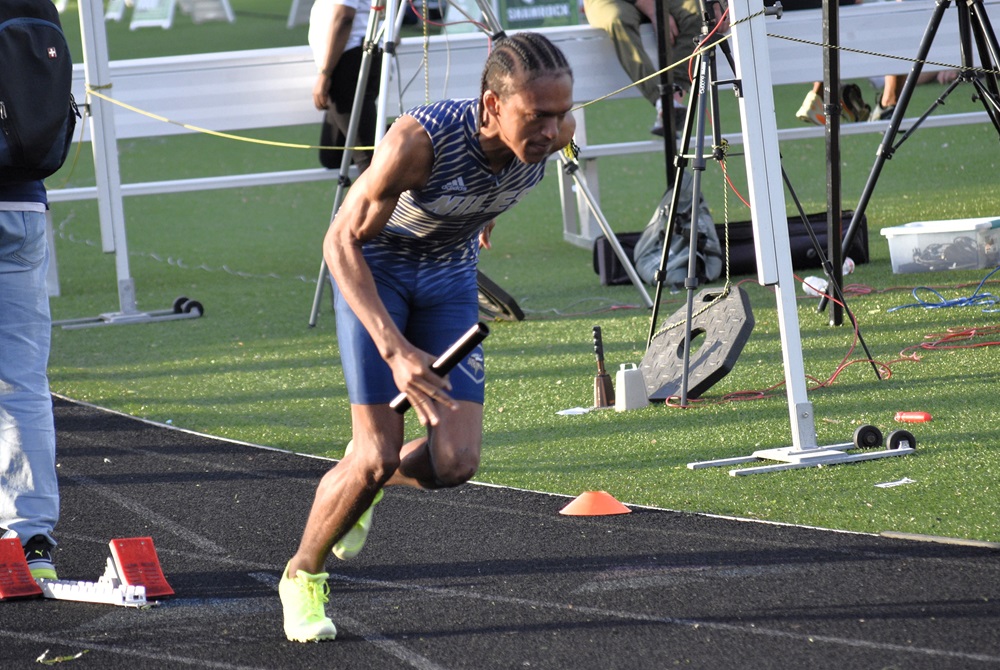
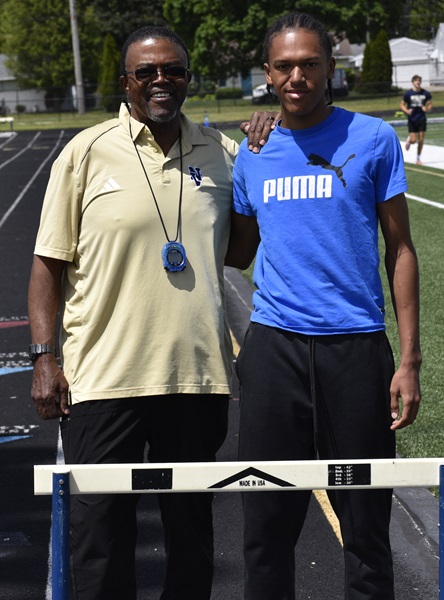
PHOTOS (Top) Niles senior Ayden McCarey leaves the starting block during the 1600-meter relay at his team’s Regional. (Middle) Niles coach Tony Todd, left, takes a photo with McCarey before the start of a practice last week. (Photos by Scott Hassinger.)