

Generations of Dedication, Pride Fuel Milford's 34-Year Regional Hosting Run
By
Steve Vedder
Special for MHSAA.com
May 22, 2026
It may seem a bit of a stretch on the surface, but it makes perfect sense to Brian Salyers.
How can planning a wedding feature work much along the same lines as a school hosting an MHSAA Lower Peninsula Regional track meet for 34 straight seasons?
Easy, contends Salyers. Both take an immeasurable amount of planning.
"I have a couple friends who planned a wedding," said Salyers, Milford's girls track coach. "I told them I'd hosted a track meet, and they're so much alike. There are so many things you entrust other people with. There is so much work to be done, you're hoping things go smoothly."
Like a wedding, Salyers said Milford takes great pride in the event's final outcome. The meet's philosophy includes more than being a stepping stone of funneling deserving athletes along to the MHSAA Finals. At Milford, Salyers said organizers have worked diligently for more than three decades to ensure the participants not only leave with lifelong memories, but also that the meet brings together an entire community.
Volunteers from the school work alongside Milford natives not connected in any way to a track program in a multitude of roles from timing races to rototilling and raking long jump pits, selling dogs and T-shirts and taking tickets. Alumni from up to 45 years ago faithfully return to the school to pitch in whenever needed while also taking a moment to rehash old memories with former track teammates.
 Put it all together, Salyers said, and the meet is special.
"It's a melting pot," Salyers said of the mostly unpaid volunteers who work the meet. "It's like, who can come and do it this year? It's not always a fluid list because we pull from such a large group."
The large group has been banding together since 1993. Started by former Mavericks track and cross country coach Gene Balawajder, the school hosted its first Regional in 1988. After moving to a nearby site for a couple years, the Regional landed back at Milford for keeps 34 years ago. Whether it was those first Regionals in the late 1980s or the three and a half decades since, Salyers said the school and community's philosophy hasn't wavered: Take care of the athletes foremost, but also bring the community together to ensure that care happens by organization, identifying issues and swiftly taking action to solve problems.
Milford athletic director James Marszalek said the school handily recruits about 30 people for various positions, only a "handful," he said, who are paid. He said the key to ensuring a smooth meet begins with the volunteers and longtime meet organizer Chris Ceresa, a former athletic director and current assistant coach.
"The No. 1 thing is making sure we have competent people in the right positions and that we make sure it's a day the kids will remember," he said. "But it definitely takes an army."
Ceresa said much of the meet's success comes down to planning and the unselfishness of alumni. For instance, at this year's meet there were five alumni working the long jump, four on the throwing events and two on both the high jump and pole vault as well as many involved as timers.
Ceresa begins recruiting for the following year's Regional at the current event. There he seeks commitments from officials and event workers 12 months in advance.
"We take it very personally; the staff is very committed to the meet," he said. "If you talked to our colleagues at other schools, I think they would tell you they love to come here. It's quite a spectacle, a matter of pride."
The meet even features an unofficial system of where and how volunteers are used. Meet newcomers typically start out in smaller roles, eventually working themselves into the meet's most prestigious position: being an official timer for races. Unfortunately, when the meet became the last Regional in the state to go to electric timing more than a dozen years ago, there was no need for about 20 volunteers who worked as hand timers at the finish line.
 Milford boys track coach Eric Hincka ran in the meet as a junior and senior before graduating in 1998. He said while some Regionals typically run more smoothly than others, because of the hours upon hours of organization and the quality of the volunteers, the Milford event annually draws praise from visiting coaches and participants. And that's no accident, he said.
"Every year you hear horror stories of meets which have problems," he said. "We try our best to see that everything is done right so we don't run into problems. We want to honor the kids – it's our philosophy and we take pride in it.
"At Milford, it's multi-generational. Gene as the founder set the standard, and we're just trying to follow in his footsteps."
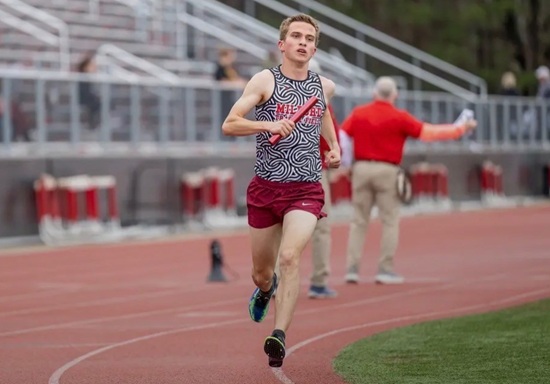
The athletes notice, Milford senior distance runner Kyle O'Rourke said. Headed to run at Michigan State next season, O'Rourke's pedigree in the meet is three-generational. His grandfather has clerked and also made T-shirts for volunteers while O'Rourke has had an older brother and sister run at the Regional. His mother also ran in the meet.
"It's touching for me to see all the old alumni to come back and work; a highlight of the season," said O'Rourke, a six-time all-stater in track and cross country. "They treasured their time here, and now many of them are part of a community that unites to make this meet run well.
"Yeah, it comes in handy (competitive-wise) that this meet is home for us. But there is also a certain pride in us hosting it. I think we all take pride in how we conduct ourselves at the Regional."
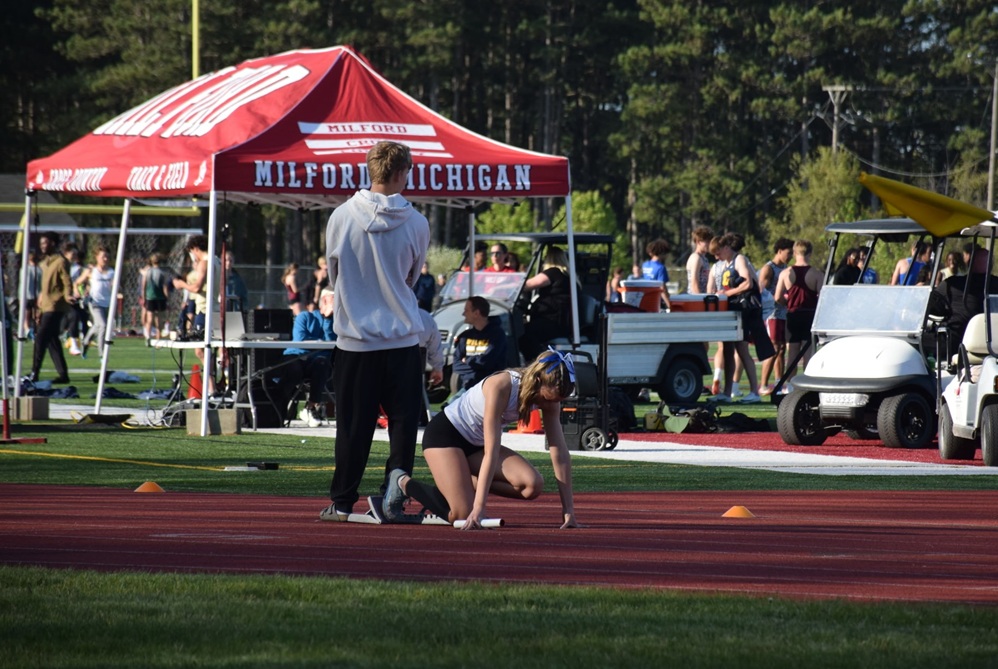
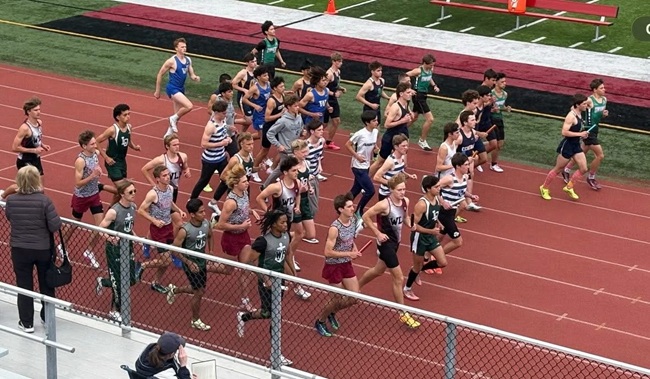
PHOTOS (Top) A relay runner sets up in a starting block during the Lower Peninsula Division 1 Regional hosted by Milford on May 15. (Middle) Runners move toward the starting line before their relay. (Below) Milford’s Kyle O’Rourke rounds a curve during a relay. (Photos courtesy of the Milford athletic department.)
Sault Ste. Marie Girls End 23-Year Championship Wait with UPD1 Win
By
John Vrancic
Special for MHSAA.com
June 2, 2024
KINGSFORD — The Sault Ste. Marie girls made a statement here Saturday while earning their first Upper Peninsula Division 1 Track & Field Finals title since 2001.
Sault scored 117 points, followed by Negaunee with 94 and Gladstone at 65.
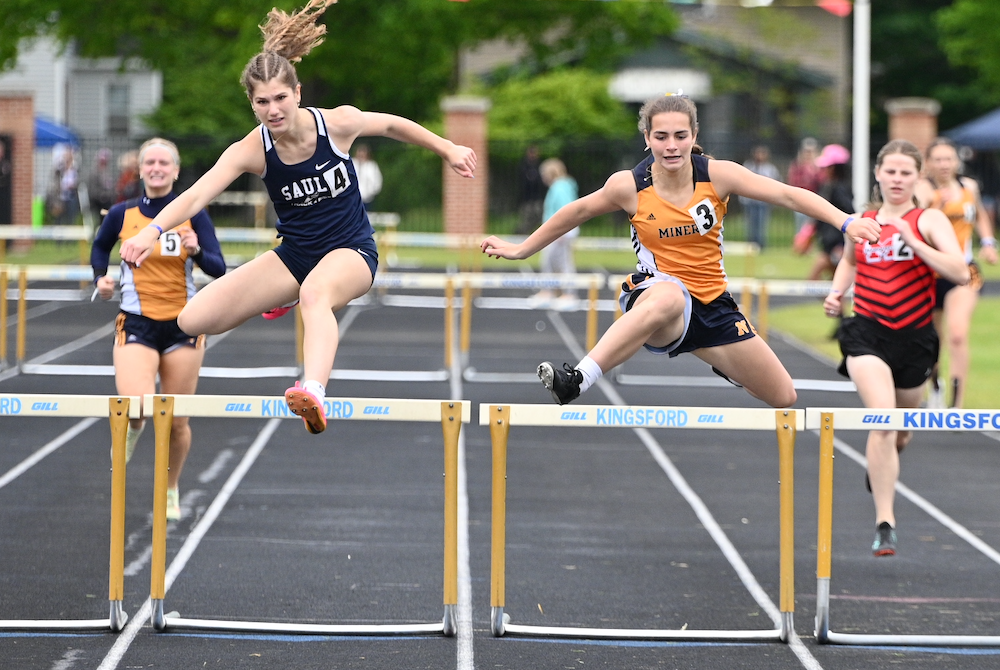
The Blue Devils placed 1-2 in discus, won by senior Katie Anderson at 115 feet, 3 inches, with junior Annabelle Fazzari uncorking a runner-up toss of 101. Freshman Ahnaka Oshelski added a first in the 300 hurdles in 48.29 seconds, followed by Negaunee freshman Sadie Rogers (48.30) and Marquette freshman Chloe Jackson (49.56).
Oshelski also helped the Blue Devils take the 800 relay (1:49.55).
“Our handoffs were a little rough, but I just ran as fast as I could (in the 800),” freshman Grace Mayer said. “It feels great to come away as U.P. champions.”
Mayer was also part of the winning 1,600 relay, clocked at 4:17.4.
Fazzari provided the Blue Devils with a second place in the 100 hurdles (17.07) and a third in shot put (34-0).
Rogers won the 100 hurdles in 16.65 seconds, and Negaunee classmate Keira Waterman placed first in the 400 (59.23) and 800 (2:28.2).
“I didn’t really know what to expect here today,” Rogers said. “I had a good start and just pushed myself real hard. I could hear the crowd. It was very important for me to win this one. I also thought my chances in the 300 were pretty good. I knew I had to push it.”
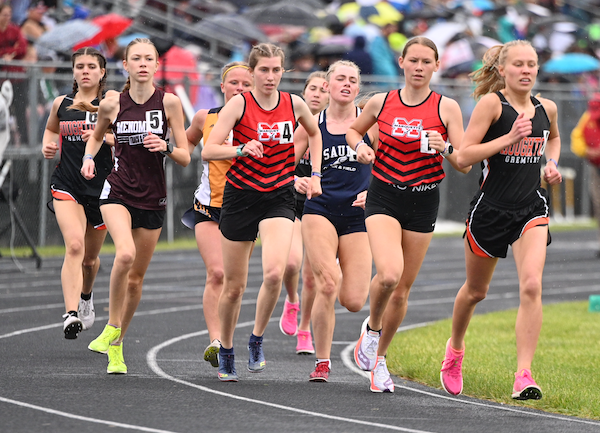 Gladstone set a UPD1 Finals record in the 400 relay at 50.78, shaving basically ⅓ of a second off the previous record (51.11) run by Marquette three years ago.
The Braves were led by junior Jacie Tuljus, who anchored that relay, won the 100 (12.75) and 200 (26.85) and was runner-up to Waterman in the 400 at 1:02.54.
“My starts were slow, but what we did in the 400 relay was good for today” Tuljus said. “Everybody was pretty hyped. We’re happy with it. Overall, I’m happy with the way everything went.”
Marquette sophomore Ella Fure took the 1,600 (5:31.33), followed by Houghton sophomore Tessa Rautiola (12:13.39) and Marquette junior Monet Argeropoulos (5:37.27).
Rautiola then captured the 3,200 (12:13.39), followed by Fure (12:13.46) and Argeropoulos (12:23.91)
“I just wanted to have fun and asked God to pull me through,” Fure said. “I knew if I just trusted God, He would get me through. My mom is pretty sick and couldn’t be here. I just wanted to do this for her.”
Rautiola also helped the Gremlins win the 3,200 relay in a season-best 10:10.38.
“Our school record is 10:08,” she said. “We didn’t get the record this year, although we’re absolutely happy we won. There was miscommunication in the exchange zone which created some confusion. We weren’t in the proper place for one of our handoffs. Otherwise, I think we would have had it.”
Ishpeming Westwood junior Faith Spiroff became a double winner, taking high jump (5-0) and long jump (16-4½).
Other winners were Manistique senior Danielle Lund in shot put (38-7¾) and Calumet senior Caitlyn Strom in pole vault (10-0), where she edged Westwood junior Lexi Olson on a tie-breaker. Houghton freshman Amy Sziber won the adaptive shot put, 100 and 200 events.
PHOTOS (Top) Sault Ste. Marie's Ahnaka Oshelski, left, edges Negaunee's Sadie Rogers by one hundredth of a second to capture the 300 hurdles title Saturday. (Middle) Houghton's Tessa Rautiola (2) leads the 1,600 with Marquette's Ella Fure (1) and Monet Argeropoulos (4) following close behind. Fure won the race, with Rautiola taking second. (Click for more from Cara Kamps/RunMichigan.com.)