


High 5s - 5/1/12
May 1, 2012
Each week, Second Half gives "High 5s" to multiple athletes and a team that have performed exceptionally on the field or made a notable impact off of it.
Please offer your suggestions by e-mail to editor Geoff Kimmerly at [email protected]. Below are this week's honorees:
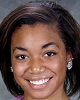 Sarita Dotson
Battle Creek Lakeview junior
Girls Track and Field
For the second straight season, Dotson was named the Most Valuable Female Athlete at the Eldon Draime/Al Geisler Memorial All-City Meet held at Battle Creek Harper Creek (she shared the award in 2011). Dotson won the 100-meter dash (12.5 seconds), the 200 (25.5) and the long jump (16 feet, 3.5 inches) and was on the winning 800 relay (1:48.11) as Lakeview scored 250 points as a team to win the meet by 102.83. Dotson qualified for the MHSAA Division 1 Final last spring as a sophomore, but just missed making the championship races in the 100 and 200. She focuses solely on track, but was a cheerleader as both a freshman and a sophomore.
100 is my No. 1: "It's just so much fun. It's really exciting. You've got it or you don't. After a while, everyone is at the same level. Whoever is on her game that day, prepared the hardest, it's going to show in the 100 meters."
I learned the most about track from: Dotson said a number of coaches, and that her first youth coaches -- including Larry Caper -- could tell right away what she should be running. "Immediately, the first day of practice, one of them said, 'She's a sprinter.' I didn't know what a sprinter was."
A few words to run by: "I always start off with a prayer, or at least try, to remember why I do this and to get my mind straight. My pastor was my coach when I started in third grade, and the first thing he taught us to do when we get on the track is pray."
Favorite formula: Dotson's favorite school subject is chemistry -- and she is considering a career in cosmetic science with a focus on the engineering and creation of make-up.
 Cullen Prena
Walled Lake Central junior
Boys Track and Field
Prena has blasted onto the throwing scene this spring and especially the last few weeks after twice throwing the discus more than 180 feet -- and according to an Oakland Press report, broke both school and Oakland County records that had each stood for at least 29 seasons. He threw the discus 187 feet, seven inches, to win the event at Saturday's Oxford Invitational, and he also won the shot put with a toss of 52-1. Prena's best discus throw last season was 159 feet -- and his toss Saturday would've won every MHSAA Final dating back to 2003. Prena finished fifth in discus at last season's Division 1 championship meet. He's not the only thrower in his family -- older sisters Kari (University of Michigan) and Kelsey (Michigan State) throw in the Big Ten.
I learned the most about throwing from: "Definitely Coach (Nebojsa Stojkovic). And it helps to have my sisters now in college. They can give me advice all the time."
Be like Ryan (Crouser): The University of Texas freshman owns the national high school discus record of 237-6, and "is definitely a model (for me). That's quite a mark."
My dream scenario: "... after this would be college, then to train for the Olympics after that, and win gold in the Olympics. Realistically, I don't know if that's out there or not. But it's a great place to aim."
Major decision: Prena hasn't picked his college or what he'll study some day, but "I'm thinking some kind of marketing or business, or something in the communications field. I do like working with people, and I also like talking. Potentially a sports broadcaster or a marketing engineer."
 Muskegon Mona Shores boys golf
Mona Shores didn't finish first during either round of this weekend's Traverse City Central Invitational. But the Sailors, ranked No. 2 in the Division 1 state poll, finished second both at Spruce Run (309) and the Wolverine (297) for a combined score of 606 -- good for a one-stroke win over top-ranked Grand Rapids Forest Hills Central and two strokes ahead of then No. 5 Traverse City West. Three more teams from that field have since joined the Division 1 top 10.
Reed Hrynewich shot a 69 to finish second at the Wolverine and a 75 to finish fifth at Spruce Run, while teammate Andrew Van Aels finished eight overall at both courses. Those two, Joel Maire and Eric Kastelic also were among the team's top five when it finished fifth at last season's MHSAA Division 1 Final.
This spring's previous honorees
- Sarah Appold, Saginaw Valley Lutheran softball
- Jake McFadden, Clare track and field
- Nick Stiles, Bath baseball
- Malloy Weber, Northville soccer
- Grand Rapids West Catholic golf
- Stevensville Lakeshore softball
Blind Vaulter Builds on Promising Launch
By
Paul Costanzo
Special for MHSAA.com
May 24, 2019
When Bradly Rainwater’s family members learned he was born blind, they decided to not put any limits on him.
 As it turned out, Bradly had the same mindset.
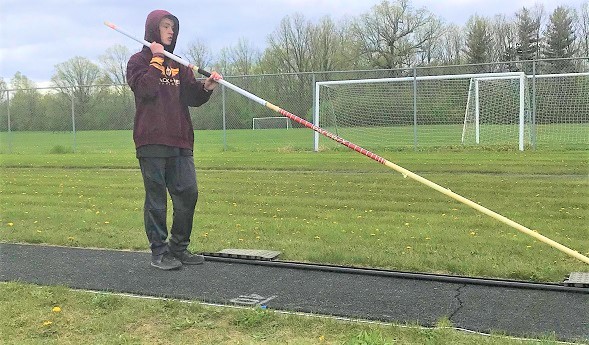
The Davison sophomore is a pole vaulter on the track & field team. It’s an event that he took up not just because his father and uncle were former all-state pole vaulters, but because it was one of the most difficult events in any sport.
“I have always gone after the hardest things,” Rainwater said. “I thought this would be another thing that I would see if I could do it.”
Rainwater, who also is a member of the marching band and wrestling teams at Davison, recently finished his first full season competing as a vaulter and has proven that he can do it, with a personal best of 8 feet, 6 inches. But he’s not satisfied with simply clearing a height in competition – he wants to go higher.
“In the end, I’d like to go to state and get a reasonable placing,” Rainwater said of his career goals. “That would be good for me. I’d enjoy that. For someone in a situation like mine, or a situation similar, you have to work twice as hard to get things where you want them to be. But I am dedicated to it.”
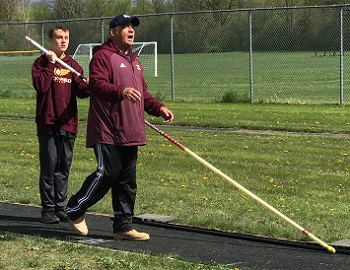
Davison pole vaulting coach Brad Rainwater, Bradly’s grandfather, is also dedicated to it, and is doing all he can to help his grandson reach his goals. Brad Rainwater has been coaching for four decades, but had to teach himself some new tricks when Bradly came along.
“It’s a learning process for us, as well,” Brad Rainwater said. “We started by putting our heads together, my sons and I, and I took it basically like I would coach anyone, but we had to be more hands-on. Basically, it’s step-by-step. It’s the same way when he wrestles; they have to literally do every movement like step, step, step, step. Everything on the vault is done by steps, so we start him with doing three steps, then four steps, then five steps. We’re thinking of ways to teach him to turn, so we use a lot of rings and high bar so he can get that feel.
“What it’s done for me is made me a better coach, because I have to break everything down. Now I’m a little more technical with them all.”
Recently, Bradly began using a track on the runway to help guide his pole to the box, which allows him to start his run farther back. He’s made steady improvement throughout the season, setting his personal best May 13 during a dual meet against Flint Carman-Ainsworth and matching it two days later at the Heritage Hawks Last Chance Invitational.
During practices with a bungee cord, he has cleared more than 10 feet. He’s also started imparting wisdom on other vaulters.
“If I have young vaulters, he teaches them the first three steps and a plant,” Brad Rainwater said. “If people are around (Bradly) and they didn’t know he was blind, because he’s actually doing the drills or showing kids how to do drills, they go, ‘He’s blind?’”
Bradly said the reaction from teammates and opponents alike has been great.
 “They work with me some, like they’ll say, ‘You didn’t turn correctly,’ or ‘You didn’t do this correctly,’ which I appreciate, because criticism like that I can’t necessarily see on film,” he said. “Opponents, some of them come up to me and say thank you to me, and that I inspired them. It’s still hard for me to grasp, because I’m not as good as I should be, but I appreciate people saying that.”
While there’s no official number of blind individuals who have competed in the pole vault, it is rare.
“I know that he’s only one of maybe three others in the state (history), and the other three had some sight,” Brad Rainwater said. “We try not to limit him; we try not to put him in a box that he can or can’t do that. As far as I know, he’s one of the very few in the country that’s doing this. We love it, because we hope it opens doors for other kids that have desire to do other things.”
Bradly, however, said he hasn’t quite grappled with the fact that what he’s doing is special, as he feels he still needs to get better. That’s his focus now, and it’s reflective of someone who has played sports his entire life, from T-ball to soccer to basketball, and now wrestling and track.
He’s not a blind pole vaulter; he’s simply a pole vaulter. And when he’s done, he wants to be known as a great one.
“I’ve always had the attitude of why not,” he said. “Why not work extra hard to be as good as they are?”
 Paul Costanzo served as a sportswriter at The Port Huron Times Herald from 2006-15, including three years as lead sportswriter, and prior to that as sports editor at the Hillsdale Daily News from 2005-06. He can be reached at [email protected] with story ideas for Genesee, Lapeer, St. Clair, Sanilac, Huron, Tuscola, Saginaw, Bay, Arenac, Midland and Gladwin counties.
PHOTOS: (Top) Davison pole vaulter Bradly Rainwater lines up for an attempt this spring. (Middle) Rainwater works with his grandfather Brad Rainwater, the school’s longtime pole vaulting coach. (Photos and video provided by the Rainwater family.)