

Just Halfway Done, Tatum Well on Way to Rewriting West Bloomfield Record Book
By
Keith Dunlap
Special for MHSAA.com
April 18, 2025
WEST BLOOMFIELD – Batting .500 is impressive in baseball or softball, but it’s even more so these days when talking about the track & field program at West Bloomfield.
 When gazing at the school record book for the girls program, junior Kamryn Tatum has her name listed at the top for six of the 12 running events.
She owns the school records in the 100, 200 and 400-meter dashes and is a part of three relay teams (400, 800, 1,600) that own school records.
All of those have been established over the last two years. And if all that wasn’t enough evidence that it’s been quite a start to her high school career, Tatum already also owns three individual MHSAA Finals championships.
Two years ago as a freshman, Tatum won the 200 (24.20) and 400 (55.74) dashes at the Lower Peninsula Division 1 state meet, and followed those up by winning the 200 (24.63) at last year’s MHSAA finale at East Kentwood.
So, what’s the expected encore this spring? Well, more championships and really fast times, of course.
“She’s always a student of the sport, but she’s always driven to beat her previous times,” West Bloomfield head coach Nick Stration said. “She’s always trying to get better. You don’t have to coach her much because she always wants to get better.
“Her will to win is what stands out. She is one of the fiercest competitors I’ve been around.”
Tatum is the younger sister of two past West Bloomfield standouts – current assistant coach Raven Tatum, who ran at Wayne State and Indiana Tech; and current Michigan State football player Dillon Tatum.
 Kamryn said she has never actually raced Dillon, but good-naturedly said she’d have a good shot if they did now.
“I believe I would win, especially since Dillon is all about football now,” Kamryn said. “He’s much stronger and bigger, so that makes a difference on how fast or slow he can run. However, back in high school he would have beaten me for sure.”
Kamryn said she started running track at age 7, but didn’t really enjoy it at first, only doing it because her siblings were racing.
But the love of the sport eventually developed.
“When I got to middle school, that’s when I started having fun,” she said. “I was breaking school records, winning, and getting lots of exposure. Overall, I am somewhat searching for my purpose and enhancing my passion in running.”
It certainly didn’t take long for Tatum to make her mark on the rest of the state with those two Finals titles as a freshman, and the thought of her still having two more seasons at West Bloomfield to go faster has to make other runners cringe.
As a junior, Tatum’s college recruitment is peaking. At the moment, she said she has not received any scholarship offers, but she has been communicating with both in-state and out-of-state coaches.
“My biggest goal right now is to work on my self-confidence,” she said. “From my perspective, it’s been a little tough so far, but I will continue to put in the work and believe in the plan God has for me. I would love to beat my freshman personal records and break more school records and hopefully earn a medal (or two) at the state meet and nationals.”
 Keith Dunlap has served in Detroit-area sports media for more than two decades, including as a sportswriter at the Oakland Press from 2001-16 primarily covering high school sports but also college and professional teams. His bylines also have appeared in USA Today, the Washington Post, the Detroit Free Press, the Houston Chronicle and the Boston Globe. He served as the administrator for the Oakland Activities Association’s website from 2017-2020. Contact him at [email protected] with story ideas for Oakland, Macomb and Wayne counties.
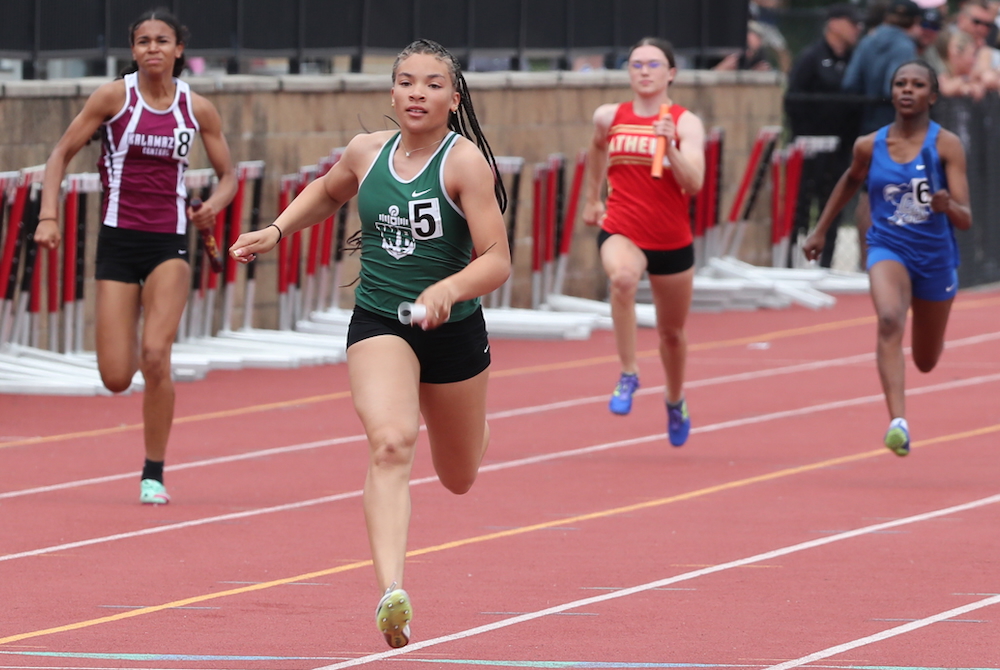
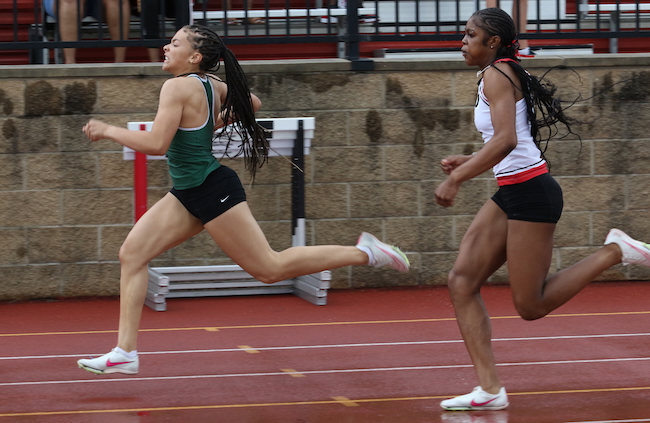
PHOTOS (Top) West Bloomfield’s Kamryn Tatum (5) runs the final leg of the 400 relay at last season’s LPD1 Finals. (Middle) Tatum, left, leads the 200 last spring at East Kentwood. (Photos by John Brabbs/RunMichigan.com.)
Performance of the Week: Saginaw Swan Valley's Sydney Kuhn
May 16, 2025
 Sydney Kuhn ♦ Saginaw Swan Valley
Senior ♦ Track & Field
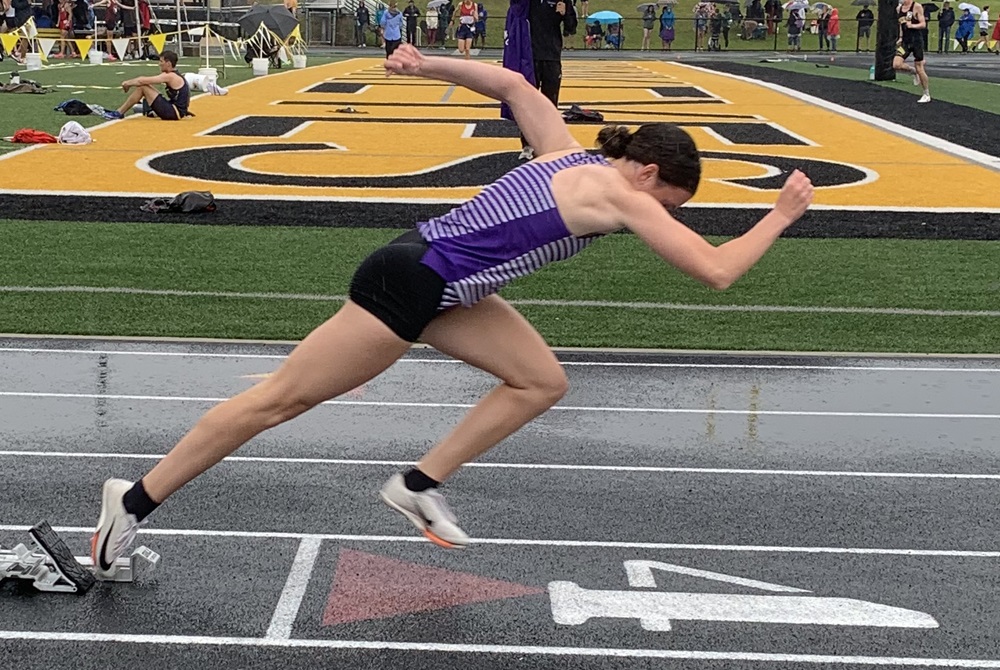
The reigning Lower Peninsula Division 2 Finals champion in the 200 and 400-meter races, Kuhn is undefeated across those two events and also the 100, 800 and 300 hurdles this spring. She ran the state's fastest 300 hurdles time this season (42.06) during last week's Tri-Valley Conference Red championship meet, winning that race by seven seconds, and she also won the 200 (24.63) by more than three seconds and ran on the first-place 1,600 relay.
Kuhn's top 400 time (53.90) also is the state's fastest in that event this season, and her best 800 (2:08.73) ranks second. She's planning to run the 200, 400, 300 hurdles and as part of the 1,600 relay at Friday's Regional at Cadillac, and notably also posted a combined three top-six Finals finishes as a freshman and a sophomore despite suffering stress fractures (one in each foot) during those first two high school seasons. Kuhn also played volleyball all four years of high school and basketball during her first two, earning all-state honorable mention and academic all-state in volleyball and all-league honorable mention in hoops. She will continue academically and on the track at University of Michigan, and intends to major in kinesiology as she studies to become a physician assistant.
@mhsaasports 🏃♀️➡️POW: Sydney Kuhn #track #undefeated #5events #swanvalley #vikings #part1 #highschoolsports #tiktalk #interview #performanceoftheweek #mistudentaid #fyp #MHSAA ♬ original sound - MHSAA
@mhsaasports 🏃♀️➡️POW: Sydney Kuhn #sourpatchkids #spaghetti #chipotle #cryinglaughing #criminalminds #juggle #part2 #performanceoftheweek #mistudentaid #fyp #MHSAA ♬ Monkeys Spinning Monkeys - Kevin MacLeod & Kevin The Monkey
Follow the MHSAA on TikTok.
MHSAA.com's "Performance of the Week" features are powered by MI Student Aid, a division within the Department of Lifelong Education, Advancement, and Potential (MiLEAP). MI Student Aid encourages students to pursue postsecondary education by providing access to student financial resources and information. MI Student Aid administers the state’s 529 college savings programs (MET/MESP), as well as scholarship and grant programs that help make college Accessible, Affordable and Attainable for you. Connect with MI Student Aid at www.michigan.gov/mistudentaid and find more information on Facebook and Twitter @mistudentaid.
Previous 2024-25 honorees
May 8: Ryan Bosch, Fruitport baseball - Report
May 1: Jackson Lam, Kalamazoo Loy Norrix track & field - Report
April 25: Isabelle Horvath, Bangor softball - Report
April 18: Presley Jones, Sterling Heights Stevenson soccer - Report
April 11: Olivia Jasniewicz, Troy soccer - Report
March 27: Katie Spicer, Fowler basketball - Report
March 21: Moses & Markus Blackwell; Warren Lincoln basketball - Report
March 13: Keyshawn Summerville, Lansing Sexton basketball - Report
March 6: Maggie Buurma, Fowlerville wrestling - Report
Feb. 28: Maren Studt, Pontiac Notre Dame Prep skiing - Report
Feb. 21: Olive Krueger, Marquette swimming - Report
Feb. 14: Hunter Lemmon, Fraser swimming - Report
Feb. 7: Aubrey Hillard, Rochester competitive cheer - Report
Jan. 31: Wyatt Spalo, Reed City wrestling - Report
Jan. 24: Olivia Flynn, Harbor Springs basketball - Report
Jan. 17: Levi Rozema, Holland Christian swimming - Report
Jan. 10: McRecco McFadden, Burton Bentley basketball - Report
Dec. 18: Nash Leonard, Bay City Western hockey - Report
Dec. 11: Blake Cosby, Dundee wrestling - Report
Dec. 4: Keaton Hendricks, Zeeland West football - Report
Nov. 29: Kate Simon, East Grand Rapids swimming - Report
Nov. 22: Ella Kokaly, Essexville Garber volleyball - Report
Nov. 15: Caroline Bryan, Grosse Pointe South swimming - Report
Nov. 8: Kaylie Livingston, Whitmore Lake cross country - Report
Oct. 25: Oliver Caldwell, Grand Rapids West Catholic tennis - Report
Oct. 18: Alex Graham, Detroit Cass Tech football - Report
Oct. 11: Victoria Garces, Midland Dow cross country - Report
Oct. 4: Asher Clark, Bay City John Glenn soccer - Report
Sept. 26: Campbell Flynn, Farmington Hills Mercy volleyball - Report
Sept. 19: TJ Hansen, Freeland cross country - Report
Sept. 12: Jordan Peters, Grayling soccer - Report
Sept. 6: Gabe Litzner, Sault Ste. Marie cross country - Report
Aug. 30: Grace Slocum, Traverse City St. Francis golf - Report