

Negaunee Girls Complete Perfect Season with Record-Setting Saturday
By
John Vrancic
Special for MHSAA.com
June 1, 2025
KINGSFORD — The Negaunee girls completed a perfect track & field season here Saturday, earning their first Upper Peninsula Division 1 title in three years with 155 points.
They were followed by Marquette with 109 and Gladstone at 78.
“I am incredibly proud of my team’s effort today,” Negaunee coach Vickie Paupore said. “They have been undefeated throughout the season, and I know they were a little nervous going into the final meet, but they took the confidence that they have had all year and finished strong.”
Miners’ sophomore Keira Waterman set school records while winning the 400-meter dash in 58.55 seconds and 800 (2:21.86). She anchored the winning 400 relay, which was clocked at a school-record 51.21.
Waterman added a second place in long jump at 15-11¼ and was runner-up to Marquette sophomore Taylen Todd, who jumped a personal-best 16-3½.
“My Regional time in the 800 wasn’t the best,” Waterman said. “I came in here seeded sixth, but it ended up being a pretty good day. Taylen had a real good jump.”
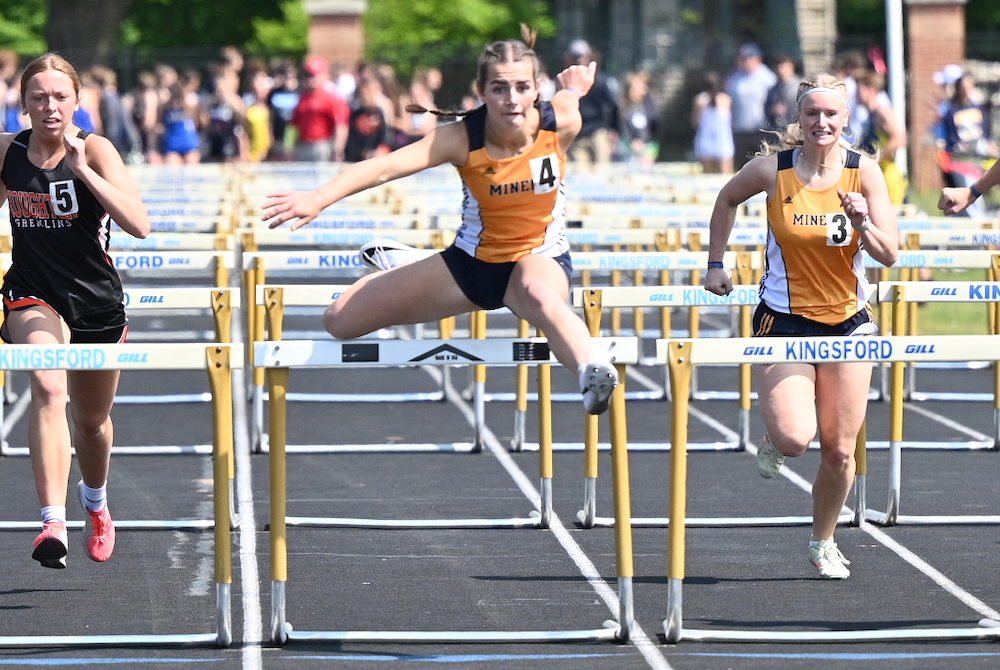
Miners classmate Sadie Rogers also had a hand in three firsts, retaining her 100 hurdles title (15.78), winning the 300 (47.94) and anchoring the 400 relay on this sunny and mild day at Flivver Field.
“I like it,” she said. “Feels good to win the 100 hurdles again. I was nervous before the race, but just had to have a positive mindset and do my best. This gets me in a good spot, although I have to stay humble. You never know what can happen. We had perfect weather with no wind when we were running.”
 Senior Macyn Dellangelo added a first in the 100 at 12.88 seconds, followed by Gladstone senior Lauren Sundquist in 13 seconds flat and Negaunee freshman Elvera Coyne (13.05).
“I enjoy starting out of the blocks,” Dellangelo said. “It’s always nice to know I got a good start and push through it.
“This is probably the best team we’ve had in a while. We’re filled with good athletes.”
Dellangelo, who will continue her education at Northern Michigan University this fall, also led off the 400 relay.
“Keira had a phenomenal day and ran with so much heart,” Paupore said. “She improved upon her own 400 record time and broke Emily Paupore’s record in the 800 from 2018. Sadie Rogers also had some phenomenal performances in the hurdle races. She has run the hurdles so well all year.
“Our seniors really showed up today. Madison Pekrul had PRs (personal records) in both hurdles and was on a winning leg of the mile (1,600) relay. Macyn was the U.P. champion in the 100 and was a leg of our school-record setting 400 relay. She has had some tremendous improvements this season.”
Negaunee junior Baylie Bourdeau won discus with a personal-best toss of 98-2, and sophomore Priya Morey took second (93-10).
“Our discus throwers really came in clutch today,” Paupore said. “They were sitting in fourth and fifth after the preliminary rounds and ended up throwing themselves into first and second place on their last throws.”
Marquette showed its strength in the distances.
Junior Ella Fure won the 3,200 (11:44.58), and senior Maija Maki-Warne added a first in the 1,600 (5:20.98) and was runner-up in the 800 (2:22.56).
Fure placed second in the 1,600 (5:21.12) and third in the 800 (2:27.45).
“I’m really happy with my day,” she said. “I’m really proud of my teammates and Alisha (Mabie of Escanaba). Our friendship is going to last a lifetime. It’s kind of bittersweet because all my best friends are graduating. I ran my race for special people (Jenn, Addie, Stella and Jordan DeMay).”
Mabie, also an NMU recruit, was runner-up in the 3,200 in a personal-best 11:51.46 and third in the 1,600 (5:28.3).
Marquette senior Chloe Miller, bound for Wisconsin-Parkside this fall, placed fourth in the 400 (1:02.41) and 800 (2:31.58) and helped the winning 3,200 relay (10:21.35).
“I’m happy with the times I ran,” the former Alton, Ill., the resident said. “I moved up here in May 2024. I think we have the best athletes we could ask for. The people are so supportive. I never had that before. The thing I’ll remember the most is the way they took me in as one of their own.”
PHOTOS (Top) Negaunee's Sadie Rogers (center) jumps over the last hurdle of the 100 race ahead of the rest of the field Saturday at Kingsford. (Middle) Manistique's Ashlyn Jones, Marquette's Eryn Veverka, and Negaunee's Nori Korsman start the 3,200 relay. Marquette took first place and Negaunee took second. Members of the winning team also included Evelyn Grant, Chloe Miller, and Ella Fure. (Click for more from Cara Kamps/RunMichigan.com.)
Ironwood Savors Home-Track Advantage in LaBlonde Memorial Invitational Sweep
By
John Vrancic
Special for MHSAA.com
May 15, 2025
IRONWOOD — Most high school tracks have at least six lanes and are 400 meters.
 But there’s an exception to every rule.
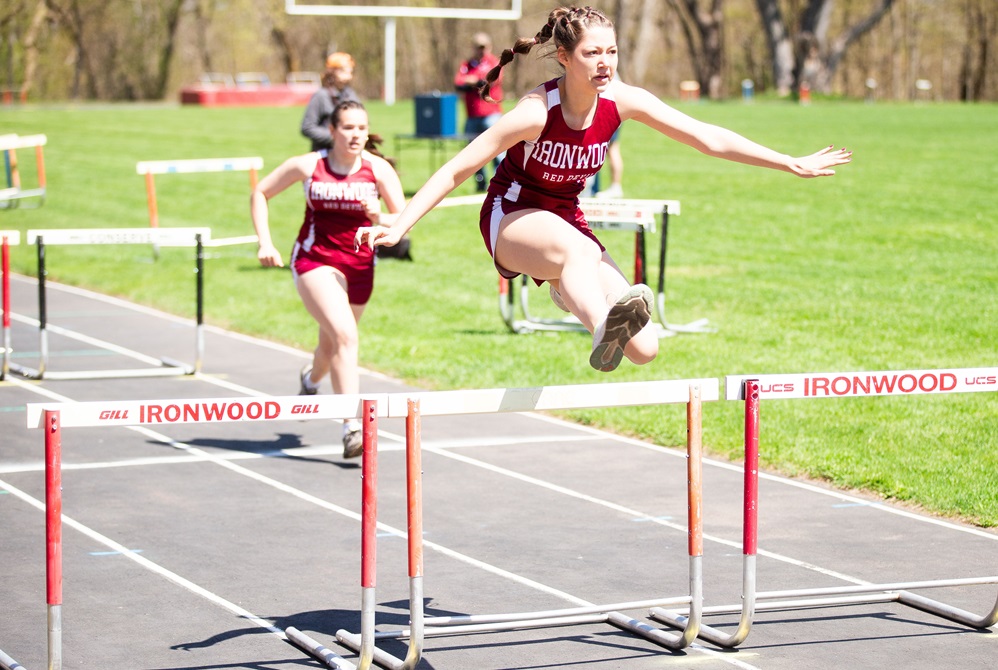
That’s the case at Ironwood, where the Red Devils run on a 350-meter, five-lane asphalt surface.
“That’s something we’ve addressed,” Ironwood coach Cecilia Aho said “We’re probably the last ones who have a track this small, although the distances are the same. When we do mile repeats the kids don’t like it, but it’s better than not having a track. We make it work. Some of the smaller schools don’t have a track.”
Both Ironwood teams retained their titles Saturday afternoon at the Jim LaBlonde Memorial Invitational at Longyear Field, with the boys scoring 74 points to stay ahead of Hurley, Wis., at 57, and the Ironwood girls collecting 104 points to pull away from the field.
“The kids come here and have fun,” Aho said. “We have a nice group of kids who are working real hard.”
Ironwood junior Talon Hughes, who had a hand in four meet records, said the smaller track provides some challenges.
“It’s a pretty unique track,” he added. “We have different lanes and it’s hard to switch lanes. It can be intimidating for visiting teams. It’s sometimes hard for them to adapt, although we get used to it through practice. The biggest adjustment for us on 400-meter tracks is they have longer straightaways.”
Hughes won the 100-meter dash in 11.74 seconds and also took first in the 200 (24.42), 110 hurdles (16.84) and helped the Red Devils take the 800 relay (1:40.37).
“It’s a great feeling to win at home,” he said. “Many of your friends are here to cheer you on. We’re looking forward to our last few meets.”
The different exchange zones appeared to affect the Bessemer girls 800 relay the most. After a fast start, the Speedgirls struggled with all three handoffs, dropping them to third place (2:06.05), fewer than two seconds behind the winning team from Ironwood.
“I think it has a mental block on you,” Bessemer sophomore Sarah Hoffenberg said. “It really depends on the person. In my opinion, I think it helps if you don’t think about it. It’s really a learning experience.”
Hoffenberg later helped the Speedgirls bounce back with a victory in the 400 relay (1:01.38).
Ironwood senior Aubrey Smith, who will be attending classes at University of Michigan this fall, said it’s like having a homecourt advantage.
“It’s a little confusing,” she added. “It’s a little less than 4½ laps for a mile. It’s hard to tell where everyone is.”
Smith dominated the distances, taking the 800 (2:38.84), 1,600 (5:59.53) and 3,200 (11:58.87).
The Red Devils also ran in Wednesday’s Upper Peninsula Division 2 Regional at West Iron County, the boys team winning and the girls finishing runner-up to the host Wykons. Ironwood travels to Lake Linden-Hubbell for the Copper Mountain Conference meet Monday before ending the season at the Upper Peninsula Finals on May 31 at Kingsford.
“Our seniors are looking forward to their last couple meets,” Aho said. “I’m going to miss them. Our school is 100 years old. We started celebrating our centennial last July. We’re in the process of finishing up our celebration.”
 John Vrancic has covered high school sports in the Upper Peninsula since joining the Escanaba Daily Press staff in 1985. He is known most prominently across the peninsula for his extensive coverage of cross country and track & field that frequently appears in newspapers from the Wisconsin border to Lake Huron. He received the James Trethewey Award for Distinguished Service in 2015 from the Upper Peninsula Sportswriters and Sportscasters Association.
PHOTO Skyla Ballew clears a hurdle during a race at Ironwood High School. (Photo by Jason Juno/Ironwood Daily Globe.)