

Oak Park Sprints to 4th-Straight Team Title Win, Zielinski Rebounds for Winning Finish
By
Steve Vedder
Special for MHSAA.com
May 30, 2026
ROCKFORD – It would have been the perfect time for Lorelai Zielinski to toss her cards on the table and walk away.
After suffering a crushing disqualification Saturday in the discus, a disastrous development that ensured she wouldn't repeat her dream of defending her Lower Peninsula Division 1 Finals title in that event as well as the shot put, Zielinski could have called it a season.
Instead, the Traverse City Central junior mentally gathered herself by taking several slow walks around the shot put area, listening to some music and generally clearing her head.
"Just tried to keep calm in the moment," she said. "I didn't dwell on what was done."
So instead of falling off a mental cliff, Zielinski went out and captured the shot put with a toss of 48-6¼, two feet farther than the rest of the field.
"I had worked so hard to get better," she said. "But it was a mental battle. I just had to compose myself and get ready for the shot."
While Zielinski had to overcome her mental roadblocks, the Oak Park girls had to overcome their own adversity as well – but employed the same formula they used to win the last three Division 1 titles and claim their 10th over the last 12 years: power in the sprints.
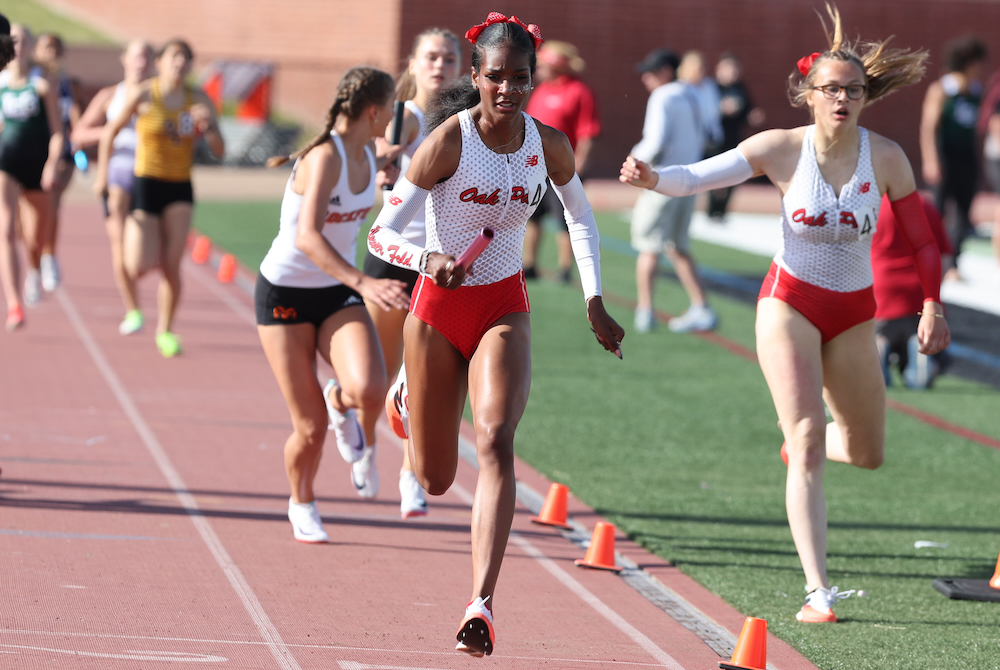
Oak Park finished with 61 points to 48 for runner-up Detroit Cass Tech and 28.5 for third-place East Kentwood. West Bloomfield was fourth with 28. The Knights took firsts in the 1,600 and 800 relays, seconds in the 400 relay, open 100 and 400, a third in the 300 hurdles and a fourth in the 200.
Put it all together and it was business as usual for the team, coach Brandon Jiles said.
 "Today was a little tough because we had battles with Cass Tech and East Kentwood," he said. "We had a few tough breaks, but when bad things happen you pick yourself up. The result is you deal with adversity."
Because the team has only two seniors, Jiles said Oak Park had to rely on a handful of younger athletes who were mainstays on the 2025 championship team, including junior Nevaeh Burns, who while not winning the 400 for a third straight time did post one of team's highest individual finishes with a second in the race. Teammate Aubrey Douglas was second in the 100.
"We had to spread things out," Jiles said. "Even though we were the favorite, we knew it would be tough. We do have a lot of experience from last year, but it's always tough to see what a young team will do. Twice we've gone for four in a row and didn't do it. This year we did."
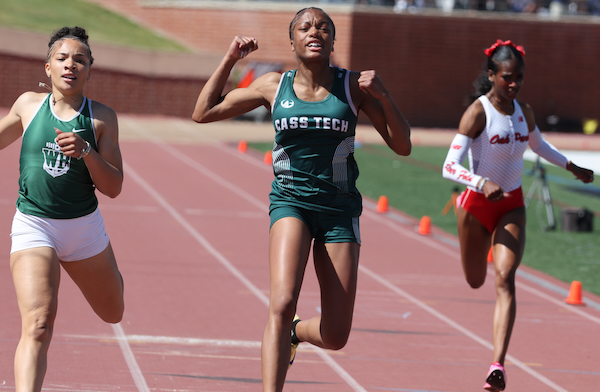
Senior Kamryn Tatum of West Bloomfield won the 100 (11.74) while finishing second behind Malise Brown of Detroit Cass Tech in the 200 (23.13). Brown's time was an all-Finals record and sixth-best in the country this spring.
Tatum said she actually prefers running the longer 200-meter dash over the 100. She entered Saturday as a three-time Finals champ in the 200 while also winning the 100 a year ago.
"I hate the 100," Tatum said. "You have to get out strong to win the 100 because it's shorter. But I do what I do, and it's nice to win. My sophomore year was hard because I was injured, but now I was pretty much healthy."
East Lansing freshman Cayla Hawkins pulled one of the biggest upsets at the meet when she edged Oak Park's Burns in the 400. Hawkins had a 52.89 to creep past Burns' mark of 53.63.
"I know her from AAU," Hawkins said of Burns. "I was kind of shocked with myself, but I really pushed for this. I've had my days this year, kind of in and out. We call it "deep water," which means we save some of the hardest workouts for leading up to the state meet so we know what our bodies are capable of."
Richland Gull Lake junior Lane Isom won the 800 (2:11.06) after finishing just ninth a year ago. She was the best of a strong field which featured seven runners separated by less than three seconds. Isom had run a 2:09 a week ago.
"I knew I could run a fast time," she said. "It just depended on what would happen. I just went out and tried to do my best."
Grand Ledge's Katie Blue was a two-time champion in events with little in common. The Comet senior won the pole vault (14-0) as well as the 300 hurdles (43.14). The pole vault was an all-Finals record after her previous best was a 13-10 two weeks ago.
"My main goal was to go 14-feet," said Blue, who missed on her first attempt at three heights. "It just depends on the person. If you're mentally strong, you can bounce back from that. You can't let it get in your head because that just makes the next two or three attempts harder."
Other individual champs were Natasza Dudek in the 3,200 (10:15.25), Elliana Neuer of Hartland in the 1,600 (4:51.73), Kyleigh Peacock of Troy in the long jump (19-1), Olivia Latunski of Grand Rapids Forest Hills Central (138-2) in the discus, Detroit Cass Tech's Laila Hawkins in the 100 hurdles (14.15) and Alannah Love of Lansing Waverly in the high jump (5-0).
West Bloomfield won the 400 relay (46.88) and Ann Arbor Skyline took the 3,200 (9:05.75). Clarkston’s Allison Thurman (100, 400) and Fenton’s Molly Katic (200) finished first in adaptive events.
PHOTOS (Top) Oak Park's Nevaeh Burns bursts forward after taking a handoff during for her team's winning 1,600 relay Saturday. (Middle) Detroit Cass Tech's Malise Brown, middle, crosses the finish line in record time in the 100. (Click for more from John Brabbs, Carter Sherline and Jamie McNinch/RunMichigan.com.)
Finals Title Next Step for Versatile Swan Valley Record-Breaker Kuhn
By
Paul Costanzo
Special for MHSAA.com
May 22, 2024
Sydney Kuhn’s habit for smashing school records at Saginaw Swan Valley has forced the track & field program to start taking cost-cutting measures.
 “We stopped changing out the records on our record board,” Swan Valley coach Dave Dawson said. “We just figured she has another year and she’ll break it again, so we figured we’re going to save money this way.”
Kuhn, a junior, owns the school records in the 200, 400, 800 and 1,600 meters. She also has the program record in 60 meters, an indoor track event. She’s run the school’s second-fastest 300 hurdles time, and one of the top five 100-meter times. The 1,600-meter relay team she’s part of with Mackenzie Morgan, Grace Spear and Mackenzie Powell is close to setting a record, as well, and has qualified for the MHSAA Lower Peninsula Division 2 Finals on June 1.
“Her ninth-grade year, everybody knew, depending on what happens and her attitude, they knew she could be something special. There was potential there,” Dawson said. “Lauren Huebner, she graduated in 2016 and went to SVSU and was a two-time Division II national champion, she had eight records on the board. Sydney feeds off that. Especially now that Lauren is helping coach, she’s definitely been pivotal in this.”
Kuhn qualified for the Finals in the three events she ran at last week’s Regional: the 200, 400 and 1,600 relay. She will be the No. 1 seed in the 400, and has run the fastest time in the state regardless of division, at 55.11 seconds. She’s the No. 2 seed in the 200, where her personal best of 24.89 is the fifth-fastest time in the state this year, regardless of division. She finished third and sixth, respectively, at the Finals in the events a year ago.
“I feel good,” Kuhn said. “I’m just getting ready. It’s been a good year, it’s been going smoothly. The 400 looks pretty good, and the 200 there will be some good competition. Freshman year, I got fifth, then third (as a sophomore) in the 400, so hopefully this year is first.”
She did not run the 800 at the Regional, as it was decided it was too close in the meet order to her other events. She’s run 2:12.75 in the event, the fourth-fastest time recorded in the state this season.
That could be where she has the most potential, however, as it’s a race she had never run competitively until her sophomore season. The first time she ran it in a varsity meet, she recorded a 2:21, setting the school record.
 “(Coach) Andrew Wendler put a bug in her ear, ‘If you’re running this fast in the 400, think of what your 800 would be,’” Dawson said. “She says, ‘Yeah, I’ll try it.’ So, in one of our first conference meets, she ran against a girl that’s pretty good in the 800 and we just said to follow her – stick with her and see what you can do. With 200 meters left, she just took off and broke the school record the first time she ran it.”
A year later, they tried the same thing with the 1,600. And again, Kuhn responded by running 5:12.73 in her first try, setting the school record. She’s since run 5:06.45.
“The first time I ran the 800, I ran against Mary Richmond from Frankenmuth who is really fast, and I sort of paced behind her the first 400, then the last 300 I took off. Same thing with the 1,600. I felt like staying behind her, I wasn’t really racing, so I could just go, I thought.”
Richmond is a three-time all-state finisher in both the 1,600 and the 3,200, as well as a four-time all-state cross country runner.
With Kuhn’s instant success in every race she’s tried, the logical next question is, what about the 3,200?
“My coach mentioned that,” Kuhn said with a laugh. “But I usually just shake my head. You never know.”
There is a real question, however, about what event, or events, Kuhn is best suited for moving forward. She said that she would like to shift some focus to the 800 for her senior year, and several college coaches who have been in contact with her have indicated that’s where she could land.
“The pattern typically is they would probably turn her into a half-miler or a miler,” Dawson said. “Some college coaches want her for the heptathlon with her hurdle experience, and she is not a stranger to the weight room. That’s the fun part about this, she tries something and it’s usually pretty fun. It’s usually a positive experience.”
Kuhn is ready for whatever is thrown at her.
“They’re mostly like 800, 1,500, those types of races,” she said. “Some of them just say whatever you like best. One coach mentioned the steeplechase – I don’t know about that. One coach did mention (heptathlon). I’d be open to whatever is best.”
While she’s taken some unofficial visits, she said she’s in no hurry to choose a college. Her focus remains on winning a Finals title at Swan Valley, and a series of times she’s set as goals for herself: 24.4, 54.9, 2:09.9, 4:59.9.
They’re all saved on her phone screen, where they’re easy to change as she reaches them. And at no cost.
“Every time I look at my phone, I see the times I want to get,” she said. “I’ve changed my screen saver a lot when I do break it.”
 Paul Costanzo served as a sportswriter at The Port Huron Times Herald from 2006-15, including three years as lead sportswriter, and prior to that as sports editor at the Hillsdale Daily News from 2005-06. He can be reached at [email protected] with story ideas for Genesee, Lapeer, St. Clair, Sanilac, Huron, Tuscola, Saginaw, Bay, Arenac, Midland and Gladwin counties.
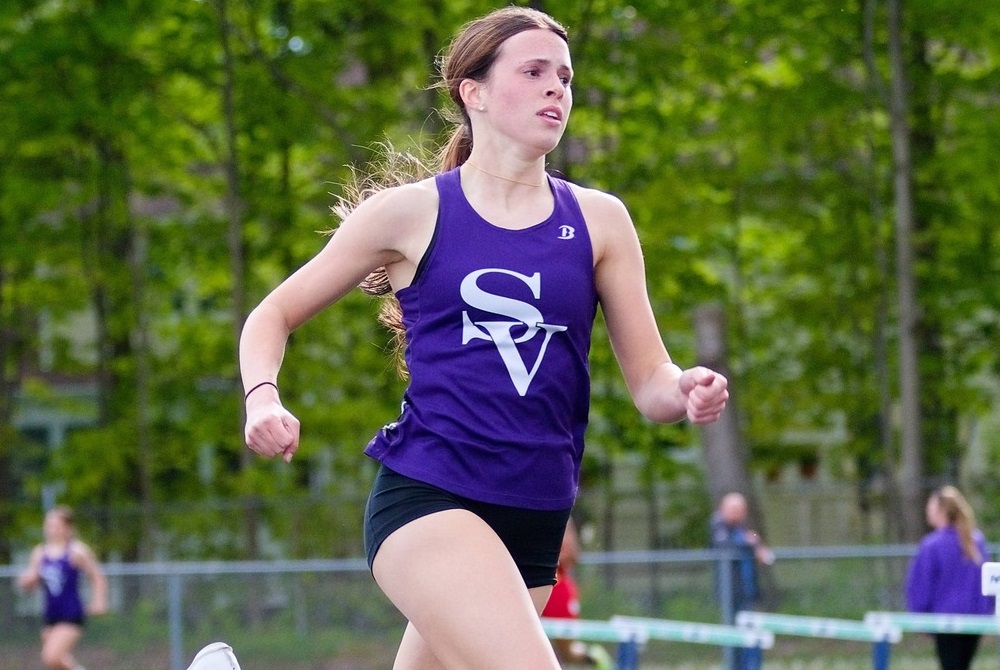
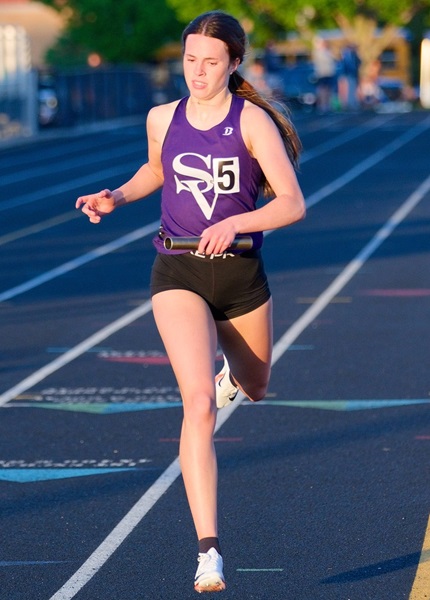
PHOTOS (Top) Saginaw Swan Valley’s Sydney Kuhn runs toward the finish during the Korf/Schultz Saginaw County Invitational on May 10 at Hemlock. (Middle) Kuhn anchors a relay during the Tri-Valley Conference Red meet May 8 at Frankenmuth. (Photos by Eagle Eye Photography.)