

Olivet Girls Continue Reign as Peters Closes Championship-Filled Career
By
Todd VanSickle
Special for MHSAA.com
May 30, 2026
KENT CITY – After winning its first Finals championship in girls track & field a year ago by just five points, Olivet extended its title reign with another close finish Saturday at Kent City.
The Eagles scored 82 points at the Lower Peninsula Division 3 championship meet to outpace Lansing Catholic (76), with Pewamo-Westphalia (61.5) third.
“I am an alumni of the school, so to come back and do this is, is awesome,” Olivet head coach Brian Lincoln said. “We knew going in that it is was going to be a battle with Lansing Catholic. Our girls stepped up, like they have all season and for the past four seasons.”
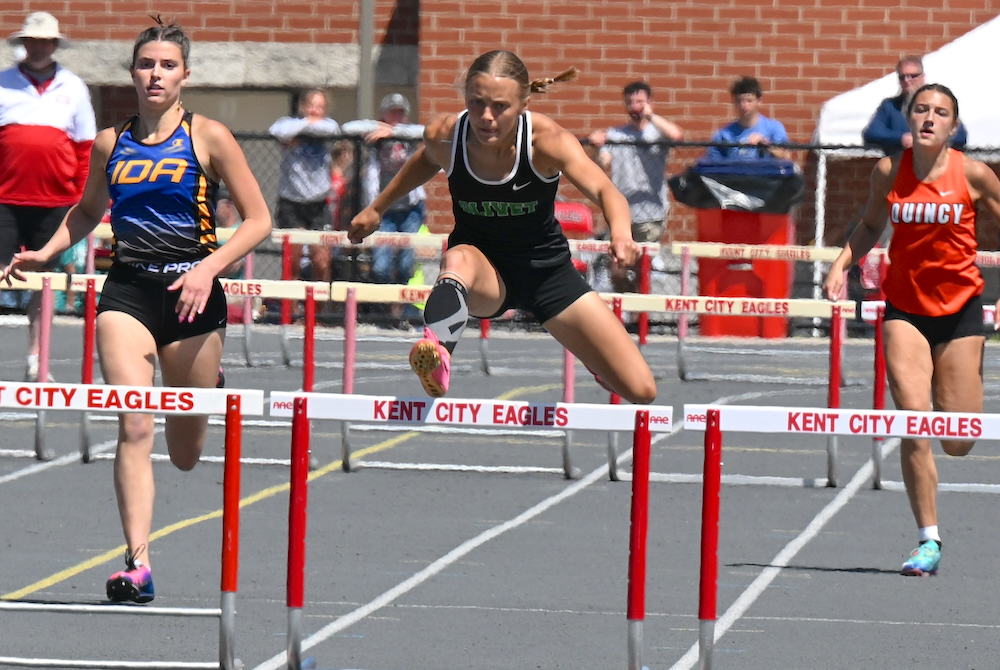
Olivet senior Emily Peters claimed her fourth 300-meter hurdles title in 44 seconds. She qualified for this meet in seven events.
“It is pretty crazy,” said Peters said, who plans to run track for Northwood University next season. “Going into my freshman year, I knew I was pretty fast, but I never expected to have this kind of success.
“This is a perfect ending. It is the culmination of all my hard work. I am so grateful for this.”
Peters also took second in the 100-meter hurdles with a personal best of 14.83 seconds as the Eagles had success in several events.
Celina Sinclair won the 200 meters with a personal best of 24.91 seconds after finishing second in the prelims. The Eagles’ 400 relay team of Bailey Powell, Lola Miars, Peters and Sinclair took first place (49.51) over Kingsley (49.53) and Traverse City St. Francis (49.77). Olivet’s 800 relay team (Peters, Sinclair, Miars and Kendall Eggerstedt) also found the top spot on the podium (1:44.67).
Pewamo-Westphalia won the 3,200 relay (9:40.94) with Julia Paxton, Katherine Schafer, Adelyn Thelen and Calista George. Lansing Catholic was second and Saugatuck finished third.
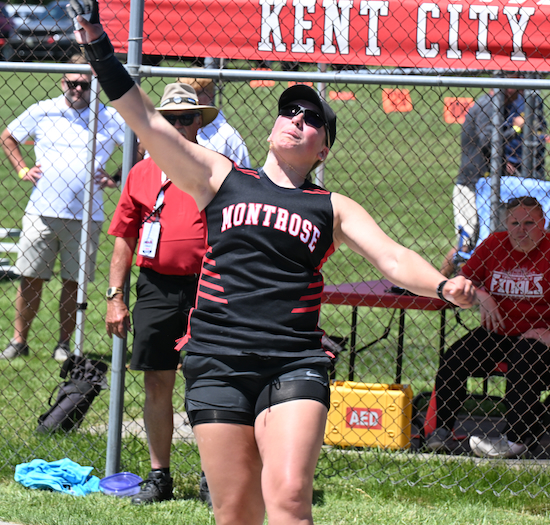 Montrose’s Addyson Stiverson won the shot put with an all-Finals record of 55 feet, 6½ inches. The previous record (50-9½) was set in 2021 by Bryon’s Sarah Marvin.
Second place went to Pewamo-Westphalia’s Jenna Spitzley with a toss of 38-1¾. “If you would have asked me a week ago, I didn’t think I would have been in the 38 range,” Spitzley said.
The Pirates senior also won the discus with a throw of 136-7. She credited her family for her success.
“I had my brother there,” Spitzley said. “He has been coaching me a lot and helping me.”
She will attend Hillsdale College in the fall and plans to throw the shot put, discus and the hammer at the collegiate level.
Olivia Beaudrie, of Monroe St. Mary Catholic Central, won the high jump with a leap of 5-4. Julia Sergeant, of Houghton Lake, took first place in the pole vault clearing 11 feet after finishing sixth in the event last spring.
“I am really happy with my progress this year,” Sergeant said.
Despite being the top seed, she was a little nervous coming into meet.
“There were a few girls I was a little intimidated by,” Sergeant said. “There were two girls I have never seen vault before, but I knew what I was capable of and I did it.”
Novella DeGraff, of Saugatuck, had a personal best of 10-9 in the pole vault to finish second. She also finished third in the long jump with a personal best of 17-2. Smantha Hopkins, of Harrison, was first with a leap of 17-4¾.
Both of DeGraff’s marks in the field events set school records. It was the second year DeGraff had competed at the Finals, although she missed last season’s meet due to a torn knee ligament. She also ran a personal best in the 100-meter hurdles for third place (14.83).
“Today has been pretty chaotic,” DeGraff said. “I planned to try my best, but I didn’t expect I would do as good as I am. My mentality was to have a good time.”
Lansing Catholic’s Grace Wonch (4:58.84) and Josie Bishop (4:58.89) took first and second, respectively, with personal bests in the 1,600 meters. Bishop won the 800 meters (2:16.07), while Wonch took the bronze. Wonch also claimed the 3,200 meters (10:53.12) and Tiya Feldpausch, of Olivet, was second. (10:58.84).
The reigning 100 hurdles champion Julia Hughes repeated with a run of 14.55 seconds. She took third in the 300 hurdles.
Erie Mason senior Giuliana Nastale repeated as the 100 champion in 12.11 seconds. Sinclair, of Olivet, was second. Ella Clause, of Clinton, ran a personal best (57.99) to claim the 400. Centreville's Diannah Schwartz finished first in the 100, 200, 400 and shot put adaptive events.
PHOTOS (Top) Olivet's Emily Peters, center, clears a hurdle on the way to a runner-up finish in the 100 hurdles race Saturday. (Middle) Montrose's Addyson Stiverson launches the shot; she set the all-Finals record in the event. (Click for more from Mary Wilson and John Willoughby/RunMichigan.com.)
Finals Title Next Step for Versatile Swan Valley Record-Breaker Kuhn
By
Paul Costanzo
Special for MHSAA.com
May 22, 2024
Sydney Kuhn’s habit for smashing school records at Saginaw Swan Valley has forced the track & field program to start taking cost-cutting measures.
 “We stopped changing out the records on our record board,” Swan Valley coach Dave Dawson said. “We just figured she has another year and she’ll break it again, so we figured we’re going to save money this way.”
Kuhn, a junior, owns the school records in the 200, 400, 800 and 1,600 meters. She also has the program record in 60 meters, an indoor track event. She’s run the school’s second-fastest 300 hurdles time, and one of the top five 100-meter times. The 1,600-meter relay team she’s part of with Mackenzie Morgan, Grace Spear and Mackenzie Powell is close to setting a record, as well, and has qualified for the MHSAA Lower Peninsula Division 2 Finals on June 1.
“Her ninth-grade year, everybody knew, depending on what happens and her attitude, they knew she could be something special. There was potential there,” Dawson said. “Lauren Huebner, she graduated in 2016 and went to SVSU and was a two-time Division II national champion, she had eight records on the board. Sydney feeds off that. Especially now that Lauren is helping coach, she’s definitely been pivotal in this.”
Kuhn qualified for the Finals in the three events she ran at last week’s Regional: the 200, 400 and 1,600 relay. She will be the No. 1 seed in the 400, and has run the fastest time in the state regardless of division, at 55.11 seconds. She’s the No. 2 seed in the 200, where her personal best of 24.89 is the fifth-fastest time in the state this year, regardless of division. She finished third and sixth, respectively, at the Finals in the events a year ago.
“I feel good,” Kuhn said. “I’m just getting ready. It’s been a good year, it’s been going smoothly. The 400 looks pretty good, and the 200 there will be some good competition. Freshman year, I got fifth, then third (as a sophomore) in the 400, so hopefully this year is first.”
She did not run the 800 at the Regional, as it was decided it was too close in the meet order to her other events. She’s run 2:12.75 in the event, the fourth-fastest time recorded in the state this season.
That could be where she has the most potential, however, as it’s a race she had never run competitively until her sophomore season. The first time she ran it in a varsity meet, she recorded a 2:21, setting the school record.
 “(Coach) Andrew Wendler put a bug in her ear, ‘If you’re running this fast in the 400, think of what your 800 would be,’” Dawson said. “She says, ‘Yeah, I’ll try it.’ So, in one of our first conference meets, she ran against a girl that’s pretty good in the 800 and we just said to follow her – stick with her and see what you can do. With 200 meters left, she just took off and broke the school record the first time she ran it.”
A year later, they tried the same thing with the 1,600. And again, Kuhn responded by running 5:12.73 in her first try, setting the school record. She’s since run 5:06.45.
“The first time I ran the 800, I ran against Mary Richmond from Frankenmuth who is really fast, and I sort of paced behind her the first 400, then the last 300 I took off. Same thing with the 1,600. I felt like staying behind her, I wasn’t really racing, so I could just go, I thought.”
Richmond is a three-time all-state finisher in both the 1,600 and the 3,200, as well as a four-time all-state cross country runner.
With Kuhn’s instant success in every race she’s tried, the logical next question is, what about the 3,200?
“My coach mentioned that,” Kuhn said with a laugh. “But I usually just shake my head. You never know.”
There is a real question, however, about what event, or events, Kuhn is best suited for moving forward. She said that she would like to shift some focus to the 800 for her senior year, and several college coaches who have been in contact with her have indicated that’s where she could land.
“The pattern typically is they would probably turn her into a half-miler or a miler,” Dawson said. “Some college coaches want her for the heptathlon with her hurdle experience, and she is not a stranger to the weight room. That’s the fun part about this, she tries something and it’s usually pretty fun. It’s usually a positive experience.”
Kuhn is ready for whatever is thrown at her.
“They’re mostly like 800, 1,500, those types of races,” she said. “Some of them just say whatever you like best. One coach mentioned the steeplechase – I don’t know about that. One coach did mention (heptathlon). I’d be open to whatever is best.”
While she’s taken some unofficial visits, she said she’s in no hurry to choose a college. Her focus remains on winning a Finals title at Swan Valley, and a series of times she’s set as goals for herself: 24.4, 54.9, 2:09.9, 4:59.9.
They’re all saved on her phone screen, where they’re easy to change as she reaches them. And at no cost.
“Every time I look at my phone, I see the times I want to get,” she said. “I’ve changed my screen saver a lot when I do break it.”
 Paul Costanzo served as a sportswriter at The Port Huron Times Herald from 2006-15, including three years as lead sportswriter, and prior to that as sports editor at the Hillsdale Daily News from 2005-06. He can be reached at [email protected] with story ideas for Genesee, Lapeer, St. Clair, Sanilac, Huron, Tuscola, Saginaw, Bay, Arenac, Midland and Gladwin counties.
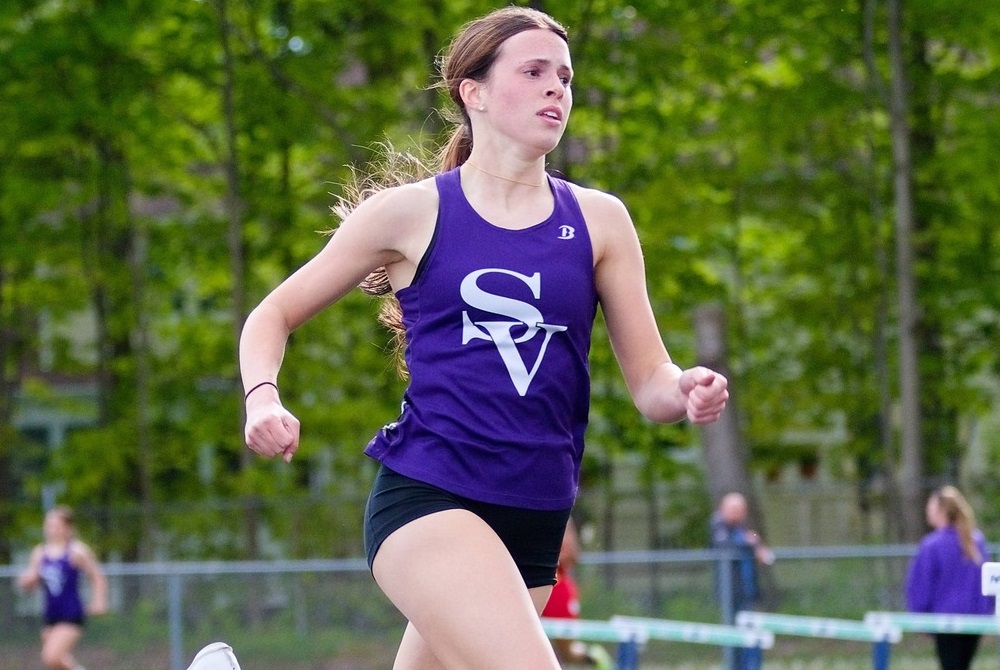
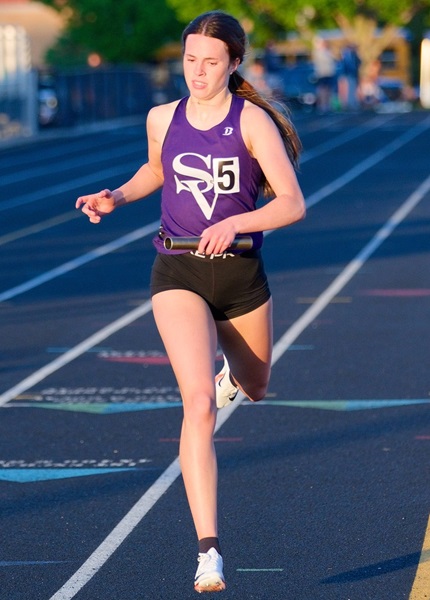
PHOTOS (Top) Saginaw Swan Valley’s Sydney Kuhn runs toward the finish during the Korf/Schultz Saginaw County Invitational on May 10 at Hemlock. (Middle) Kuhn anchors a relay during the Tri-Valley Conference Red meet May 8 at Frankenmuth. (Photos by Eagle Eye Photography.)