

Perfection: Negaunee Girls Finish Undefeated Record-Setting Season as Repeat Champs
By
John Vrancic
Special for MHSAA.com
June 17, 2026
NEGAUNEE — This was a highly-successful track & field season for the Negaunee girls, to say the least.
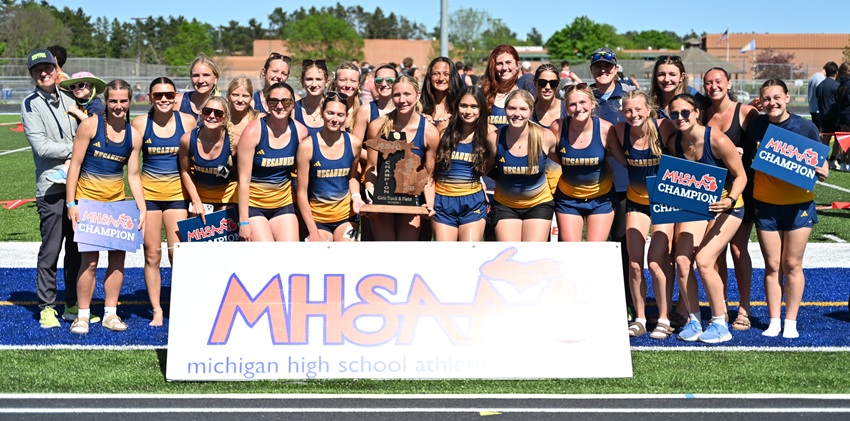
 The Miners finished first in every meet they ran, completing a perfect spring by retaining their Upper Peninsula Division 1 Finals title May 30 at Kingsford.
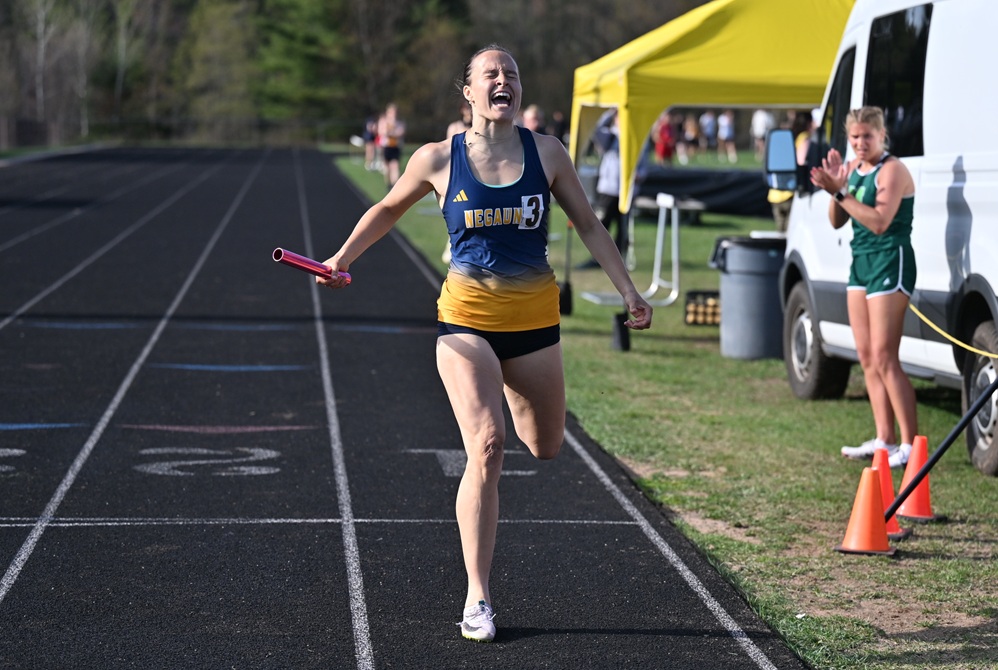
The team set eight school records during the season, including a pair by junior Keira Waterman. Her record in the 800 (2:19.78) took place at the U.P. Finals, and she broke the 400 with the top performance (58.5) at the Negaunee Lions Invitational on May 8.
“We had lots of fun,” she said. “I think the season just went by so fast. I was pretty confident we would do well. It feels great to get the school records, which is sometimes unexpected. We were so supportive of each other. This was a fun group to be with.”
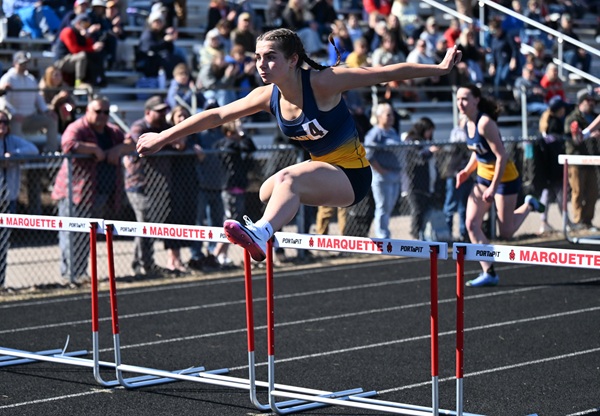
Junior Sadie Rogers set a U.P. Finals and school record in the 300-meter hurdles in 45.04 seconds and established an additional school record in the 200 (26.21). Rogers also holds the school record in the 100 hurdles (15.75), which she set a year ago.
She is now a three-time U.P. champion in the 100 hurdles and a repeat winner in the 300.
“You just think about the next hurdle and go on,” she said. “I try not to stutter-step, and get into a rhythm. The 100 is such a fast race. There’s no margin for error. I had a good finish in the Finals, which I think set the tone.”
In the 200, Rogers was runner-up to Marquette freshman Jordyn Anthony who was clocked in a personal-best 26.11 seconds.
The Miners set a school and league scoring record in the Mid-Peninsula Conference meet at Gwinn with a whopping 317 points. Manistique was runner-up at 85.
“We scratched three of our top runners because we were going after the (school) 400 record,” junior Izzy Francisco said. “We got that by six seconds and were surprised by that, but I’d say our biggest highlight was the Lions meet because we didn’t know if we were ready to go. Winning that meet made us realize we were right where we wanted to be.”
Rogers, Waterman, Riley Conklin and Brynn Wieciech combined to set the school record in the 1,600 relay (4:02.64) while putting the finishing touches on their 16th consecutive M-PC title.
 “One of our goals is to get under four minutes next year,” Rogers said. “I think it’s cool that our team is so deep.”
Beside winning the M-PC, the Miners were crowned Western Peninsula Athletic Conference champions for the fifth-straight time.
“These girls are very competitive,” coach Vickie Paupore said. “I never saw so much depth among the hurdlers. We were down by 10 points early in the U.P. Finals. We really got pushed by Marquette. Kiera ran the perfect race in the 800. I never had a girl go under 2:20 (through 30 years of coaching).”
Francisco joined Rogers, Waterman and sophomore Elvira Coyne in the 400 relay which set the school record at 50.47 in the Marquette County Meet on May 26.
“It felt good to do that,” Coyne said. “We weren’t really going for the record. It just happened to work out. We always supported and pushed each other and went into the U.P. Finals with a positive mindset. Marquette was our biggest challenge, especially in the distances. Our hard work paid off. It was a lot of fun receiving the (championship) trophy.”
Coyne also set a school record while placing second in the 100 (12.61) at the Finals, topping last year’s record run by Macyn DellAngelo by one tenth of a second.
Junior Priya Morey earned her first U.P. title with a throw of 110 feet, 5 inches in discus.
“I think last year’s experience helped me a lot,” she said. “I had a lot better idea of what to expect. Having my teammates there also helped a lot. Last year I was there to have fun. This time there was a little more pressure.”
Morey says winning the Ram Scram at Harbor Springs on April 24 was a major motivator for the team.
“That was a confidence builder,” she added. “Our coaches just put in so much work to make a happy environment. When we went downstate, our coach came over and watched us because the timing of everything allowed her to do that. She’s such a motivator and great leader. We had such a great time this season. I’m so grateful for the opportunity to throw.”
Rogers was the team’s leading scorer this season with 229¼ points. Waterman collected 213¼, followed by Coyne 195¼, senior Nori Korsman 177¼ and senior Josie Mechling 132. Korsman also is the owner of the school’s pole vault record at 10 feet and finished her career with more than 500 points.
Waterman recently competed at the Michigan Interscholastic Track Coaches Association Champions of Champions meet at Davison, where she placed fourth in her 800 race.
“That was quite a learning experience,” she said.
 John Vrancic has covered high school sports in the Upper Peninsula since joining the Escanaba Daily Press staff in 1985. He is known most prominently across the peninsula for his extensive coverage of cross country and track & field that frequently appears in newspapers from the Wisconsin border to Lake Huron. He received the James Trethewey Award for Distinguished Service in 2015 from the Upper Peninsula Sportswriters and Sportscasters Association.
PHOTOS (Top) Negaunee's Keira Waterman reacts to breaking the school record in the 1,600 relay (with Sadie Rogers, Riley Conklin, and Brynn Wieciech) as she crosses the finish line during the Mid-Peninsula Conference finals May 18 at Gwinn. (Middle) Negaunee's Sadie Rogers leads and eventually wins the 100 hurdles April 21 at Marquette. (Below) The Miners pose for a team photo after winning the UP Division 1 Finals championship May 30 at Kingsford. (Photos by Cara Kamps.)
Red Devils Impress as Ironwood Honors Record-Setter with Jim LaBlonde Invitational
By
John Vrancic
Special for MHSAA.com
May 20, 2024
IRONWOOD — The Ironwood track & field teams provided themselves with an opportunity to do a victory lap on a very special Saturday earlier this month.
Both teams were crowned champions at the first Jim LaBlonde Invitational on May 11 on their 350-meter track during a sunny and mild afternoon.
The Ironwood girls scored 126 points, followed by Hurley, Wis., with 43, Ontonagon 37 and Watersmeet with 13. Ironwood’s boys collected 100 points, followed by Hurley at 84, Ontonagon 32 and Watersmeet with seven in a meet held in honor of the former Luther L. Wright High School star athlete who passed away due to an aneurysm on March 31, 2019.
LaBlonde, who was recently inducted into the school’s Hall of Fame, was an all-Upper Peninsula football player and still holds school records in the 100 and 200-meter dashes from his senior year in 1997.
“This is very special to me personally,” Ironwood coach Cecilia Aho said. “Jim was a great person and athlete. I came to Ironwood from Argentina in December 2003 and know the family very well. I had some good conversations with Jim before he passed. This is a great tribute to him. It turned out to be a beautiful day. We had perfect weather and the kids from all four schools were smiling and having fun.
“Jim was well known in the community, not only as a coach, but as a parent. He was a phenomenal runner and football player.”
LaBlonde played football for three years at Wisconsin-LaCrosse and was on the school’s track team for a year while earning his bachelor’s degree in physical education in 2003.
He was a middle school teacher and coach in the Howard-Suamico District near Green Bay, Wis., at the time of his passing.
“He always asked about what was going on in Ironwood and was a good leader,” Aho said. “He would never turn his back on you when you asked him a question. The kids loved him. I wish I would have had a chance to work with him.”
 Senior Aubrey Smith topped a field of four Ironwood runners in the 1600-meter run in 5 minutes, 55.69 seconds, followed by freshman Iyla Lagalo (6:54.08) and sophomore Aubrey Balduc (7:21.16).
Smith also won the 300 hurdles at 52.43, more than six seconds ahead of the rest of the field.
“It was nice to have everyone here,” Smith said. “It’s nice to have a home meet, especially on a Saturday. I think it’s a fun meet. It’s nice to know everyone here. I think this gives me a little momentum going into our remaining meets.”
Sophomore Emma Wardon was also a double winner for the Red Devils, taking shot put (32-11) and discus (87-0).
Ironwood sophomore Logan Holm took the 110 hurdles (20.17) and 300s (48.05), and Hurley had a triple-winner in junior Jeremiah Wallis, who captured the 100 (12.0), 200 (24.52) and long jump (17-3).
Watersmeet junior Thomas Carson won the 400 (54.06), five days after setting the school record (52.31) while placing second in the Welker Invitational at Ashland, Wis. (52.31).
“I strained my hamstring in Ashland,” he said. “It was a little windy up by the big lake (Superior) and there were a lot of good runners up there. I’m probably about 80-90 (percent), but everything went okay. I just wanted to make sure I didn’t overdo it. This is a nice little meet, especially for a Saturday.”
Ontonagon sophomore Violet Amos took the 200 (28.26) and 400 (1:02.03) and was runner-up to Hurley senior Jaana Aukee on a lean (13.65) in the 100.
“I’ve been in the 27s in the 200, but I’m very happy with my time in the 400” Amos said. “This being a little smaller track was probably a factor because the curves are a little tighter. I prefer to run a 400-meter track, although I like the running surface and competition.
“It’s always fun to come here. Our track is getting resurfaced. I’m looking forward to running on it the next couple years.”
Ontonagon coach Brian Amos said he also enjoys going to Ironwood.
“Ironwood runs a nice meet, and we get a chance to see Hurley,” he added. “It’s always nice to run against somebody different.”
John Vrancic has covered high school sports in the Upper Peninsula since joining the Escanaba Daily Press staff in 1985. He is known most prominently across the peninsula for his extensive coverage of cross country and track & field that frequently appears in newspapers from the Wisconsin border to Lake Huron. He received the James Trethewey Award for Distinguished Service in 2015 from the Upper Peninsula Sportswriters and Sportscasters Association.
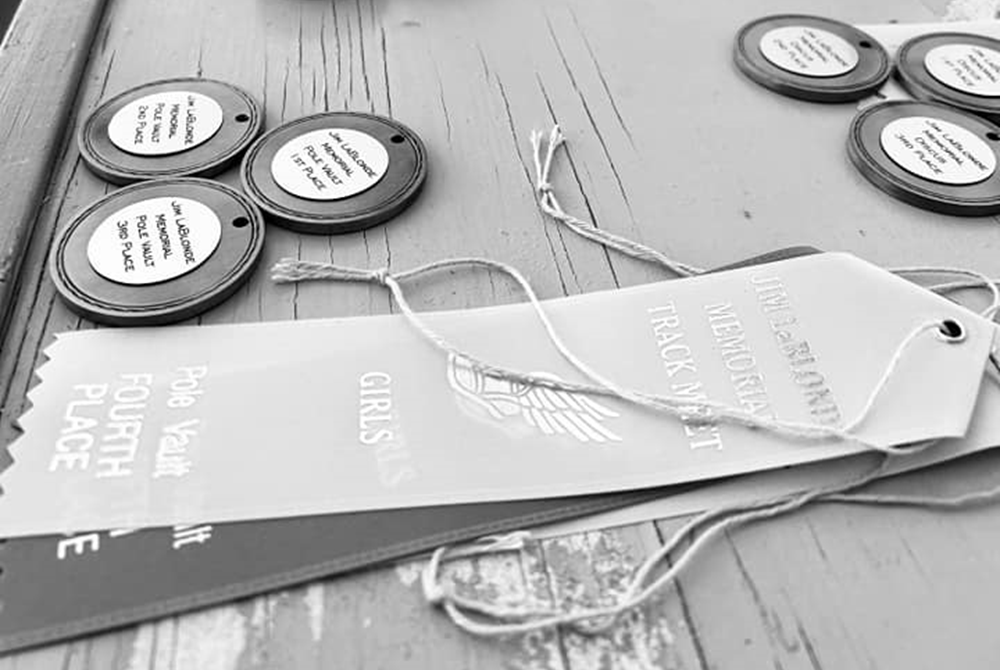
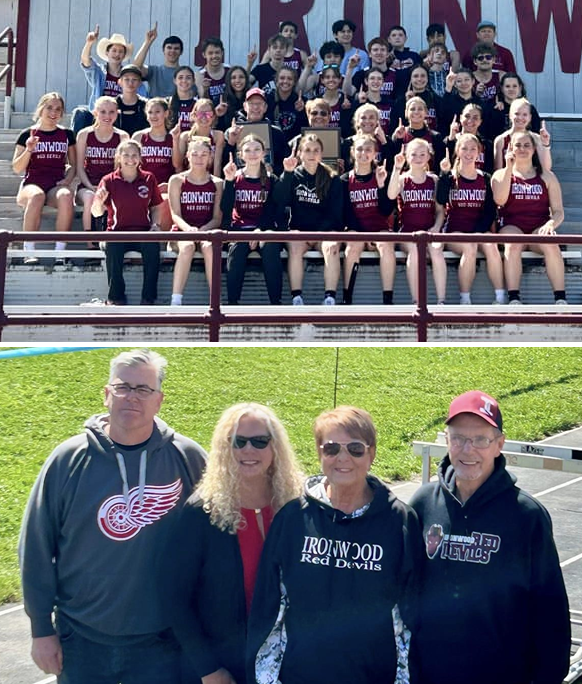
PHOTOS (Top) Ribbons and medals are set out to be awarded during the first Jim LaBlonde Invitational at Ironwood. (Middle) The Ironwood teams take a photo together, at top, after sweeping the meets. Below, from left, LaBlonde’s brother-in-law Dave Lundin, sister Dena Lundin and parents Marlene and Jim LaBlonde attend the meet. (Photos provided by the Ironwood Red Devil Booster Club.)