

Perfection: Negaunee Girls Finish Undefeated Record-Setting Season as Repeat Champs
By
John Vrancic
Special for MHSAA.com
June 17, 2026
NEGAUNEE — This was a highly-successful track & field season for the Negaunee girls, to say the least.
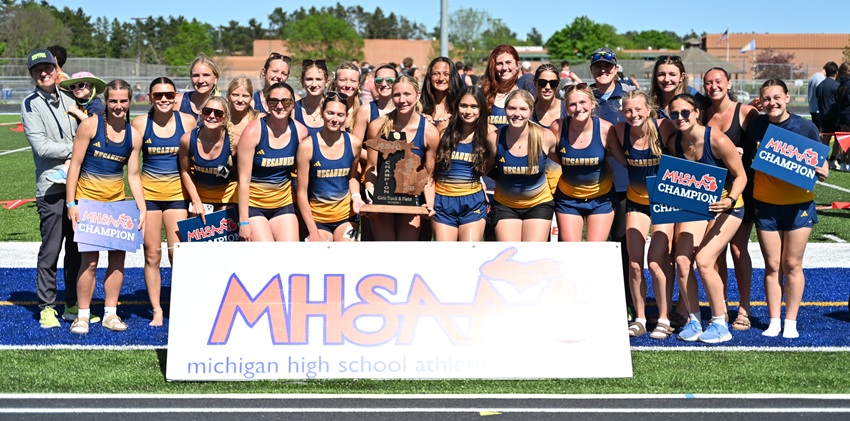
 The Miners finished first in every meet they ran, completing a perfect spring by retaining their Upper Peninsula Division 1 Finals title May 30 at Kingsford.
The team set eight school records during the season, including a pair by junior Keira Waterman. Her record in the 800 (2:19.78) took place at the U.P. Finals, and she broke the 400 with the top performance (58.5) at the Negaunee Lions Invitational on May 8.
“We had lots of fun,” she said. “I think the season just went by so fast. I was pretty confident we would do well. It feels great to get the school records, which is sometimes unexpected. We were so supportive of each other. This was a fun group to be with.”
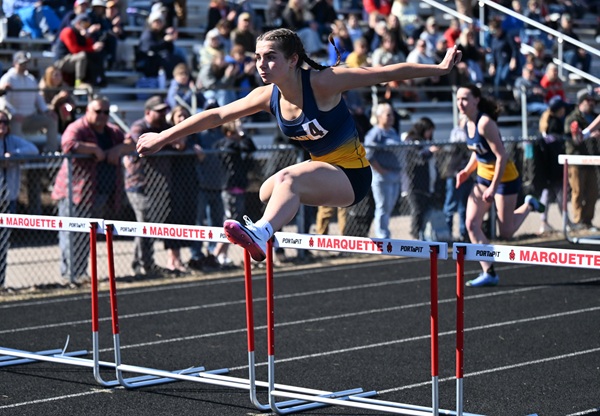
Junior Sadie Rogers set a U.P. Finals and school record in the 300-meter hurdles in 45.04 seconds and established an additional school record in the 200 (26.21). Rogers also holds the school record in the 100 hurdles (15.75), which she set a year ago.
She is now a three-time U.P. champion in the 100 hurdles and a repeat winner in the 300.
“You just think about the next hurdle and go on,” she said. “I try not to stutter-step, and get into a rhythm. The 100 is such a fast race. There’s no margin for error. I had a good finish in the Finals, which I think set the tone.”
In the 200, Rogers was runner-up to Marquette freshman Jordyn Anthony who was clocked in a personal-best 26.11 seconds.
The Miners set a school and league scoring record in the Mid-Peninsula Conference meet at Gwinn with a whopping 317 points. Manistique was runner-up at 85.
“We scratched three of our top runners because we were going after the (school) 400 record,” junior Izzy Francisco said. “We got that by six seconds and were surprised by that, but I’d say our biggest highlight was the Lions meet because we didn’t know if we were ready to go. Winning that meet made us realize we were right where we wanted to be.”
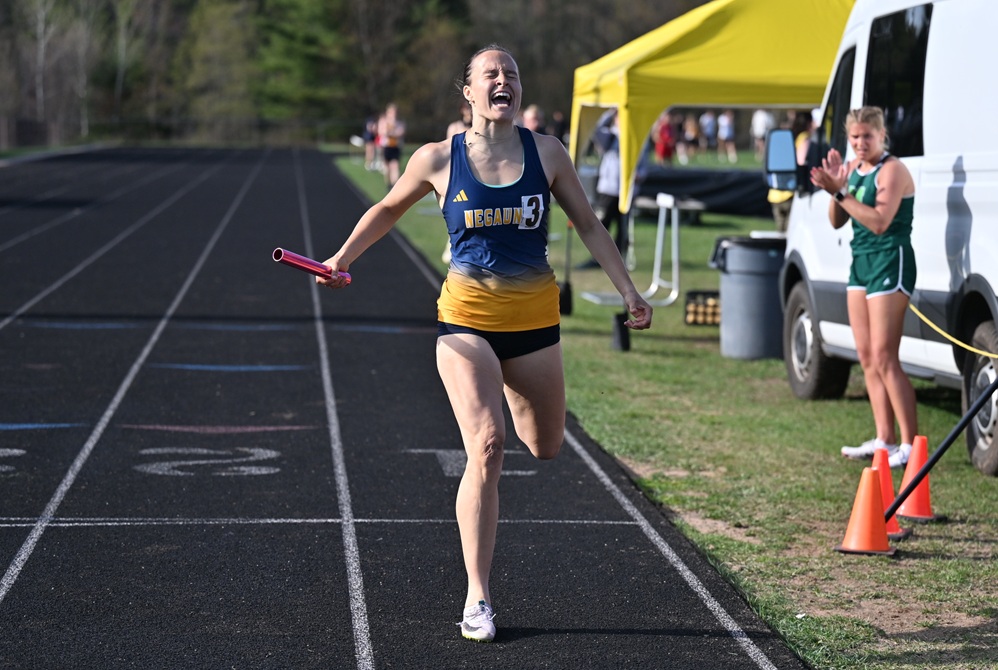
Rogers, Waterman, Riley Conklin and Brynn Wieciech combined to set the school record in the 1,600 relay (4:02.64) while putting the finishing touches on their 16th consecutive M-PC title.
 “One of our goals is to get under four minutes next year,” Rogers said. “I think it’s cool that our team is so deep.”
Beside winning the M-PC, the Miners were crowned Western Peninsula Athletic Conference champions for the fifth-straight time.
“These girls are very competitive,” coach Vickie Paupore said. “I never saw so much depth among the hurdlers. We were down by 10 points early in the U.P. Finals. We really got pushed by Marquette. Kiera ran the perfect race in the 800. I never had a girl go under 2:20 (through 30 years of coaching).”
Francisco joined Rogers, Waterman and sophomore Elvira Coyne in the 400 relay which set the school record at 50.47 in the Marquette County Meet on May 26.
“It felt good to do that,” Coyne said. “We weren’t really going for the record. It just happened to work out. We always supported and pushed each other and went into the U.P. Finals with a positive mindset. Marquette was our biggest challenge, especially in the distances. Our hard work paid off. It was a lot of fun receiving the (championship) trophy.”
Coyne also set a school record while placing second in the 100 (12.61) at the Finals, topping last year’s record run by Macyn DellAngelo by one tenth of a second.
Junior Priya Morey earned her first U.P. title with a throw of 110 feet, 5 inches in discus.
“I think last year’s experience helped me a lot,” she said. “I had a lot better idea of what to expect. Having my teammates there also helped a lot. Last year I was there to have fun. This time there was a little more pressure.”
Morey says winning the Ram Scram at Harbor Springs on April 24 was a major motivator for the team.
“That was a confidence builder,” she added. “Our coaches just put in so much work to make a happy environment. When we went downstate, our coach came over and watched us because the timing of everything allowed her to do that. She’s such a motivator and great leader. We had such a great time this season. I’m so grateful for the opportunity to throw.”
Rogers was the team’s leading scorer this season with 229¼ points. Waterman collected 213¼, followed by Coyne 195¼, senior Nori Korsman 177¼ and senior Josie Mechling 132. Korsman also is the owner of the school’s pole vault record at 10 feet and finished her career with more than 500 points.
Waterman recently competed at the Michigan Interscholastic Track Coaches Association Champions of Champions meet at Davison, where she placed fourth in her 800 race.
“That was quite a learning experience,” she said.
 John Vrancic has covered high school sports in the Upper Peninsula since joining the Escanaba Daily Press staff in 1985. He is known most prominently across the peninsula for his extensive coverage of cross country and track & field that frequently appears in newspapers from the Wisconsin border to Lake Huron. He received the James Trethewey Award for Distinguished Service in 2015 from the Upper Peninsula Sportswriters and Sportscasters Association.
PHOTOS (Top) Negaunee's Keira Waterman reacts to breaking the school record in the 1,600 relay (with Sadie Rogers, Riley Conklin, and Brynn Wieciech) as she crosses the finish line during the Mid-Peninsula Conference finals May 18 at Gwinn. (Middle) Negaunee's Sadie Rogers leads and eventually wins the 100 hurdles April 21 at Marquette. (Below) The Miners pose for a team photo after winning the UP Division 1 Finals championship May 30 at Kingsford. (Photos by Cara Kamps.)
Preview: LP Girls Finals Welcome Back Stars, Hopefuls Ready to Join Them
By
Geoff Kimmerly
MHSAA.com senior editor
June 1, 2023
The MHSAA Lower Peninsula Girls Track & Field Finals have showcased plenty of stars over the years, and Saturday’s meets will celebrate more with returning competitors owning a combined 22 individual championships won over the last three seasons.
But this season’s field also sticks out because of several hopefuls who appear on the verge of greatness as well, many of whom we highlight below.
All four LP Finals will again be contested at Grand Rapids-area schools, with pole vault and long jump beginning at 9 a.m., race semifinals and the 3,200 relay at 10 a.m. and the rest of the running finals starting at noon. Tickets cost $11 and are available digitally only via GoFan.
MHSAA.tv will live-stream all four meets beginning at 10 a.m., viewable with subscription.
Following is a glance at team contenders and individuals to watch in all four divisions:
LP Division 1 at Rockford
Team forecast: After winning three straight LPD1 team titles, Oak Park finished second last season to Detroit Renaissance – which had finished second twice in a row before claiming its first title since 2007. Those two are the likely favorites again, and Renaissance won their Regional matchup two weeks ago 135½-108 as they combined to post the top two times in three relays from all LPD1 Regionals. Oak Park continues to surge with one of the top hurdler groups in recent memory, while Renaissance’s depth in elite sprinters has been unmatched despite graduating one of the all-time greats last spring. All of that said, keep an eye on Ann Arbor Huron too. The River Rats finished third last season, are paced by an elite sprinter and have the potential to pick up points in a variety of events.
Jayla Dace, Detroit Renaissance sophomore: After qualifying in the 200 and running on the winning 800 relay last season, Dace enters this weekend after running the fastest 100 (11.91) and fourth-fastest 200 (24.95) at LPD1 Regionals while also slated to run on two contending relays.
Arianne Olson, Holland West Ottawa senior: Last season’s 3,200 champion and 1,600 runner-up enters with the third-fastest 3,200 (10:48.40) from LPD1 Regionals and also again will run the 1,600 and on a contending relay.
Mackenzie Robinson, Ann Arbor Huron senior: She finished second in the 100 and 200 last season and ran on champion and runner-up relays, and she could be in for an even bigger finish after posting the second-fastest LPD1 Regional 100 (12.11) and 200 (24.74) and running on the third-fastest 400 relay two weeks ago.
Morgan Roundtree, Oak Park junior: Her sophomore-year Finals included a 300 hurdles title and runner-up finishes in the 100 hurdles and 800 relay. She enters this weekend with the fastest LPD1 Regional time in the 300 (41.86), third-fastest in the 100 hurdles (14.14) and running on two contending relays again.
Abigail Russell, Allen Park junior: She swept the throws as a sophomore and could be in line to do the same this weekend with the top LPD1 Regional throw in discus (148-3) by more than 12 feet and the second-farthest shot put (42-5) behind only Howell senior standout Sophie Daugard.
Kamryn Tatum, West Bloomfield freshman: She enters her first Finals having run the fastest 200 (24.70) and 400 (56.08) times in any LPD1 Regional, with those times fast enough to have finished third in those races at last year’s Finals.
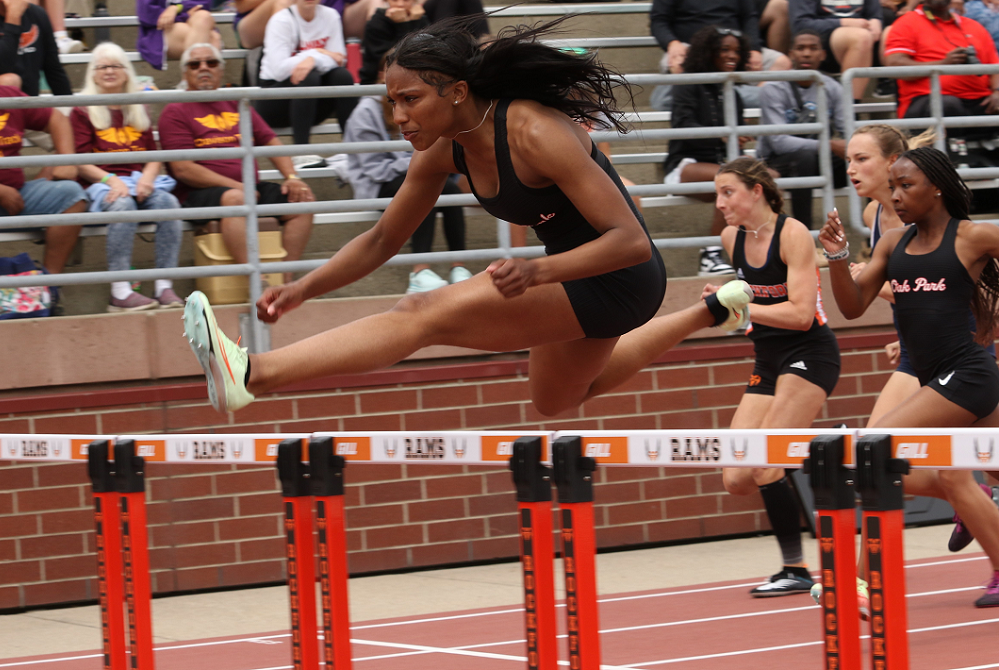
Nonah Waldron, Oak Park senior: She’s finishing a career that’s included the last two 100 hurdles championships and a 300 hurdles title as a sophomore. She enters this weekend with the fastest LPD1 Regional time in the 100 hurdles (13.61), second-fastest to Roundtree in the 300 (42.70) and likely to run on the same two contending relays as that teammate.
LP Division 2 at Ada Forest Hills Eastern
Team forecast: The last five Finals have seen five schools win Division 2 once and three more schools finish second at least once. East Grand Rapids nearly doubled up the field last year, however, and power in distance races and relays could have the Pioneers on track again. New Boston Huron was fourth last season behind the scoring of Elizabeth Anderson and could follow her into contention, and Dearborn Divine Child has qualifiers in all but pole vault and a pair of relays expected to do exceptionally well.
Elizabeth Anderson, New Boston Huron senior: She won the 200 and 400 and was runner-up in the 100 last season to score 28 of her team’s 29 points, and she could take that over 30 this weekend entering with the fastest LPD2 Regional times in the 200 (24.93) and 400 (56.62), the second-fastest in the 100 (12.34) and as part of one of the fasted 1,600 relays.
Camryn Bodine, East Grand Rapids senior: Last season’s 800 champion ran the fastest LPD2 Regional time in that race (2:13.14) two weeks ago by nearly four seconds and will also run on two contending relays after helping hers to first, second and seventh places in 2022.
Janae Hudson, Marysville junior: She could move up substantially after placing third in discus and 10th in shot put last season, coming off the top LPD2 Regional shot put (41-4½) and second-longest discus toss (125-5).
Ella Jenkins, Warren Regina senior: The reigning champion in the 300 hurdles and runner-up in the 100 hurdles ran the fastest LPD2 Regional time in the 100 hurdles (15.14) and second-fastest in the 300 (47.55).
Drew Muller, East Grand Rapids junior: The reigning 1,600 champ and 800 fifth-place finisher – and LPD2 cross country champion in the fall – ran the fastest 1,600 LPD2 Regional time (5:03.32) and fourth-fastest 800 (2:17.88) and will also run on two contending relays after hers finished first and second last year.
Keyanna O’Tey, Sturgis sophomore: She qualified for the 100 in LPD1 as a freshman and could play a starring role Saturday entering with the fastest LPD2 Regional time in the 100 (12.10), second-fastest in the 200 (25.49) and as part of two contending sprint relays.
Natalie VanOtteren, Grand Rapids Christian junior: She finished seventh in the 3,200 and ran on a runner-up relay a year ago and enters this weekend with the fastest LPD2 Regional time in the 3,200 (11:09.76) and second-fastest in the 1,600 (5:07.06).
Jordyn Wright, Tecumseh senior: The reigning pole vault champion by a foot posted the top LPD2 Regional height (11-9) two weeks ago and is expected to run two relays as well.
LP Division 3 at Kent City
Team forecast: Hart and Pewamo-Westphalia both have won two championships over the last five seasons, and Hart was first and P-W second a year ago. Hart again has the mix of sprint, distance, field event and relay standouts to finish first, and P-W has nearly the same amount and variety. But they’ll have company. Lansing Catholic has strong contenders in five races and two relays, Olivet could score big in relays, field events and hurdles; and Onsted could jump up with a handful of potential winners as well.
Ryan Finstrom, Grayling junior: Last season’s discus champion and fourth-place shot put finisher returns this weekend looking for a discus repeat after throwing the fourth-farthest LPD3 Regional toss (119-1).
Addison Hovey, Hart sophomore: She played a big role in last year’s title run with runner-up finishes in high jump and as part of the 400 relay, and she’ll return this weekend with the top LPD3 Regional time in the 100 (12.38) and top high jump (5-3) plus as part of two relays.
Heidi Newhouse, Lawton junior: The reigning high jump champion also finished just outside scoring range in the 400 last season, and she’ll enter this weekend tied for the second-best LPD3 Regional high jump (5-1) and third-fastest 400 (59.76).
Ally Olszewski, Grand Rapids West Catholic senior: She won the pole vault last season by half a foot and her 10-3 LPD3 Regional vault two weeks ago was half a foot better than the field. She also posted the fourth-best LPD3 Regional long jump (15-9½) and will run the 200 and again on the 800 relay after helping the latter to fourth place a year ago.
Madison Osterberg, Jackson Lumen Christi junior: After finishing 800 runner-up and seventh in the 1,600 a year ago, plus running on the runner-up 800 relay, Osterberg enters with the fastest LPD3 Regional times in the 1,600 (4:59.62) and 3,200 (11:01.05), the second-fastest in the 800 (2:16.56), and she will also run on a contending 3,200 relay.
Emmry Ross, Onsted sophomore: Her Finals debut included championships in the 400 and as part of the 1,600 relay and a runner-up finish as part of the 800 relay. She returns with the top LPD3 Regional times in the 400 (57.07) and 800 (2:15.03) and as part of contenders in the 800 and 3,200 relays.
Gloria Stepanovich, Benzie Central senior: The reigning long jump champion will return seeking a repeat after placing second at her Regional but only 1¼ inches off the lead.
LP Division 4 at Hudsonville
Team forecast: A close race came down to just a few points last season, with Muskegon Western Michigan Christian edging 2021 champion Mount Pleasant Sacred Heart by four. This could be close again – but with a different collection of contenders. Fowler, fourth last season, may be back in the mix with elite relays leading the way. Frankfort is back after finishing third and bolsters a strong field events group to go with relay strength. Hillsdale Academy could follow a strong distance group into contention, and Buckley should put up some points with a pair of stars. Portland St. Patrick is another interesting possibility with runners all over the meet and three contending relays.
Molly Brown, Addison sophomore: She had an impressive debut last season with two top-five relay finishes, a 10th in the 100 hurdles and fifth in the 300 hurdles. But this could be even better as she brings in the top LPD4 Regional times in the 100 hurdles (16.03) and 300 hurdles (46.82), the second-fastest in the 100 dash (12.98) and the seventh-best long jump.
Olivia Findlay, Marlette junior: Last season’s runner-up in the high jump and fifth-place finisher in the long jump is a favorite in both with the top LPD4 Regional performances in both at 5-5 and 16-11¾, respectively. She also posted the sixth-fastest 100 hurdles time (17.12) to qualify.
Aiden Harrand, Buckley junior: She’s won the 1,600 the last two seasons, the 800 last year and finished fourth in the 3,200 as well, and was the LPD4 cross country champ in the fall. Her LPD4 Regional times in the 800 (2:19.15), 1,600 (5:06.52) and 3,200 (11:26.04) all topped those lists.
Anna Plum, Mount Pleasant Sacred Heart senior: She’s the reigning champion in the 300 hurdles and was part of winning and runner-up relays as well as a qualifier in the 100 hurdles last season. She could put up plenty of points again entering with the fourth-fastest LPD4 Regional times in the 100 (13.06) and 200 (26.75) and the third-fastest in the 300 hurdles (48.46).
Megan Roberts, Hillsdale Academy senior: After missing last season’s Finals with an injury, Roberts will get another chance to build on a sophomore debut that included a relay championship, two relay runner-up finishes and a sixth place in the 800. She will run on two relays that posted the fastest LPD4 Regional times in their respective races and also the 400 after racing to an LPD4 Regional-best 59.85 two weeks ago.
Natalie Wandrie, Indian River Inland Lakes senior: She finished seventh in the shot put and 11th in the discus last season but could be set for a big finish with the top LPD4 Regional discus toss of 124-3½ and the third-longest shot put (37-3). She’ll also run a relay.
PHOTO Oak Park’s Nonah Waldron leaps a hurdle during last season’s LPD1 Finals. (Click for more from RunMichigan.com.)