

Record Books Rewritten as Negaunee Girls Bring Their Best at Power-Packed Final
By
John Vrancic
Special for MHSAA.com
May 31, 2026
KINGSFORD — Doing as expected can sometimes be challenging.
The Negaunee girls did that in convincing fashion here Saturday by retaining their Upper Peninsula Division 1 Track & Field Finals title with 173 points.
Marquette earned the runner-up honor with 123, and third-place Gladstone scored 61.
“We thought we had an outstanding season, although you’re still a little nervous coming in,” Miners coach Vickie Paupore said. “The girls worked hard. They believed in themselves and each other. All of our throwers showed up today and got personal bests. All of the girls performed very well.”
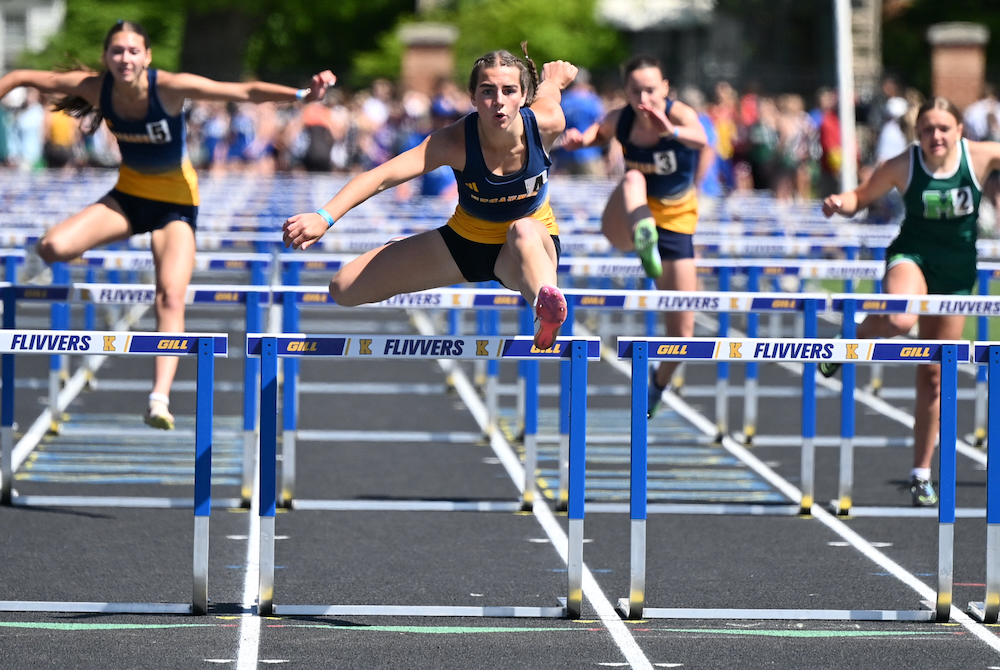
Negaunee junior Sadie Rogers set the U.P. Division 1 Finals record in the 300-meter hurdles in 45.04 seconds, topping the previous record (45.4) run by Sault Ste. Marie’s Selena Moser in 2010.
That also marked a school record for Rogers, who also won the 100-meter dash in a season-best 15.96 and placed second in the 200 in a school-best 26.21 on this sunny and warm afternoon.
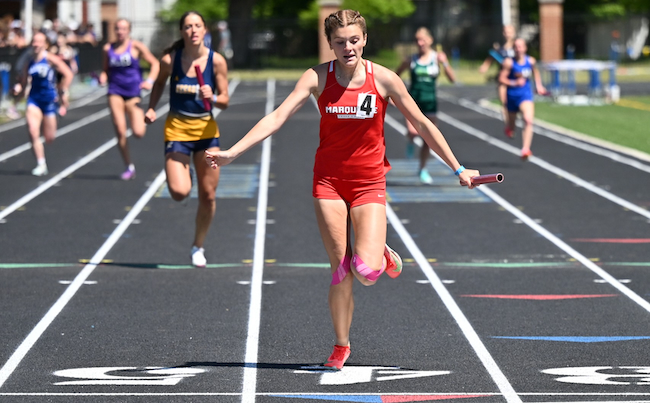
Marquette freshman Jordyn Anthony tied the UPD1 Finals record in the 100 at 12.55, which she shares with Calumet’s Chelsea Jacques from 2012.
Anthony also won the 200 in a personal-best 26.11 and helped the Sentinels sweep the sprint relays.
“She’s a very talented runner,” Rogers said.
“It’s so relieving to set the school record in the 300 hurdles. It was just so hard to get here, and it feels so good to get the school record in the 200. This is a confidence builder for sure. Having good weather also helped. These were perfect conditions.”
 Classmate Keira Waterman added a Negaunee school record while winning the 800 (2:19.78), followed by Marquette senior Ella Fure in a personal-best 2:21.14 and freshman Emma Ziegler (2:33.82).
Waterman also won the 400 in a personal-best 58.5 and placed third in long jump (15-3¼).
Sophomore Elvera Coyne provided the Miners with yet another school record while placing second in the 100 (12.61), followed by junior teammate Izzy Francisco (12.9).
Coyne’s season-ending effort in the 100 topped the previous record (12.62) by Macyn DellAngelo set a year ago.
“It felt amazing,” Coyne said. “It’s an awesome feeling to do it as a sophomore. Macyn was a good friend of mine.”
Negaunee junior Priya Morey added a first in discus at 110-5.
Fure, who anchored the winning 3,200 relay, later set a meet record in the open 3,200 (11:21.58), which surpassed the previous best from seven years ago (11:25.52) by Emily Paupore of Negaunee.
“The 3,200 is my race,” Fure said a week after running a 10:49.17 at Grand Rapids. “I was real confident because all three of us PR’d downstate. I knew I could run a sub-11. Emma Ziegler had a good, strong finish and Ava Cantway ran real well.”
Junior Taylen Todd, also part of Marquette’s sprint relays, added a first in long jump (16-8½). Kingsford junior Mylee Kreider was runner-up (16-6¾).
Manistique set a school record while placing third in the 800 relay (1:50.42), and senior Gwen Brewster took first in shot put (33-1½).
“I just kept pushing myself,” freshman Harper Andersen said after anchoring Manistique’s record-setting relay. “Our handoffs went well. This makes me feel I can accomplish a lot because I’m a part of this.”
Also winning championships were Escanaba’s Rayne Martin in the high jump and Gladstone’s Maggie Karl in the pole vault. Houghton’s Amy Sziber finished first in the 100, 200 and shot put adaptive events.
PHOTOS (Top) Negaunee's Sadie Rogers, center, leads and eventually wins the 100 hurdles Saturday. (Middle) Marquette's Jordyn Anthony, center, gets ready to lean for the finish line during a Sentinels relay victory. (Click for more from Cara Kamps/RunMichigan.com.)
Elk Rapids' Schulte Sisters Splitting Finals Weekend Between Tennis, Track
By
Tom Spencer
Special for MHSAA.com
June 2, 2023
Today began with a bye for Elk Rapids’ Jaida and Brynne Schulte as the Elks returned to the Lower Peninsula Division 4 Girls Tennis Finals in Kalamazoo.
 They’re planning to say bye to their tennis teammates, though, when the first day of competition is over. The Elks will have to advance to Saturday without them.
That goodbye is just fine with tennis coach Keith Schulte. And, it will be more than fine with the Elk Rapids track & field team – which will be happy to say hello to the sister pair as they head to their LPD3 Finals in Kent City.
Regardless of how they fare today, the Schulte sisters will run Saturday.
Coach Schulte, who teaches strength and conditioning at Elk Rapids, is also the father of Jaida and Brynne. Today’s he’s beaming with pride, and not just for his tennis team’s success. He’s proud of all the student-athletes and their successes this spring, including the girls soccer team moving on to Regionals with a 2-0 win Thursday over Boyne City.
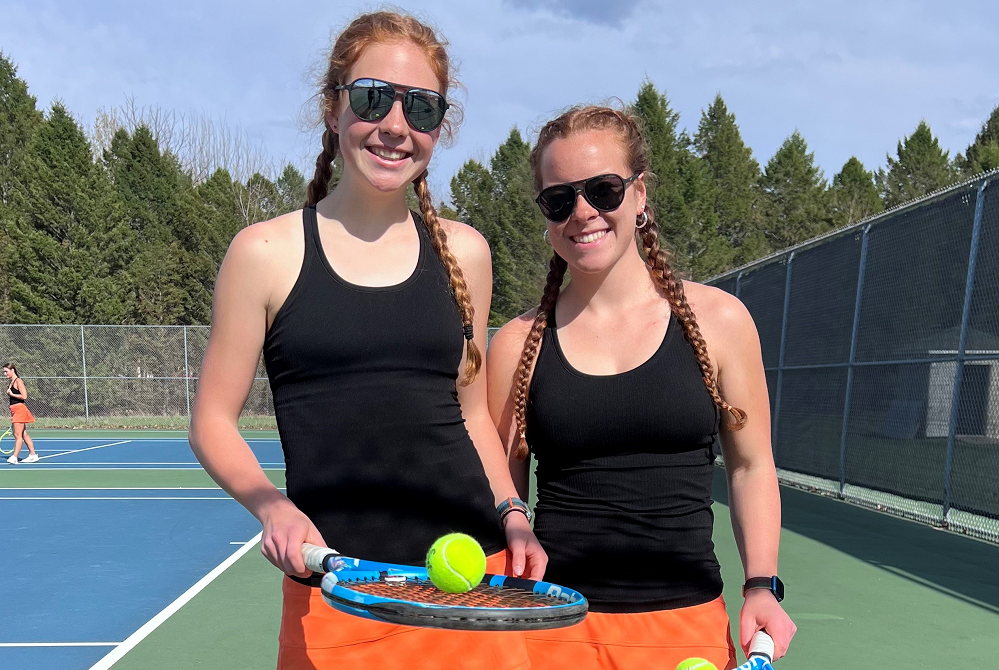
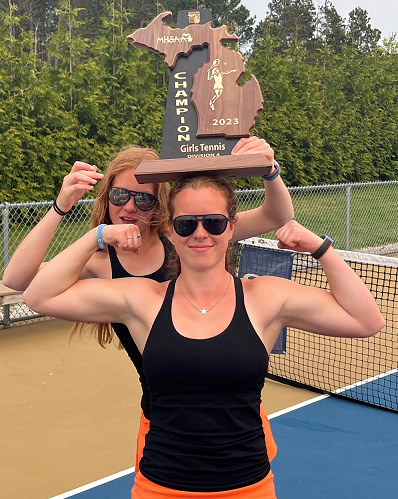
And while all this is going on, he should have a moment or two to just be Dad. Jaida and Brynne teamed up to win the No. 2 doubles title at their Regional as the Elks tied for first place with Traverse City St. Francis two weeks ago. Then the Schulte girls captured first place in the Regional track meet to qualify for Saturday’s Finals. Brynne won the 1,600 and 3,200, and Jaida’s 3,200 relay team took first to move on.
 Coach Schulte hasn’t had much time to pause and soak in the moment of his daughters’ qualifying for two Finals competitions during the same season.
“I didn’t think much of it until now,” the fourth-year coach said. “I’ve always just challenged my kids to do something difficult and not be scared to fail.
“They’ve just kind of found the balance on making this stuff happen,” he continued. “It is a pretty cool opportunity if you can go to two state championships.”
Getting to today’s Tennis Finals is a story full of success. The Elks’ first year under Schulte was halted after a week of practice due to the pandemic. The second year saw the team looking at a season with just nine potential players, but recruitment efforts resulted in the 2021 Elks managing to qualify for the Finals for the first time in their history.
Elk Rapids went on to win the Regional championship in 2022. And then, after graduating six athletes, the Elks were able to repeat this spring with a valiant effort resulting in the co-championship with their conference rival St. Francis.
Dual-sport standouts, while rare, aren’t entirely unheard of – especially at the state’s smaller schools where athletes frequently are needed to fill rosters in multiple sports during the same season. In fact, the Schultes aren’t even alone on their tennis team – sisters Ryleigh and Haleigh Yocum also are playing doubles today but softball on Saturday.
The Yocums won the Regional title at No. 2 doubles and also are slated to be the Elks’ first two batters as they take on Mancelona as one of the favorites to win a Division 3 District title on the softball diamond.
“I do feel bad for them – it’s states,” said 14-year veteran softball coach Erin Merchant. “I do want them to have that opportunity.
“I hope they go far,” she continued. “But then deep down, I’m like, ‘We need them Saturday.’”
Tim Nance and Jesse Way are in their first year co-coaching the boys and girls track teams at ER. They’re pleased the Schultes are prioritizing track while enjoying tennis.
 “I think it is remarkable how resilient, laid back and casual the girls are about their success,” Nance said. “I would say it hasn’t compromised their talent, hard work and success.
“I think it has worked out great,” he continued. “I am selfish and I want them to myself only, but I am happy they can have two successes.”
The Elks will have Ayva Johnstone at No. 1 singles, Kelly Minidis and No. 2, Morgan Bergquist at No. 3 and Jasmine King at No. 4 this weekend. They also will have No. 1 doubles Chloe Taylor and Caroline Best and No. 4 doubles Tessa Nico and Portia Beebe, in addition to the Yokums and Schultes.
Jaida Schulte is a junior. She’s one of the recruits who joined to help the Elks get to their first Tennis Finals in 2021. Bergquist and Beebe were recruits in 2022.
Tennis is the favorite sport today for those three, but track and cross country are right up there for Jaida thanks to the opportunity to run with her freshman sister Brynne.
Jaida is hoping to at least match her personal-record split of 2:36 in the 3,200 relay Saturday. But her goal was first to win all of her doubles matches Friday and see the tennis team finish top-five in its division.
“Brynne loves track, and I love the challenge of running,” Jaida said. “I don’t think I would have the experience of running track or cross country without Brynne.”
Coaches saw very little disruption, if any, with their track, softball and tennis teams this spring with the Yocums and Schultes dual-sporting. The Schultes were able to get track and tennis practice or competition most every day.
“I prioritized track,” Brynne said. “I also got a lot of hitting time in for tennis.
“I would go to track practice first, and as soon as I would be done I would run over to the tennis courts and hit with my sister for a half an hour before going home,” she continued. “It has been worth it.”
 Tom Spencer is a longtime MHSAA-registered basketball and soccer official, and former softball and baseball official, and he also has coached in the northern Lower Peninsula area. He previously has written for the Saginaw News, Bay County Sports Page and Midland Daily News. He can be reached at [email protected] with story ideas for Manistee, Wexford, Missaukee, Roscommon, Ogemaw, Iosco, Alcona, Oscoda, Crawford, Kalkaska, Grand Traverse, Benzie, Leelanau, Antrim, Otsego, Montmorency, Alpena, Presque Isle, Cheboygan, Charlevoix and Emmet counties.
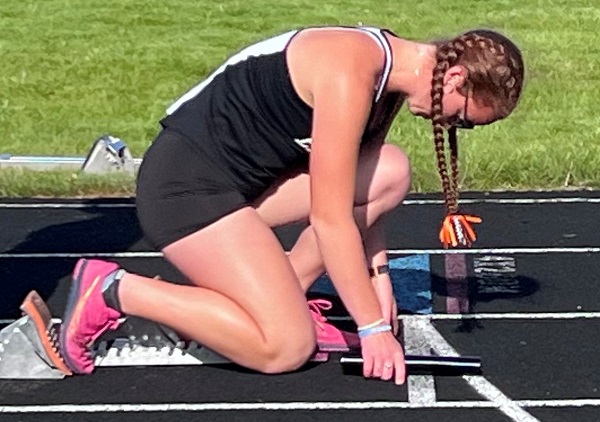
PHOTOS (Top) Elk Rapids sisters Brynne (left) and Jaida Schulte have teamed up at No. 3 doubles for the tennis team this season. (Middle) Brynne Schulte sets to start a track relay. (Below) The Schultes helped the Elks to their first two Regional titles in tennis, including their second straight this spring. (Photos courtesy of Jaclyn Schulte.)