

Slattery's High-Scoring Day Helps Hackett Catholic Prep Prevail by Slimmest of Margins
By
Brian Freiberger
Special for MHSAA.com
May 30, 2026
HUDSONVILLE – Kalamazoo Hackett Catholic Prep junior Clara Slattery made sure her name will remain known after Saturday.
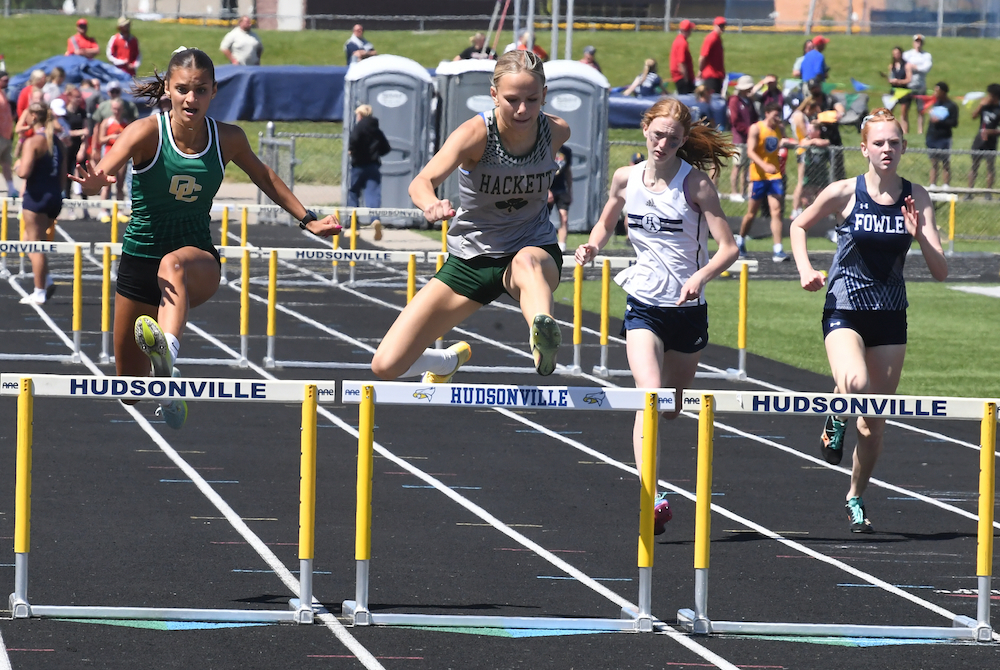
The junior took home Lower Peninsula Division 4 Finals championships in the 100 hurdles and 300 hurdles, along with a blazing fast 200-meter time of 25.26 to win her third event of the day.
All of those helped the Fighting Irish claim the team championship with 44 points – just one more than Hudson. The title was the program's first in this sport.
“It means a lot since last year I struggled in the 200 and 300, and it was good for me to get back. It helps show me that my training is paying off,” Slattery said. “I will take with me most from this season being around my friends and teammates, especially those seniors that are graduating. They really help when they're screaming at me, pushing me to go even harder.”
Frankfort finished a close third in the team standings, with Fowler fourth and Whitmore Lake and Gobles tied for fifth.
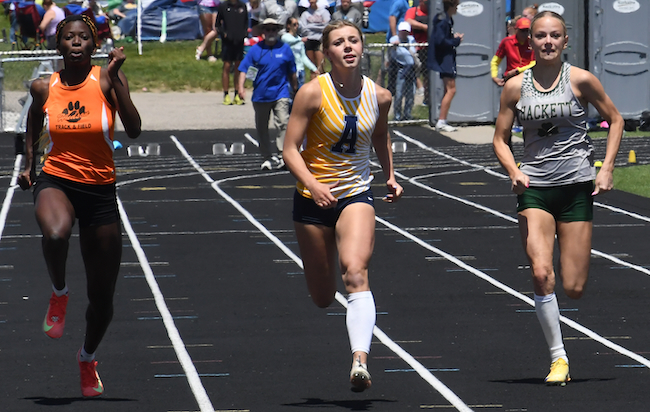
Alcona senior Addi Beatty broke LPD4 Finals record in the 100-meter dash with a time of 12.22. She also had quality performances in the high jump and long jump, finishing fifth and fourth, respectively.
 “I have been working for this for years,” Beatty said. “Last year I got state runner-up (in the 100), and I was a little sad about it, so it's good to come here this year and win it all.”
Concord sophomore Annie Saenz placed her name into history as well after breaking the 25-year-old girls high jump record with a leap of 5 feet, 8 inches. To go along with the meet record, Saenz now holds the school record as well.
“It feels great. I've been working hard to get the records … that’s been my goal all season. I hope to just keep working hard, keep reaching higher heights, and, like, be happy about this, but focus on the next thing,” Saenz said.
Mancelona junior Leili Frollo took home the top honor in pole vault with a height of 11 feet to win her first Finals championship. Despite attempts being hours in-between, Frollo remained focused.
“It was kind of slow because people were checking out for an event, so I waited hours between my jumps, which is really different for me,” Frollo said. “I was just really glad that I had my coaches and family supporting me. I am super excited. I've been wanting this for a while, and I worked so hard, so I feel so proud of myself that I was finally able to accomplish that.”
Gobles 3,200 champion Libby Smith blazed her way to the title with a time of 11:16 in a highly-contested race.
“I just went out racing. I was worried about time. I didn't even start my watch. I can't even look at this,” Smith said.
Around the 900-meter mark, Smith hit the turbo boost, and luckily she had enough in the tank to finish the race because 1,600 champion Kaylie Livingston of Whitmore Lake was at her heels.
Gobles’ 3,200 relay team of Smith, Lauren Shaffer, Ava DeYoung and Madison Cooley also earned a championship.
“I’m not giving up by myself when it gets hard; I just keep pushing through,” Smith said.
Lilly Szappan from St. Charles won the adaptive shot put with a throw of 18 feet, 8.7 inches.
“It just proves to me that I can do more than I think I'm capable of at times,” she said. “A lot of people say that just because I am different, that I can't do as much or can't do as well. But this just proves everybody wrong. And it proves to myself that I can do good things.”
Other champions included Saginaw Nouvel Catholic Central’s Claire Long in the 400, Kingston’s Norah Kiley in the 800, St. Louis’ Tess Farkas in the shot put, Unionville-Sebewaing’s Ryleigh Ewald in the discus and Buckley’s Brooklynn Frazee in the long jump. Frankfort’s 400 relay, Portland St. Patrick’s 800 relay and Kingston’s 1,600 relay also were winners.
PHOTOS (Top) Kalamazoo Hackett Catholic Prep's Clara Slattery, second from left, charges over a hurdle on the way to winning the 100 hurdles championship Saturday. (Middle) Alcona's Addi Beatty, middle, runs to the 100-meter dash title. (Click for more from Ken Swart/RunMichigan.com.)
Elk Rapids' Schulte Sisters Splitting Finals Weekend Between Tennis, Track
By
Tom Spencer
Special for MHSAA.com
June 2, 2023
Today began with a bye for Elk Rapids’ Jaida and Brynne Schulte as the Elks returned to the Lower Peninsula Division 4 Girls Tennis Finals in Kalamazoo.
 They’re planning to say bye to their tennis teammates, though, when the first day of competition is over. The Elks will have to advance to Saturday without them.
That goodbye is just fine with tennis coach Keith Schulte. And, it will be more than fine with the Elk Rapids track & field team – which will be happy to say hello to the sister pair as they head to their LPD3 Finals in Kent City.
Regardless of how they fare today, the Schulte sisters will run Saturday.
Coach Schulte, who teaches strength and conditioning at Elk Rapids, is also the father of Jaida and Brynne. Today’s he’s beaming with pride, and not just for his tennis team’s success. He’s proud of all the student-athletes and their successes this spring, including the girls soccer team moving on to Regionals with a 2-0 win Thursday over Boyne City.
And while all this is going on, he should have a moment or two to just be Dad. Jaida and Brynne teamed up to win the No. 2 doubles title at their Regional as the Elks tied for first place with Traverse City St. Francis two weeks ago. Then the Schulte girls captured first place in the Regional track meet to qualify for Saturday’s Finals. Brynne won the 1,600 and 3,200, and Jaida’s 3,200 relay team took first to move on.
 Coach Schulte hasn’t had much time to pause and soak in the moment of his daughters’ qualifying for two Finals competitions during the same season.
“I didn’t think much of it until now,” the fourth-year coach said. “I’ve always just challenged my kids to do something difficult and not be scared to fail.
“They’ve just kind of found the balance on making this stuff happen,” he continued. “It is a pretty cool opportunity if you can go to two state championships.”
Getting to today’s Tennis Finals is a story full of success. The Elks’ first year under Schulte was halted after a week of practice due to the pandemic. The second year saw the team looking at a season with just nine potential players, but recruitment efforts resulted in the 2021 Elks managing to qualify for the Finals for the first time in their history.
Elk Rapids went on to win the Regional championship in 2022. And then, after graduating six athletes, the Elks were able to repeat this spring with a valiant effort resulting in the co-championship with their conference rival St. Francis.
Dual-sport standouts, while rare, aren’t entirely unheard of – especially at the state’s smaller schools where athletes frequently are needed to fill rosters in multiple sports during the same season. In fact, the Schultes aren’t even alone on their tennis team – sisters Ryleigh and Haleigh Yocum also are playing doubles today but softball on Saturday.
The Yocums won the Regional title at No. 2 doubles and also are slated to be the Elks’ first two batters as they take on Mancelona as one of the favorites to win a Division 3 District title on the softball diamond.
“I do feel bad for them – it’s states,” said 14-year veteran softball coach Erin Merchant. “I do want them to have that opportunity.
“I hope they go far,” she continued. “But then deep down, I’m like, ‘We need them Saturday.’”
Tim Nance and Jesse Way are in their first year co-coaching the boys and girls track teams at ER. They’re pleased the Schultes are prioritizing track while enjoying tennis.
 “I think it is remarkable how resilient, laid back and casual the girls are about their success,” Nance said. “I would say it hasn’t compromised their talent, hard work and success.
“I think it has worked out great,” he continued. “I am selfish and I want them to myself only, but I am happy they can have two successes.”
The Elks will have Ayva Johnstone at No. 1 singles, Kelly Minidis and No. 2, Morgan Bergquist at No. 3 and Jasmine King at No. 4 this weekend. They also will have No. 1 doubles Chloe Taylor and Caroline Best and No. 4 doubles Tessa Nico and Portia Beebe, in addition to the Yokums and Schultes.
Jaida Schulte is a junior. She’s one of the recruits who joined to help the Elks get to their first Tennis Finals in 2021. Bergquist and Beebe were recruits in 2022.
Tennis is the favorite sport today for those three, but track and cross country are right up there for Jaida thanks to the opportunity to run with her freshman sister Brynne.
Jaida is hoping to at least match her personal-record split of 2:36 in the 3,200 relay Saturday. But her goal was first to win all of her doubles matches Friday and see the tennis team finish top-five in its division.
“Brynne loves track, and I love the challenge of running,” Jaida said. “I don’t think I would have the experience of running track or cross country without Brynne.”
Coaches saw very little disruption, if any, with their track, softball and tennis teams this spring with the Yocums and Schultes dual-sporting. The Schultes were able to get track and tennis practice or competition most every day.
“I prioritized track,” Brynne said. “I also got a lot of hitting time in for tennis.
“I would go to track practice first, and as soon as I would be done I would run over to the tennis courts and hit with my sister for a half an hour before going home,” she continued. “It has been worth it.”
 Tom Spencer is a longtime MHSAA-registered basketball and soccer official, and former softball and baseball official, and he also has coached in the northern Lower Peninsula area. He previously has written for the Saginaw News, Bay County Sports Page and Midland Daily News. He can be reached at [email protected] with story ideas for Manistee, Wexford, Missaukee, Roscommon, Ogemaw, Iosco, Alcona, Oscoda, Crawford, Kalkaska, Grand Traverse, Benzie, Leelanau, Antrim, Otsego, Montmorency, Alpena, Presque Isle, Cheboygan, Charlevoix and Emmet counties.
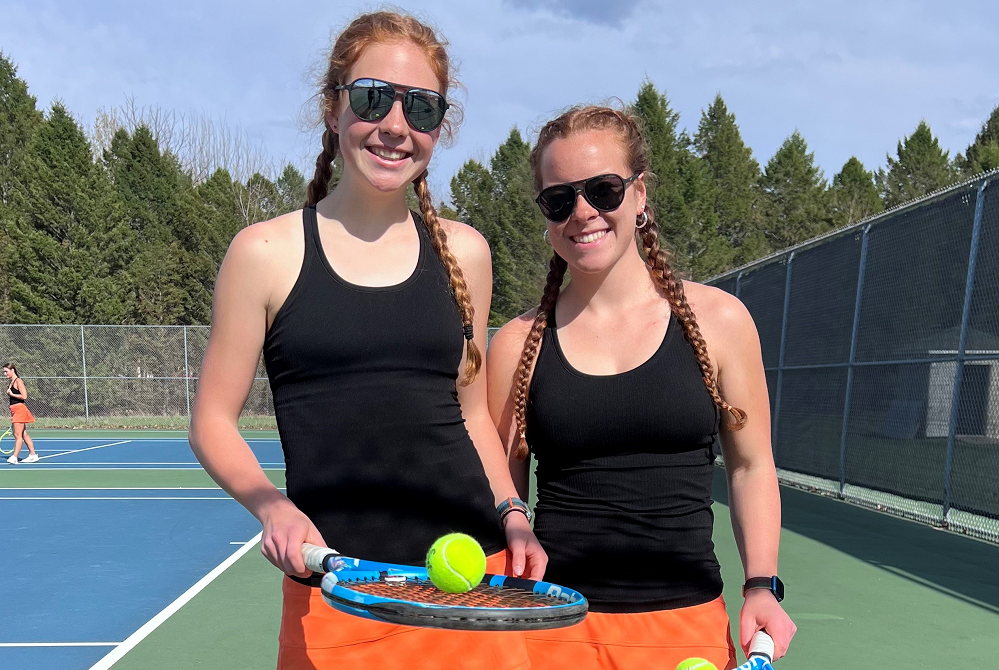
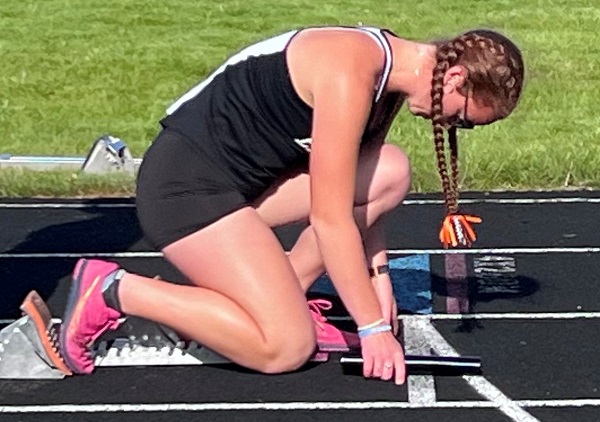
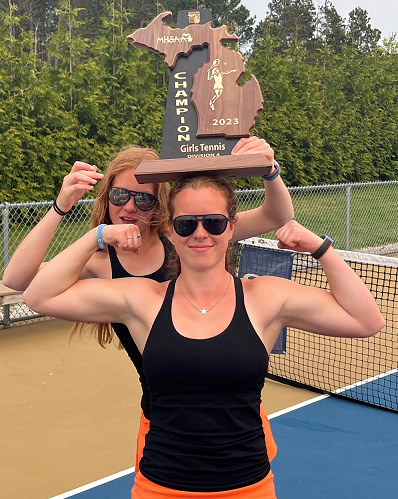
PHOTOS (Top) Elk Rapids sisters Brynne (left) and Jaida Schulte have teamed up at No. 3 doubles for the tennis team this season. (Middle) Brynne Schulte sets to start a track relay. (Below) The Schultes helped the Elks to their first two Regional titles in tennis, including their second straight this spring. (Photos courtesy of Jaclyn Schulte.)